
Introduction
Grace Episcopal Church, West Palm Beach can be clearly defined as a multicultural parish. I remember struggling after the pandemic with getting folks of all races to work across cultures. The congregation consists of twenty-six different nationalities with three distinct racial groups. These include Black, White and Hispanic people. The age among the people ranges from toddlers to nonagenarians. Women make up about eighty percent and men twenty present of the total congregation. The nationalities primarily originate from North, South and Central America, Caribbean/ West Indies, England and Europe. The largest group comprise of older couples, with a few single men and women and young families with children.
The church is located in southeast Florida at the North end of the City of West Palm Beach. Due to the tropical climate, it attracts people from around the globe who settle here. Within each culture there exists sub-cultures which form this new community. It therefore requires an engagement of all cultures to promote a good cross-cultural working relationship. A multicultural church does not automatically bring about an engagement of its members, but an intercultural church demands it. The challenge is to determine what would best cultivate a community that engages one another.
An intercultural experiment
My research topic Music Moves Us To An Intercultural Church For a Changing World came about because of the need to have the various races working in a cross cultural way. Presently they operate in Silos. Conscious of our present political climate intercultural relationships may not be looked upon as acceptable. The participant observation research method allowed me to be both a participant and an observer. From my observation, I witnessed firsthand the engagement among the races as they gather for worship and social time. The parish wide survey revealed some root causes for lack of racial engagement, concerns about dominance and other areas related to the future of the church.
From the data the following factors contribute to what would become the new intercultural community. Migration, being one of the major root causes that brought people from across the globe to form a blended community. The traditions they bring with them become difficult to implement, especially if the dominant group focuses on assimilation and yet their preservation is essential. Diversity in music, food, and worship therefore becomes a necessity for the survival of the church.
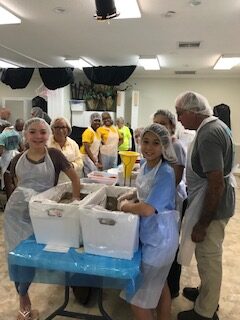
Picture taken by Jones Smith. Food packing for the poor.
Engaging across racial barriers
Areas of concern include the parishioners’ fear of the unknown, their ability to trust each other and a disruption of their level of comfort. From my observation, the introduction of new hymnals by the church has fallen short of attracting those who would become the future church. This is primarily due to the lack of interaction among the members regarding these changes. It is crucial that all age groups and all three of the primary racial groups experience equal sharing in the ministry, and all should have equal voice in making changes of this nature.
Many people find it disruptive when members of one race must shift to accommodate other cultural practices. The ability of a community to adapt to new cultural practices, though, will cultivate not only a richer practice, but also a wider blended community. The idea was formed by Cho-Wong’s theory that individual experiences are central to the creation of a multi-racial community. If the church uses this concept as its basis, the intercultural sharing will flourish. This opens a new space for telling each other stories, overcoming biases, and making the church a more welcoming place.

Picture taken by Janice Waddell at church event.
The results from both research methods mentioned above provide hard data from which the church will use to engage the future. An intercultural church must engage youth, young adults, and young professionals. It must employ uniform communication, outreach and intentional member engagement. The choice of music for worship should be done in a cross-cultural way to keep it current, relevant and acceptable to all. This will help make sure that the quality of the music is more diverse to generate long and sustaining interests.
A new way of doing church
Youth, young adults and young professionals must be engaged to build a cohesive group that share ideas in a cross-cultural way. The combined strength of each group in the community will provide a new way of thinking for the future. This will increase the visibility of our youth, and it will encourage their participation while maintaining their cultural identity.
Crucial to the general congregation is the ability to communicate and engage with each other from a cultural perspective. Thomas Sowell has written about this delicate balancing act and how it takes a concerted intentional effort to keep people of different races working together. To do this, they must ask the right questions, listen to each concern, and embrace new ideas to foster a community of inclusion. This should result in numerical growth, and it should attract people with needed skill sets unique to the needs of the parish. Engaging these diverse talents will increase participation, especially in the sphere of music.
The church’s worship experience must include music that represents the traditions of all racial groups. Music informs the scripture readings, enhances our prayers and enriches the spiritual connection between God and each other. Music as practice is embedded in the hearts of the people and is essential in constituting a congregational life. It is therefore imperative that the church embraces a variety of culturally sensitive music for a meaningful worship experience.
In my own experience, building an intercultural church does require a particular skill set to maintain a level of acceptance to all races. Music then becomes that tool that can ease this process by bringing about what people value. This, in turn, energizes the people to faithful commitment. Signifying that the people have a deep appreciation for the music practiced from their individual traditions.
For the church to embrace the future, it must blend the different types of music to meet its present demand. As the people integrate across cultural lines, the deeply held practices will need to be shared to create a new practice. These may be in the form of a wide variety of music that has enriched their lives in the past and now continues to be the source of enrichment for the new community. This is what challenges an intercultural church to begin embracing inclusion for a sustainable future.
As the church seeks to cultivate a working intercultural community, it must deal with the social, political and economic climate. The global impact faced by the church also needs to be addressed. This constitutes both a mandate and an opportunity, which allows for exciting new modes of intercommunication toward the creation of a new and vibrant community. This kind of church must see its diversity rooted in creation where all people participate equally.
Resources
Choy-Wong, Kathryn. Building Lasting Bridges: An Updated Handbook for Intercultural Ministries. She offers a theology supporting diversity in which individual experiences are central to the creation of a multi-racial community.
Deymaz, Mark. Building A Healthy Multi-ethnic Church. He illustrates a formula on how to integrate, transform and build lasting and sustaining approaches for a viable church.
Emerson, Michael E. People Of Dreams: Multicultural Congregation in the United States. He argues that multiracial congregations become the avenue by which racial integration takes place.
Marti, Geraldo. Worship Across the Racial Divide: Religious Music and the Multicultural Congregation. He addresses the complexities of worship, where worship music becomes the vehicle for the involvement of visible diversity.
Powe, Douglas. Sustaining While Disrupting: The Challenge of Congregation Innovation. He introduces a new way to preserve traditions while adjusting to new ways of serving God.
Snow, Martyn. An Intercultural Church for a Multicultural World. He offers two perspectives on intercultural work: First, that diversity existed from the time of creation and second, that an exchange of gifts allows us to explore the offerings of an intercultural practice.
Sowell, Thomas. Migration and Culture: A World View. He argues that it will take a delicate balancing act to keep people of different cultures working together.