
Summer 2026 was one for the books for ECDS Staff! Our ECDS faculty has been busy with varied projects over the Summer, ranging from archival research to conference presentations. Keep reading to learn more about what Alexander Cors, Bailey Betik, Jesse P. Karlsberg and Joanna Mundy got up to over the summer.
Alexander Cors – Archival Research on Indigenous Migrations in 18th Century North America
As Associate Director of Programs, Dr. Alexander Cors oversees ECDS’s student employees, training program, and internships. He came to digital scholarship through historic geography and digital mapping. Trained as an early modern historian, his work is mapping the legal geography of eighteenth-century North America. This summer, he was at the Spanish National Archive in Madrid to examine colonial records that shed light on Indigenous migration and settlement patterns in the Mississippi River Valley. He will use information extracted from administrative sources to create new maps that highlight the mobility and adaptability of parts of the Shawnee and Chickamauga Cherokee nations who moved westwards to present day Missouri in the 1790s and built prosperous towns on the Mississippi River.

Bailey Betik – ILiADS (Institute for Liberal Arts Digital Scholarship)
Dr. Bailey Betik spent her summer co-organizing and running the Institute for Liberal Arts Digital Scholarship, or ILiADS. ILiADS is a week-long summer institute where participants develop digital projects in teams of faculty, students, librarians, and technologists. During this week of immersion, teams build upon established digital pedagogy or scholarship projects and/or launch new ones. The week consists of focused teamwork time as well as workshops, tutorials, and community conversations.
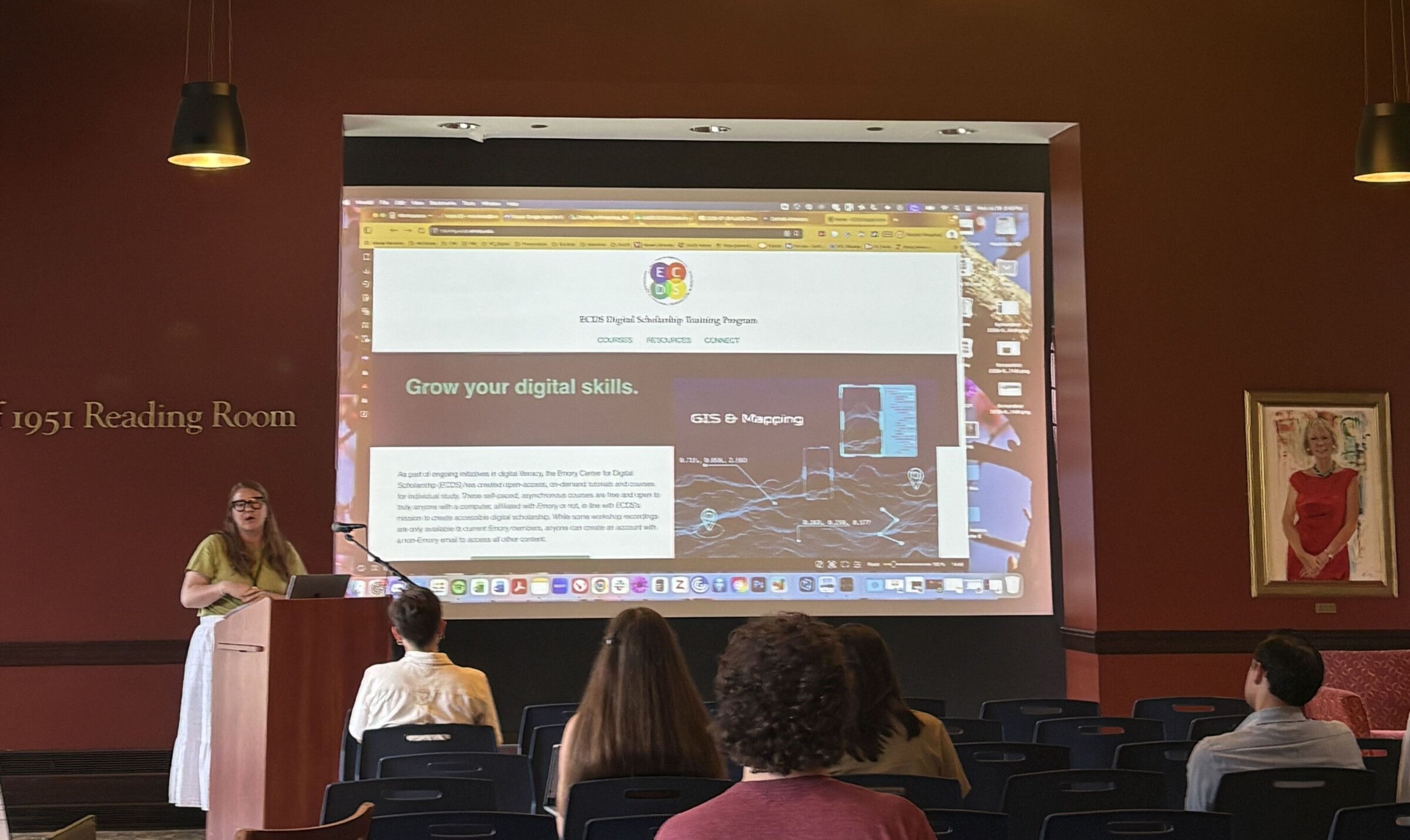
As Vice Chair of the 2026 Institute at Vassar College, Dr. Betik assisted in the day-to-day running of the institute and helped teams with user experience testing and WordPress builds. She also ran a workshop on creating more accessible web projects with ILiADS colleague Nicole Scalessa (Vassar Libraries). She also showcased the Emory Center for Digital Scholarship digital training resource, which you can find at this link.

Jesse P. Karlsberg – Sacred Harp Research
This summer, Dr. Jesse Karlsberg presented new research on the reception of songs introduced to the Sacred Harp repertoire at Camp Fasola, an all-ages residential singing school in Anniston, Alabama, organized by the Sacred Harp Musical Heritage Association. The research drew on a new dataset from ECDS’s Sacred Harp Minutes project, completed this year with support from an Atlanta Interdisciplinary AI Network seed grant, featuring proceedings from more than 7,500 annual singings from The Sacred Harp, the preeminent shape-note songbook. The Sacred Harp has been in active use since 1844 and is revised every generation. The dataset is the first to capture the full set of singings out of one of these revisions, charting use of the 1991 edition of the songbook from its introduction through the release of a new edition last fall.

Jesse and his collaborator Mark Godfrey, a software engineer, developed a series of data visualizations that charted shifts in the geography, demographics, and repertoire of Sacred Harp singings during this thirty-four-year period. Their research documented:
- The dip and recovery in participation in Sacred Harp singings during the Covid-19 pandemic,
- A dramatic expansion from the US Southeast to locations across the United States and Europe, and
- How songs added to The Sacred Harp were adopted across this geography over time.

They shared these findings with an enthusiastic audience of singers from across the United States and beyond—among the more than 150 attendees at the five-day singing school. Held each summer since 2003, Camp Fasola mixes practical instruction in Sacred Harp singing with electives on the practice’s history and traditions and a healthy dose of recreation including swimming, hiking, and a water zipline over the camp facility’s “Lake Really Chilly.” Their presentation afforded a great opportunity to receive feedback and new ideas from the singers who lived through the history they analyzed.
Joanna Mundy – Code 4 Lib SE Conference
On July 16th of 2026, Joanna Mundy presented at the Code4Lib SE conference in Athens, Georgia. Code4Lib is an organization made up of computer programmers and library technologists from libraries. The Code4Lib southeast chapter holds a one-day conference in the summer, in which regional library workers can connect, discuss timely issues relating to library work, and hear about new projects. Joanna gave a presentation, “Interactive Digital Archives – the Apollo 15 and Gemini 8 Hubs.”

The Emory Center for Digital Scholarship has partnered with sociologist Dr. Tracy Scott and her father, astronaut Colonel David Scott, to create the Apollo 15 Hub, launched in 2021, and the Gemini 8 Hub, currently under development. The mission of these digital archives is, in the words of Professor Scott: “to assemble, preserve, and make available primary source records of [these missions] for research, education, and preservation as an example of a unique human endeavor.” Digital archives greatly increase access to archival documents, which share details on historical events and people. The ECDS team in concert with Dr. Scott have worked to make the Apollo 15 Hub more engaging by using interactive digital techniques. Digital approaches such as 3D reconstructions that provide historical context for documents, an interactive timeline to illustrate the historical setting for the collection, and a document software platform that allows users to deep zoom and annotate historical documents, can make digital archives more engaging and approachable for students and users who are unfamiliar with the material.