Introduction
Public signage, such as store aisle labels, safety reminders, and advertising displays, is not only functional but also a powerful form of semiotic communication that can either invite or alienate depending on whom it addresses and how. The selection of linguistic and visual elements for public signage serves to influence the way people perceive spaces. In a more comprehensive language landscape, multilingual signage is a service of a community that shows the visible presence of the different linguistic groups and also shows the amount of involvement or marginalization of the groups.
Researchers in the area of linguistic landscape have explored how language on signs serves as a reflection of societal hierarchy and contributes to cultural identity formation. For example, according to Matras and Gaiser (2020), signs are events where people feel a sense of togetherness and belonging, not so much their reflection. Their research stresses that public texts comprise interactive zones within which language choice determines what takes place, who is seen, registered as welcome, or excluded altogether. Moreover, Crisman, Cheng, and Kim (2024) reveal strip malls in Los Angeles as ethnic and immigrant community-forming locations, as well. This research, for example, highlights the use of signage in commercial areas as immigrants mainly use linguistic signs to express their cultural and symbolic presence, thereby transforming a commercial item into a cultural one. These studies shaped the conceptual foundation of my project by encouraging me to look beyond the presence or absence of a language on a sign and instead ask how signs help or hinder belonging and engagement.
To explore more, I selected a Home Depot in Duluth, Georgia, near both H-Mart and GreatWall Supermarket, for my pilot study. The area is home to a large number of immigrants, including Korean, Chinese, and Spanish speakers, along with a dominant English-speaking population. Despite this, many major retailers continue to rely primarily on English-only signage. Home Depot, as a large retail chain with a wide customer base, offers a valuable space to investigate how linguistic inclusivity is or isn’t practiced in commercial environments. Duluth was chosen both for its demographic relevance and for its physical accessibility and familiarity.
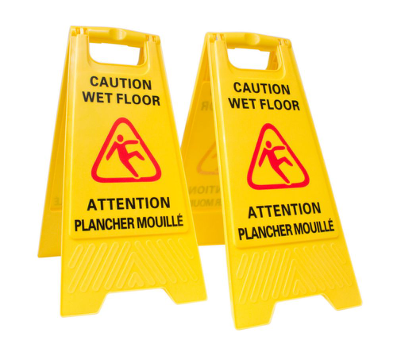
Regarding Home Depot’s policies and practices regarding multilingual signage, there is limited information about a formal, company-wide policy mandating multilingual signage in stores. Instead, the company emphasizes linguistic inclusivity through its associates, highlighting that over 95,000 of its 400,000 associates speak more than one language and wear badges indicating the languages they speak to assist customers more effectively (The Home Depot, 2020). Regarding signage itself, as Figure 1 indicates, Home Depot offers bilingual signs, particularly for safety and compliance purposes. For example, they sell “No Smoking” signs in both English and Spanish, and “Caution Wet Floor” signs in English and French. However, these bilingual signs appear to be more about meeting legal safety requirements rather than reflecting a broader multilingual signage policy aimed at customer inclusion. This suggests that decisions about broader signage accessibility may vary by location and are not necessarily mandated from the corporate level.
This pilot project seeks to answer the following questions: How do visitors to Home Depot perceive the signage in terms of language accessibility? What languages are visible, and who is visibly addressed or excluded? How do these perceptions shape participants’ sense of inclusion, comfort, or participation in that space? And finally, is the walking interview method effective in eliciting meaningful reflection on language and space in a retail setting?
Methods
To explore how multilingual signage affects perception and experience in a commercial setting, I conducted a small-scale pilot study using walking interviews. I brought two friends, referred to here by the pseudonyms “Alex” and “Ben”, to the Home Depot in Duluth on April 13 at around 4 p.m (Table 1). We walked together through several aisles of the store, stopping to discuss visible signage, their impressions of language accessibility, and how the space made them feel. I used a pre-written set of open-ended interview questions, but I also followed up when something interesting came up at the moment. The walking interview format was important because it allowed participants to respond to what they were actually seeing and experiencing in real time, rather than thinking back or imagining a space from memory.
Since this methodology is time-consuming and a bit intensive to coordinate, I decided to focus on just two participants for this pilot. The smaller sample size gave me the space to try out the method and see how well it worked, which is especially useful as I plan my larger future study. Table 1 below presents some basic background on my two participants:
| Name | Age | Gender | Nationality | Language Background |
| Alex | 19 | Male | US Citizen | Fluent in English & Mandarin |
| Ben | 20 | Male | Chinese Citizen | Fluent in English & Mandarin |
The “data” in this case came from two main sources: the signage visible in the store and the recorded responses from my participants. I defined a sign as any posted textual information provided for customers, including aisle signs, product labels, directional signs, safety warnings, and promotional materials, similar to how Backhaus (2006) defines public signage in a linguistic landscape. I took notes on language use (English, non-English, or symbolic), placement, and any accompanying symbols. Meanwhile, the interviews were audio recorded, so I could later review and pull out relevant observations.
After the visit, I went through the audio and organized the responses based on recurring themes. I looked for moments where participants explicitly mentioned language, accessibility, feeling included or excluded, and their reactions to specific signs. I also noted any comments about layout or design elements that affected how they processed signage.
Results
Overall, the most immediate result from both participants was that neither Alex nor Ben felt particularly included or excluded by the signage in Home Depot. Both are fluent in English and Mandarin, and they said they did not really notice the language as a barrier. However, they did point out that everything in the store was in English, with no visible presence of any other language. In other words, they were not excluded, but they also were not directly addressed.
One interesting insight came from Ben, who said that while some of the English words were unfamiliar to him, he could still understand what they meant because of the accompanying symbols shown in Figure 2. For example, aisle signs often included icons for plumbing, garden, or lighting, which helped fill in any gaps. He described this as “surprisingly intuitive” and said it made the space feel accessible even without linguistic translation.
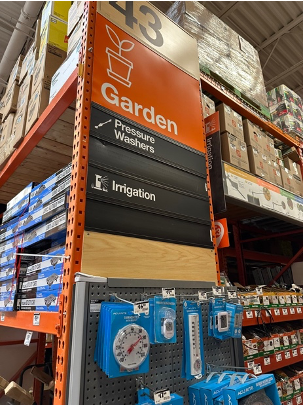
A few other patterns stood out. Both participants commented on how large and uniform the signs were—always orange and white, always in the same font. Alex mentioned that the repetition gave the space a kind of “orderliness” but also made it feel more generic. Neither participant recalled seeing any customer-facing signage in another language, though they guessed that bilingual staff might be available if needed.
Discussion
This pilot study partially supported my original research question, which asked how multilingual signage or the lack of it affects people’s sense of inclusion, accessibility, and participation in a public space. Based on walking interviews with two bilingual participants at Home Depot in Duluth, I found that while they did not feel excluded by the English-only signage, they also did not feel particularly included. The signage did not speak to them in a meaningful way; it was simply there, functional but not engaging. This suggests that for some users, signage in a dominant language might not be a barrier, but it also does not contribute to a sense of visibility or belonging.
Compared to what I have seen in other studies, my findings align in some ways but offer a slightly different angle. Matras and Gaiser (2020) describe signage as a communicative event, something that can actively shape a community through interaction. That dynamic was not present in my site. At Home Depot, the signs felt functional and static. There was no invitation to dialogue, no cultural cues that spoke to the diversity of the neighborhood. Instead of serving as identity markers, the signs mostly blended into the store’s corporate branding.
This contrasts with findings from Crisman, Cheng, and Kim (2024), who show how multilingual signage in L.A.’s immigrant strip malls supports both cultural expression and economic participation. The signs in those spaces are intentional, reflecting the community’s languages and becoming part of its identity. But at Home Depot, the signage was standardized and disconnected from the local linguistic reality in Duluth, which includes large Chinese, Korean, and Spanish-speaking populations.
One helpful insight was that even when participants were fully fluent in English, signage design still mattered. Although neither participant felt excluded, they also did not feel particularly seen. Both Alex and Ben are fluent in English and Mandarin, so for them, language was not a challenge, but that neutrality is revealing. Ben mentioned that he did not recognize some English terms but could figure them out through symbols and icons, which made things easier to understand. That one detail helped me realize that signage is more than just language; it is also visual design, layout, and how people read space through clues beyond words.
That said, this small pilot study already gave me a clearer sense of how the walking interview method actually plays out in a commercial setting. It helped me see what kinds of responses are possible and where things might need adjustment if I want to apply this method elsewhere. Even though both participants were linguistically fluent in English, their experience of the space still depended partly on information visually and symbolically communicated by the store. It reminded me that “accessibility” sometimes can be about layout, icons, and design that can work across language boundaries.
Of course, there are limitations. The sample size was very small, and the participants were relatively comfortable navigating English spaces. If I had included someone less fluent in English, or from a more marginalized linguistic background, I might have gotten a completely different reaction. Also, Home Depot is a big-box chain, and it is possible that signage is standardized across locations, meaning local adaptations might not happen, even in places like Duluth with high linguistic diversity.
Next steps would include expanding this research to include participants with limited English proficiency and possibly comparing multiple commercial sites across different neighborhoods. I would also like to apply this method in my future fieldwork in Guangzhou, where language visibility might feel more politically or socially charged. This pilot helped me realize how flexible and reflective the walking interview method can be, and I am excited to build on it.
In the bigger picture, this study speaks to the subtle but important ways public signage shapes who feels acknowledged in shared spaces. Even when people are not actively excluded, they might not feel fully included either. And that gray area matters. By maintaining English-only signage in a multilingual community like Duluth, businesses like Home Depot may unintentionally reinforce rigid language hierarchies that privilege English and render other languages invisible. Multilingual signage, or even just more culturally responsive design, could challenge these hierarchies and make public spaces more inclusive. It is not just about words on walls—it is about recognizing and validating the full range of linguistic identities that shape the community.
Bibliography
Backhaus, P. (2006). Multilingualism in Tokyo: A look into the linguistic landscape. International Journal of Multilingualism, 3(1), 52–66.
Crisman, J. J., Cheng, A., & Kim, A. M. (2024). From shopping centers to cultural centers: Los Angeles strip malls as sites of ethnic and immigrant placemaking. Urban Geography, 1–31. https://doi.org/10.1080/02723638.2024.2337569
Matras, Y., & Gaiser, L. (2020). Signage as event: Deriving ‘community’ from language practice. Linguistic Landscape, 6(2), 213–. https://doi.org/10.1075/ll.19029.mat
The Home Depot. (2020, October 1). You’re speaking my language: More than 95,000 associates are bilingual. The Home Depot. https://corporate.homedepot.com/news/company/youre-speaking-my-language