Introduction:
Language access is an essential part of equitable healthcare, and is often overlooked as a field of linguistic study. The physical signage in healthcare settings can be an opportunity to provide patients with essential information about hospital policy or health information. Previous studies have examined linguistic landscapes in healthcare settings in locations such as Jordan (Alomoush 2021), Tanzania (Benedicto 2022), and Shanghai (Li 2024). These studies explore bilingual spaces and how language choice in healthcare represents the audience of the signage. In particular, Alomoush (2021) and Benedicto (2022) explore how English is used in foreign-dominant spaces as opposed to the official languages of the country. Moreover, previous research into language access in healthcare settings has shown that individuals with limited English proficiency (LEP) tend to have lower levels of insurance coverage and worse health outcomes. Lu (2020) documents that 50.4% of individuals with LEP in the United States from 2010 to 2016 had health insurance, compared to 86.4% of people with English proficiency. In particular, Latino populations are known to have less access to preventative care and regular healthcare access than other populations (Brooks 2016).
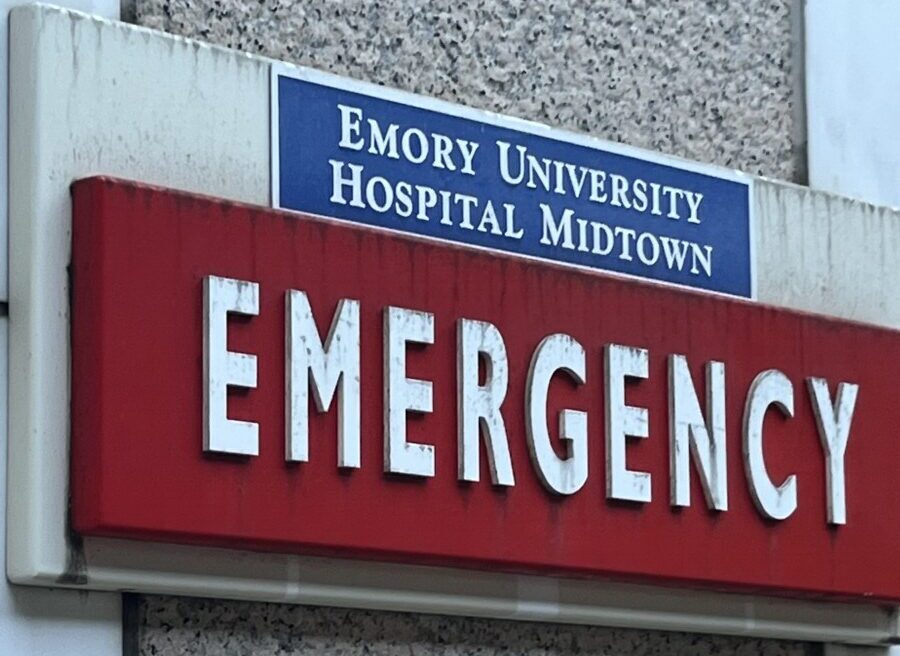
No previous studies have explored the linguistic landscape of a large US city hospital such as Emory University Hospital Midtown (EUHM). EUHM is a 511-bed acute care teaching hospital located in the center of Atlanta that serves primarily Fulton and Dekalb counties, of which 6.4% of the population identify as LEP. The majority of those are Spanish speakers, though there are also significant populations of Chinese, Korean, and French speakers (Emory Healthcare). Emory Healthcare covers numerous hospitals and clinics in Georgia, and implements the same language policy at every location. This policy follows national guidelines to provide language services for any individual with LEP. At EUHM, the emergency room offers in person interpreters in Korean, Vietnamese and Spanish, and over 200 other languages via phone. American Sign Language interpretation is also offered via video call, and translation of medical documents are available upon request.
By exploring the linguistic landscape of EUHM, I hope to understand how hospital policy is reflected physically in the signage in the Emergency Room (ER) lobby. Through analyzing the language content and context of the signage, I will be able to draw conclusions about the language accessibility of the EUHM ER for individuals with LEP.
Methods:
Photographs of physical signage were collected from the Emory University Hospital Midtown Emergency Room lobby and were categorized based on language, informational content, and placement. Particular attention was given to the presence of information about interpreter services or language access. Permission was granted to the researcher by Emory University Hospital Midtown employees to document signage in the lobby of the Emergency Department. No photos were taken of patients or hospital workers, or any identifying information. 36 signs were photographed, and 24 distinct signs were identified. Drawing on Backhaus (2006), a sign is defined as written text or image within a spatially distinct frame that communicates something. Every sign that fell under this category and was located within the hospital entrance doors was photographed and included. Images were collected on Friday, March 14th, 2025 between 9:00am and 9:30am. During analysis, each sign was tagged with language, location, whether the sign contained images, and the topic of the sign. The signs were then coded into two categories: informational and locational. Locational signs include door or room labels, and directions within the lobby. Informational signs included three subcategories: policy information (ex: patient rights), health information (ex: breastfeeding signage), and practical information (ex: information about hospital cleaning crew).
Results:
Of the 36 signs photographed, every sign contained English, three signs offered a translation in Spanish below, and one sign contained languages other than Spanish or English. The Spanish signs contained themes of health information or policy information. The sign with multiple languages contained information about the Affordable Care Act, detailing that hospitals are required to provide language services, which was translated into 20 languages. The sign was written in small print and was located in the waiting area above a row of chairs (Figure 1). Figure 2 shows a bilingual sign in the EUHM ER, which contains grammatical errors in both Spanish and English, but provides consistent information in both languages. 58% of signage content pertained to locational information – specifically room labels and directions (Figure 3). While interpreter services are available through Emory Healthcare, there is no signage communicating these services in the EUHM ER.

Figure 1: Affordable Care Act Sign in the Emory University Hospital Midtown Emergency Department. Size of the sign is estimated at 9 by 12 inches. There are 20 languages present under the section titled “Language Assistance Services”, stating “If you speak [given language], you have language services at your disposal”.

Figure 2: Emergency Information in the Emory University Hospital Midtown Emergency Department lobby, located next to the nurse’s station. Message is first presented in English, then in Spanish.

Figure 3: Language content of 24 signs were categorized into two categories: Locational (relating to description of location or directions to a location) or Informational, which was divided into three subcategories: health, policy, and practical. These signs provided written information relating to each subcategory.
Discussion
The results of this linguistic landscape of the EUHM ER lobby support that there is additional signage needed in order to ensure that individuals with LEP are aware of their rights and have access to language services during their time with Emory Healthcare. By examining the linguistic landscape of Emory University Hospital Midtown, this research contributes to broader discussions on language accessibility and health equity. While hospitals may comply with legal requirements to provide interpreter services, the way information is presented in the physical environment may still create barriers to access. It emphasizes the need for hospitals to not only provide interpreter services but also ensure that information about these services is effectively communicated through visible and comprehensible signage. Improving linguistic accessibility in healthcare settings is crucial for reducing disparities and fostering a more inclusive healthcare system for LEP patients.
This linguistic landscape analysis of EUHM encompasses one large city hospital that serves a certain population. Further research should consider rural healthcare, smaller clinics, and clinics that serve primarily LEP individuals. Additionally, further research exploring how patients and providers at EUHM feel about language access would contribute an important practical lens to this analysis. Access to the interior of the hospital is limited, however more information about the language accessibility of the inpatient floors and the interior of the ED would help place the linguistic landscape of the ED in context of the larger hospital setting.
Bibliography:
Alomoush, O. I. S. (2021). Linguistic landscaping in medical settings. English Today, 39(1), 68–75. https://doi.org/10.1017/s0266078421000304
Backhaus, P. (2006). Multilingualism in Tokyo: A Look into the Linguistic Landscape. International Journal of Multilingualism, 3(1), 52–66. https://doi.org/10.1080/14790710608668385
Benedicto, G. (2022). Linguistic landscape of referral hospitals in Tanzania: Reasons for language choice on signage. International Journal of English Literature and Social Sciences, 7(2), 148–157. https://doi.org/10.22161/ijels.72.19
Brooks, K., Stifani, B., Ramírez Batlle, H., Aguilera Nunez, M., Erlich, M., and Diaz, J. (2016). Patient Perspectives on the Need for and Barriers to Professional Medical Interpretation. Rhode Island Medical Journal. http://www.rimed.org/rimedicaljournal/2016/01/2016-01-30-cont-brooks.pdf
Emory Healthcare. (2022). 2022 Community Health Needs Assessment Implementation Plan. https://www.emoryhealthcare.org/-/media/Project/EH/Emory/ui/pdfs/community/2022-chna-ip-12-22.pdf
Li, X., & Shen, Q. (2024). Spatial Justice in Health Communication: Exploring affective responses to the linguistic landscape in a Shanghai International Hospital. International Journal of Applied Linguistics. https://doi.org/10.1111/ijal.12671
Lu, T., and Myerson, R. (2020). Disparities in health insurance coverage and access to care by English Language proficiency in the USA, 2006–2016. Journal of General Internal Medicine, 35(5), 1490–1497. https://doi.org/10.1007/s11606-019-05609-z
Medical interpretation and translation services at Emory Healthcare. (n.d.). https://www.emoryhealthcare.org/patients-visitors/patient-resources/interpretation
US Census Bureau. (2021, October 8). 2020 Census Non-English Language Support Press Kit. Census.Gov. https://www.census.gov/newsroom/press-kits/2020/2020-non-english-language-support.html#:~:text=People%20can%20respond%20to%20the,the%20census%20in%20their%20language