Introduction
The pervasive nature of visual communication in contemporary society manifests in diverse forms, one of which is stickers. Found on a variety of surfaces ranging from vehicle bumpers and laptops to public infrastructure, stickers contribute significantly to the semiotic landscape of a given environment. These small, adhesive messages serve as a non-traditional or transgressive means of self-expression, allowing individuals and groups to communicate their opinions, attitudes, beliefs, and identities in a concise and publicly visible manner. This form of communication can reflect personal sentiments, social observations, cultural affiliations, and political or moral stances.
Several studies have touched upon the role and meaning of stickers in different contexts highlighting their significant role in everyday communication, where they are actively used by drivers to convey political messages and beliefs, fostering public discourse on social and political issues. This demonstrates the potential of stickers to serve as a dynamic medium for expressing opinions on salient societal concerns. For example, the study of bumper stickers in Jordan reveals a pattern of themes such as lessons of life, humor, challenges to other drivers, religious sayings, and economic status, while notably finding a lack of political stickers and an avoidance of serious criticism on major social issues (Jadarat 2016). This suggests that cultural norms and the perceived taboos might influence the themes and content expressed through this medium in different socio-political contexts. Furthermore, research on transgressive signs, like stickers, in Münster, Germany examines how these bottom-up forms of communication can convey artistic, social, and spiritual messages, often standing out as “out of place” and requiring interpretation. These studies collectively suggest that the content and function of stickers are shaped by the specific social, cultural, and political landscapes in which they are displayed (Kastner 2018). Additionally, since I was investigating a group with a shared religious identity I wanted to explore existing scholarship about the overlap between religious identity and sticker choice, like one on religious vehicle stickers in Nigeria, which found them used to express social vision, group identity, and reaffirmation of faith (Chiluwa 2008).
Considering the diverse ways in which stickers function as communicative tools in various settings, a study focusing on the use of stickers within a specific context, such as a university campus, could yield valuable insights into how individuals express themselves and their affiliations within that particular linguistic landscape. One of the features of Emory’s specific landscape that we have discussed is the new posting guidelines. Within Emory’s linguistic landscape there is majority bottom-up signage, but due to the authoritative nature of top-down language, it feels that institutional language holds more weight, however, through looking at bottom-up signage such as stickers, patterns within student identity and expression can be uncovered. Additionally, the Office of Civil Rights (OCR) recently began an investigation due to a joint lawsuit by the Council on American Islamic Relations (CAIR)’s Georgia chapter and Palestine Legal accusing Emory University of discriminating against Muslim, Arab, and Black students. Emory was then designated as a “hostile campus,” making it interesting to me to investigate how students at the crux of this alleged discrimination choose to display their identity through laptop stickers (CAIR-Georgia 2024).
Therefore, within the specific context of Emory University, the study of laptop stickers among Muslim undergraduate students could reveal how they navigate the tension between the restrictive campus environment and the need to express their identities in the face of alleged discrimination. Their choice of themes, languages, and the visibility of these stickers on their personal belongings might offer valuable insights into their experiences and responses to this particular linguistic landscape.
Methodology
Data for this study was collected by examining stickers adhered to the laptops of Muslim undergraduate students at Emory University. The data source was defined simply as any sticker that was adhered to a laptop. A total of 14 laptops were included in the data collection. This specific number was primarily chosen out of convenience, representing the number of students I was able to reach who had stickers on their laptops, as some encountered students did not have stickers. As this study functions more as a content-based analysis of the linguistic landscape, no interviews were conducted and basic demographic information beyond the students being Muslim undergraduates at Emory was not collected. The data was collected over the course of a few weeks through in-person interactions and via text messages or GroupMe. When interacting in person, I took pictures of the laptops. When communicating through messages, students were asked to send clear pictures displaying all stickers to ensure the data functioned the same as the in-person collection.
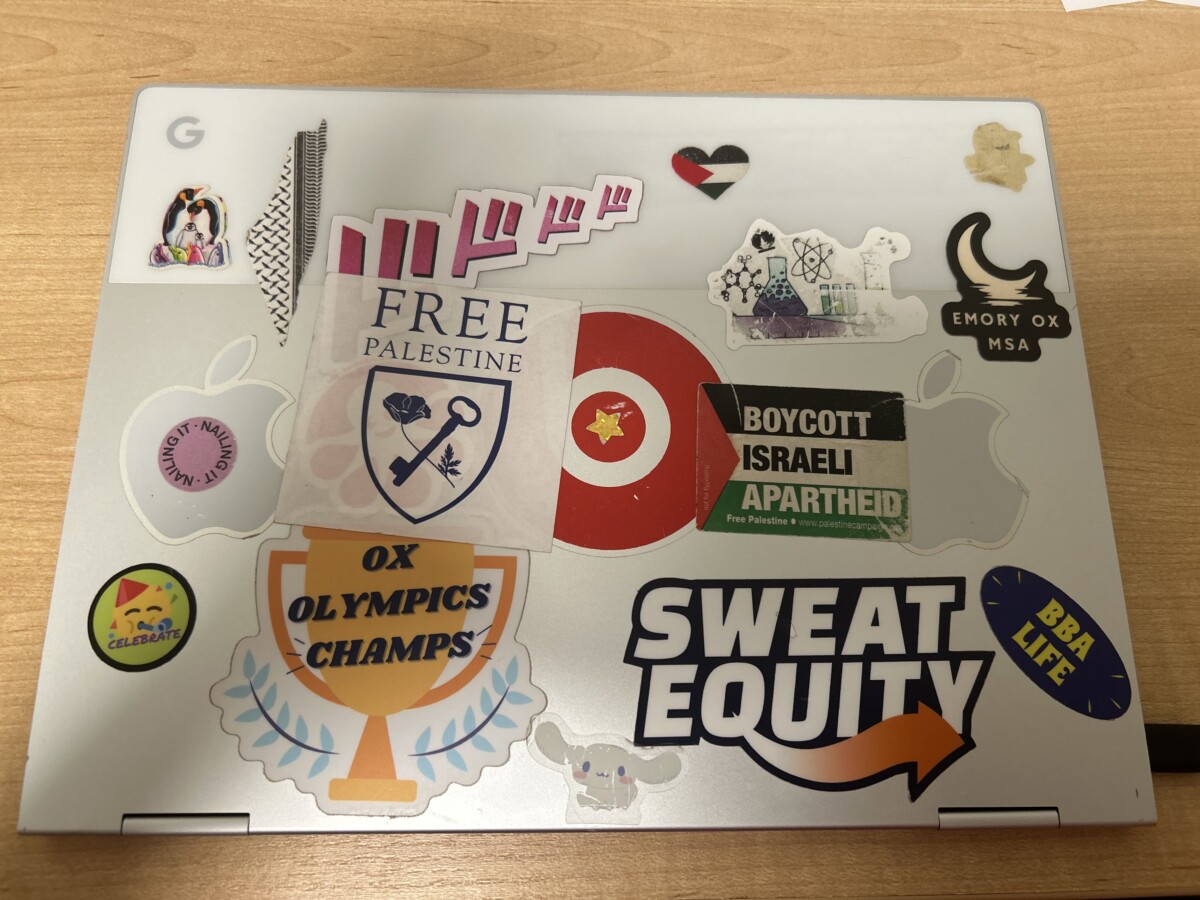
To make sense of the collected data, I organized it using a spreadsheet. The laptops were categorized based on several criteria, including the number of stickers and the number of languages present. Additionally, the amount of stickers containing any type of language was noted. A key part of the organization involved classifying the stickers into the following content categories: political, academic, student organization, brand/corporation, geographic, hobby/interest, and religious. For example, in the laptop in figure 1a I would categorize the stickers stating “Free Palestine” or “Boycott Israeli Apartheid” as political, but the geographic outline of Palestine is categorized as geographic since it’s not inherently a political statement. In figure 1b, the sticker stating “Georgia Muslim Voter Project” would be categorized as a student organization sticker since the content is not religious even though it references a Muslim group.

Figure 1a: Example of Laptop

Figure 1b: Example of Laptop
After categorization, everything except the raw number of stickers and languages was converted into percentages, and the numbers were averaged. The most prevalent languages among the stickers were also noted. For languages I could not recognize, such as the languages in the top right corner of figure 1c, I used ChatGPT to identify the languages present in order to note them on the spreadsheet.

Figure 1c: Example of Laptop
Following the percentages, graphs were made and statistical analysis was done to visualize and understand the results.
Results
This section presents the findings revealed by the data collection and organization process. The dataset comprises sticker data collected from 14 laptops belonging to Muslim undergraduate students at Emory University. Each entry includes the total number of stickers on the laptop, the number of languages present across the stickers, and the percentage of stickers falling into defined content categories: political, academic, student organization, brand/corporate, geographic, hobby/interest, and religious. The spreadsheet used for organizing the data allowed for quantification of these categories, including the number of stickers, the languages used, and the distribution of content themes.

Figure 2: Languages Present on Stickers as Percentages
A general overview of the collected data found that the average number of stickers per laptop was approximately 7. Multiple languages were observed on the stickers, including English, Arabic, Hindi, Chinese, Spanish, and Sanskrit. English was found to be the dominant language, appearing on every laptop and among 78.3% of all instances of language on stickers, while Arabic appeared as the second-most frequently used language, appearing on 6 of the 14 laptops and among 10.1% of language instances. The data indicated a moderate level of linguistic diversity among the stickers, with the average number of languages per laptop being about 2.

Figure 3: Prevalence of Sticker Categories as Percentages
Looking at the categories used to classify the content of the stickers displayed in Figure 3, a particular finding that stood out was that the highest percentage among all the content categories was hobby/interest, appearing on an average of 32.3% of stickers per laptop. Student organization stickers were the second most prevalent category with an average of 24.5% of stickers per laptop. Political stickers made up the third most prevalent category with an average of 21.5% stickers per laptop. This is notable given the heightened political relevance of Muslim identity in the current Emory context. Interestingly, even among a group of Muslim students, religious-themed stickers only accounted for about 5.7% of stickers on average, showing up sporadically across the sample. In addition to religious stickers, corporate/brand related stickers was the least common category with an average of 3.3%.
In summary, the findings reveal a diverse and nuanced linguistic landscape of sticker expression among Muslim undergraduate students at Emory University. While the high presence of hobby/interest stickers suggests a preference for personal and culturally neutral forms of self-expression, the presence of political and student organization stickers, indicates that some students still engage with identity and community in visible ways.
Discussion
The findings offer insight into how Muslim students at Emory use laptop stickers as a medium for self-expression. The higher proportion of hobby/interest stickers challenges the initial hypothesis that identity-related stickers, especially political or religious, would dominate. This suggests that in a campus climate marked by institutional scrutiny and allegations of discrimination, many students might opt for safer, less contentious forms of expression.
The frequency of political stickers was particularly of interest to me. Given the current investigations into discrimination and Emory’s designation as a “hostile campus,” it might be expected that students would use stickers as a means of visible resistance or solidarity (CAIR-Georgia 2024). Instead, the data may reflect a strategic self-censorship, where students balance a desire for self-expression with caution in a potentially surveillant environment. Similarly, the limited use of religious stickers, despite all participants being Muslim, suggests a nuanced approach to visibility. While Arabic language presence may offer a subtle indicator of this religious identity, the overall data implies that identity affirmation may occur through less overt or coded channels, possibly as a protective strategy. Additionally, some of the student organization stickers are related to religious organizations such as the Emory Muslim Students Association, so while the sticker isn’t inherently religious students still elect to display their participation in a religious community, another avenue to display this part of their identity.
To determine whether the observed differences in the three most prevalent sticker categories were statistically meaningful, a one-way ANOVA was conducted comparing the average percentages of hobby/interest, political, and student organization stickers across the sample. The analysis yielded no statistically significant difference between these groups (p = 0.56 > 0.05). Additionally, a post-hoc Tukey’s HSD test also confirmed that none of the pairwise differences were significant (all p-values > 0.05). Despite hobby/interest stickers appearing more frequently, the statistical testing results suggest that the variability across laptops is too high and the sample size too small to conclude that Muslim students at Emory are significantly more likely to display this category over others. In the context of the project, this supports the idea that while personal expression through hobby-related content may be common, there is no strong statistical evidence that political or student organization themes are being actively avoided or favored, though social or contextual pressures could still influence individual choices in more subtle, qualitative ways.
The linguistic diversity found across some laptops also points to intersectional identities and global cultural affiliations, which may not always align directly with religious or political themes. This aligns with broader studies of sticker use in urban and institutional landscapes, where expressive forms often reflect micro-level personal affiliations more than macro-level ideologies.
Overall, this study indicates that laptop stickers serve as a complex semiotic resource, reflecting how Muslim students at Emory navigate personal identity, institutional pressures, and public visibility. Future research could benefit from qualitative interviews to better understand the motivations behind sticker choices and the role of perceived safety in shaping expression. Another possible future direction is to continue with a content-based framework, but make it longitudinal to observe trends in how sticker content categories may change over time with evolving campus climates. Stickers are an interesting form of expression, since they have an element of disposability, giving the user the option to add on or remove stickers, thus changing the linguistic landscape.
In conclusion, the findings of this study underscore the nuanced and strategic ways Muslim students at Emory University engage in self-expression through laptop stickers. Rather than making overt identity claims, many students appear to adopt subtle or neutral forms of communication, potentially as a response to the perceived risks associated with heightened surveillance and institutional scrutiny. The absence of statistically significant differences between sticker categories reinforces the idea that expression within this context is more individualized than categorical, shaped as much by personal comfort and social climate as by group identity. The data speaks to a broader pattern of cautious visibility, where students balance authenticity with safety in their everyday semiotic practices. By exploring laptop stickers, a seemingly mundane yet deeply personal medium, this research contributes to a more layered understanding of how identity, resistance, and belonging are performed within contested campus spaces. As the campus climate continues to evolve, longitudinal and qualitative approaches may provide further insight into how such expressions shift over time, offering a dynamic lens into student voice and agency.
Works Cited
Council on American-Islamic Relations Georgia (CAIR-Georgia), & Palestine Legal. (2024). Title VI complaint against Emory University. https://cairgeorgia.org/in-your-community/read-title-vi-complaint-against-emory-university-by-cair-georgia-and-palestine-legal/
Chiluwa, I. (2008). Religious vehicle stickers in Nigeria: a discourse of identity, faith and social vision. Discourse & Communication, 2(4), 371-387. https://doi.org/10.1177/1750481308091909
Jaradat, A. A. (2016). “Content-Based Analysis of Bumper Stickers in Jordan.” Advances in Language and Literary Studies, 7(6), 253-261. http://www.journals.aiac.org.au/index.php/alls/article/view/2937
Kastner, L., Spreckelsen, T. S., & Talhaui, Y. (2018). “Refugees Welcome”: Analysing Transgressive Stickers along Münster’s Harbour. Satura, 1, 7–13. https://doi.org/10.17879/satura-2018-3136