
Thérèse of Lisieux as a Model of Moral Agency Under Constraint

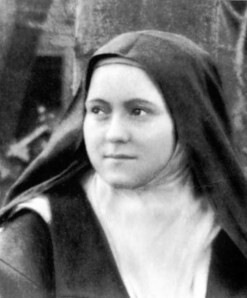
St. Thérèse of Lisieux is a complicated figure. On the one hand, she is a darling of Catholic conservatives—esteemed as a model of Catholic womanhood by advocates of traditional gender roles, and invoked in the prayers of male seminarians, whom she is purported to court to the priesthood through the miraculous gift of roses.[1] At the same time, Thérèse is a hero of disaffected and marginalized Catholics—particularly queer Catholics and women who desire Catholic ordination.[2] To these people, Thérèse is a model of transgressive gender performance and a champion of women’s access to the ministerial priesthood.[3] How do we account for this contradictory presence? One way would be to simply suggest that Thérèse is, herself, a hopelessly contradictory person, whose memory can be cynically employed in competing ideological projects. I want to offer a less cynical view. Rather than seeing Thérèse as a victim of contemporary Catholic discourse, I want to suggest that this contradictory position is precisely the one Thérèse would hope to occupy.
“Small Apotheosis of the Beatification,” by Celine Martin, accessed from the Carmel de Lisieux archives, https://archives.carmeldelisieux.fr/en/naissance-dune-sainte/iconographie-theresienne/tableaux-2/
Agency, like Thérèse, is complicated. For many, the attribution of agency entails claims about causality, originality, and the relationship between the self and social structures. Here, I make no such claims. Rather, I use the term agency to refer to the experience or interpretation of one’s own actions as free and responsible. Thus, in reading Thérèse’s self-narration in The Story of a Soul as a form of moral agency under constraint, I do not try to disentangle an authentic and original Thérèse from the social structures that constrained her. Rather, I take her efforts at self-narration in the midst of those constraints—efforts evidenced by her autobiography—as an exercise in self-interpretation that generates agency.
I use the term agency to refer to the experience or interpretation of one’s own actions as free and responsible.
Thérèse’s canonization as a saint is, in no small part, due to her autobiography, The Story of a Soul.[4] As such, we can say that Thérèse takes an active role in determining how she will be remembered. In many ways, The Story of a Soul is written to illustrate Thérèse’s desire to be a saint. In the first part of the autobiography, she tells us that her earliest memories in life include the experience of Jesus gently but persistently calling her to a life of holiness.[5] As the text progresses, Thérèse narrates how this call awakens in Thérèse a desire for the virtues and external piety she understood to be required of a saint. Thérèse acknowledges that this desire is influenced by her family’s guidance, but she also considers it to be something that is original to herself. In this way, Thérèse comes to understand her desire to be evidence that she was created for sainthood.
In 19th century Catholic France, sainthood was not merely an abstract, spiritual process of sanctification. Rather, it signified a highly specific mode of religious life which idealized suffering as reparation for the sins of the nation.[6] Following the French Revolution in the late 18th century, the 19th century was marked by the abrupt (and sometimes violent) removal of the Catholic Church from French public life.[7] For Catholics (particularly middle- and upper-class Catholics), this social shift was perceived as an apostasy that must be atoned.[8] When Thérèse speaks of sainthood as suffering, therefore, it is likely that she is (in part) participating in this bourgeois reactionary spirituality.
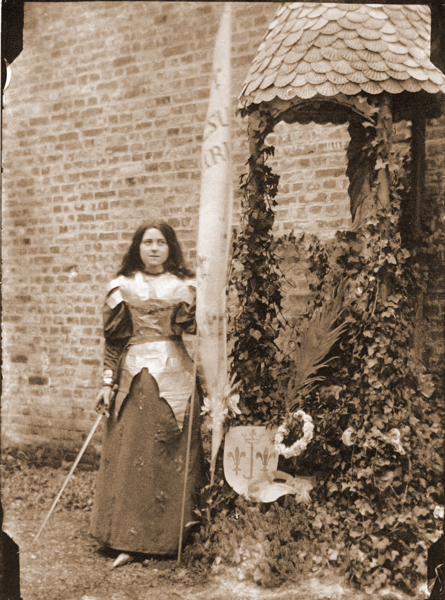
Yet despite Thérèse’s endorsement, the ideals of bourgeois Catholic femininity seem to contrast with much of her own temperament. Though Thérèse often describes herself as docile, quiet, and timid, her description of her own childhood gives us a very different image. The child Thérèse poured over “tales of chivalry,” dreaming of doing “all the patriotic things the heroines of France had done, especially Joan of Arc.”[9] While on pilgrimage, the teenage Thérèse raced her sister Céline to the highest turret of the Cathedral of Milan.[10] In Rome, she scrambled surreptitiously over ruins to see the Colosseum even though it was closed off to visitors.[11] At the Vatican, she ignored the orders of her Vicar General and spoke directly to Pope Leo XIII, imploring him to allow her to enter the Carmelite Order a year early.[12] This is hardly the silent, long-suffering, and patient Catholic woman idealized by bourgeois French Catholic society.
“Thérèse as Joan of Arc,” by Celine Martin, accessed from the Carmel de Lisieux Archives, https://archives.carmeldelisieux.fr/en/photos-de-therese/
We might turn to the influence of her family to explain the divide between Thérèse’s ideals for herself and her childhood temperament. Thérèse’s parents, Louis and Zélie, were intensely pious and conservative French Catholics, and they cultivated a deeply religious environment for their household. Implicit in this was the expectation that their children attain to sainthood.[13] This environment had a clear effect on the young Thérèse. At age two, Thérèse declared that she would become a nun like her second oldest sister, Pauline.[14] By the age of three, Marie, her older sister and godmother, had given Thérèse a chaplet so she could begin tracking her prayers and “good deeds.”[15] Marie and Thérèse would also make a game of piety, pretending to be “anchorites,” and playing at a life of solitary devotion.[16] This domestic environment of piety was also reinforced outside of the home. Whenever St. Teresa of Avila was mentioned at Mass, her father would exhort her to listen closely, reminding her that Teresa was her Patron Saint.[17] In this way, the Martin household eagerly encouraged any tendency Thérèse had toward pious activity.
At the same time, her parents were swift to correct tendencies they saw as an obstacle to virtue. If, for instance, the young Thérèse’s “pride” kept her from quickly following her parents’ orders, she was immediately and bluntly scolded.[18] One scene that particularly encapsulates the commitment of Thérèse’s father to addressing her pride occurs when Thérèse was six or seven. During a visit to the beach, Thérèse encounters a man and his wife who tell her and her father that she is “very beautiful.”[19] She writes that her father immediately asked them to not pay Thérèse “any more compliments.”[20] In Thérèse’s telling, this encounter taught her to disregard “admiring words” and focus on living a life of holy simplicity.[21]
These scenes of encouragement and rebuke, albeit mundane, form the foundation of Thérèse’s self-understanding. It is tempting to use these moments to tell a simple narrative of moral constraint, wherein a naturally adventurous and self-confident young girl is slowly pressed into the mold of gentle and obedient Catholic femininity idealized by a reactionary French conservativism. To do this, however, misses two key things. First, it ignores how Thérèse comes to identify with her family’s piety. It is undeniable that, in the Martin family’s desire for Thérèse’s sainthood, the social history of French Catholicism and its reaction to modernity is impressed upon Thérèse in a deeply intimate way that constrains the way she can imagine her life. Yet to emphasize this desire as a mere external imposition is to deny Thérèse’s agency to narrate her own sense of self and to disregard her expressed gratitude for the ‘constraints’ of her upbringing.[22]
The second thing such an account misses is the role sociality plays in forming the elements of Thérèse’s personality that seem to run counter to her family’s piety. For instance, Thérèse’s miniature adventures are never taken alone, but always with her sister Céline. It is Céline who agrees to leave behind the “timid women of the party” to climb to the top of the Cathedral in Milan.[23] It’s Céline who leaps with Thérèse across rubble to reach the floor of the Colosseum.[24] And it is Céline who, when the Vicar General forbade the pilgrims to speak to the Pope, urged Thérèse to “speak” anyway.[25] Thus, to speak of Thérèse’s self-confidence or adventurousness as her ‘natural’ temperament is to ignore the way in which these desires too are influenced by the social relations in which the child Thérèse found herself.
Thérèse’s desire for heroism and chivalry was not the only one that conflicted with her desire for idealized femininity. Rather, throughout the text of The Story of a Soul, Thérèse begins to narrate another desire whose conflict with the social ideals of 19th century Catholicism is much harder to overcome. As we will see, throughout her life, Thérèse expresses a growing desire for the priesthood. Though subtle, at first, Thérèse’s narration of this desire becomes explicit by the end of her life. The Story of a Soul, then, seeks to mediate and unify her desire for sainthood not only with her personal tendencies to apparently masculine behaviors, but also with her expressed desire for an apparently male vocation.
Toward the end of her life, Thérèse’s understanding of her vocation as complementary to the priesthood shifts to a vocational desire for the priesthood itself. In Manuscript B, she writes:
“ If only I were a priest! How lovingly I would bear You in my hands, my Jesus, when my voice had brought You down from Heaven. How lovingly I would give You to souls! Yet while wanting to be a priest, I admire St. Francis of Assisi and envy his humility, longing to imitate him in refusing this sublime dignity.”[26]
This passage is the first moment in The Story of a Soul in which Thérèse openly names a desire to be a priest. Though she contradicts this desire by comparing herself to St. Francis, it is important to note that Francis renounces the opportunity to be ordained voluntarily.[27] Thus, even in her comparison, Thérèse subtly asserts the possibility of her priesthood and, therefore, the legitimacy of her desire.

Just as with her desire for chivalry, Thérèse attempts, in The Story of a Soul, to sublimate her desire for the priesthood into an image of sanctity that would be acceptable to her traditional Catholic context. In Manuscript B, shortly after Thérèse expresses her desire to be a priest, she declares that her contradictory vocational desires do not reflect actual callings, but rather emerge from her true vocation to love and pray for the entire church.[28] In this way, then, her vocation is bound to ‘warriors, priests, apostles, doctors of the church, and martyrs,’ without being strictly identical to them. Despite this, however, Thérèse’s explicit desire for the priesthood itself persists. As she neared death, she told her sister Céline how glad she was to die at twenty-four, the age of priestly ordination, and had her head shaved in a tonsure—the distinctive hairstyle of male ordinands.[29]
“Thérèse Sacristan” by Celine Martin, accessed from the Carmel de Lisieux Archives, https://archives.carmeldelisieux.fr/en/naissance-dune-sainte/iconographie-theresienne/fusains-et-lavis-representant-therese/
Thérèse Martin was a young woman riven with contradictory desires. She yearned for idealized feminine docility and masculine chivalry; contemplative life in the convent and priestly life on the mission field. In The Story of a Soul, we encounter this woman within a particular scene of address, wherein three familial and religious authority figures have asked Thérèse to review these desires and give an account of her true self. In response, Thérèse works to unify a divided self under the supreme vocation to sainthood. Throughout the text, Thérèse endeavors to show how her desires for chivalry and heroism were actually naïve misunderstandings of her true call to saintly, hidden, glory and how her desires for priesthood and mission work were rooted in her true vocation to love and pray for those actually called to such a life. In so doing, Thérèse reproduces the conservative gendered expectations of 19th century Catholicism. At the same time, however, she quietly and subtly subverts these expectations by creating a space where she can name these competing desires as both genuinely authentic and constitutive of a holy life.
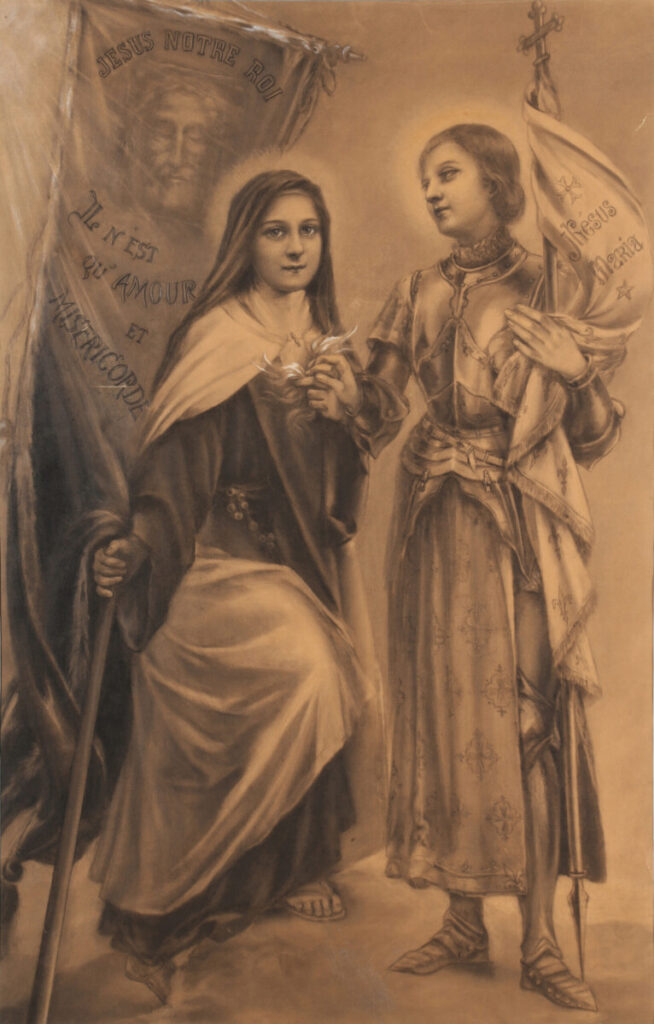
“Thérèse and Joan of Arc” by Celine Martin, accessed from the Carmel de Lisieux Archives, https://archives.carmeldelisieux.fr/en/naissance-dune-sainte/iconographie-theresienne/fusains-et-lavis-representant-therese/
What then shall we say about Thérèse’s ongoing presence in contemporary Catholic discourse? It would be true to say that, in a certain sense, her contradictory role in Catholic debates can be attributed to her own divided sense of self. It would be wrong to say, however, that such a divided sense of self means that Thérèse has no agency in the way that she is invoked today. Rather, through her explicit narration of her contradictory desires in The Story of a Soul, Thérèse presents these contradictions as a true and faithful account of herself. In this way, she guarantees that she will not be remembered merely for her ability to conform to Carmelite piety nor for her transgressive gendered tendencies. Instead, she has enshrined both as constitutive parts of her journey toward the love of God. Perhaps then, we might not need to read Thérèse’s presence on both the conservative and progressive side of Catholic discourse about gender and vocation as evidence of her appropriation by one or the other ideological camp. Rather, we might see that discursive space as one which was opened up, in part, by Thérèse herself.
[1] For an example of Thérèse’s role in popular conservative Catholic discourse, see “Extraordinary Women for Ordinary Time: St. Therese of Lisieux,” Blessed Is She, accessed November 6, 2023, https://blessedisshe.net/blogs/blog/extraordinary-women-ordinary-time-st-therese-lisieux.; For an example of Thérèse’s role in the spirituality of seminarians, see “When St. Thérèse Showers Roses (and Miracles) on Her Friends,” NCR, October 1, 2019, https://www.ncregister.com/blog/when-st-therese-showers-roses-and-miracles-on-her-friends.
[2] Because of institutional marginalization, the evidence of this is largely found on personal blogposts and from grassroots organizations. See Carl Siciliano, “How Saint Thérèse of Lisieux Helped My Gay Friend When Dying of AIDS,” Outreach, October 1, 2023, https://outreach.faith/2023/10/how-saint-therese-of-lisieux-helped-my-gay-friend-as-he-was-dying-of-aids/.; contoveros Says, “Therese of Lisieux: An Ally in Our Gay Great War.,” Queering the Church (towards a Reality-Based Theology) (blog), October 10, 2009, https://queeringthechurch.wordpress.com/2009/10/10/therese-of-lisieux-an-ally-in-our-great-war/.
[3] Paul Halsall, “The Transgendered Sexual Imagery of St. Theresa of Lisieux,” Internet History Sourcebooks Project, accessed November 6, 2023, https://sourcebooks.fordham.edu/pwh/st-therese.asp.; Nancy Corran, “Sainte Thérèse of Lisieux: The ‘Little Flower,’” Women’s Ordination Conference: The Table (blog), October 1, 2022, https://www.womensordination.org/blog/2022/10/01/sainte-therese-of-lisieux-the-little-flower/.
[4] Thérèse and Mary Frohlich, St. Thérèse of Lisieux: Essential Writings, Modern Spiritual Masters Series (Maryknoll, N.Y: Orbis Books, 2003), 28.
[5] Thérèse, The Story of a Soul: The Autobiography of St. Thérèse of Lisieux, ed. Agnès de Jésus, trans. Michael Day (Charlotte, North Carolina: TAN Classics, 2010), 58.
[6] Thérèse and Frohlich, Essential Writings, 17-18.
Steffen Lösel, “Prayer, Pain, and Priestly Privilege: Claude Langlois’s New Perspective on Thérèse of Lisieux,” The Journal of Religion 88, no. 3 (July 2008): 273–306.
[8] Thérèse and Frohlich, Essential Writings, 17-18.
[9] Thérèse, Story of a Soul, 58.
[10] Thérèse, Story of a Soul, 91.
[11] Thérèse, Story of a Soul, 95.
[12] Thérèse, Story of a Soul, 97-98.
[13] Thérèse and Frohlich, Essential Writings, 18.
[14] Thérèse, The Story of a Soul, 26.
[15] Thérèse, The Story of a Soul, 27.
[16] Thérèse, The Story of a Soul, 47.
[17] Thérèse, The Story of a Soul, 40.
[18] Thérèse, The Story of a Soul, 25.
[19] Thérèse, The Story of a Soul, 44.
[20] Thérèse, The Story of a Soul, 44.
[21] Thérèse, The Story of a Soul, 44.
[22] Thérèse, The Story of a Soul, 27.
[23] Thérèse, Story of a Soul, 91.
[24] Thérèse, Story of a Soul, 95.
[25] Thérèse, Story of a Soul, 97.
[26] Thérèse, Story of a Soul, 186.
[27] “CATHOLIC ENCYCLOPEDIA: St. Francis of Assisi,” accessed November 6, 2023, https://www.newadvent.org/cathen/06221a.htm.
[28] Thérèse, Story of a Soul, 188.
[29] Lösel, “Prayer, Pain, and Priestly Privilege,” 301.