The artifact that I am analyzing is the cover page of a cold war propaganda comic book. The propaganda object appealed to me because the way that the United States used biased information as a method to influence the public to view an issue a certain way seemed comical and attention-grabbing. The cover page also fits with the themes of this course in that the picture foreshadows a dystopian society as a result of a more modernized idea. The comic book, called Is This Tomorrow: America Under Communism, was published in 1947 by the Catechetical Guild Educational Society, an anti-communist group. The comic book was intended to inform the citizens about the dangers of the possible spread of communism through scare tactics and pathos. For instance, false dilemma is expressed in the picture by claiming that either the citizens of the United States stay away from communism or the United States will fall apart as a nation, and hasty generalization is used to demonstrate that all communists are evil because the communists represented in the picture are harming the Americans. The cover page is also farce in the way that the fire is destroying everything. The picture of the cover page is designed to encourage fear of communism in America and a sense of nationalism in that the public can come together to defeat the common enemy being communism. The author assumes that the audience, being Americans, can be manipulated enough to be brainwashed through the fear of the country crumpling as a result of communist influence. The message of the cover page directly relates to the rise of the Cold War and the panic of communism threatening national security. As a whole, the cover page attracted me because of everything that I can gain from the message of the picture intellectually and emotionally.
Savannah Ramsey Artifact Analysis
I have chosen an online ad for music therapy programs at Sant Joan de Deu Hospital in Barcelona, Spain sponsored by Fundacion Ilusiones. I was drawn to this artifact by the powerful imagery and the message that music can cure. As a musician and an aspiring doctor, this deeply connects with me. The strong images used provide so much hope and meaning, and caught my eye enough that I couldn’t help but study it in more detail. The ad is focused on a young girl that has lost all of her hair due to treatments to fight her illness. She is smiling in spite of her trials, and is surrounded by blue and white watercolor that looks like the sky on a partially cloudy day. There are music notes of different rhythms overlaid that look like hair billowing in the wind. In the bottom corner it says “Music also cures.” This ad is raising awareness that music therapy can aid in curing severe illness, which is directed towards the general public. It was published in February of 2007 online in Spain. The tone is positive, uplifting, and hopeful. The commanding imagery of a child battling cancer is a tough reality to face, and most people share the value of protecting children from harm. This ad really plays on emotion and pathos to bring across its message of music being therapeutic.
Stephanie Pish- Artifact

I chose to analyze this mural by the graffiti artist Banksy after seeing a poster of it in my friend’s room. I think it is an interesting piece of art as it captures the conflict between the common people and the police, as well as the conflict between innocence and violence. It depicts a teddy bear (innocence) throwing a Molotov cocktail (violence) at police in riot gear. The words “The Mild Mild West” are inscribed in white on the top of the black background, which is again, a contrast. The police are wearing black, in front of a background, which can suggest that the police are the evil here, while the bear is white, suggesting that he is the “good guy,” or the common people.
This mural was painted by the graffiti artist Banksy. This is a mural on the side of a building, so he intended for it to be seen by the general public. Anyone with access to the area would be able to see the artist’s message, which I described above. This is an effective way of sharing his idea with the public because it is free to everyone. He draws attention to the main focus of the piece (the teddy bear) by centralizing the light and color on that part of the image. It is, important however, for the audience to have an idea of the people’s relationship with the police, as that is the focus of this mural. Overall, this piece can be interpreted in many ways, and I would like to analyze it further.
Kenny Igarza- Pre-Petcha Kucha Analysis
I have cho
sen to analyze this poster, as I wanted to reflect on the ongoing issue of illegal immigration in Italy, my homeland.
The far-right Italian party Lega Nord, which seeks to promote the traditions of a unified Italian populace, publicized this advertisement in 2008. The English translation to this poster’s message is “They underwent immigration. Now they live in reserves. Think about it.” This poster asks the audience, native-born Italians aware of the influx of immigrants from North African countries to Italy, to reflect upon the happenings in the United States of America throughout its period of colonization. Native Americans (being compared to Italians) were invaded by colonists from Europe (being compared to immigrants from Egypt, Morocco, Algeria, etc), who eventually took their lands and confined them in governmental reserves. The subjugation of American tribes by North American settlers shaped the course of history to the extent that Americans would be associated with the Caucasian race, rather than with the original population of American Indians. In summary, the Native American identity perished to give place to a new American identity. With this poster, Lega Nord wants to raise awareness pertaining to the threat against the Italian identity and country. For this reason, this piece of political propaganda aims to create a common purpose among Italians in order to stop unwanted and incessant immigration. The conveying of this message is made powerful due to its solemn tone, expressed by bold, blue characters, a striking image of an American Indian embracing its cultural individuality, and a popping red “Think about it” which contrasts with the green and white party-logo above to symbolize Italian patriotism. In an effort to evoke anger and resentment against illegal immigration through logical historical happenings, Lega Nord, a widely known Italian political party, asks Italians to take action.
Blog Post #3- Artifact
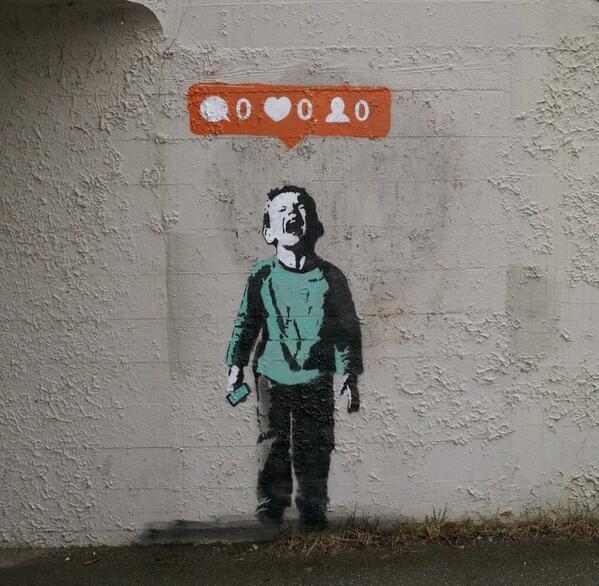
I was initially drawn to this work of art by the way it brought social media to life. I want to study it more because I think it is making an interesting reflection on the priorities of youth today and from where they derive their self-worth. The street art/graffiti depicts a young boy bawling with a cell phone in his hand. And floating above his head is the orange Instagram trademark notification box, only, the boy has zero notifications.
The picture was painting by a Vancouver street artist who goes by the name of I <3 (iHeart) and is titled “Nobody Likes Me”. There could have been a range of purposes for the piece but its effect on me is the highlighting of how society obtains its self-worth from social networks. I think it is very effective in showing this. By indication of the young boy, I would assume the youth of this generation to be the audience. The art assumes that all youth take part in social networking, including very young children. The cultural time period seems to reflect the 21st century in it’s attention to social media, specifically Instagram. The tone is one of turbulence and desperation. I looked up a list of genres and Speculative seemed to be the best fit from that list. A little bit of pathos and logos are represented. Pathos because you can plainly see that the child is obviously in distress and emotional. And logos because if you recognize that the orange rectangle above him is from Instagram, you can logically conclude that he is crying because he has no notifications. Which is, in a greater extent, an introspective comment on society.
Wenxin Lu Blog3
When I was looking over the contents in the Pandora Box, I was immediately drawn to a paper with two lists: countries which have already abolished death penalty and which have not. The countries which have already abolished the death penalty are printed black and the countries which have not are printed red, as if printed by blood. By this strong contrast of color, the author clearly wants us to think upon this grave and serious topic: Should the death penalty be abolished? In addition, with the names of countries in black bigger than those of countries in red, the quote of Justice Sandra Day O’Connor: ’If statistics are any indication, the system may well be allowing some innocent defendants to be executed.’ and an archaic and horrifying electric chair on the background, the author implicitly endorses the abolition of death penalty but still hopes to arouse readers’ rational and incisive thinking.
This paper reminded me of an old Chinese saying: Render injury with kindness, then with what to recompense kindness? To be honest, I remain neutral on this topic. As far as I am concerned, death penalty is the real respect for human beings because if punishment for killing is not far more severe than that for theft or smuggling, how can we differentiate human life from anything else? Thus, I firmly believe that the kindness to malefactors is the cruelty to victims. On the contrary, I also question our society’s power to sentence one person’s death. If the killer can decide the fate of the victim, then how are we different from the killers when we execute one’s final sentence? After all, no one is the god.
Ideally, a country without the death penalty is the symbol of a highly developed and civilized society. Whether the current world can function well without the death penalty still needs more deliberation.
Artefact Lucas Richard-Carvajal
My artefact is a poster from a Greenpeace campaign. It was created in an attempt to draw attention to the effects of littering and non-recyclables on the environment. Plastic bottles and other non-biodegradable containers are mass-produced, used, and often just left in landfills to rot. However, the plastics in bottles can take up to 450 years to decompose. In that time they wreak havoc on local eco-systems.

The poster very effectively draws attention to this. It shows a partially dissected bird, with plastic chunks in its digestive system, lying next to the Coca-Cola logo. Part of the reason I believe it is so forceful, is the author has very successfully utilized color. The bright unnatural colors of the plastic stand out against the grey of the bird, more than that, the red of the logo seems to mimic the color of blood. This combines to give a very clear message about who is responsible for the bird’s death. The graphic nature of this image also serves to grab the audience’s attention. If posted in a public place, the grisly photo would publicize the intended message.
The argument is based on Pathos. It relies on the audience’s emotional reaction to the explicit image. Our reaction to something so brutal is one of shock and horror; the poster uses this to garner sympathy for the bird and anger towards Coca-Cola.
Jonny O’Brien Pecha Kucha Artifact
For my Pecha Kucha presentation, I am choosing a panel from the comic book Avengers Vol 1 Issue 213. I was drawn to this artifact because of its stark imagery and profound impact it has on the reader, as well as my interest in comics. I want to study this panel in greater detail due to its infamy in the comic community and its lasting effect in Marvel. Why this panel? It is when the hero Ant-Man hit his heroine wife Wasp.
This comic was produced by Marvel, specifically written by Jim Shooter, in November 1981. This panel in particular, tying into the overall story, was meant to bring more attention to one of Marvel’s more uninteresting characters, Ant-Man, and to bring in more readers in general. Shooter plays off of the morality and ethos of the reader to bring out a strong reaction and want to know what the character will become following the story. Despite the Avengers being more fantasy and sci-fi, this particular comic was more serious, dark, disturbing, making the reader feel like the character was teetering on the borderline of insanity. In the scene, the background is mechanical, dull, and gray, making the reader entirely focused on the actions in the panel rather than absorbing the scenery. The speech bubbles are jagged and contain bolded phrases to signify the shifts in the scene despite it being a still-frame of one part of it. The whole of the panel is jarring, which has drawn me to investigate it more.
Lopez, D Pecha Kucha Object
My artifact is an online banner advertisement from Dove. It is part of Dove’s Real Beauty Campaign. This campaign address mainly women, although its concepts can be applied to men. The main purpose of this campaign is to raise women’s self esteem. Dove has been running its’ real beauty campaign since 2004. Previous to the campaign Dove made a worldwide study and found that only 2% of women describes themselves as beautiful. Since then, Dove has taken the initiative to challenge beauty stereotypes posed by modern day models. Their goal is to make beauty a sense of confidence.
The tone of this artifact is empowering. The whole point is to empower women to be confident in their skin, widening the definition of beauty. In this advertisement 11 middle aged women of different colors, shapes, and sizes are portrayed underneath the words “Dove Real Beauty Campaign.” This goes to show that there is no set definition for beauty, beauty comes in all different shapes and sizes.
The campaign appeals by pathos. It uses emotional appeals to persuade women that they are beautiful. It shows women who are happy with different appearances, demonstrating that they are happy in their own skin and you should be too. The campaign also appeals by ethos, credibility, because since Dove is such a large and lucrative company, people assume its campaign is something worth listening to.
Pechu Kucha Object- Satty
For my Pecha Kucha presentation, I chose the cover of Taylor Swift’s 1989 album:
As I was looking for an object to analyze for my Pecha Kucha project, I happened to be listening to Pandora as a Taylor Swift song came on as did the album cover image. As I was looking at the photo I realized there are a lot of aspects that have to do with Taylor Swift’s identity and persona that would be interesting to analyze and since identity is a main theme in our class, I chose to analyze this cover for my project.
a) For this image, the creator/author is Taylor Swift herself.
b) The author’s purpose is to attract an audience to buy her album. I also think that the purpose of her album cover is to demonstrate the message of her music and also her identity as a whole. I think it is very effective. This CD cover is very different from her other ones and thus is interesting and the audience would want to buy the album to listen to the difference (this is especially true because it is her first documented pop album).
c) The intended audience is mostly young adult females, yet there are many different types of people who like Taylor Swift and would buy her album. I think the assumption of the audience is that they already know who Taylor Swift is. Because this image does not say her name or even have her whole face, the assumption must be that people already know who “T.S” is and that this is her album.
d) The context of this cover is that it is Taylor Swift’s fifth album and it was released in October of 2014 through Big Machine Records. While this album was released in 2014, it has significance and relates to the year 1989 (the year of Taylor Swift’s birth)
e) To me, the tone of this image is mysterious. Half of her face is cut off, including her eyes which is a defining feature on people’s faces as well as is mostly blank except for her initials and birth year. Without knowing who the album was for, it would be hard to figure out who the artist is.
f) I think the genre of this album, just by looking at it, is unknown. I think this is done purposely since this is her first documented pop album and thus her history as a pop artist is unknown and mysterious and thus translates to her album cover.
g) One strategy used on her album cover is the fact that it is a polaroid. I think that it relates to the fact that it is titled “1989.” In present day, polaroids are rare, but in 1989 polaroids were popular and thus helps connect her with her title. Another strategy used is the mysterious aspect. By not having her full name, or even her full face makes it mysterious and thus will attract more curiosity and attention.
h) I think this cover image appeals to both pathos and ethos. I think it appeals to pathos because of the mysterious aspect. The more mysterious, the more curiosity it will generate and thus more albums will be sold. I think it appeals to ethos because of the fact that Taylor Swift is already famous and known. She is recognized world wide and thus, people will trust her album especially with her signature hand writing on the front.
Overall, I think the cover of this album has a lot to do with representing Taylor Swift’s personality and will be interesting to further analyze and discuss. I believe the fact that this image presents a certain identity to the population also relates to the fact that we put images of ourselves on social media for the public to look at and thus we also give out a certain “identity” over social media.