
Elm Street Eatery: NOLA Style

I pulled up to the cutest little house on Elm Street in an Uber and called my mom to tell her I was outside, she said she tracked my phone and already knew so the door was unlocked. She tracked my phone as long as I remembered because my mom is the definition of over protective. When I walked in, the kitchen was filled with savory aromas; if only I could share that smell with a picture. She had Camellia red beans simmering in a pot, crawfish étouffée in a bowl, and had just began preparations for stuffed bell peppers.

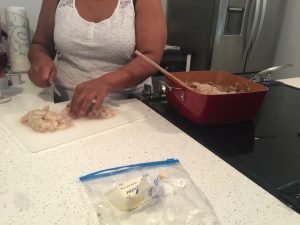


I said “Wow, ma. You really transformed this AirBNB into the ‘Elm Street Eatery’ with all this cooking.” She recanted in that New Orleans accent that I had missed so much, “Girllllll, when you told me that you ain’t had no red beans in three whole weeks, I had to come see ya. That should be illegal.” She poured me a glass of wine and told me to let her know how the étouffée was, even though she had cooked it over a hundred times since I was born.



She had flown with so many pots, pans, and bags of seafood stuffed in her checked luggage that TSA broke the locks on her bags.


She saw me taking pictures of everything and said “You and that damn snapchat, always taking pictures. Just live!” I explained to her that it was for a school assignment and that I was posting on a blog. Upon hearing that, she said “oh, well take a better picture of me!” I ended up bargaining with her, I would only take a better picture of her if she fixed me a bowl of red beans.
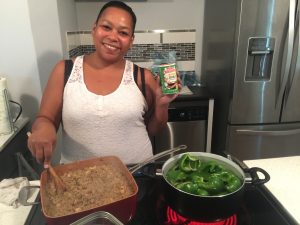


She finally finished cooking everything she planned to, and sat down and talked with me about what was happening back home, how my classes were, and the cases of water she wanted to get me in preparation for the hurricane heading toward Georgia.  After eating my favorite meal ever, stuffed bell peppers and baked macaroni and cheese; she suggested we end my blog with a “cute selfie.”


The Black Male Initiative @ Emory University

With the dawn of a new school year, comes the dawn of new changes for Emory University. While some, such as the demolition of the Dobbs University Center, are extremely obvious, there are others that aren’t known to the general public. The Black Male Initiative (BMI) is a pilot program targeted at first-year black males at the University. The purpose of the program is to counteract the disproportionately high dropout rate experienced by black males in comparison to their other peers. To do this, the program is designed to give black, male, first-year students both academic and professional resources as well as develop leadership and comradery between each other through events, workshops, and outing in Atlanta. It great to know the purpose of the program, but it’s much more important to see the impact and effectiveness of said program. How do current students feel about the program? Why or why not students applied to BMI? How well known is the program in the Emory community? To answer these questions, we decided to interview three students, Aaron Campbell, Christopher Benedict, and Alex Koo, in order to provide more perspective.

Harris Hall is a traditionally second-year resident hall where some freshman and the BMI reside.

When speaking with Aaron Campbell, a member of the pilot program we learned more about what the program means to him, the Emory community, and the greater black community. The desire to be surrounded by “an environment where black people did well… were successful… [and] were educated” drove Campbell to initially apply for the program. It was clear that Campbell felt as though this program was important and he wanted to be a part of it, due to its recognition of such a prevalent issue. Regarding the BMI’s relationship with other first-years in Harris Hall, Campbell expressed a generally positive relationship between the two groups but voiced concern that “more awareness” could be drawn to the purpose of the initiative itself.

We found the remarks made by Aaron regarding the BMI to be quite interesting, but we wanted to know how others who were not part of the program saw it; more specifically, a black male who did not participate in it and one of Campbell’s fellow hall mates. Christopher Benedict is another first-year black male at the University, who unlike Aaron, decided not to be part of the BMI. Benedict argued that while the idea of a program such as the BMI was good, he wanted a more “immersive” first-year experience. Another first-year named Alex Koo is a current resident of Harris Hall as well. When asked about the BMI she did not initially know what it was, however, after we explained to Koo the premises behind it, she had a better understanding. Koo described being put in a sophomore dorm as “shocking,” however, much like Campbell, she described the atmosphere as a “friendly community.” Koo recognized Emory University’s proactiveness to take the initiative to set up the program, but she did voice concern that more information regarding its purpose should be advertised to other members of the University.

Overall, it seems like the Black Male Initiative here at Emory is just the first step to a longer process. Being that this is the pilot year and the year just got started, it’s hard to judge whether the program is effective in meeting its goals. However, it can be concluded from speaking to Campbell and Koo that the BMI creates a close community for participants surrounded with like-minded individuals. Moreover, the program is being proactive in trying to solve such a pressing issue, therefore we can see the strides being taken and a possible bright future for the BMI and university.

By Zion Kidd and Daquon Wilson