While reading about narrative form and the cinema of attractions, I kept thinking about Harry Potter and the Deathly Hallows, Part 1 and how its slower pace and moments of spectacle make us feel the story’s uncertainty in a really visual way. Unlike the earlier Harry Potter movies, The Deathly Hallows, Part 1 slows everything down and narrows the focus. The film uses restricted narration, so we only see and know what Harry, Ron, and Hermione do. Because we’re limited to their perspective, we’re able to strongly connect to their confusion and frustration as they struggle to search for the Horcruxes. The long stretches of silence and constant wandering throughout the film make the narrative itself feel tense, almost as if the characters are stuck in time.
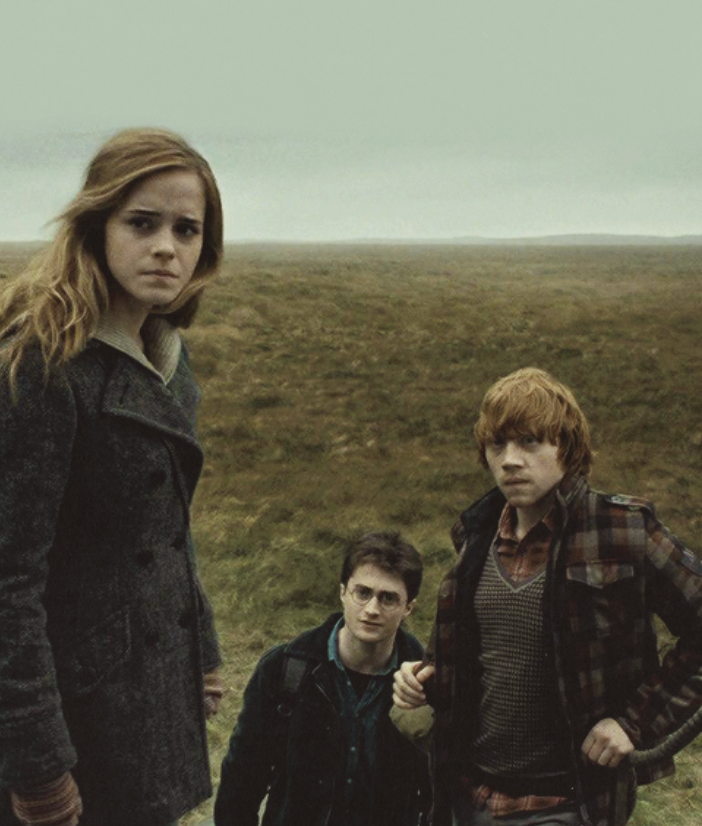
The film also plays with the element of temporal order which further encourages us to put ourselves in the positions of the main characters. For example, the long and quiet forest sequences make the passage of time feel stretched out, and the use of flashbacks and dream sequences momentarily disrupt the flow of events. When Harry sees flashes of Voldemort’s movements through their mental link, we’re pulled out of the present moment and into his mind, which leaves us disoriented and questioning what’s real or imagined. These choices in narrative form force viewers to question what’s real, what’s memory, and what’s imagination, blurring the line between the past and present. It’s less about building toward a single climax and more about showing how time itself feels distorted when the characters are directionless while searching for Horcruxes the whole movie.

Even with its slower pace, the film still has moments that support Tom Gunning’s idea of the cinema of attractions, which are scenes meant to astonish the viewer rather than just move the story forward. The Tale of the Three Brothers sequence, which is told through shadow animation, is a perfect example. For a few minutes, the film pauses the main narrative to tell a story within the story that’s visually striking and stylistically different from everything else. Considering that we only realize the tale’s significance later in the film, it feels like this pause invites us to watch for the sake of wonder before its deeper meaning clicks into place.
Through the mixture of restricted narration, disrupted temporal order, and visually striking flashes, Deathly Hallows, Part 1 is a perfect setup for the battle to follow. The decisions in narrative form regarding time, perspective, and spectacle allow viewers to more deeply empathize with the characters and actually feel what it’s like to live inside a wizarding world that’s falling apart.
Leave a Reply