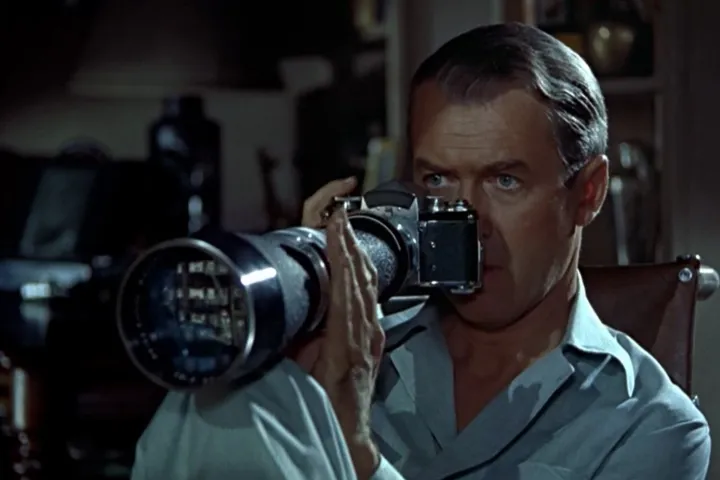
Funny Games (1997, Haneke) is a disturbing tale of violence and intrusion. Following 2 men who invade a family’s vacation home and put them through a series of twisted and lethal “games”, the film creates a similar commentary on voyeurism and complicity in violence as is present in Rear Window (1954, Hitchcock). As we have discussed in class, Rear Windows places the viewer into the role of voyeur, mirroring our actions with L.B. Jefferies, a man literally incapable of movement and action. Rear Window asks the viewer about their willingness and implicit desire to watch and spy on others. Jefferies’ camera becomes symbolic of the movie screen itself, showing how he, and the viewer, are separated from physical harm, but gain a natural excitement from learning about the private lives of others. The murder of Thornwald’s wife is simply a method for the viewer to excuse and justify their voyeuristic actions.
Funny Games adds on to this conversation of voyeurism and natural desire to watch violence. However, Haneke definitely punishes the viewer for their viewership of violence, while Hitchcock mainly just asks the question if its wrong. Funny Games starts as a reasonably normal thriller with frightening antagonists and a strong sense of suspense. That is, until one of the home-invaders, Paul, stares directly into the camera after the family learns a terrible truth.

I was shocked by this moment, and initially very confused about the meaning behind it. Overtime, I came to an understanding that this film is not about 2 men torturing a normal family, but actually about torturing the audience. Haneke is literally punishing the audience for having any interest in watching such a movie. Following horrifying act after horrifying act, the audience is finally given a moment of justice and a glimpse of joy. It is then immediately taken away by Haneke through breaking every rule of cinema. A film that started completely in reality is then complicated with time travel and reality manipulation. All of this is done just to take our moment of justice away, and put us back into pain. Additionally, there are multiple minute long scenes of us simply watching the characters sit in silence, suffering in both physical and emotional pain. Overall, there isn’t a comfortable moment in the entire movie, and that is the point. Haneke takes Hitchcock’s commentary on complicity in violence and turns it into blame; blaming the audience for having any desire to watch.

Leave a Reply