This chapter of Film Art introduces documentary, experimental, and animated films. Documentary films interpret reality to tell what is meant to be a nonfiction story. This can be a nonpartisan organization of information or an attempt to persuade the viewer into believing something; these are defined as categorical and rhetorical. Experimental films do not follow traditional narrative rules, but rather may focus on patterns of sound or light and may have an unconventional narrative or no story at all.
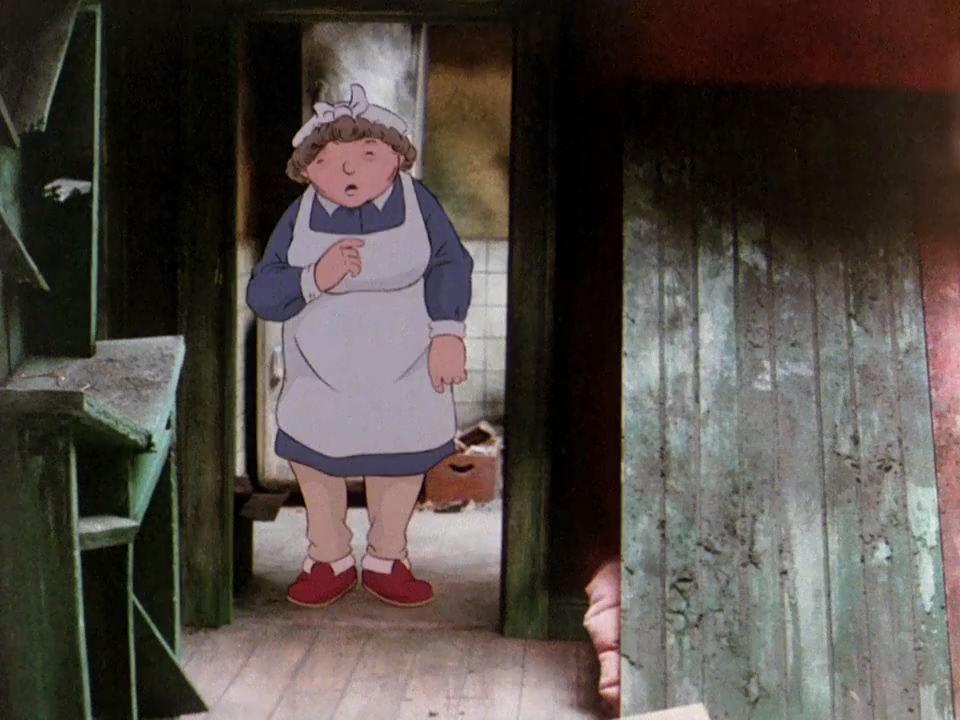
There are many types of animated films, but their defining characteristic is that it constructs reality by drawing, computer generating, or manipulating objects frame-by-frame. When I read this section in Film Art, I reflected on how a lot of animated media uses multiple forms of animation. One film that came to mind was Jimmy Murakami’s 1986 war film When the Wind Blows.
The film utilizes a mix of traditional and stop-motion animation, which creates a juxtaposing effect that is perfect for the message of the film. The two characters are drawn and animated with the process of cel animation. This is when clear sheets of celluloid (or “cels”) are drawn on and then layered and photographed. When these cels are shifted, it creates the illusion of movement. However, rather than a drawn background. This film uses sets made of real objects and adds the drawn characters in later. The objects in the set are animated to move as characters interact with them. This film is about the devastating impacts of nuclear warfare, but the characters are relatively oblivious to the danger they are in, which is displayed by the set around them mimicking reality as they remain drawn. There are even multiple live-action scenes in the film, such as when the bomb drops in the film. I don’t think this fully classifies as experimental but the use of mixed media definitely breaks traditional narrative rules.
Another animated movie that came to mind was one of my favorite animated films, Satoshi Kon’s Paprika. This film blends hand-drawn imagery (cel animation) with CGI, which is computer-generated imagery. This is an extremely surrealist film with an extreme amount of detail, and the CGI is used to aid the drawn animation to aid this effect and be more efficient. (https://www.tboake.com/manipulation/yeung/4films/paprika.html)

After reading the Guardian article about Paris is Burning, I think it raises a concern in documentary-making that I never considered. The documentary received backlash because the director is a white filmmaker making a film about a predominantly black/latino scene. This raised questions about cultural appropriation and lack of profit/recognition for participants in the film. This also highlights how, while documentaries are meant to be fully nonfiction, the experiences/identity of the filmmaker always matters as it can create bias.
Leave a Reply