Not too long ago, I watched the horror film Weapons with my friends. I found the film to be very interesting in the way that it kept cutting to different characters and timelines. I had to try to order the events in my mind so that I could make sense of what was happening. It reminded me of Holy Motors in that way; both films make you create your own meaning instead of giving you a straightforward explanation.
While watching this documentary film, Grey Gardens, I felt like I was getting a look into the lives of the characters (Little Edie and Big Edie); their true personalities were being expressed without any filter. They said whatever came to mind and acted however they wanted. Women in the mid-1970s were not “supposed” to act this way on camera, which is why viewers originally thought the film must have been scripted. Their bickering even feels comedic. They are performing, but only because they like to perform, not for money. Long takes and no narration suggest a direct cinema style, but the actors’ performances turn it into a theater performance.
Like the decaying house, it is clear to the viewers that their lives are becoming less and less interesting. They are constantly talking about regrets and memories, reliving the moments again and again. Psychologically, the Edies live in a bubble of the past. Little Edie keeps saying she wants to leave, but the moment she’s with her mother, she becomes a “Little Girl”. They’re unreliable narrators of their own histories, but it is a part of the film’s attraction, making it more entertaining and theatrical.
The house and the chaos of objects inside it symbolize the internal chaos in their minds. The physical disarray mirrors the emotional chaos of their relationship, which includes dependency, resentment, affection, and nostalgia. Still, they stayed together.
The film Shampoo (1975) addresses the themes of politics, gender, and sexuality through comedy. It shows how the politics and the sexual revolution of the time were very disingenuous, and it shows this through the deceptive words of the main character (George) and through the use of irony. The film makes us feel as though we are guilty because we know of George’s promiscuous acts long before the women he is with do. It does this by using dramatic irony; we know the true nature of the main character, while the female character Jill is completely in the dark about him. At the same time as viewers, we are scared of her finding out the truth, as we do not want to soil her innocence and trust.
The movie depicts the messy and promiscuous love life of the main character, who is a hairdresser shown to be self-centered and oblivious. He is always trying to go somewhere (always chasing something), but we never know where or why. He is very dishonest, even with himself. The uncertainty of the times politically matches the uncertainty in his personal life, which makes his aimlessness feel even more intentional in the film’s narrative.
Many sexual innuendos appear throughout the film to bring comedy and further express his carefree nature. We dislike him at the beginning because he is with so many women behind his wife’s back and because he doesn’t seem to take anything anyone else says seriously. He even claims he felt “immortal” when sleeping with many people, which shows how disconnected he is from the emotional weight of his choices. However, by the end, we end up feeling bad for him. He loses everything that was actually important to him. He didn’t know what he wanted until it was too late, and it is very ironic that someone who was always chasing everything ends up completely alone.
My favorite scene of the movie was the party scene. The party scene is similar to the political and social chaos that was happening during the time of the film’s creation. The party scene is an example of how the film uses mise-en-scène to build tension. The loud music and the aggressive flashing lights create a sense of conflict and emotional overload. The loud atmosphere and hectic lighting reflect how unstable his life is becoming, with the women so close to finding out about his promiscuous ways. Viewers become very anxious, and the suspense builds as the truth about the main character is so close to be revealed to others, it is nerve-wreaking to watch, but it is hard to look away. The scene keeps shifting from George with a woman to his wife (Jill) slowly approaching. We feel anxious as she almost misses the truth, walking by the area where George is in the act of intercourse with another woman.
Over the last weekend, I watched Inside Out 2 again with my family. Inside Out 2 continues the exploration started in Inside Out into the internal states of mind that are anthropomorphized as characters. New emotions (such as Anxiety, Embarrassment, Nostalgia, and Boredom) are added to the core emotions from the first movie. They are more complex and in conflict with older emotions such as Joy, Sadness, Anger, Envy, and Fear. Riley, the main protagonist, is a girl coming of age and is not yet sure how to accept and regulate her emotions. She is yet to realize that even Anxiety at times is useful, but that it has to be kept from becoming overwhelming.
A dual narrative in the movie that helps connect the two worlds: the internal world of Riley’s emotions and her external world as a teen who wants to succeed at a hockey camp. Inside her, emotions are fighting, and Joy, with the help of Sadness and other emotions, has to stop Anxiety from controlling and ruining the internal balance in Riley’s mind.
One of the most memorable scenes in Inside Out 2 is the anxiety scene, when Anxiety frantically tries to “solve” Riley’s problem, and accelerates so quickly that she actually stops (or glitches). The animation shows her vibrating at a supernatural speed (like electrons, which are moving so fast that they are everywhere and nowhere at once). It’s a great visualization of cognitive overload when the emotions and thoughts overwhelm a person, and they become paralyzed. The scene uses cross-cutting to show how Riley’s internal emotional collapse affects her body on the hockey field. When Anxiety is out of control, there is an intense sound of Riley’s breathing that can be heard as she is spiraling due to anxiety during the hockey game (it is like she is having a panic attack).
Camera movements support an internal state Riley is in, with faster movements when Anger takes over, and slower movements when it is Sadness. The colors and shapes are used to represent emotions. Joy is round and light green-yellow, Anxiety is irregular-shaped and orange, Anger is red and square, Sadness is blue, Envy is green, as one would expect.
I had to watch Inside Out 2 because I am interested in cognitive psychology (especially memory formation and recall). The movie helps me visualize how memories become core beliefs (for example, the belief that “I’m not good enough”). A single bad moment drops into a machine to be processed and comes out as a judgment about oneself. Repeated negative experiences literally crystallize. Inside Out 2 is perhaps not as solid as a neuroscience textbook, but I think it can help people realize the role of emotions in their lives and how to cope with them and does it in a visually appealing and truthful manner. That makes the movie psychologically real. By using characters who portray the internal emotions of Riley, the movie helps viewers visualize her internal psychological states and internal conflicts that she faces, not just follow her external journey into adulthood.
While watching the film, I noticed that the main character, Harry Moseby, is often visually framed by his surroundings (e.g., doorways, windows). This framing makes Harry seem trapped, not just physically but mentally. It reflects how limited his thinking is. He is a detective, but he never actually sees the full picture. Instead, he jumps from clue to clue without stopping to understand what is really happening.
The main character (Harry) reminded me of George from Shampoo (also 1975), another character who constantly keeps himself busy but does not actually understand the situation (until it is too late). Both men move through their stories reacting instead of understanding, so I predicted early on in Night Moves that it would not end well for Harry.
And that is exactly what happens. He cannot stop the disaster, even though he is supposed to be the “hero.” The more he tries to take control, the more confused and lost he becomes. The last shot of him going in circles in the boat shows this perfectly. He is still moving, but he is not getting anywhere.
I also found the chess scene really interesting. The game seems to symbolize how little Harry actually knows. He thinks he is solving a mystery, but he doesn’t see the strategy or the larger pattern of it at all. He is basically playing a game he doesn’t understand/know the rules of, up against people who are always one step ahead of him.
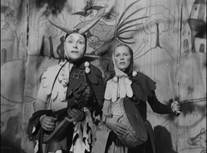
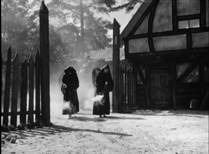
The Seventh Seal is a classic 1957 movie by Ingmar Bergman. It raises many existential, philosophical questions related to faith, death, and the meaning of life. I was struck by the powerful scene of a religious procession. The film cross-cuts between a noisy, merry crowd enjoying an acting troupe’s performance and a grim religious procession through the village. This creates a sharp contrast of juxtaposed images of merry drunkards and lines of fearful, mournful figures in black who are dragging their feet and beating themselves with whips.
The contrasting scenes show two ways people coped with life during the Black Plague, and neither looks attractive. Some people engage in partying and drinking to forget themselves. Others self-punish themselves even further (perhaps to feel a bit more in control, as if they choose their suffering). The diegetic sound suddenly shifts from the laughter and loud chatter of the crowd to the chanting and drums of the flagellants, with the actors and crowd going silent as if in fear or awe of the procession that may remind them of God and their sins, or of Death.
The shot of the religious procession entering through the frame of the wooden gate may be symbolic. They are crossing a threshold into the everyday world of the villagers. The framing of dark bodies against light fumes and dust turns the figures into symbolic silhouettes (not real people), as if the fear is entering the village with people caught in a wild party.
The movie still speaks to people, after so many years, because people still confront traumatic experiences (such as a pandemic) in the same ways. We either distract ourselves with noise and activity or turn to fanaticism/extremism, religious or otherwise, trying to impose order in a world full of uncertainty.
A few weeks ago, I watched Ex Machina. It is a sci-fi movie with an added psychological thriller element that keeps you guessing who is going to “win” the mind game of the Turing test – a human protagonist, Caleb, or Ava, a sexy female robot. The setting for this battle is the remote house of Nathan, a tech-savvy inventor-billionaire who is designing female robots and running an experiment on them and a human subject, Caleb. The house looks like a barn but is filled with high-end tech. When Caleb enters it, the door closes behind him as suspenseful music plays in the background, and it locks with a hissing sound, unlike a real barn door would.
The mise-en-scène inside the house is in sharp contrast to the lush green forest outside, in the mountains. Inside, there are long hallways, glass walls, cool lights, and locks that give a sense of entrapment. The glass walls form barriers that allow Caleb to watch Ava, for Ava to watch Caleb. Cameras are installed for Nathan to watch them both. This lack of privacy and lack of physical connection dehumanizes everyone because everyone is under surveillance, an object of observation. The viewers are watching others watching. That is a double voyeurism, and it can make one uncomfortable.
I was also interested in the themes of the male gaze, the creation of a female persona, and a gendered portrait of women. Nathan is building a very gendered portrait of a female robot persona in his basement. On the surface, it just looks like objectifying women robots (who are robots, after all). They are made to be pretty and obedient for their male owner. He designs them to look beautiful and serve him, but in the end, Ava outsmarts everyone (especially Caleb, who develops intense feelings for her). The movie is a male-controlled fantasy of the “ideal woman” (or even several versions of them, with interchangeable parts) that turns into a female empowering message that controlling a woman, even a female robot, is just an illusion.
A few weeks ago, I watched the film The Boy (2016) for the first time. I have not watched horror movies, so I wanted to try one out, and I was recommended by a friend to watch this movie. While watching the movie, I found the doll very creepy, the way it just kept staring at the screen. And to make the movie even creepier, sound was used to make us feel like the doll is alive. You hear sounds, but you don’t ever see the doll move. It is implied to us that the doll is moving and making those sounds by the changes in its location after the door is closed. It is the creepier version of the moving toys in Toy Story because we are not let in on the doll’s movement; we are left out of its perspective. As humans, we are often scared of the unknown and of things that seem eerily similar to human functioning, such as dolls and robots. We fear that they will take over. That is why so many horror films are based on dolls/robots. Additionally, we discussed in class why so many horror films take place in homes. Similarly, this movie does as well. It causes greater distress in the viewers watching because homes are supposed to be a place of comfort.
Talking about the film with my friend made me notice how the movie constantly uses sound, camera angles, and off-screen space to keep us guessing. It doesn’t always show us what’s happening; it just lets us imagine it, which is usually scarier.
After watching the whole film with my friend, there were still parts I didn’t fully understand; it seemed to me that a lot was left unexplained. Now I realize that confusion is actually a big part of how horror works. The movie gives us just enough information to make us suspicious, but not enough to feel certain about anything. Viewers were given clues about whether the doll is alive or not in the film’s universe. However, there were also moments in the film that purposely made viewers doubt and rethink their suspicions. Nothing is certain, and that is scary to think about because if that were true in real life, it would be hard to tell what really matters and what doesn’t. We want answers, and horror films don’t always give them, so we are left wondering instead. I think that is why so many people love watching horror films. Yes, sure, the thrilling aspects of jump scares and plot twists are appealing due to the adrenaline rush you get from watching, but also the unsolved mystery and confusion you get at the end of the film make the film all the more memorable and creepy. People get to make their own reasoning about the film. And different theories are made about what the films could mean.
I recently watched the film The Diving Bell and the Butterfly both in its original language, French, and in English. The movie starts entirely from the perspective of the main character, Jean-Dominique Bauby, who has suffered a stroke and now finds himself disoriented and unable to move, but mentally as sharp as before. The camera captures the hospital surroundings as seen by a person with low/blurry vision, unable to move. There are extreme close-ups of the eyes and other physical parts of the onlookers as they occasionally come into his line of sight. This perspective creates the feeling of being locked in the body, separated from the world, unable to move or control the field of vision.
There is a recurring motif of eyes, eyesight, and dream-like visions. Later in the movie, he starts to communicate with the world, the only way he can communicate, as he discovers, by blinking an eye.
Bauby’s internal monologue adds psychological realism. Viewers can understand and feel compassion for his paralyzed state through the non-diegetic sound of his inner voice. Only viewers can hear his internal dialogue; other characters cannot. The heavy sounds of breathing that the main character makes create the illusion that you are very close to him.
Although Jean-Dominique Bauby is trapped in his body (as if in a diving bell), he is free to imagine and replay images from the past (his imagination is like a butterfly, hence the name of the movie). There is a sharp contrast between the immobility of the main character’s body and the liveliness of his mind that knows no constraints. The movie is extremely sad and, at the same time, liberating and powerful because it shows that even a person who can only use his imagination can still find a purpose in life as he dictates his memoir, one letter at a time, by blinking.
While watching the film, viewers are taken on a rollercoaster of emotions. The two protagonists’ relationship keeps us in suspense. They start as friends, but we know that conflict is looming between them because of their opposing views. Indeed, they become enemies, but in a shocking reversal, they put aside their differences and become friends again. The movie definitely pulled on my heartstrings.
An article about the ethics of the film by Alex Woodson talks about how different people view the movie from different perspectives. Symbolism is lost for those who do not know much about Indian history/culture. Alex Woodson argues that clothing, flags, names, and locations are “all packed with symbolism” that can be interpreted as suggesting Hindu nationalism. The author of the article mentions that it is hard to understand the details about the inner struggles that were going on during the time. People in the U.S. may not fully comprehend the conflict between the two religious groups, Hindu and Muslim. The director of the film addressed the political topic while bringing entertainment through comedic stunts and supernatural action scenes.
Woodson’s article questions the selection of leaders who were shown at the end of the film. This list of figures did not include any Muslims, which could be interpreted as a political minimization of the role of Muslims in the Indian political struggle for independence from the British Empire.
Woodson points out the use of violence and blood in the film. He mentions the scene where blood splashes on a map with the words, “The sun never sets on the British Empire.” This scene is very symbolic, seemingly going against a non-violent stand that Mahatma Gandhi (who was not depicted in the movie) had on the struggle for independence in India.
In a New Yorker interview, the director (Rajamouli) states, “Entertainment is what I provide.” Rajamouli claims that he is averse to any extremist position, while at the same time stating that he “hates” extremism, suggesting that he is more extremist than he wants to portray himself as.
Throughout the interview, Rajamouli tries to defend the political implications that critics state the movie implies. He says that he did not think that the movie would be interpreted as a “Hindu nationalist fantasy.” He states that he just drew on his subjective views, mentioning the historical figures he admired when he was little. He keeps reiterating that the movie’s purpose was entertainment, not a political statement. The issue is that the movie has reached millions of people and is highly influential, affecting the beliefs of people, so the director has a responsibility for more equal inclusion and representation.
Rajamouli states, “American audiences are looking with fresh eyes.” They may not have seen his previous movies as Indian audiences have, so they were probably less expectant of big action scenes. This seems to be a contributing factor to why the movie was such a big hit globally.