Author: Andrew Cai

  • Andre Bazin and the Documentary

    Andre Bazin and the Documentary

    Many, many weeks earlier in the semester, we had discussed alternate forms of editing. In this discussion, we briefly learned about French film critic Andre Bazin, and his idea of “The Myth of Total Cinema”.

    In this idea, Bazin believed cinema strives for an objective and authentic capturing of reality. In other words, the goal of cinema is to portray reality as is, in a 1:1 representation. According to the film critic, reality would be captured through mainly long takes and deep focus. Though this idea itself is labeled as a myth, one of the reasons we haven’t obtained this goal yet (said by Bazin) is lack of technology to do so. As we make further advencements in tech, humanity will get closer and closer to total realism in cinema.

    Still from The Act of Killing (Oppenheimer, 2013), a documentary I am currently watching.

    After learning about documentaries a couple months later, I began to wonder: What does Bazin think of documentaries? This genre of film is meant to provide an objective view of reality, depicting actual events to educate the audience. In theory, would Bazin then prefer every film made to be a documentary?

    Though documentaries do embody Bazin’s idea of Total Cinema by showing real people/places/events and placing the audience in the place of an observer or fly on the wall, there’s still a caveat.

    As discussed in class, someone still needs to make the documentary. Each documentary requires choices, such as framing, editing, or point-of-view. No film in this genre can be truly objective, as Bazin intends. Some documentaries can also be completely false. For example, Nanook of the North, a documentary we watched in class, showed an Inuit man’s life in the Arctic. In reality, the entire film is staged. There is no Nanook, just a character played by a Inuit man. The costuming is staged as well, along with multiple scenes throughout the “documentary”. Though documentaries seem like the genre that aligns best with Bazin’s ideas, personal choices and views are still projected onto these films and affect them whether we know it or not. Including or not including just one cut could change the entire lesson we take away from the film.

    Though documentaries demonstrate our power to capture the world as it is, it does not meet the goal of Bazin’s Myth of Total Cinema. Documentaries are still riddled with choices that shape it’s message and meaning. What matters more is the filmmaker’s respect for reality and their attempt to keep their film as close to reality as possible.

    If you’re interested in this topic like me, here is some further reading from Bazin I found: https://www.mccc.edu/pdf/cmn107/the%20evolution%20of%20the%20language%20of%20cinema.pdf

    Please let me know if you agree or disagree!

  • Conspiracy Theories in Bugonia

    During class today, we discussed the idea of ideology and how present it is in every aspect of our lives. Directors have, and will continue to voice their own ideologies and opinions through their films.

    There were two things I wanted to talk about today, both stemming from this morning’s conversation. We also touched on conspiracy theories and how, though extreme, they can reinforce current beliefs or stem from past experiences.

    Spoiler warning for Bugonia.

    Bugonia, which I watched last week, is a movie oozing with ideology. Teddy, a rural bee farmer, manipulates his mentally disabled cousin, Don, into helping him kidnap a pharmaceutical CEO. He believes the CEO, Michelle Fuller, is an Andromedan alien sent to destroy Earth.

    At first, I felt Teddy’s methods were outlandish and cruel. He was so insistent that Fuller was an alien, he went at lengths to prove it. For example, he shaved her head and even lathered her in antihistamine cream to prevent her from “communicating with the mothership”.

    But as the film goes on, we start to understand where he’s coming from, and even sympathize with him a little. We realize that Auxolith, Fuller’s company, was developing a medication to fight opioid addiction. Teddy’s mother was a voluntary test subject for this product and was sent into a coma as a result. Multiple other childhood incidents are mentioned throughout the movie offhandedly, often through a single line that never gets addressed again. Teddy mentions how he and Don have been “chemically castrated” by Auxolith while talking with Fuller. The town sheriff (also Teddy’s childhood babysitter), Casey, continuously tries to befriend Teddy, apologetically referencing a sexual assault he had committed against Teddy as a child.

    All of this childhood trauma acts as a weight on Teddy’s shoulders. As far as we know, he never sought any assistance for his presumably unstable mental state. Trying to figure out why all these things are happening to him, Teddy turns to the internet. He falls into the rabbit hole of conspiracy theories, and because of internet algorithms, finds himself in an ideological echo chamber. This echo chamber feeds him more and more conspiracies, ultimately turning him into the man he is today.

    What’s interesting to me is as weird as this film’s premise is, Teddy’s conspiracy theory transformation happens to people every day on a smaller scale. Because of past experiences and their interactions with other people, people’s worldviews change (albeit usually not as extreme as Teddy’s).

    Bugonia’s director, Yorgos Lanthimos, even talks about this himself in this interview (https://www.rogerebert.com/interviews/bugonia-interview-2025) with film critic Roger Ebert. He says how he’s ” always interested in the ways people’s interactions with themselves or others affect their nature.” He also says this about Teddy: “…he’s someone who has created a story, which is, by the way, not entirely untrue–but I think he’s someone who, like a lot of us, has not been told a better story that’s true from the powers that be…He’s been abused by the system that keeps talking without doing anything–or at least doing anything that’s helping him in some way.” This film could also be Lanthimos heeding us a warning about the slippery slope of politics, and how one can easily find themselves in an echo chamber and alienate themselves from the other side of the political spectrum.

    All-in-all, Bugonia is a wonderfully bizarre film about how one’s past can shape their current worldviews. It satirizes the modern internet-conspiracy culture and is hilariously unpredictable at times.

  • Experimental Film in 2001: A Space Odyssey

    Experimental Film in 2001: A Space Odyssey

    This week, we’re discussing three distinct genres of film: documentary, experimental, and animated. Although I haven’t delved into the first two genres extensively, 2001: A Space Odyssey by Stanley Kubrick stood out to me immediately as an experimental film I’ve actually seen (so many films that are considered experimental have been on my watchlist for a LONG time, such as House and Stalker).

    Though not all of the film is considered “experimental”, the “Stargate” sequence definitely should be.

    At the beginning of the sequence, Bowman, our main character, is in space investigating one of the monoliths when he is pulled into a gateway of colorful lights.

    Throughout the rest of the sequence, we see tunnel-like flashes of light (shown above), with shots of Bowman in distress interspersed between. It’s worth noting that as the sequence continues, the shots of Bowman become motionless, his face frozen in horror and distress. As the sequence continues, we begin to see shots of blinking eyes (presumably Bowman’s?) with different color schemes, space phenomena, and landscapes of strange colors.

    This sequence is a version of what Film Art calls “associational form”. Using these images, Kubrick suggests ideas and emotions to the viewer, despite the images seemingly having no logical connection.

    Through the tunnel-esque design of the colors, we infer that Bowman is traveling somewhere. Then, using the short, shaky shots of Bowman in distress, along with the freeze-frames, we know that whatever journey Bowman is on is nowhere near pleasant. But on the other hand, some parts of this sequence are also abstract (the second form). The images aren’t necessarily used to convey a meaning; it’s up to the viewers themselves to find meaning within them. A good example of this in the sequence is the eyes or the space phenomena. Is Kubrick trying to show what Bowman is seeing as he travels?

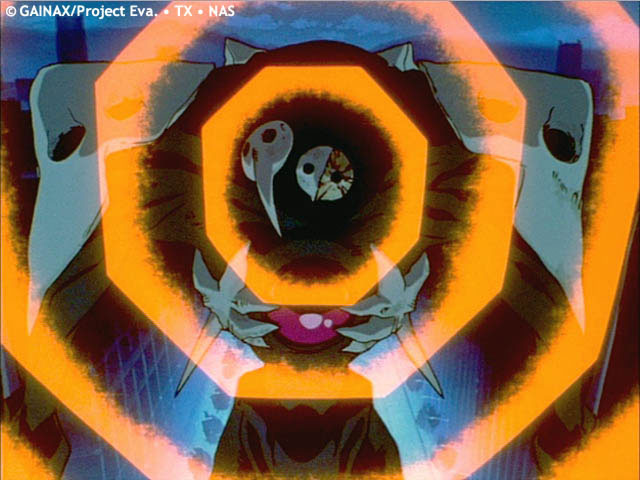
    On the topic of 2001, it’s also fun to see references to such an influential movie in other media. There were two pieces of media that came to mind immediately, which are the anime Neon Genesis Evangelion and one of my favorite video games of all time, Signalis.

  • Jupiter’s Spectacle

    Rewatching Nope today was a blast. It was really fun seeing the reactions of people who had never seen it before, and how similar their reactions were to mine when I first saw the movie a few years ago. One theme of the film that stood out to me during this second viewing, though, is how the need for a spectacle is constant throughout the entire movie.

    Before the film even begins, Jordan Peele shows an epigraph of a Bible quote, specifically Nahum 3:6: I will cast abominable filth upon you, make you vile, and make you a spectacle.

    The theme of spectacle continues during the rest of the film. For example, Steven Yeun’s character, Jupe, turns his childhood trauma from “Gordy’s Home” into a camp museum exhibit. The blood-soaked shoe we see at the beginning of the film can be seen on a glass plaque in the room, along with several fan-made posters that seem to glorify the horrible attack that occurred.

    On the topic of Jupe’s childhood trauma, a scene that stands out to me is immediately after Jupe reveals the museum exhibit in his office. When Emerald asks him what really happened on set, Jupe isn’t able to explain it through a firsthand account. He has to use an SNL skit, a spectacle itself, as a medium to describe the events that took place. Spectacle is almost like a coping mechanism for Jupe: he uses it to avoid direct confrontation with his past and to downplay the damage it did to his mental state. He almost frames Gordy’s killings as an act in a show.

    Going back to the quote from Nahum, and some things we discussed in class, we determined that what makes something a spectacle is if it catches your eye. In other words, the content needs to be shocking enough to make you stop (scrolling) and watch. The quote from Nahum implies something very similar. Only after “filth” is cast on the subject (in the context of Nahum, God is casting filth upon the Assyrian capital of Nineveh) is the subject a spectacle.

    This is why Jupe has capitalized on Gordy so much. It’s an event so violent and shocking that people can’t help but watch it unfold and become obsessed with it. Jupe even says it himself, how there is a growing fanbase for the show and most importantly, for its violent ending.

    Jupe also tries to do the same thing with Jean Jacket. Though he doesn’t necessarily paint Jean Jacket in a very violent light, he buys the Haywoods’ horses for the sole purpose of luring the alien down from its cloud and turning its hunt into a spectacle.

    Though spectacle is an obvious theme throughout the film, there are many different ways of looking at it. Though I talked about spectacle purely from Jupe’s point of view, you can also analyze the Haywoods or even Antlers Holst. I’m curious to see how their ideas of spectacle differ or coincide. Is their fixation on spectacle also originating from past events like Jupe’s?

  • In Praise of Nope’s Sound Design

    This week, we discussed the power of sound design in a film, which Film Art describes as “a world in the background”. Different aspects of sound design can change how the audience interprets a scene. For example, volume can give us a perception of distance, but can also be used to draw the viewer’s attention to a certain sound or dialogue line.

    A film that came to mind while I was reading through the chapter that shows the power of sound design perfectly is Jordan Peele’s Nope (Peele, 2022). A good source to check out regarding the effectiveness of its sound design is Thomas Flight’s video, “How Nope Tricks Your Ears” (https://youtu.be/cWPFMmuagQ4?si=l04q3J3dWclvuuUy). I also felt it was fitting to talk about this video, considering how we’ll be watching Nope as a class later in the semester. Semi major spoilers ahead, so read and watch at your own risk!

    One thing Thomas Flight discusses in his video is how Peele employs a technique he (Flight) calls “sonic ambiguity”. He brings up how Spielberg does this technique exceptionally well in Jaws. In fact, he cites the sequence of Brody keeping watch at the beach, which we actually watched in class. Throughout the sequence, Spielberg adds in sounds that could be attributed to a shark attack, such as a woman screaming or frantic splashing. These sounds, buried in the ambience of a crowded beach, are paired with the observer-esque editing of the sequence to instill a feeling of anxiousness in the viewer.

    Nope does something similar. During a nighttime scene shortly after the first alien attack, OJ sits outside with his horse. He begins to notice strange noises above him and realizes the alien has been circling the farm. The sounds of the alien in the scene are present, just very faint. Instead, Peele masks the screams of the alien’s victims behind the much louder sounds of cicadas, nighttime wind, or a horse’s snort. As Thomas Flight says, though at some point, viewers are able to discern between the sounds of the night and the sounds of the alien, the beginning few moments leave us on the edge of our seats. Is the alien there, or is it just sounds in the night? What’s going to happen?

    Another thing Nope uses sound design for is to trigger a psychological response in the viewer. In the flashback scenes, where Gordy brutally kills his castmates, most of the carnage is obscured by doors, furniture, or tablecloths. Instead, Poole utilizes sound. With every sound of skin tearing, bones breaking, or people crying out, viewers are forced to listen to the carnage and come to a conclusion on what’s happening themselves. The terror of this scene is almost personalized in a way: each member of the audience has a different image of the violence in their head, and to them, that’s the scariest outcome there is.

    If this sounds interesting, I wholeheartedly recommend Thomas Flight’s video that’s linked earlier in the blog. I also recommend going through Flight’s entire channel, as it’s a gold mine for video essays on film and TV.

    I look forward to watching Nope with you all after midterms!

  • The Editing of Memento

    This week, we looked at how editing can change how a film feels through changes in rhythm, space, and time. Film Art refers to them as “relations” (rhythmic relations, spatial relations, etc).

    One particularly good example of a good execution of these techniques is Christopher Nolan’s Memento (2000). Based on Jonathan Nolan’s (Christopher Nolan’s brother) short story “Memento Mori”, Memento follows Leonard, a man with amnesia and short-term memory loss, as he uses polaroids, tattoos, and notes to find the man who assaulted and murdered his wife.

    Spoiler warning.

    The masterful editing is most evident through Dody Dorn’s (the editor) ability to manipulate temporal relations. For a film about amnesia, telling the story from start to end would be, as Jared Devin writes, “nothing interesting and…[lacking of] impact” (https://medium.com/@jdevin413/the-editing-room-memento-in-reverse-bd379b33620). Instead, this film is edited from end to beginning, working backwards through a series of black-and-white flashbacks and color lapses of memory for Leonard.

    Our perception of time and the film’s plot as a whole is altered by the editing because we’re suddenly thrown into Leonard’s situation. We don’t know the full picture, yet we’re barrelling ahead into the unknown. As the film progresses (backward), we learn more and more about the people around him, and how some characters aren’t what they seem. For example, Natalie is seen as a particularly benevolent character who is helping Leonard out of pity, but later on, it’s revealed that she’s taking advantage of his amnesia and manipulating him to do cleanup work for her late drug dealer boyfriend.

    Another way Memento manipulates temporal relations is through switching between color and black-and-white shots. When the color scene initially cuts to a black-and-white shot, we’re left confused as to why it happened. But as the film goes on, we begin to reach an understanding of what the color change is meant to signify – color means the story is going backwards, and black-and-white is going forwards. My favorite part of the entire movie is when the ending sequence begins in black-and-white, and halfway through, it seamlessly transitions into color, and you realize that the stories have converged.

    Another aspect I’d like to point out is how Dorn uses repeating actions (this could also be overlapping editing) in the film to help the viewers familiarize themselves with where they temporally are in the film. For example, one scene opens with Leonard frantically trying to find a pen to write something down. We’re not sure what he’s panicking about, and soon we forget as Natalie walks in. But in the next color scene, it’s revealed that Natalie is manipulating him. That color scene ends with him panicking to find a pen, which Natalie had taken out of the room. As jarring as this sounds, this film is able to transition between the two seamlessly. Dorn uses a variety of dissolves and fades to move between black-and-white and color snippets.

    All in all, this film is a masterpiece in both storytelling and editing. Nolan and Dorn are both so talented at hiding information from the viewer and foreshadowing future events that you will be on the edge of your seat for the entire movie. I wholeheartedly recommend you watch this film if you like psychological and/or thriller movies.

  • Utopia

    Celine Sciamma’s Portrait of a Lady on Fire (2019) is a wonderfully wistful film, following the painter Marianne as she paints and begins a love affair with the reclusive bride-to-be, Heloise. Through long takes and the almost exclusive usage of diegetic sound, we viewers are transported into this quiet world of longing.

    Typically, a utopian film portrays “a setting that is idyllic or a society that strives for perfection” (Hellerman, No Film School – https://nofilmschool.com/utopian-fiction). A good example of a utopia within a film is The Truman Show, where Truman lives in a perfect, scenic neighborhood. Though Portrait of a Woman on Fire doesn’t depict a perfect society –

    (sidebar) In fact, Sciamma makes a point of highlighting the imperfections of the society in the film, especially when Marianne discusses her inability to paint male nudes due to her gender.

    – The film does take place in the idyllic setting of an isolated island off the coast of France. The color and mise-en-scène of this film reinforce this picturesque setting as well. Sciamma utilizes many softer colors throughout the film, such as the blues, reds, and greens of the women’s dresses, or the offwhite/cream colored walls of the mansion. This muted color scheme is often associated with feelings of gentleness and tranquility. The sound design is the same, with the avoidance of non-diegetic sound. We’re fully immersed in the story and feel as though we’re walking the cliffs with Marienne and Heloise ourselves. This also makes the scenes that utilize non-diegetic sound more meaningful and attention-grabbing, such as the bonfire scene. Lastly, each character’s positioning and blocking is done so intentionally in this film, and makes every frame a painting. These three aspects of the movie make Portrait of a Lady on Fire as utopian as possible.

    The utopia is also shown through the film’s material. Left alone on their own island, Marienne and Heloise are given a utopian freedom like never before. As Michael Brzezinski writes for The DePaulia, “she [Sciamma] makes a utopia of femininity for her characters in this world…even though it’s temporary…it’s almost elegiac in that nature”(https://depauliaonline.com/46466/artslife/film-tv/review-portrait-of-a-lady-on-fire-is-utopia-of-femininity/).

    An example that stands out to me is the unwanted pregnancy section of the film, where Sophie (the maid) chooses between keeping or aborting her baby. It was very meaningful to see a world in the 1700s where woman could make their own choices regarding their body and sexuality. Ultimately, this utopia is shown as temporary when Marianne leaves her room on her last day on the island and sees a man eating at the dinner table while Sophie serves him.

    Ultimately, the two women must leave their feminist utopia and return to the oppressive patriarchal society that they came from, where women lack autonomy and equality.

    Portrait of a Lady on Fire provides us with a look into a utopian world, where women are given freedom over their own decisions and health. Sciamma further emphasizes this through using almost unrealistic, picturesque colors in setting, set, and costume to make this world feel perfect and otherworldly.

  • Aspects of Mise-en-scene: High and Low and Playtime

    Aspects of Mise-en-scene: High and Low and Playtime

    The use of mise-en-scène refers to the arrangement of everything within the camera frame. Through this week’s lectures, readings, and screenings, we’ve come to learn that mise-en-scène consists of many aspects: the setting, costuming/makeup, lighting/color, and staging. As I’ve thought over how these different parts work together to compose a scene, I’ve found myself reflecting on movies that I enjoyed in the past, and how the films’ mise-en-scène could have enhanced my enjoyment. Two films especially jumped out at me, being Akira Kurosawa’s High and Low and Jacques Tati’s Playtime.

    In High and Low, Kingo Gondo, a business executive, faces a moral dilemma when his driver’s son is mistaken for his own and kidnapped. In the particular scene shown above, the police (left) are attempting to help Gondo in identifying the kidnapper, while his wife (right) and driver (back left) beg him to pay the ransom money that has been demanded. It’s worth noting that Gondo himself is reluctant to pay the ransom, as it will cause him to go bankrupt if he does so. Minor spoiler warning.

    The thing that stands out to me in this movie is how Kurosawa places his actors within a frame. In the image above, each character has its own space within the frame. None are imposing on each other, and each character is doing something to draw your attention. The police have their heads bowed, unsure of what to do. Gondo’s mentee looks toward him, expecting him to come up with a plan. Gondo’s wife cries in the corner of the frame, the weight of the situation too much for her to handle. The driver looks away, partially obstructed by the police, positioned behind the policemen as if he were merely a lingering afterthought for the executive. My favorite part of this shot, though, is Gondo himself. As he decides to not pay the ransom money (though he is later convinced to), he separates himself from everyone else in the frame, who all believe paying the ransom is the right thing to do. There is a visible blank area around him, alienating him from all other characters.

    In one small shot, Kurosawa can show each character’s emotion, while also portraying the metaphorical (and literal) distance between Gendo and the rest of the cast.

    Though Tati’s Playtime is still a masterpiece in terms of actor blocking, I’d like to talk about the mise-en-scène aspects of color/set design and costuming.

    Playtime follows the Frenchman Hulot as he finds himself exploring an increasingly modern Paris. It’s an extremely enjoyable and funny film, and I highly recommend you all give it a watch.

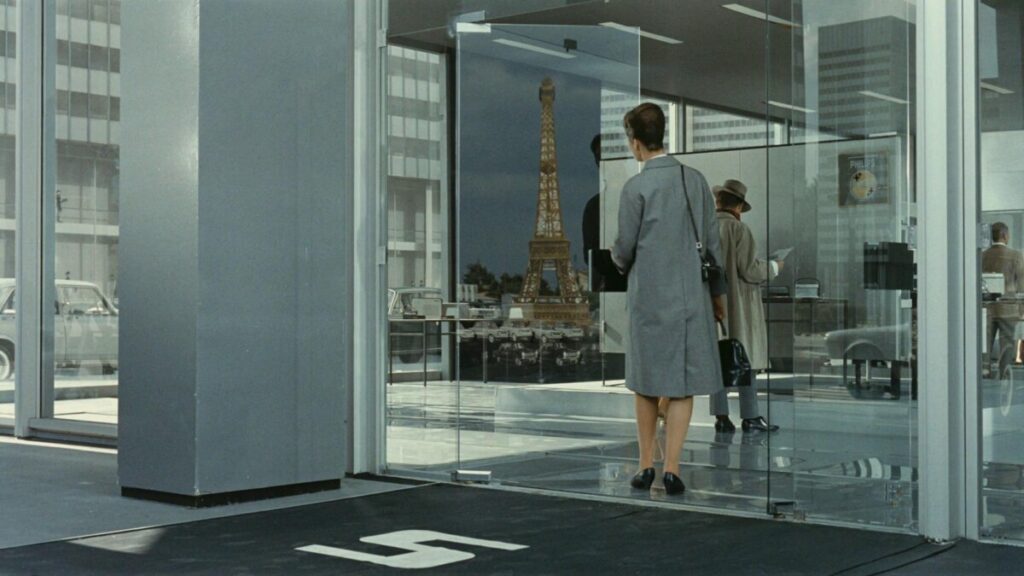
    For a film set in Paris, you’d expect to see the city’s ornate and charming buildings. But in Playtime, those beautiful buildings are overshadowed by drab office buildings, which serve as the setting for the film. There’s even a scene where a character enters an airport, just to see all the classic landmarks on travel posters blocked by office buildings. In both set design and costuming, Tati opts to use muted colors like beige and grey as the main color palette for the film. In fact, most sets are completely bland (in a charming way).

    Character costumes are the same. Hulot, in his grey raincoat, begins to blend in with the sea of ordinary suits and coats. The only way of distinguishing him from the extras in the frame is from the way he moves: The others know their place and move robotically, while Hulot roams and explores the frame, lost. When I watched the movie, I recognized him through the long umbrella he always carried by his side.

    Though Tati doesn’t use any striking and attention-seeking colors, this film is still one of the visually strongest films I’ve seen. Its sets and costumes could also be seen as a critique of urbanization and modernity – a world with too many pointless buildings and gadgets. But in this drab world, there are still signs of life. As Hulot begins to interact with the Parisians and take part in their nightlife and morning routines, the settings he finds himself in become increasingly colorful. It could be as subtle as the pink flowers in a woman’s hair or as eye-catching as a bright red car.

    All in all, both films are absolute gems in showing the power of mise-en-scène. High and Low shows the power of blocking, in both fitting all actors in the frame and also adding narrative significance to their positioning. Playtime employs neutral colors to critique modern styles and also increase our appreciation for color.

    If this blog convinced any of you to watch either of these movies, please let me know in a comment! I’d love to hear what you all think about these movies and the aspects of mise-en-scène they employ.