Author: John Cross

  • The Linguistic Politics of RRR

    We are all very familiar with the intense Hindu nationalist propaganda throughout RRR. There is an immense amount of very in-your-face Indian and Hindu pride, as well as a subversion of Islam, a very prominent religion in India both at the time during which the movie is set and in present times. What I thought was really interesting was how this staunchly anti-colonial film can still involve so much colonial/imperialist sentiment in its production. Professor Zinman mentioned that the film is originally done in Telugu, a prominent southern Indian language, but was dubbed over in Hindi for the Netflix version. The following Al Jazeera article delineates disputes raised by Prime Minister Modi, targeted at officials from the Tamil Nadu state.

    https://www.aljazeera.com/news/2025/4/10/indias-language-war-why-is-hindi-causing-a-north-south-divide

    This article centers the rising issue of Hindi imposition. Hindi is mainly spoken in north India, with other languages like Telugu being spoken in the southern part. The national government has pushed Hindi southwards for so long, incorporating it deeply into school curricula out of displayed intention of linguistically unifying India. Several Telugu, Tamil, Bengali, and Marathi speakers are completely against this, however. This Hindi imposition is less of a force for unification and moreso a vehicle of linguistic conformity and erasure of so many Indian subcultures.

    This nationalistic desire of a fully Hindu, Hindi-speaking country is reflected in RRR. Bheem appears as a soft and fragile Muslim at first, but when he admits his Hinduism he is portrayed as a literal God. RRR bigoted-ly posits that Islam is delicate, but Hinduism is a source of true strength. In this related Hindi imposition, Telugu and other South Indian languages take that subverted role, facing propaganda and legislative action promoting the use of Hindi instead of the language of their own cultures. RRR was such an entertaining movie and I felt so horrible at times for leaning into the propaganda at times, because they show this Hinduism intertwined with Indian identity as such a powerful thing. This becomes a weapon against British colonizers, and I obviously love their opposition to their colonizers, but portraying India as a one dimensional, Hindi-speaking and Hinduism-practicing country is extremely problematic for such a populous diverse community.

  • Leos Carax in the short “my last minute”

    After watching Holy Motors today, I had to see what else the director, Leos Carax, had out there for me to watch. I found that, in addition to notable feature films like Boy Meets Girl and Annette, he’s also known for his shorts. I watched “my last minute,” which is a 1-minute short film commissioned by the Vienna Film Festival.

    CONTENT WARNING FOR GRAPHIC AND SHORT DEPICTION OF SUICIDE AND DRUG ABUSE: I will also be discussing this content in the blog post.

    A defining factor of underground film is the lack of sense or characterized motivation for a character’s actions. In this short, the character depicted lights a cigarette, then immediately goes to his laptop, which is on an open Word document, and types “tonight, I stop smoking.”

    Then, he puts out his cigarette, and quickly opens a drawer at his desk, grabs a gun, and shoots himself in the head. This is also a seemingly uncharacteristic, or at least absurd, action. The scene moves quickly in this small minute, and the character moves without hesitation. What I found most interesting and relevant to Holy Motors is the final thirteen seconds of the short.

    It’s a quick sequence of a toddler, presumably the character when he was much younger. The child has its mouth open, we hear static, the frame zooms in on the child, and then black. This reminded me of Holy Motors a lot because of its quick transition time. In our class feature, it was sometimes hard to tell what was true to Oscar’s life and what was an appointment. With this short, we can see Carax’s tendency for quick, sensational directional choices with the character’s spontaneous actions. Additionally, we see a tendency for playing with graphic quality of his images in both, controlling colors as well as clarity to influence the viewer’s experience.

  • The Genres of Chapter 9

    This week’s reading takes us away from the harder, technical knowledge of the class of editing, cinematography, and mise-en-scene, and towards more big-picture aspects of film: the film genre. This reading covered some history and logistics behind genres, as well as four of the main genres in American film: the Western, Horror, Musical, and Sports. I thought this was an interesting list–I figured rom-coms would be featured, but I figured wrong. This list was still very interesting to read, and covered in-depth descriptions of each genre type. Here’s a brief re-telling of the genres:

    The Western movie is a classic, born at the beginning of the 20th century, not so much later than the birth of film itself. I really liked the beginning of this description, the Western film displays the “conflict between civilized order and the lawless frontier.” Whenever I think about a Western, I consider the rebellious aspect of it a lot. Also, the standoffish nature of it all, with duels and the whole “this town ain’t big enough for the two of us” deal.

    Horror movies, as well as the Horror genre, are characterized very distinctly by their subjects, themes, and iconography. Iconography, especially, is prevalent in this genre. The Horror genre immediately elicits images of Jason’s mask from Halloween or the doll from Annabelle. All of these are very iconic examples of iconography.

    As a theatre kid, I’m very familiar with the musical genre–both onstage and onscreen. There are two types of musical films: the “backstage musical” and the “straight musical.” The backstage musical contains actors that perform for an audience in their story world, while a straight musical follows a typical narrative, just with singing and dancing throughout as a storytelling mechanism. A good example of a straight musical is Singin’ in the Rain!

    The last genre on the list is the sports movie. I haven’t seen many, but the first that comes to mind is a classic from my childhood, The Sandlot. This genre is characterized by not only sports-playing, but by competitions and tournaments and typically containing the big game at the story’s climax. Additionally, this is where the popular underdog narrative often takes place.

  • Cinematography and Plot Structure in Citizen Kane

    I really get the hype around this movie! Citizen Kane seems to have it all, with a lot of elements that I wouldn’t imagine were typical for other films at the time. This movie is an extremely successful experiment of plot, editing, and cinematography, and features a talented cast of emerging actors–which is such a successful debut to have.

    One of the first technical elements I noticed about Citizen Kane was the transitions. Welles keeps transitions constant between shots–there is a tendency to maintain similar silhouettes of subjects within shots between the transition as one dissolves into the next. He also sometimes takes a more dynamic approach, like when it cuts to a kid holding a newspaper that covers the frame, then properly entering the scene as he puts it down. Either way, every transition was clean and calculated, and made this film a much more enjoyable watch. The music, as well, was very enhancing. In many cases, dramatic and comedic, it was sort of cartoon-ish and had the interesting effect of detracting from the seriousness of a more dramatic plot point, but still maintaining the tone. This cartoon-ish tendency certainly enhanced the comedic points as well, to give into the more borderline slapstick moments. Lastly, in regards to cinematography, I noticed that the camera frame is frequently moving. Whether it’s a zoom (which is very frequent in this film relative to others) or a mobile frame, the cinematography became much more dynamic through this active handling of the camera.

    As for plot structure, the time of the movie seemed very confusing–in a very engaging way. The plot is somewhat structured by each interview with a different person speculating who/what Rosebud is. In many cases, these responses in the interviews only confuse the search for Rosebud. I found this to be reflected in the plot, since there were many points that seemed to divert from this main objective, particularly the opera arc, among others. In doing this, the film throws a lot at you, in a sort of watered-down, super early-on postmodernist way. I thought it was really cool how they played around with so many aspects of this movie, which made it all the more entertaining to watch!

  • The Role of Hansel and Gretel in The Zone of Focus

    Watching The Zone of Interest for this week, I was so drawn to the scenes of a girl under an x-ray, night vision filter placing apples and pears into the ground. These clips were so separate from the typical cinematography of the rest of the film. Jonathan Glazer maintains his pattern of long takes, but the difference in color is more than notable. What I also noticed in one of these sequences is that the audio is a continuation of Rudolf reading the story, Hansel and Gretel, to his children before bed. Then I was like–Woah. Is Hansel and Gretel Nazi propaganda? Here’s a link to the fairytale again for those who need a refresher. I had to look into this, because I had never heard about it being used in this way. There is no journalism focused on the use of Hansel and Gretel in the movie past a couple of Reddit posts, so here come some articles that touch on its usage:

    Embedded above is an article from Film Quarterly. It mentions that, “When crosscut with Höss reading Hansel and Gretel to his children, the scenes of resistance take on an ethereal, fairy-tale-like quality that seems at odds with the film’s overriding resistance to sentimentality” (Amy Herzog, Film Quarterly). I thought this was an interesting thought, and likely mirrors Glazer’s direct intention of including the fairytale. The act of resistance being leaving a trail of apples as a parallel to the trail of bread crumbs in Hansel and Gretel is such an interesting choice. In Nazi propaganda, Hansel and Gretel were made to represent two blond German children, and the witch a Jewish person who is ultimately burned alive in the oven she tries to cook the children in. By including this trail of apples, Glazer mocks that propaganda and creates an entirely different, benevolent narrative.

    Here’s an article from Vanity Fair. In this interview, Glazer reveals that the girl with the apples was a real person, whom he met when she was 90 years old! Although the film does not explicitly disclose what is based on a true story and what isn’t, there are many characters that are based on real people, including this hidden hero.

  • Chapter 5: Cinematography and its applications

    Chapter 5 provided us with a lot of information, as well as a lot of new vocabulary to help us look at film in a new way. My main takeaways fall under the categories Tonality, Perspective, and Framing.

    Under tonality, there are a whole bunch of concepts and practices regarding lighting and coloration, but I must closely held onto Contrast and Exposure.

    I know this example doesn’t come from a film, but I have known it for a while to be the epitome of contrast in an image. Back in high school theatre, we learned about good poster design and often referenced the poster for Broadway’s Wicked, primarily for the substantial contrast shown. It showcases two characters: Galinda (or Glinda), whose all-white design only touches Elphaba’s black costume. This white-on-black contrast makes the image so much more engaging.

    Here’s an example from Who’s Afraid of Virginia Woolf, which showcases rather low exposure. This comes near the end of the film, when the mood, given the previous chaotic events, is much darker than at the beginning.

    Continuing on this image example, the perspective shown appears to utilize a middle-focal-length lens. This avoids distortion at either end of the frame, while short-focal-length and long-focal-length lenses tend to distort the ends and obstruct binocular cues respectively. This image also showcases a certain depth of field. We see inside the house just fine, but, past the pole on the outside, the trees and background are blurred–outside of the given depth of field.

    I found framing to be the most interesting section of the reading. It deals a lot with how shots are taken through angle, level, height, and distance, among other elements.

    In Rabbits, by David Lynch, the framing often stays the same as its long, establishing shot, with slight reframing as characters move to the edges of the set. There are some exceptions to this, as seen in the below image:

    Being able to see the full set becomes unsettling after a while, as the viewer never knows what could pop out of any corner at any moment, but shots like these are even more off-putting. The height of the camera tends to be high like a security camera, but then we’re suddenly eye-level with creatures we’ve already labeled as volatile/potentially dangerous. Additionally, the duration of shots is extremely long, which draws out the creepy mood even more. Framing can truly fully frame the viewer’s experience as they peer into the world of the film.

  • It’s the little things that count with Wes Anderson

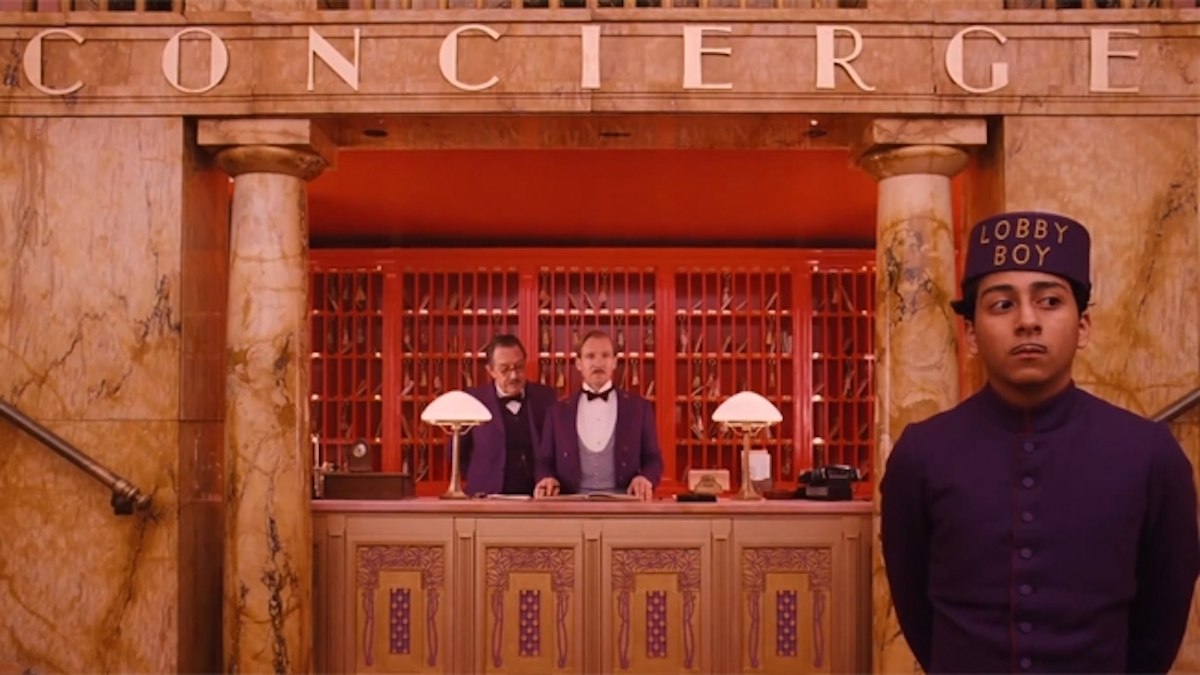
    The Grand Budapest Hotel is an incredible example of what we read about mise-en-scène. The shapes and actions performed by the actors and set pieces contribute significantly to the film’s themes of culture, violence, and absurdism. I noticed great contrasts between costume and setting that made the experience of watching The Grand Budapest Hotel that much more engaging. The designers, in tandem with Wes Anderson’s directorial vision, created an incredible, avant-garde world that draws audiences in more and more with each frame.

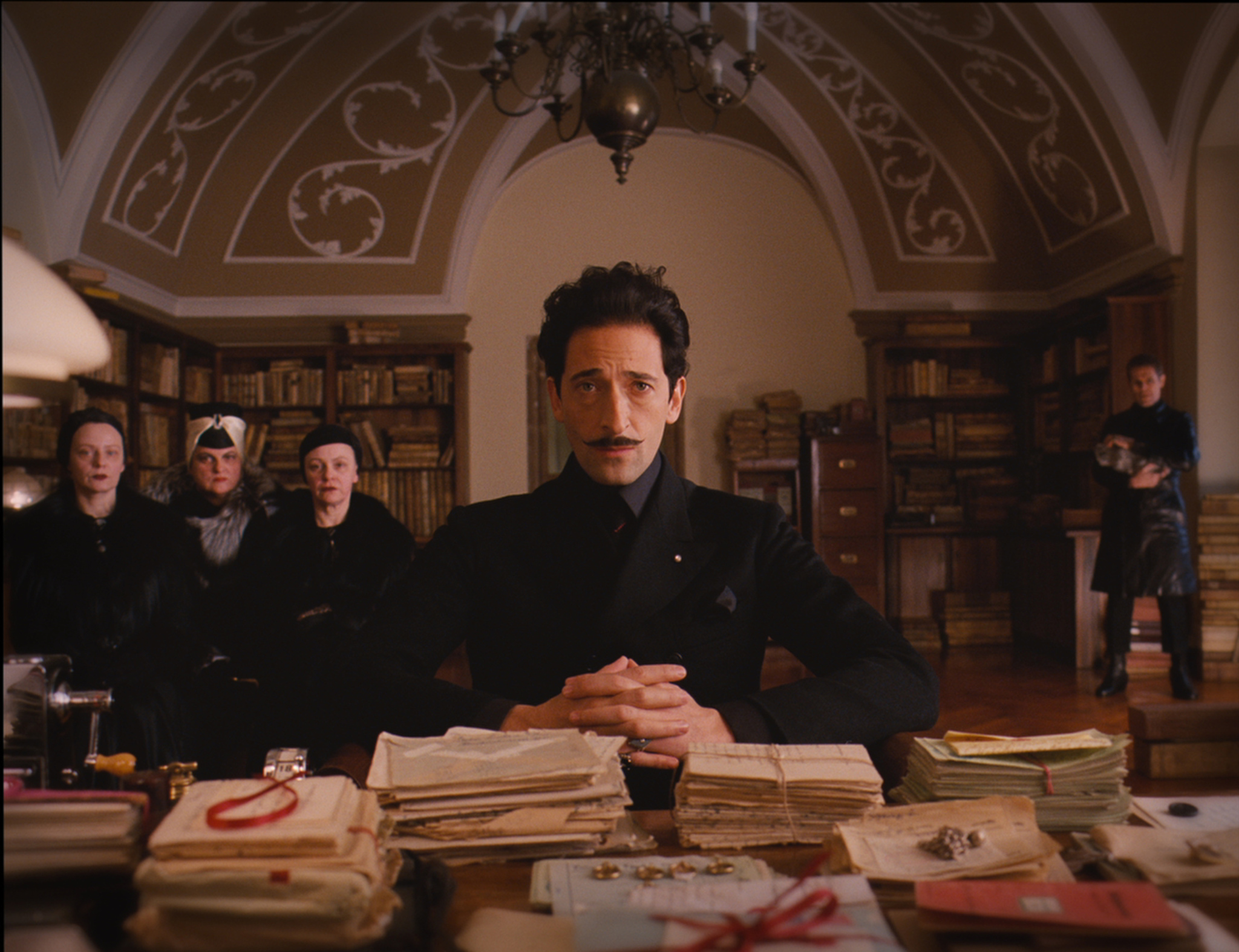
    Watching this movie, I, much like every other viewer, was immediately drawn to the color schemes present in each shot. The titular Grand Budapest Hotel is filled with oranges of different shades, interspersed by hotel staff and Monsieur Gustave’s consistently purple clothing. The narrator outside of M. Gustave’s story wears a pale pink suit, himself. All of this shows vibrancy–and perhaps happiness or lightheartedness. As we progress through the film, we are introduced to a much more contrastive and brooding color palette. With the introduction of Dmitri in his home, the viewer is inundated with brown, black, and dark red, all of which denoting danger. Dmitri himself wears black, blending in with his surroundings while Gustave and Zero stick out wherever they go. The world of the film dips further into an ever-increasing fascist government as we see the beginning of the Lutz Blitz. By this point, the film is in black and white. It is reminiscent of the story of The Giver, both in the novel and the film adaptation. Both of these works depict the loss of ROY G. BIV colors as a loss of freedom, joy and individuality, being replaced by grayscale hues as conformity and evil dominate the world.

    I also noted the minuteness of action on-screen. I remember the particular act of creating the escape tunnel through the prison’s floor being so small by volume: none of the escapees wanted to be heard. Additionally, when Zero and M. Gustave reach Checkpoint 19 and they are met by a giant wall. Outside of the frame, we hear a guard whistling to them. The camera pans to his relatively microscopic body as he motions them through the once non-visible door.

    In directing this film, Anderson paid great attention to detail–particularly the tiny ones. It is through this work that films like The Grand Budapest Hotel captivate audiences. In watching this, the viewer, too, pays attention to even the smallest details.