Author: Mary Puryear

  • Holy Motors: Merely Players?

    “All the world’s a stage,/ And all the men and women merely players;/ They have their exits and their entrances;/ And one man in his time plays many parts” (Shakespeare, As You Like It).

    I think the world is a stage in Holy Motors. The limo is like backstage, with the Hollywood vanity mirror, costumes, and makeup. We even hear Oscar practicing a line that he later says in the hilarious death scene with “Léa” (Élise). Maybe hilarious isn’t the right word, but I enjoyed a hearty snigger at the obvious theatricality and melodrama of the interaction. Once I got into it, I liked this movie a lot. I could start to predict things— of course Oscar was going to get up and go on after being shot multiple times in the torso! After all, he had just come back from being stabbed in the neck. I saw echoes— while the connecting door in the hotel wasn’t technically a hidden door, it had a similar feel. Add a man, in bed, with a dog? It reminded me of the opening sequence. I felt like I was playing a video game where I was finally starting to make sense of the world, the rules, and the themes. For me, watching this film was a weird and wonderful experience. 


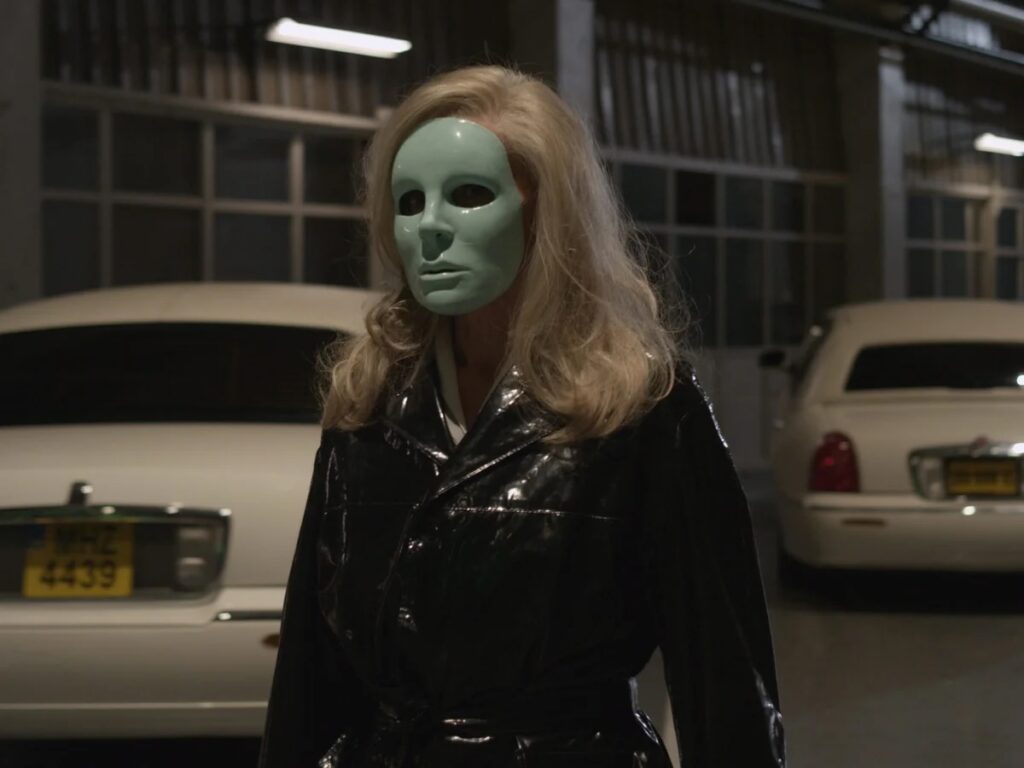
    A scene that stood out to me was when Oscar and the concerned guy from the agency talked in the limo. According to my notes, they discussed how small and imperceptible cameras have become, Oscar’s believability to his watchers, and the idea that beauty is in the eye of the beholder. I started to watch this movie as if every time Oscar stepped out of the limo, out of the liminal, interior space where he could be honest and authentic, he was participating in a piece of performance art— perhaps even acting for a camera we can’t see. We as watchers had a choice to believe or not to believe what we were seeing. And while I think I constructed a somewhat plausible explanation for what was literally happening in the movie— a professional actor going from gig to gig to film short scenes— that was just a way to force the film into a narrative I could wrap my head around. But the “literally,” the what’s-really-happening, my made-up, interpretive narrative isn’t what matters. I think the limo driver putting on a mask before stepping out asks us to recognize that all humans grapple with the actor’s struggle: we all struggle to define ourselves, to disentangle and distinguish ourselves from the many roles we play. 
  • The Female Gaze in Film

    In contemplation of Portrait of a Lady on Fire, I thought a comparison to another recent movie which demonstrates the female gaze could be useful: Greta Gerwig’s Barbie

    If the Male Gaze envisions women as sexualized objects of desire, then the Female Gaze sees women as full, real human beings, as complex individuals. In adopting the Female Gaze, a difficulty that arises is how to navigate nudity, sexuality, and desire on screen. Gerwig’s Barbie sidesteps that issue and decides to emphasize that women (and men) are complete individuals who are not defined by their sexual or romantic relationships. Ken, in an obvious reversal of typical gender structures, tells Barbie, “I just don’t know who I am without you” and “I only exist within the warmth of your gaze.” Ken also cited the way others define him as part of a pair, saying, “it’s ‘Barbie and Ken.’” Barbie challenges that construct, saying, “Maybe it’s Barbie and it’s Ken.”

    The happy ending of the movie isn’t the boy and girl getting together, it’s the boy and the girl learning how to stand on their own and be happy independently. When Ruth took Barbie’s hands to show her what it means to be human, none of the images in the montage depicted relationships between men and women. There were children, there was a women laughing, a woman playfully kissing her friend on a couch, a woman playing in a pool, a woman skydiving, bowling, putting on makeup, and there was even a brief shot of a woman in what appeared to be a wedding dress— but there were no men. The implication seemed clear to me: there is more to life for a woman than heterosexual romantic love. The way Barbie talked about becoming a human rather than a doll also sounded a lot like breaking free from the limitations of the male gaze. She said she wanted to make meaning rather than being the thing that’s made. “I want to do the imagining. I don’t want to be the idea,” she continued. With all this in mind, I think Gerwig’s movie is a powerful denunciation of the male gaze.

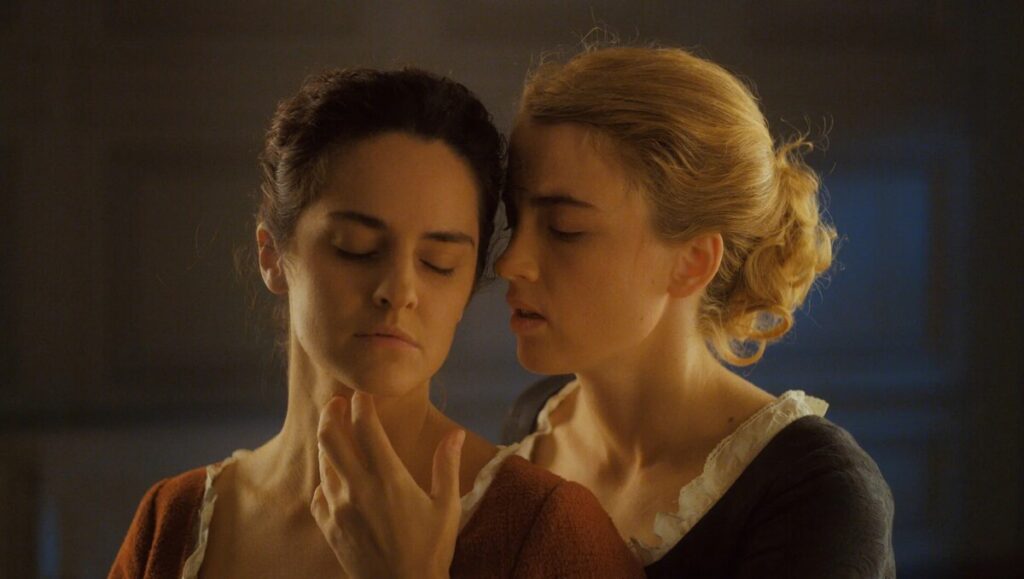
    I found the lack of nudity or sex scenes in Barbie refreshing, given film’s long tradition of stripping and sexualizing women under the male gaze. But Portrait of a Lady on Fire shows that that a film can maintain a feminist point of view and a female gaze while incorporating sexuality and nudity. The scene where Marianne sat naked in front of the fire initially worried me. It seemed unnecessary to have her be fully nude, and I wondered what the purpose was. She just sat by the fire, warming up, smoking a pipe— apparently at ease and comfortable in her own skin. I’m still not entirely clear on the point of this scene, but I suppose I appreciated that it showed her body outside of a sexual context. Putting this confusing take aside, I thought the way the relationship between Marianne and Héloïse was captured catered more to women than to men. The film showed their knowledge of each other and their emotional intimacy, and the more sexual scenes were slow, sensuous, reciprocal, and tender. The movie allowed both women to embody desire without degrading their agency. Actually, their sexual relationship seemed to be a powerful expression of their agency, as they seized upon a brief window of freedom and acted upon their own desires.

    In Barbie, the focus was independent identity and agency, and sexual desire wasn’t really dealt with. In Portrait of a Woman on Fire, a sapphic relationship allowed women to act upon their sexual desires in a way that enhanced their agency. After watching Portrait of a Lady on Fire, I wondered if there was a movie with both the female gaze and heterosexual desire as beautiful and feminist as Portrait of a Lady on Fire. No one movie title immediately sprung to mind. Is it even possible to fully realize the female gaze with a male-female relationship that may at some level always have inequality baked into it? I found this BBC article, “Top 100 films directed by women: What is the ‘female gaze’?,” and maybe there is such a movie listed therein— it bears further investigation! I hope my classmates might also enjoy pursuing this list! https://www.bbc.com/culture/article/20191127-the-100-films-directed-by-women-what-is-the-female-gaze