While watching stranger things over the break I heard them say that the wiz was a flop. In my childhood it did numbers and I constantly rewatched it on DVD! Diana Ross and Michael Jackson in one movie you would think that it would be a success.
It is said that the expenses of the movie did not out do the ticket sells in the box office. The pacing and the unique style of the movie turned dozens of movie-goers away including the casting of Diana Ross due to her age. Dorthy is famously known to be a young teenaged girl. Which another actress Stephanie Mills had already been playing the role on broadway. She was originally in mind for the role, but was over looked by Diana’s star power and connection to get Michael to join the cast.
I have included a article by Luke macy sharing the critiques made about the movie! It truly is an interesting read of movie critic Robert Ebert having an opposing view to the general public.
Interesting how much the publics view can make or break a movie. Even though it didn’t get as much love in the 80’s, it is now considered a Cult classic and even mentioned in the #1 rated Tv show on Netflix in 2025!
While scrolling through instagram after viewing Wicked: For Good, I stumbled upon a post that struck me. This film definitely reflects our current world whether intentional or not. It is interesting how similar things are.
Did you find any similarities in the movie? Let me know your thoughts!
After reading David Bordwell’s essay “The Art Cinema as a Mode of Film Practice”, I couldn’t help but try to compare what I had watched to every detail he described. Of course, it made me curious to figure out which modern movies pass the “test of art cinema.” I landed on Celine Song’s Past Lives. This movie is the textbook definition of precisely what art cinema is, possessing a definite historical existence, a set of formal conventions, and implicit viewing procedures.
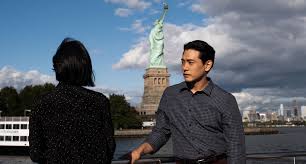
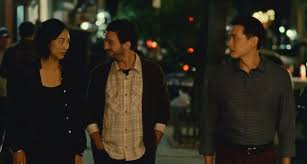
Song does not follow the classical Hollywood cinematic narratives of cause and effect. The narrative is driven by realism and authorial expressivity. We follow the main character, Nora, as she reunites with her childhood friend, Hae Sung. At the start of Past Lives, Song places us in the position of distant observers. Two unseen strangers watch Nora, Hae Sung, and Nora’s husband in a bar, whispering guesses about what their relationship might be: Lovers, friends, a triangle. This moment sets the tone for the entire film: we begin outside, speculating and interpreting, just as those commentators do.
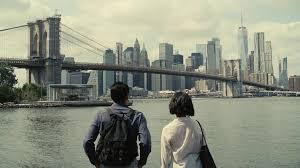
The characters’ goals are emotional rather than external. We see some characters wander out & never reappear, and events that lead to nothing. We are on the outside, watching this story unfold, and a series of flashbacks and flashforwards drives the narrative. Unlike in a classical film, the spatial and temporal elements are constantly manipulated. Like Bordwell describes, the characters often “tell” us what connections mean through autobiographical recollection, as when Nora reflects on her childhood in Korea before emigrating to Canada. We see this in Past lives after the opening scene, where we flashback 28 years to young Nora in Korea with young Hae Sung. We recount her immigration to America, where we meet Hae Sung’s mom. There is a girl on the plane who practices English with young Nora. Then, we flash forward 12 years to an older, yet still young, Nora in New York.
Nora reconnects with Hae Sung through Facebook. We follow their relationship over video calls in different time zones, switching perspectives between Nora and Hae Sung. Yet, as the movie progresses, we question who is telling the story. Song disrupts the fantasy early for the audience of “childhood friends turned lovers”, as Nora gets married to a White American man, and yet, it still feels like she is longing to be with Hae Sung or Hae Sung to be with her.
Past Lives ends where it began, the same street, the same window, but our position has changed. We now see from inside, with a deeper understanding of the characters and their unspoken feelings. The final conversation between Nora and Hae Sung offers the illusion of closure while leaving us suspended in longing. In true art-cinema fashion, Song ends not with resolution but with interpretation. The question is not whether they end up together, but what their connection means to them and to us. In this way, Past Lives fulfills Bordwell’s vision of art cinema: realist, author-driven, and deeply ambiguous.
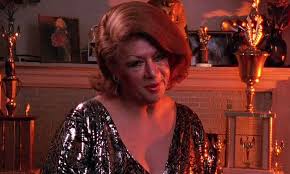
While watching Paris Is Burning, I was fascinated by how the documentary uses its form to make a rhetorical argument about the illusions of “realness.” Through interviews, performances, and their everyday night life, Jennie Livingston doesn’t simply document ballroom culture, but she persuades the viewer to see how identity itself is constructed and performed. The documentary holds power in how it blurs the boundary between reality and illusion, showing that “realness” is both a performance within the ballroom and a mirror of society’s own ideals.
We see in the interviews when explaining realness that is paired with them also embodying it on the runway. Livingston’s use of personal testimonies, like Dorian Corey’s reflections on passing and illusion, becomes a subtle argument: that realness is not deception, but a survival strategy in a world that denies minorities and those of the queer community access to power and success that white cis males receive.
The camera’s observational gaze allows the audience to empathize with the performers rather than judge them. By immersing us in their language, music, rituals, routines, the documentary shows a form of “realness” that is its own kind of truth to the performers. As a way to reclaim agency when reality offers none. Livingston seems to ask us to reconsider what authenticity really means and who gets to define it.
Does Livingston’s portrayal of “realness” empower the ballroom community by revealing their creativity, or does it risk reinforcing the very ideals they’re imitating? What does the film suggest about how we all perform “realness” in our own lives?
How does a movie like Citizen Kane, made in 1941, stay relevant in the present? Option one would be to make a film that engages the audience with cinematography and elliptical editing so smooth you won’t even notice the swift manipulation of time. Orson Welles and cinematographer Gregg Toland’s use of these techniques creates a rich and layered narrative. Or option two, make it good enough for future writers to joke about it.
Take Keanu Reeves, for example. In 2014, he released an April Fool’s joke about reimagining the movie. The new version, titled Citizen Kane 3-D, was directed by and starred Keanu Reeves, and added a martial-arts subplot to the tale of a wealthy media tycoon who dies friendless, haunted by his childhood.
Keanu isn’t the only one good at making playful remarks; in fact, The Simpsons created an entire episode dedicated to the parody and reveals the Simpsons character Mr. Burns’ backstory while doing so. This clever homage and original storytelling intertwining shows how Citizen Kane remains part of our cultural fabric. Unable to link the real episode, I have included a video from NowThisNerd to help foster the story. He also details how the Simpsons start their referencing journey, but he does a good job of making clear comparisons for our purposes.
These playful reinterpretations aren’t just jokes; they’re how classic films stay relevant across generations. They introduce timeless stories to new audiences and keep the conversation going, ensuring that the original works don’t get forgotten.
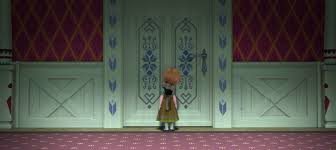
Disney’s Frozen “Do You Want to Build A Snowman?” sequence is a perfect example of a montage that isn’t just shots put together, but a story telling of how these girls grew up. Though this montage is to a song, so there is actually a rhythmic sequence happening, unlike how Eisenstein argued it should be.
We can see that the montage is also dialectical. Anna persistently tries to get Ella to come play, but Elsa can’t due to her uncontrolled powers. Anna feels neglected and left in confusion. Both grow up in isolation but in the same house, and we follow them through their teen years and even the passing of their parents, together but separated by this wall.
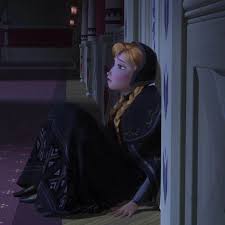
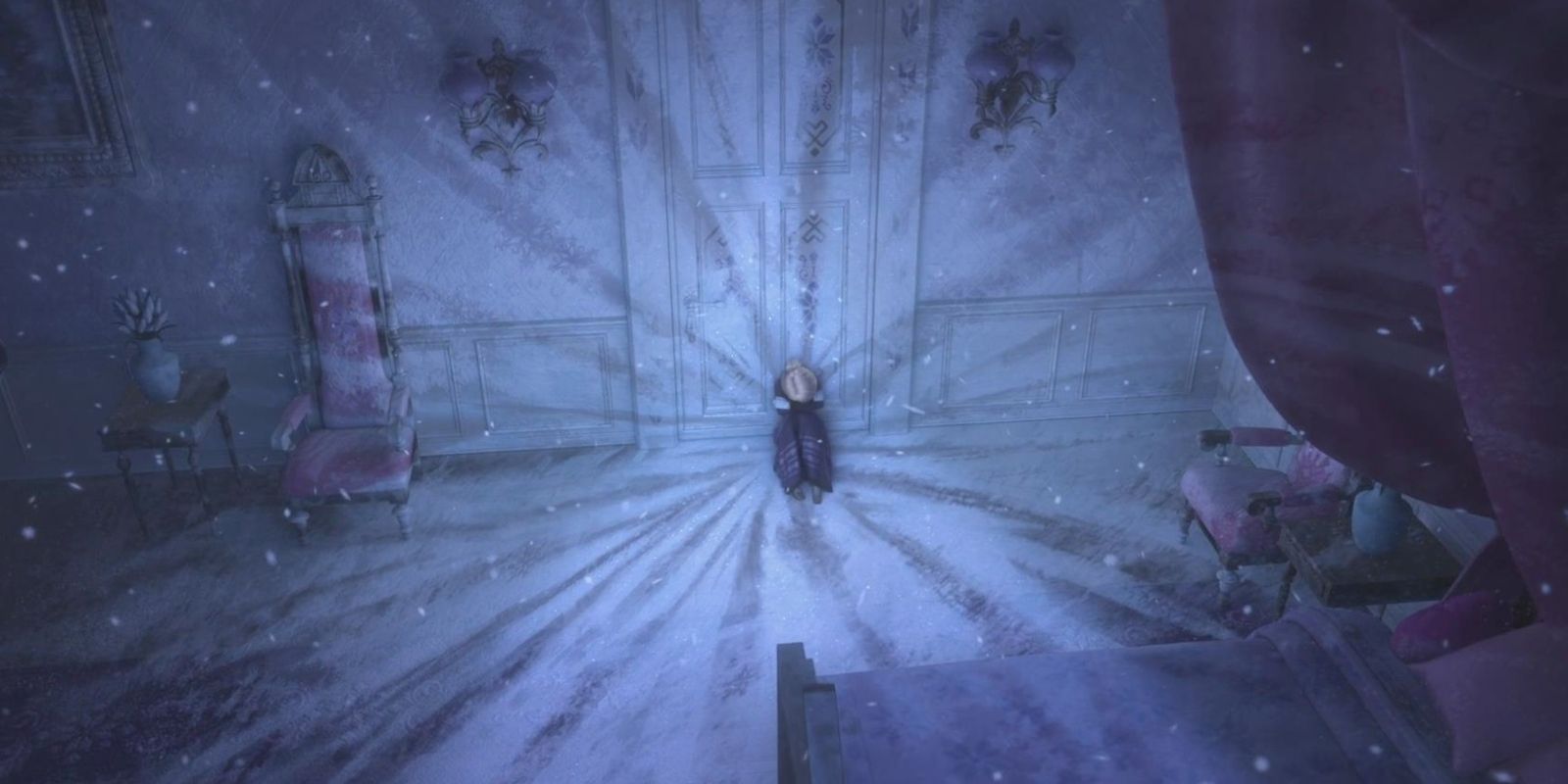
We can see in this wide long shot of Elsa in her room, how she is still unable to control her powers. Everything being cold, iced, and “frozen”, related to the ideal purpose of the movie and how she feels after just losing her parents. She repeats this mantra which Bazin would consider an “Idee fixe”. Her constant obsession with her powers drives the narrative.
All That Heaven Allows tells the forbidden love story of the older woman, Cary, and the younger man, Ron. This story is about an age gap and a social class gap as well. Rumors are spread quickly about their atypical interests in each other.
The director chooses to move us very quickly through this story. Many dissolves, fade-ins, and fade-outs transition us between places and the months. We begin in the fall, and by the end of the movie, they are reunited in the winter. The question I pose is, because of the continuity of months that passed, did the movie rush the film? Though we know months have passed due to the mise-en-scene, they are dressed in warmer clothes, the snow has packed, and she picks out a tree to take home and decorate, even presents are being received as her children return home.
When it comes to their love, did we, as watchers, have enough time to fall in love with them just as fast as they did? Do you think this editing choice was done on purpose? Does it move the story along smoothly enough for us to know it’s been months, but also feel the growth between their relationship and the distance when they reunite?
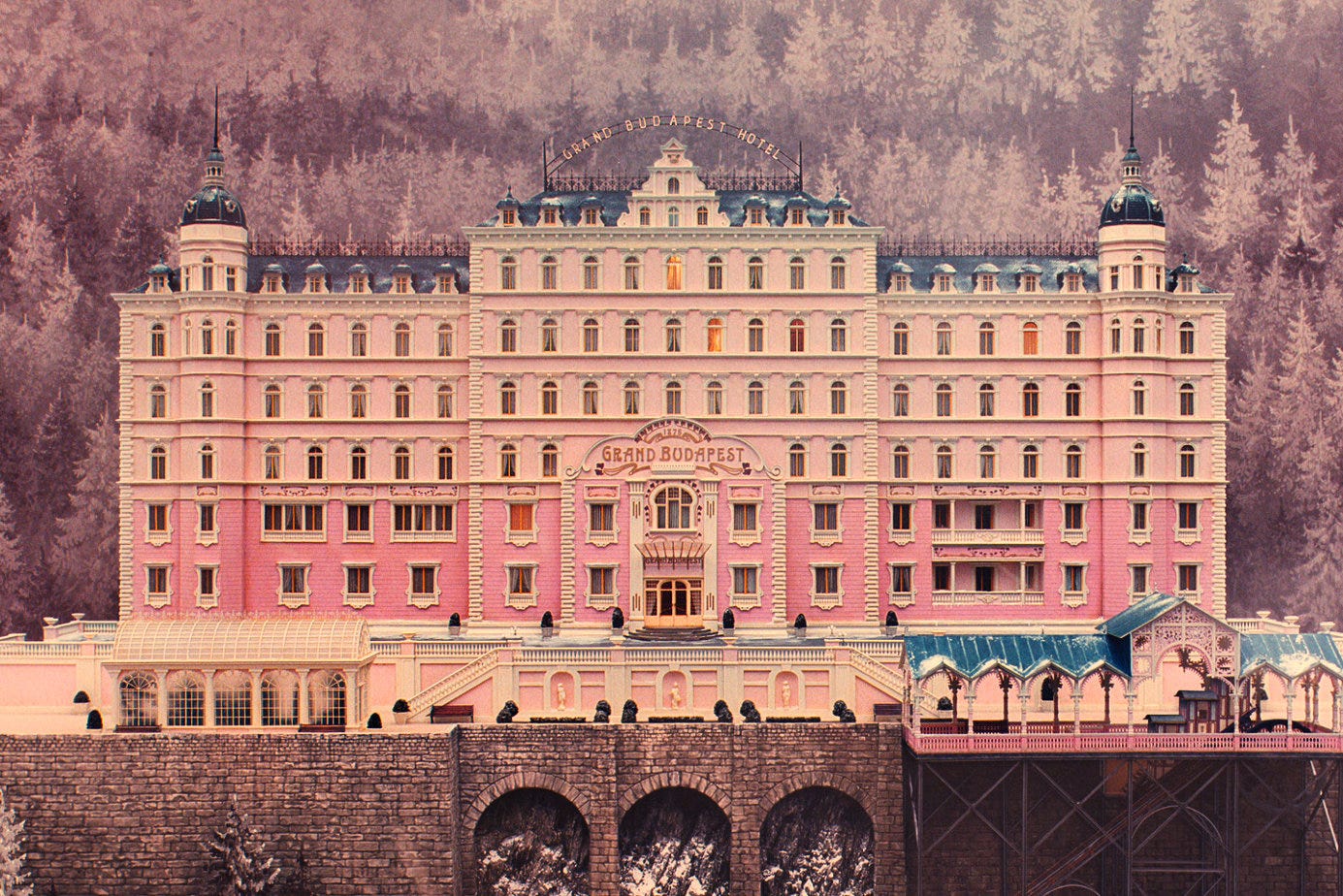
We can all admit that this Wes Anderson’s “The Grand Budapest Hotel” is a visually eye-catching film, almost to the point where you begin to question the intentions of the color scheme compared to the topic of the movie.
This video, made by StudioBinder on YouTube, does a great job of explaining why the movie’s choice of color is so peculiar while considering the circumstances of the movie, or more specifically, the characters’ stories.
Wes uses primary colors, high saturation, and brightness to portray a childlike perspective and maintain the whimsical feeling, though reality reflects the opposite. Specifically, he repeatedly reintroduces the color red into the film to reflect the childhood trauma they still carry into adolescence.
So why does he continue to use this color theory? StudioBinder says that it is an expression of dark humor and a play on the theme’s bipolar tones versus the visuals. I guess you simply cannot believe the emotion to be everything you see. It forces the audience to be engaged in the world and face the dark topics.
When the switch is made in the second train scene, it is apparent that the bipolar color vs. dialogue theory still reigns. Wes’s use of color becomes very telling when the colors become black and white at the time of tragedy. Zero says, “There are still faint glimmers of civilization in this barbaric slaughterhouse that was once known as humanity. He was one of them. What more is there to say?” In my opinion, it shows how quickly reality is turned back on, and hope in humanity was stolen when they killed Mr. Gustave, almost as if the color died with him.
If you are interested, I highly suggest watching and seeing if you also caught on to the same patterns!