Author: Sophia Oshrin

  • RRR: It’s A Lot, But It Works.

    https://www.newyorker.com/culture/the-front-row/the-netflix-hit-rrr-is-a-political-screed-an-action-bonanza-and-an-exhilarating-musical

    As I went in to watch RRR, I was expecting to see a fun action movie, which it was in some parts, but it was also so much more. It felt bigger, louder, and more emotionally direct than most blockbusters I have seen, completely open about its political purpose. The New Yorker review I read points out that “blatant is better than insidious” when it comes to political filmmaking, and I completely agree after watching this. RRR never hides what it is trying to say. It embraces its message of resistance, unity, and national pride with over-the-top energy, and that makes it more honest and interesting compared to other movies that try to slip politics in quietly. The article also explains that RRR “turns history into legend,” which is exactly how it feels. The story is not meant to be accurate, but instead takes the real history of colonial oppression and brings out the emotions behind it so strongly and obviously that the message can’t be ignored. At first I thought the exaggerated fight scenes and the personality-heavy villains were too unrealistic, but after reading the review, I agree with the idea that the exaggeration is the point. It shows the intensity of the struggle artistically rather than telling a more literal version of it.

    What stood out to me most was the way RRR mixes its political intensity with pure, wild entertainment. The feral action sequences, huge dance numbers, and dramatic plot twists keep the movie fun, but they also work to reinforce its message about resistance and perseverance. The review calls the film “giddy, exhilarating hyperbole,” and I think that captures the spirit of it exactly. In the end, RRR works because it refuses to tone anything down. It breaks out of the boxes that other action movies are inclined to stay within. It is emotional, loud, and confidently extravagant. Even though so much of it is unrealistic, the feelings behind it come across as completely genuine. This blend of fantasy and raw emotion is what will ensure that I will never forget the film.

  • Reading the Ending of Do the Right Thing

    The ending of Do the Right Thing feels deliberately unresolved, and I think that uncertainty is the point. Instead of offering a clear moment of reconciliation between Sal and Mookie, Spike Lee frames their final interaction as something uneasy yet realistic considering the violence that had just occurred. They start on opposite sides of the frame, both carrying the weight of the night before, and they only move toward each other when Mookie requests his paycheck. Their proximity at the end feels like it’s out of necessity rather than forgiveness. The blocking further suggests that survival in this neighborhood depends on navigating relationships that are never fully repaired but still necessary, showing how daily life will continue even when trust has been broken. 

    The decision to show the photo of Malcolm X and Martin Luther King Jr. being pinned on the Wall of Fame deepens this tension but does offer a slight sense of resolve in my opinion. Sal’s wall has functioned as a literal barrier between understanding and representation throughout the film and was the actual trigger for the violent and unjust ending. By adding the photo, the pizzeria, despite having been burned down, is finally acknowledging the broader cultural reality that Sal and his family resisted: that different cultures can coexist in the same space, and that tension does not always have to escalate into violence. It becomes a quiet but powerful image that complicates the idea of whose stories get displayed and validated.

    Because of this, I do not read the ending as Spike Lee successfully working the system. It feels more like an honest recognition that harmony is difficult to achieve and takes time, even when people of different races and backgrounds are living and working alongside one another. I’m still left wondering: does the film go against a complete sense of closure because repairing systemic harm is never simple/straightforward, or is it asking us to rethink why we expect reconciliation in the first place?

  • Holy Motors and Un Chien Andalou

    Last year in my high school French class, I watched Un Chien Andalou for the first time. What I remember most is the shocking scene where a razor slices through a woman’s eye. At the time, I saw it mainly as a bizarre product of avant-garde filmmaking. After our class discussion on Monday, however, I decided to rewatch it and look for deeper meaning in the film as a whole. Seeing it again after Holy Motors made me realize that both films use unsettling and absurd imagery not just to shock the audience, but to challenge how we watch and interpret what’s on screen.

    The eye scene in Un Chien Andalou feels like a direct attack on the viewer’s sense of sight. It is disturbing but also symbolic, as if the film is forcing us to open our eyes to new ways of seeing. Holy Motors captures that same kind of shock with its random bursts of violence, like when Oscar kills a man who turns out to be himself. These scenes might feel random and unnecessary, but that is what makes them effective. They remind us that cinema can still surprise us and that meaning does not always have to come from logic.

    Another parallel that stood out to me is the scene in Un Chien Andalou where a woman is hit by a car. The suspense builds as several cars narrowly miss her before one finally makes contact, and even then, the moment feels completely unprovoked. It reminded me of the quick, jarring deaths in Holy Motors that appear suddenly and are never explained. Both scenes deny viewers any sense of closure or reasoning. Instead, they reveal how unpredictable and empty violence can feel when it is removed from a clear narrative or purpose. Rewatching Un Chien Andalou helped me understand Holy Motors in a new way. Both films go against traditional storytelling, but that confusion is what makes them so captivating. They challenge us to keep watching even when we want to look away or are unsure of what we are supposed to feel.

  • Paris Is Burning and the Birth of Drag Race

    Paris Is Burning captures the vibrancy, competition, and chosen families of New York’s ballroom scene. Three decades later, RuPaul’s Drag Race has brought many of those aesthetics and attitudes into the global mainstream. Watching the show today, it’s easy to forget that terms like “shade,” “reading,” and “realness” weren’t born on a soundstage, but rather in Harlem’s ballrooms. 

    Jennie Livingston, the director of Paris Is Burning, reflected on this evolution in an interview with AnOther Magazine, noting that “if you’ve ever heard of “realness,” “reading,” or “throwing shade,” it’s probably because of RuPaul’s Drag Race. But the origin of this terminology far precedes the reality-TV show.” (Livingston, 2020) I picked up a degree of tension within this article, in that although Drag Race celebrates the artistry of drag, it also repackages it for mass consumption, sometimes distancing it from the political urgency of its roots. The ballroom scene was never just about winning but rather about being seen and loved by one’s house, since they oftentimes didn’t recieve much love from their biological families or society in general due to their identities. In contrast, on Drag Race, “family” becomes storyline rather than lifeline. 

    The show’s success has undeniably opened doors for queer performers worldwide, proving that what began in underground NYC clubs could reshape global pop culture. Regardless, RuPaul’s Drag Race should stand as a reminder that the culture it celebrates was built not just on glamor, but also on resilience, creativity, and chosen family. 

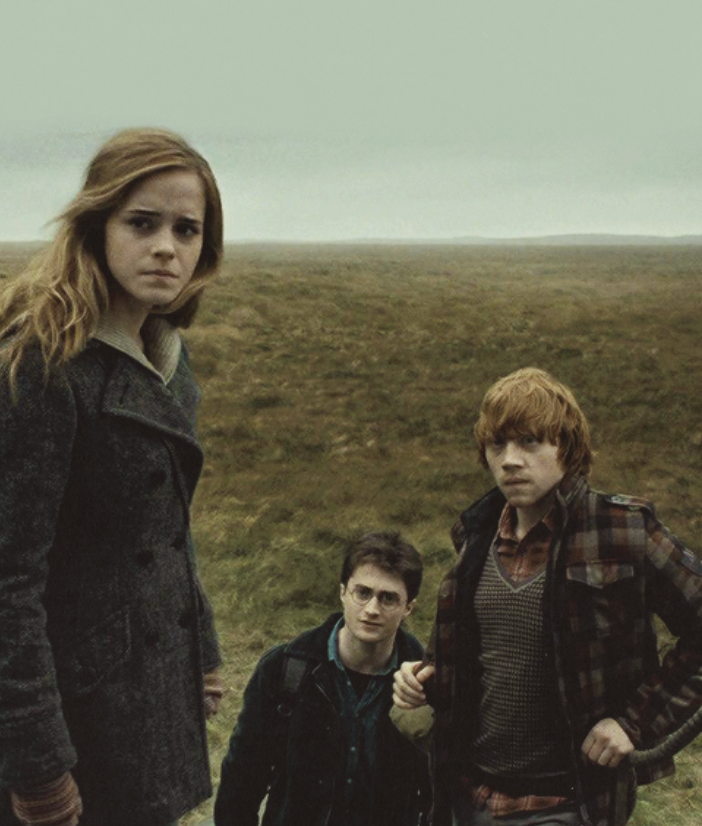
  • Following the Trio: A Narrative of Fear and Uncertainty in Harry Potter and the Deathly Hallows (Part 1)

    While reading about narrative form and the cinema of attractions, I kept thinking about Harry Potter and the Deathly Hallows, Part 1 and how its slower pace and moments of spectacle make us feel the story’s uncertainty in a really visual way. Unlike the earlier Harry Potter movies, The Deathly Hallows, Part 1 slows everything down and narrows the focus. The film uses restricted narration, so we only see and know what Harry, Ron, and Hermione do. Because we’re limited to their perspective, we’re able to strongly connect to their confusion and frustration as they struggle to search for the Horcruxes. The long stretches of silence and constant wandering throughout the film make the narrative itself feel tense, almost as if the characters are stuck in time.

    The film also plays with the element of temporal order which further encourages us to put ourselves in the positions of the main characters. For example, the long and quiet forest sequences make the passage of time feel stretched out, and the use of flashbacks and dream sequences momentarily disrupt the flow of events. When Harry sees flashes of Voldemort’s movements through their mental link, we’re pulled out of the present moment and into his mind, which leaves us disoriented and questioning what’s real or imagined. These choices in narrative form force viewers to question what’s real, what’s memory, and what’s imagination, blurring the line between the past and present. It’s less about building toward a single climax and more about showing how time itself feels distorted when the characters are directionless while searching for Horcruxes the whole movie.

    Even with its slower pace, the film still has moments that support Tom Gunning’s idea of the cinema of attractions, which are scenes meant to astonish the viewer rather than just move the story forward. The Tale of the Three Brothers sequence, which is told through shadow animation, is a perfect example. For a few minutes, the film pauses the main narrative to tell a story within the story that’s visually striking and stylistically different from everything else. Considering that we only realize the tale’s significance later in the film, it feels like this pause invites us to watch for the sake of wonder before its deeper meaning clicks into place.

    Through the mixture of restricted narration, disrupted temporal order, and visually striking flashes, Deathly Hallows, Part 1 is a perfect setup for the battle to follow. The decisions in narrative form regarding time, perspective, and spectacle allow viewers to more deeply empathize with the characters and actually feel what it’s like to live inside a wizarding world that’s falling apart.

  • The Comedy and Critique of Sound in Singin’ in the Rain

    Singin’ in the Rain (1952) is a musical about making a musical, using sound to express the ironic elements of cinema. The biggest joke of the film is that it exposes how deceptive show business really is, using sound itself as the tool of critique. This is clear in the disastrous preview of The Dueling Cavalier, where every element of sound is transformed into a punchline. For example, the dialogue is out of sync, the microphone is awkwardly hidden in Lina’s costume, and even her high-pitched voice makes us question the concept of fidelity: was this sound what we expected? The mismatched timing between sound and image makes the scene feel chaotic, but that chaos is literally the point.

    The audience’s laughter within the film mirrors our own. We are invited to find pleasure in the failure of movie magic, to enjoy the breakdown of the very systems that usually keep us immersed in a fictional world. This self-awareness turns Singin’ in the Rain into both a celebration and a critique of sound’s role in film, showing how cinema can use its own tools to question the illusion it depends on.

    Furthermore, the irony continues in the scene where Kathy secretly provides the singing voice for Lina. The timbre of Kathy’s warm and smooth tone is a stark contrast against Lina’s shrill, artificial one. The scene not only jokes about vocal authenticity and giving artists credit, but it also hints at a deeper truth: what audiences perceive as “real” emotion in many films is often a construction of layered sound, synchronization, and careful editing designed to produce the most pleasing result.

    Singin’ in the Rain turns what was once seen as cinematic progress—the introduction of sound in pictures—into both a source of comedy and a form of commentary. It’s a movie that makes us laugh at the errors of sound while also making us listen more closely to how those sounds shape our experience of film itself. This leaves us with a question: does our idea of an “authentic performance” lie in the voice we hear or in the illusion we believe?

  • Queer Identity and Rock Hudson in the 1950s

    I found an article from Film Comment called “Queer & Now & Then: 1955,” which examines All That Heaven Allows through a queer lens. It connects Rock Hudson’s closeted identity to the film’s themes of secrecy and social judgment, showing how later knowledge about Hudson reshapes the way we watch the movie. I think this perspective is valuable because it reveals how films can carry meanings beyond what their original audiences saw, especially when stars’ private lives come to light. The article is convincing because the movie already emphasizes the tension between private desire and public appearance, so Hudson’s real-life story deepens that theme. I appreciate reading a perspective that blends film history with cultural reinterpretation, making us see the film as more than just an exaggerated melodrama.

    What do you think about Cary and Ron’s struggle against social expectations being read as a metaphor for queer relationships hidden in the 1950s?

    Link: https://www.filmcomment.com/blog/queer-now-then-1955-rock-hudson-douglas-sirk-all-that-heaven-allows/

  • Color, Light, and Narrative in Amélie

    Mise-en-scène, literally “putting into the scene,” drives the narrative of a film. Through the director’s arrangement of lighting, costume, makeup, and staging, filmmakers construct not just an image but a framework of meaning. This arrangement guides the viewer’s interpretations, often hinting at thematic shifts that words alone cannot. Mise-en-scène serves a dual purpose: it makes the film’s world feel real and familiar, while also shaping it into a visual language that expresses more than everyday reality.

    Jean-Pierre Jeunet’s Amélie (2001) exemplifies this idea. The film’s vivid colors, filled with rich reds and greens, make Paris feel less like a real city and more like a reflection of Amélie’s imagination. While many of the Montmartre street scenes are filmed in real locations rather than constructed sets, the color palette is carefully manipulated: saturated reds, greens, and golds heighten the quirkiness and whimsical tone, turning ordinary streets, cafés, and alleyways into an expressive, almost dreamlike environment.

    Even the photo booth, for example, is used as a strategic prop; the discarded photo strips serving as both narrative clues and visual motifs that reinforce secrecy, playfulness, and the possibility of intimacy. 

    Costume and makeup further enhance this visual storytelling. Amélie’s striking black bob, paired with her pale skin and subtle makeup, emphasizes her whimsical nature. The hairstyle draws attention to her expressions, making her reactions central to the narrative and reinforcing her sense of individuality within the stylized Parisian world.

    By placing such an emphasis on visual style, Jeunet stretches the expressive power of cinema, showing that meaning can emerge as much from images as from words or action. Yet this stylization also comes with complications: does the film’s look tell its own story, separate from the plot and dialogue? When a movie is so carefully constructed visually, do we find ourselves paying more attention to the images than to the characters inhabiting them?