Author: Ethan Zuo

  • Schindler’s List

    Schindler’s List is originally one of the three films I decided to do for my shot list and sequence analysis, but at the end I chose All Quiet on the Western Front for its more detailed mise-en-scene and cinematography elements.

    Schindler’s List is one of the few films that make me feel it is less of a movie but rather more like a historical reflection. Steven Spielberg approaches the Holocaust of the Jewish people with a documentary style approach. He grounds the story in the transformation of Oscar Schindler, who is first a opportunist but gradually become a savior to more than one thousand Jewish captives.

    We all know that the Holocaust is terrible, thousands and thousands of Jewish people die every day, but what makes the film astounding is not the scale, but the quiet shift in Schindler’s character as he face the Nazi machines.

    In addition, I think the decision to make the film black and white is not a stylistic choice but rather a moral and humane one. Stylistically, we can say that black and white increase tension, adds on pain, and reflect the brutality, but it is more reflected in how humanity is shown through the movie, so I believe it is more of a humane choice. It takes away the cinematic comfort, and force the viewers to put themselves into a drained up world, where humans are viewed as numbers.

    The minimal use of color, most famously the girl in the red coat, is like a spear that pierce through the monotone color scheme. Emphasizing the existence of humanity in such a dull and draining world.

    Unlike other historical or war film, Spielberg does not exaggerate violence, not framing heroic deaths or sacrifices, but rather he presents it abruptly and casually, as if dehumanization is a daily job for the Nazi officers and soldiers.

    Liam Neeson’s performance as Schindler, is also interesting. He never delivers grand speeches or have heroic moments. Instead, his transformation is conveyed through small moments, like hesitations and silent realizations. This step by step change his mindset and build up to the emotional climax. Where Schindler realize that he is not saving more lives, it feels overwhelmed, the weight of goodness lands on his shoulders and will feel devastated in the face of a genocide.

    In relation to RRR that we saw this week, I see a similar starting but different ending. Both film demonstrate the vulnerableness of individuals against high power, in RRR the British and in Schindler’s List the Nazi Power. The Indian people suffer from power imbalance and the Jewish people suffer from genocide. But the ending is Ram and Bhemm saving the world in RRR but Schindler’s list making a much more reflective, thoughtful ending of real history.

    What this film ultimately suggests is the fragility of humanity under an evil world. The film ends with real survivors placing stones on Schindler’s grave, a reminder that the story is still being told and passed down, carried by the ones survived.

  • Avatar, RRR’s cousin that echos revolution and resistance

    After watching RRR, I wanted to find something similar to watch during the pre-final week, and I ended up finding Avatar 1, which is similar to the RRR’s theme of revolution and resistance, but in someways different.

    So it is set in 2154 on the moon Pandora, Avatar follows Jake Sully, a former Marine soldier set by the corporation (RDA) to help secure a rare mineral called unbotaium. Jake used a artifically designed Avatar body, infiltrates the Navi tribe, but eventually fall in love with Neytiri and the culture, and he had choose between the human corporation he serve or the world he loved. A very typical mode of the good beats the bad, but its political story behind is much more considerable.

    (Like most Sci-Fi, high-tech enemy stuff always get beated)

    THe director Cameron has admitted that the film is openly about imperialism, where technologically superior humans are tyring to uproot a native population for their precious resources and not care at all about the survival of the tribe. This echoed the European colonialism in the Americas and all the other empires. The RDA’s machines and ships are of the same role as the British cannons and rifles in RRR, a symbol of a system that only see the land, the people, the environment as accessible resources able to be turned into profit.

    Stylistically, Avatar and RRR shared the use of large amounts of props. RRR has tigers, motorcycles, dance battles, guns, and large fights. Avatar has neon forests, floating mountains, air and ground combat, and all those high-tech machines and magical creatures. Both film use spectacle as it is realistic, and the CGI technology only make the battles look cooler. The final battle, where Pandora’s wildlife joins Navi against the human army, mirror the RRR’s final battle of Ram and Bheem (fire and water) against the British army. They both represent nature and people rising together against the empire and power.

    Thematically, these two movies also rhyme. In RRR, Ram and Bheem are basically superman, the two basically killed a battalion of English soldiers with only arrows and spear. In Avatar, Jake’s body is also some kind of superman figure, where it allows him to connect with a new world that his human body cannot survive. Both film use physically strong heros as fantasy answers to a real historical question: what if the people are strong enough to fight back?

    RRR is rooted on the Indian rebellion against the British in history, while Avatar abstractly framed the same event into a sci-fi story. The actual history and name are gone, but the main idea still exists, and the power difference still remains. This makes Avatar, the blue skinned epic story that turns anti imperial anger and grief into one gigantic battle, less specific but more universally applicable.

  • RRR: Writing History through water and fire

    I really don’t know whether to classify it as a comedy or a serious movie discussing about independence. There are so many hilarious moments that just seemed so unrealistic but works fine in such a film.

    (ok this two dude just jump off a 5 level tall building like a horse)

    Although RRR is much like a mythic and exaggerated fantasy film, it is based on a very real and brutal British colonial rule in India during the early 20th century. The British ruled on a heavy racial hierarchy, exploitation, land seizure, and violent suppression to maintain control over the millions of people, like the Gond people that Bheem belonged to are often driven out of the forest. However, rebellion also exists. Activists such as Alluri Sitarama Raju resisted through guerrilla movements like the Rampa Rebellion of 1922–24 (ended when Raju was captured and killed). RRR simplifies this era into a clear good versus evil narrative, but it channels the anger and resistance that shaped the fight for independence..

    The coolest visual idea that I see in this film is the fire versus water motif. Ram is assigned with fire, and also framed in warm colors. Bheem is assigned with water, and is framed by cold colors. We often see Ram using fire and he literally blows everything up in the end of the film. And the intro sequence of Bheem is literally him unleasing animals out of a water tank. And we can follow the theme of how these two elements learn not to cancel each other out but combine into something stronger. Ram sacrifices himself to achieve the greater goal while Bheem focus more on achievable things such as rescuing his sister for the tribe.

    Another interesting part of this film is its music and dance. There is the “Naatu Naatu” dance. On the surface, it’s just a ridiculous, exhausting dance battle at a British garden party. But it became the first song from an Asian film to win the Oscar for Best Original Song, and the first Indian song to win both the Golden Globe and the Critics’ Choice awards. We see a lot of violence and gun and fights and killing throughout the movie, but here we see rhythm and music replace guns and bullets.

    What makes the scene compelling is the dance’s design: fast footwork derived from traditional Indian folk dance styles, matched with a competitive, almost combative structure. More deeply, it is not just a dance, but rather a form of fightback of colonial hierarchy. Every kick, jump, and step is a refusal to be humiliated by the British. Marking the moment of India’s cultural identity triumph at that moment right at the backyard of the British colonizers.


  • The “Heat” that never cools

    Racial discrimination in the United States didn’t end with the civil rights movement. By the 1980s, black communities in New York were still confronting systems shaped by earlier eras of racial segregation. Just as significant was the relationship with the police, unequal treatment happen everyday. Life carried a sense of vulnerability, where dignity and safety were never guaranteed.

    Spike Lee’s Do the Right Thing isn’t just a film, but rather it is a whole environment that you step into, the African American neighborhood. Also, it is a movie based on real violence. In 1986, Howard Beach, Queens, NYC, a group of white man chased three Black man onto a highway, and one of the Black men, Michael Griffith, was hit by a car and killed. This incident, plus the many many police violence happening in New York, pushed Spike Lee to create this film about what happens when racism, heat, and everyday disrespect happens to people just living across the street.

    Me knowing the social context afterwards does not change how this film give me feelings. It is not an abstract racial tension being filmed in the studio, but rather a compression of the actual thing happening everyday in Brooklyn. The heat is the pressure that made everything cook up and explode in the community. A small argument about the wall of fame arises into a violence fight and people dying in the conflict. None of the things actually seem matters, but Lee shows how they absolutely do when the happen on top of years of ignorance and violence.

    Lee doesn’t let anyone off the hook, including the audience. So this is why Lee put the two quotes at the end, one of MLK Jr. and the other one of Malcolm X.

    “Violence ends by destroying itself. “Violence as a way of achieving racial justice is both impractical and immoral. It is impractical because it is a descending spiral ending in destruction for all. The old law of an eye for an eye leaves everybody blind. It is immoral because it seeks to humiliate the opponent rather than win his understanding; it seeks to annihilate rather than to convert. Violence is immoral because it thrives on hatred rather than love. It destroys community and makes brotherhood impossible. It leaves society in monologue rather than dialogue. Violence ends by destroying itself. It creates bitterness in the survivors and brutality in the destroyers.”

    AND

    “I think there are plenty of good people in America, but there are also plenty of bad people in America and the bad ones are the ones who seem to have all the power and be in these positions to block things that you and I need. Because this is the situation, you and I have to preserve the right to do what is necessary to bring an end to that situation, and it doesn’t mean that I advocate violence, but at the same time I am not against using violence in self-defense. I don’t even call it violence when it’s self-defense, I call it intelligence.”

    That’s why those two quotes appear at the end—Martin Luther King Jr. arguing for nonviolence, Malcolm X defending self-defense. They’re not an answer, but rather they’re a contradiction the film refuses to resolve for you.

  • Night Moves

    Watching Night Moves for the first time, especially as my first crime movie, is feel eye-opening.

    The film’s slow tension and moral ambiguity show how crime stories aren’t always about action—they’re often about human conflict and hidden motives. The story follows private detective Harry Moseby as he investigates the disappearance of a teenage girl, but what starts as a simple missing case turns into a web of lies and betrayal. As the plot unfolds, the mystery becomes less about solving a crime and more about understanding people’s hidden motives.

    It might make you realize how complex people’s decisions can be when faced with guilt and fear, leaving you thinking about what justice and truth really mean.


    This cat is cute by the way.

  • Suzume: Doors and Disasters

    Makoto Shinkai’s Suzume is a road movie (?) with a heavy ritual influence. The teenager, Suzume, crosses Japan shutting supernatural “doors” that leak catastrophe into the present time. Each site she went to is a ruin, either school, bathroom, or amusement park. Those are places that everyday life was interrupted. By making Suzume kneel, touch the ground, and speak different names, the film literalize the act of remembrance as a public act rather than a private feeling. It makes Suzume a symbol of memory.

    Visually, Shinkai used this through recurring motifs: doors framed against the sky, also with short passages like operate like associational form inside a classical narrative.

    The character arc threads cleanly through the travel experience of Suzume. She begins her story as someone running: running late to school, and running late to process a childhood loss. Each stop she made pairs with a temporary caretaker and a “door” that must be closed. This story formation makes the help and repair intertwined. Sota’s transformation into a three-legged chair looks like a joke, but it is a symbol that shifts the theme from romantic into burden and compassion. Suzume must carry responsibility rather than be carried by an adult character. Daijin, the cat-like god, complicates things further: it wants love and attention, but also demands duty. That tension—affection versus obligation—maps onto Suzume’s choice to grow up.

    Technically, Suzume is a hybrid of hand-drawn and computer digital compositing. We can see its hand-drawn characters, but as well as the sky, water, fog, and all the background effect being computer generated. Shinkai also uses pockets of limited animation: held poses and micro-movements to stage stillness against richly rendered environments. Those holds let music and ambient sound carry emotion while the image rests, so when motion returns to the main component of the shot, it hits with force.

    Sound is also important in Suzume. Big moments often land on a sudden hush—right before a key turns or a “door” seals. That drop creates negative space so the next sound (a thud, a breath) carries emotional weight. Large amounts of diegetic sound is also used. Wind across grass, distant trains, , urban city and in each region Suzume visits. They’re mixed forward in quiet scenes so place feels alive even when the frame is still.

    Lastly, thematically, the film refuses to “erase” and part of the story. Closing the door doesn’t reset the ruin, but rather it honors it. The final scene returns Suzume to the origin of her loss and suffer, where she meets her younger self and offers the assurance she once needed. This loop Suzume underwent is the movie’s ethical thesis, that remembrance is the maintenance of memory, and the future is the willingness to keep moving forward nonstop.

  • Forms That Teach Us How to Watch

    In this week’s reading of chapter 10. It gives us clear forms to think with while watching a particular movie. On the documentary side, rhetorical forms are filmmaking that aims to persuade the audience. This form addresses to us directly the problem and presents arguable claims. It leans on appeals to feeling, and ultimately asks us to take a side of the problem.

    Placing Jennie Livingston’s Paris Is Burning (1990) against this framework clarifies how rhetorical form can work without a narrator. The film’s interviews, ballroom sequences, and everyday scenes openly address us through testimony of the characters speak directly about safety, recognition, realness, class, and race.

    In contrast of the documentary, experimental work often turns into associational form. The shots and sounds are linked by analogy, contrast, and motif. Through this process we build meaning across juxtaposition of these elements rather than plot points or a thesis statement. For example, the book offered the film Koyaanisqatsi. It shows that ideas about technology and modern life without narration or a very clear line of argument. It structured our experience through segments and images of Philip Glass’s work.

    Finally it is the animation section. In cel animation, studios divide labor across drawing, coloring, and photography. It uses fine detail and capture movements, while limited animation only moves parts of the image. There is also computer animation that reshape the traditional animation film world. Film such as Toy Story establish a convention in the field of fully 3D cartoon world and improving way of making film. The book still stress that human work is necessary, such as modeling, keyframing, and lighting.

    During free time I watched Suzume by Makoto Shinkai. His film feel like chapter’s hybrid model in practice: hand-drawn character aesthetics integrated with digital composition for skies, water, light, and particulate depth, very much in the Mononoke vein the book describes.

    I also spot the strategic use of limited animation for emphasis. The hold and micro motion of the character agaginst the detailed environment aligns with the chapter’s point of limited versus full. It is not just budget constrain but rather a stylistic choice of Shinkai. I will also write a viewer post later this week to discuss about Suzume later this week.

    One question I would like to bring up is:

    Do hybrid animation change how we read movement as expressive. In other words, when do we attribute meaning to limited motion as style versus as a budget constrain?

  • Saying “NOPE” to terror

    Jordan Peele’s NOPE (2022) is a film that has a very simple categorization, but it thrives because of its genre complexity.

    To be honest, I am scared. At the first glance, NOPE seems like a straightforward science-fiction horror film about this unknown UFO from the other world terrorizing a California horse ranch and the people that connects with it. Peele blends in the elements from Western, horror and science fiction genres to question not just our fear, but the way we perceive horror and spectacle.

    The Western genre influence is the most visible. We see that the setting is located at a desert valley, which is similar to the most classical cowboy movies that happen in a small town in the middle of the desert. Here, the setting and the background knowledge of we knowing the main character’s family all tame horses adds on to the Western genre influence.

    At the same time, horror is also deeply rooted in NOPE. Peele used fear through sound and silence. This echos the horror through sensory orientation to the audience. The UFO is both a top predator and a symbol of unknown and violence. Like the best horror films, NOPE exposes our psychological vulnerability — in this case, our obsession with witnessing spectacle even at our own danger. In addition to the UFO as horror, the flashback of the Chimp killing three people, and OJ’s father killed by plane crash remnants is also killing me and really scared the guts out of me.

    I REALLY DON’T WANT PICTURES HERE IT SCARES ME SO MUCH


    Nope also employs a lot of science fiction conventions to explore the curiosity of human and the approach of the unknown. The idea of meeting an alien culture becomes a indication of these people trying to catch the impossible. Just like most sci-fi films, there is a desperate attempt to take control, which may suggest how technology shape our relationship with the reality (as suggested by the lights out and all technology stuff)

    The fusion of these three genres redefine its boundaries. NOPE is a perfect example of genre hybrid. We can see the familiarness of other films we watch before of the same genre, but we can also see the influence of the three on each other. It is not just about the giant terror alien flying in the sky, but it is about the cost of observation, and the price of the spectacle.

    One thing I noticed while watching, is that why these people, though fear of the UFO, still wants to approach and get a shot of it, even knowing its destructiveness? Peele turns that fascination back on us, making viewers question their own role as spectators.

  • Silence and Survival: The Pianist

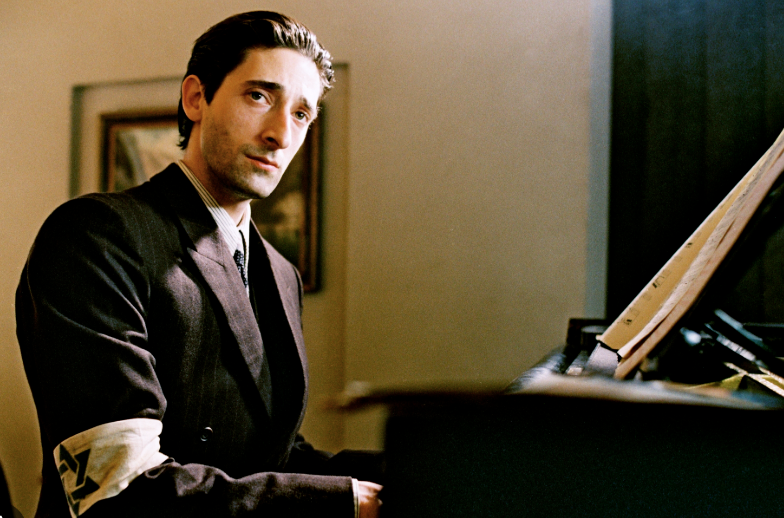
    I watched The Pianist last weekend. What makes it different from other war movies isn’t just its subject — it’s how Roman Polanski uses stillness, sound, and point of view to make you feel trapped inside the experience instead of just watching it. This isn’t a movie about fighting or victory. It’s about surviving when there’s nothing left to fight with. And don’t forget, it is a 2002 film.

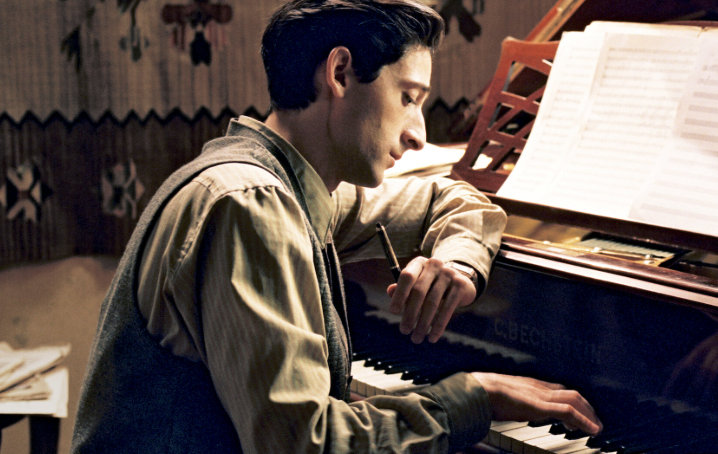
    One of the techniques we talked about in class — the use of sound, or sometimes the lack of it — is what gives this film its emotional weight. For long stretches, there’s no music at all, which feels ironic for a movie about a pianist. The silence becomes unbearable, like it’s pressing down on you. You hear every footstep, every creak in the floorboards, every breath he takes when he’s hiding. When the piano finally does return, it doesn’t sound like a triumphant comeback. It sounds like a whisper of the person he used to be. Polanski manipulates diegetic and non-diegetic sound to show how music transforms from a source of joy to one of survival.

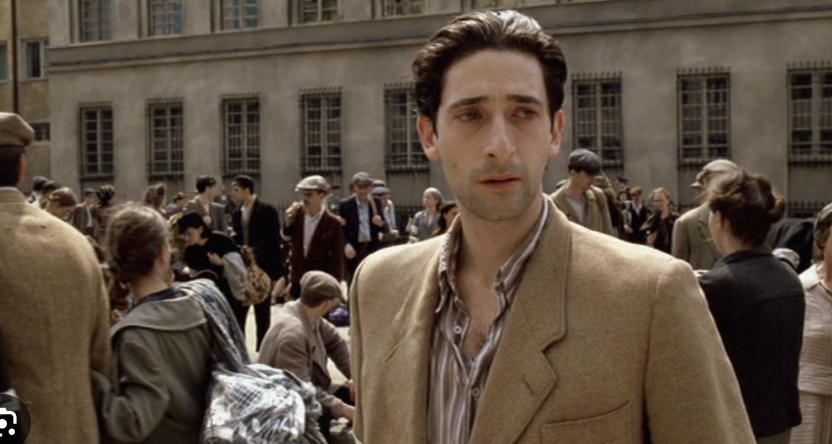
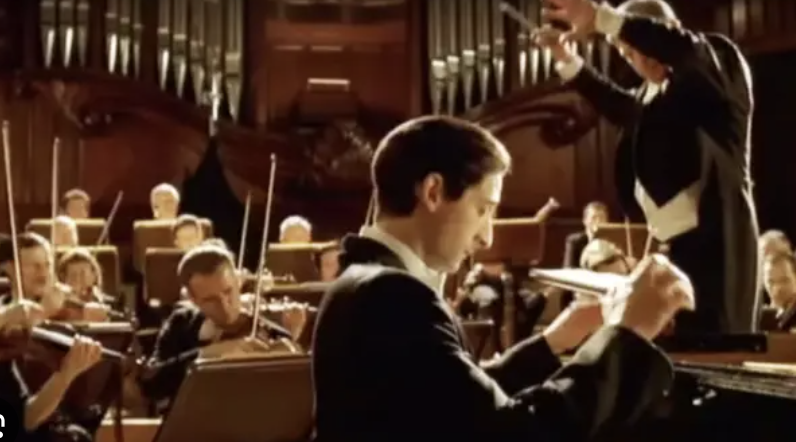
    Below wee see Szpilman in the beginning of the war and when caught by the Nazi official and playing the Piano for him. Two different scenes, the same people tortured by

    Another technique that stood out to me was Polanski’s use of camera perspective. We rarely see wide, establishing shots of the war; instead, the camera stays close to Szpilman, forcing us to see through his eyes. This first-person framing makes the destruction of Warsaw feel more intimate and claustrophobic — it’s not about the scale of tragedy, but about how it feels to live through it. There’s a particular scene when he’s watching from a window as people are beaten in the streets below. The camera doesn’t cut to close-ups of the violence. It just stays with him, silently watching. That restraint, that distance, actually makes the moment more horrifying.

    Lighting also plays a huge role in setting the tone. Early in the movie, the lighting is natural and warm, almost nostalgic. But as the war progresses, it shifts toward shadows and muted grays. By the end, everything feels drained — not just visually, but emotionally. The loss of color mirrors Szpilman’s loss of hope, and by the time he’s finally rescued, the lighting doesn’t shift back. It stays cold, like survival isn’t victory, just continuation.

    The Pianist isn’t an easy film to watch, but it’s essential. It uses the language of film — sound, perspective, and light — to tell a story that words alone couldn’t capture. It’s not just about what happened, but how it felt to live through it. And that’s what makes it worth watching.

  • Footsteps that we can feel, the usage of foley sound in Singin’ in the Rain.

    During the movie, there are a lot of dancing and jumping and characters walking around scenes. And in such scenes, all the characters’ footsteps are captured exceptionally well, and in the dance scenes we always hear the clear crisp of their feet stumbling on the ground, just like the microphone is held inside their shoes.

    This connects to this week’s reading where post-production is used to achieve this effect, which is foley sounds. Below is a link that is useful for us to read

    ⬇️

    https://soundgirls.org/lara-dale-foley-artis

    A foley artist may have many many shoes they use to create certain sounds the characters made during the film. “If you work long enough on diverse projects you will eventually need to have every type of shoe, or at least the sound of that shoe, that you possibly can.” Artist Lara Dale said so, and she herself have more than 300 shoes.

    Lara Dale also notes that the movie stars rarely record their own footstep tracks, but Gene Kelly did record his own footsteps. This makes Singin’ in the Rain one of those rare cases where the on-screen dancer is also the off-screen “Foley walker.” That choice keeps the choreography’s exact groove while still giving the mix team freedom to shape space and texture.

    In addition, notice how the footsteps all sound like the special shoes used by tap artists, but the characters in the frame are either wearing leather shoes or high heels. This is clearly not a sound such shoes can make in real life, and foley is employed here to mimic the optimistic sound. Sound enriches the image with expressive information the picture alone can’t carry, it offer fun and wit into the shots.

    If we are to listen to the actual footsteps that is recorded during the film taking period, it probably will be unclear and not so rhythimic that we are able to capture the beet and feel their dance as they do the moves.

    So the thing I noticed that how his feet sound turns out to be the point. The film wants you to feel the dance as music, not just see it. Foley makes that happen.