Jean Jacket from Jordan Peele’s NOPE is nothing like anything we have seen or could even imagine; quite literally an out-of-this-world kaiju creature. It is worth noting, however, that Jordan Peele consulted a plethora of scientific experts, such as marine biologist Kelsi Rutledge, to create the creature.
Rutledge used many existing marine animals as inspiration for Peele’s creative vision. The general saucer shape is inspired by sand dollars, it’s camouflage from cuttlefish, unfurling from bigfin squids, and it’s square shaped eyes from octopuses. Rutledge even grounded the creature in taxonomical nomenclature by giving it a name: Occulonimbus edoequus, meaning “hidden dark cloud stallion eater.”
So why does a mythical, otherworldly character need to be so grounded within earth’s limits? It is to be noted that such real-life elements are not blatantly associated with Jean Jacket within the confines of the film’s narration (OJ, for example, doesn’t say “it looks like a sand dollar” or anything of the sort). It is, however, interesting how real life elements come together to make something so strange that a human mind free from any grounded influences could not make something stranger. I think this speaks to human nature and psychology. Historically, familiar mythical creatures did not come straight from imagination, but the misinterpretation of real life animal remains. Dragons, serpents, and cyclopses all originate from strange fossil remains. Hybrid creatures, or chimeras (which Jean Jacket arguably is) have existed for millennia. I think it says something interesting about human nature: our thoughts in a vacuum are surprisingly grounded in reality, but when confronted and inspired by reality itself, they go to unimaginable places. It humorously reminds me of the idea that crazy things happen in movies, but some things in movies are so crazy, they have to be inspired by reality.
As interesting to think about as all of this is, I think it is also interesting to think about fact that Jean Jacket, a creature Peele intentionally wants to be ambiguous, has “lore.” Just reflecting on my own actions, I curiously went online after the movie to learn more about Jean Jacket, found all of this information, and found like minded people who were as interested in Jean Jacket as I was. I even found this creative depiction of Jean Jacket-like creatures created by @monstatron, inciting a Jean Jacket fandom.
Why do we try to make sense of Jean Jacket at all? Why does Jean Jacket even have a scientific name? I think that subliminally, Peele’s understanding of human nature allows him to manipulate audience’s understanding of the creature inside and outside of the theatre. People want to make sense of what is not meant to be understood, and will look for ways to re-enforce a stable point of understanding. I also think that it speaks to the creation of fandom and how ambiguity allows the audience to fill in the gaps.
I have been a practicing Hindu from birth, and growing up with Hindu parents and being surrounded by Hindu culture, much of its imagery and teachings have been familiar with me for a long time. I would not consider myself a deeply “religious” person, but I do follow my own type of Hindu faith and I am familiar with most elements of Hinduism.
Watching RRR, and following the discussion we had in class, made me think of the use of Hinduism in film and politics more critically, especially as a nationalist tool to promote discrimination and oppression. Hinduism has close ties with entertainment for years and years, but it is interesting how Hinduism, more so than any other practicing religion, is used in this manner. It is true that many films incorporate elements from other religions, even in fiction (one film that comes to mind is Ben-Hur 1959), but few films fictionalize the religious elements of the films themselves as much as Hinduism. For example, Ben-Hur‘s narrative sticks closely with recorded and accurate events of the divine even if the rest of the plot is fictional. In RRR however, both Bheem and Ram (both characters symbolically, metaphorically, or physically reincarnations of the Pandava prince Bheem and the avatar of Vishnu Ram) are put in stories never depicted or imagined in the Mahabharata or Ramayana (in fact, according to most agreed studies of mythology, the two lived at least a few thousand years apart from each other).
All of this raises the question of why Hinduism is so malleable, and I think a lot of it has to do with its formation, structure and practice. Being several thousand years old and without a founder and unifying text, Hindu has long fostered an idea of individual interpretation amongst a collective Hindu culture. This is especially highlighted in two elements outlined in Hinduism: the ambiguity of the Divine and the different schools of thought fostered by Hindus. Hinduism itself presents its subjects and texts with moral ambiguity.The Mahabharata is a great example of this, in which a story in which a clear dharma and outlinable “heroes” and “villains” are challenged with the ethically questionable actions of those on both sides; heroes sometimes commit villainous actions and tactics, and villains sometimes show more dignity and principle than their “good” counterparts. Physical ambiguity is also present in Hindu texts; the Vedas question the universe’s coming to existence and even god’s involvement or knowledge of it, stating “He knows— or maybe He does not know ” (Rig Veda, X. 1291). Different Vedas even frequently contradict each other, yet at the same time coexist in harmony as part of Hinduism as a whole. Within the very framework of Hinduism, ambiguity and different interpretations are established and welcome, encouraging individuals to find god and interpret faith in their own way through their own practices. This is further emphasized by the different schools of thought created through subcultures and interpreters, from Buddhism’s compassion and detachment to Charvaka’s material ambition and atheism, all of which are valid and accepted practices by Hinduism (it’s to be noted that Hinduism in practice and theory aligns with all other religions, including monotheistic religions such as Christianity and Islam, to co-exist as equals).
With all of this in mind, it is interesting to see how Hinduism in RRR develops in the larger sphere of Hinduism in India, including political nationalism. India’s population is a Hindu majority (roughly 80%) and the religion has developed alongside Indian society as part of a cultural ecosystem for over three thousand years. Along with the creative and interpretative fluidity of Hinduism, it is no surprise how Hinduism has embedded itself in almost everything, including art, storytelling, lifestyle and politics. It is exactly this fluidity that enables Hinduism to be transformed into a nationalist tool in the modern era. Its origins stem from colonialism, as it was a method to unite the Indian people under a single unifying influence. The irony, of course, is that Hinduism isn’t really a “unifying” religion; as mentioned before, its vast interpretive heterogeneity suggest a more personal than national connection. Since 2014, the Bharatiya Janata Party (BJP) and prime minister Narendra Modi have employed this religious nationalism as part of a superconservative agenda, most specifically in the Rashtriya Swayamsevak Sangh (RSS), a volunteer paramilitary organization that has extremely close ties with fascist ideology. By cherry picking elements and re-interpreting Hindu tradition to justify actions, Hinduism can be weaponized. One of the most telling principles is the idea of “Cow Politics.” The idea, stemming from the Hindu reverence toward the cow, is used to mask political insufficiencies through religion. It encourages practicers to ignore societal and political problems and instead worship god, which will “remove all problems,” blurring the line between mythology and reality. This effectively silences political opposition of wrongdoings with the misguided appeal of nationalism. I have also seen the “how dare you insult religion!” argument used to quell critics of the national regime as well. RSS has been involved in multiple terror attacks and riots against Muslims, and has been the forefront societal and political influence on Hindu supremacy.
Seeing the religion that I love be twisted in such a way is terrifying. Yet the incredible thing is that, despite it’s hateful nature, Hinduism in theory considers such nationalism as a valid way to practice the religion— it is simply another interpretation, amongst several others, that contributes to the collective Hindu manifold. As stated earlier, Hinduism is accepting of other religions such as Islam, yet is also accepting of ideologies that degrade and disavow Islam as well. It highlights a weakness of the religion; without a clear moral framework, it can be manipulated in a way that both divides people and creates an agenda backed unity. I think that it is important for people to recognize the prejudice laced within modern Hindu nationalism and remember the importance of individualism. People have the ability to believe what they want, and do not need someone else to tell us what they must believe in. In fact, millions of Hindus interpret the faith in ways rooted in empathy, coexistence, and personal spirituality rather than nationalism. Re-embracing these interpretations, and encouraging open conversations about how power distorts religious meaning, can counteract the narrow vision promoted by extremism. If more people approach Hinduism with critical awareness and a commitment to its pluralistic spirit, the religion can continue to evolve without becoming a vessel for oppression.
Considering the complex and divisive nature of this topic, I may have overlooked some elements, misinterpreted some events, or provided a narrow or biased viewpoint on some topics. If so, or if any clarification is needed, please leave a comment.
Realness is a theme within ballroom culture depicted in the film Paris is Burning. To “walk real” means to embody the look, attitude, and guise of a person you are not; oftentimes in the context of the film, a white, straight, well off man or woman. Fundamentally, this gives you the legitimacy of being acceptable by society, and many critics upon Paris is Burning’s release hailed drag culture as proof of identity fluidity.,
But others pointed out the “realness” is questionable, because it illustrates standards set by a dominant class and culture. In other words, identity fluidity isn’t truly the case because people “conform” to the social norms established.
Harper argues that realness in the context of the film is manipulated and controlled in a way that maintains a strict social hierarchy. When people enter the ballroom and “walk real,” they are emulating identity rather than creating identity; thus adhering to the “white, straight, and wealthy” ideals that are strived towards. As such, Paris is Burning gives an appearance of being empowering, but it is the very thing that keeps people disempowered.
Reddy takes a different approach; rather than what “realness” limits, he is more interested in what realness reveals and how it is used in ballroom culture. He argues that ballroom culture is aware of the social construct of “realism,” and instead emulation exposes how fake “realism” is; how a social hierarchy is nothing more than an act. In this way, ballroom functions as a way of cultural expression rather than cultural assimilation.
I think these two interpretation speak to the nature of the documentary itself; both can be true. Jennie Livingston, the film’s director, is a white woman, which comes at contrast to ballroom’s black and hispanic roots. The film is made for white audiences; ballroom is presented as a new concept, and much of the film covers topics people within ballroom culture would be very familiar with already. As such, the discrepancy between the white filmmakers and the black, hispanic, and queer community creates different interpretations between the creative choices used and even the nature of the interviews given. In other words, the dream to live up to “white” expectations shared by many in the ballroom community may not be as pronounced as the film presents it to be. I think that its impossible to explain a culture and its significance through media; you have to actually live it.
Says Rooster Cogburn as he bravely charges four-on-one against Ned Pepper and his outlaws. Retied and an alcoholic at the start of the film, Cogburn’s resolve on the side of moral justice and duty marks the completion of his arc, a moment of western catharsis that the audience cheers for. True Grit (1969) is an excellent exemplification of the Western genre, an adventure about a morally complex character between clear moral boundaries and all the guns, wild west environments, and exciting score to boot. However, the 2008 film No Country for Old Men approaches westerns very differently. Rather than embracing familiar themes of redemption and bravery, the Coen brothers twist these themes on their head in order to expose Hollywood and the audience’s expectations of genre.
Genre, as outlined in Film Art: An Introduction, are systems and conventions of similar iconography, plots, themes, and characters that are employed to help filmmakers structure stories and audiences form expectations. Hollywood’s relationship with its audiences are largely built off of genre; our expectations and ritualistic nature urge us toward specific films to create specific emotions. Genre differences can arise when filmmakers take old elements and present them in new ways. But it is especially rare when a film violates genre conventions entirely; taking each and every element and breaking it over its knee.
No Country for Old Men is set desert landscape with the guns, sheriffs and outlaws all exemplifying the western genre, but much of the iconography is tainted with an uneasy emptiness. One shot that sticks in my head is the establishing shot as Anton walks into the gas station. The long shot’s desert landscape looks dead and dry, both sky and earth devoid of the color that gave the American West’s adventurous look from films in the 60s. The marks of civilization that signified the “boom town” in typical westerns look rusted, old, and yet uncomfortably modern; the car, power lines, and gas station somehow look older than the environment around them. The Coen’s opt for still shots rather than pans, letting the audience sit in the dinginess of the environment rather than projecting spectacle and grandeur.
No Country for Old Men‘s wastelands, both desert and urban, convey a sentiment of a time long gone and an uneasiness that sets this film apart from other Westerns.
The score of the film is also notable, mostly because the film doesn’t really have much of score, or any music for that matter. Rather than the adventurous overtures of typical westerns, an empty sounding film creates tension that betrays the audience’s expectations. The use of sound is incredible, from the “blip” of the transponder to Carter Burwell’s subtle, almost unnoticeable swells of ambient music, sound is integral to the film’s mise en scene and the emotion it conveys.
Sheriff Bell isn’t the “main character” but certainly the protagonist in which the central theme revolves around. Nostalgic for a past that no longer exists, he retires at the end of the film once the morally straightforward, “good vs. evil” perspective, his kind demeanor, and solid wits akin to an old detective no longer hold up in the modern world. It’s notable that the Sheriff and his deputy ride horses, iconography that Film Art: An Introduction attributes to the “outlaws” of westerns, as opposed to the criminal’s use of modern automobiles. Bell’s most powerful scene, in my opinion, is when he sits down with Carla Jean to discuss Moss’ unwillingness to get help from the police. When Carla Jean tells Bell how determined and resourceful Moss is, Bell breaks into a metaphorical story, about how one of friends Charlie, when trying to kill livestock for slaughter, was himself injured when his bullet missed and ricocheted. He concludes with “even in the contest between man and steer, the issue is not certain.” Then Bell sighs and laments, “‘course they slaughter steers a lot different these days. They use an air gun, shoots a little rod… animal never knows what hit him.” This scene is written so tragically, and you along with Bell can feel the way a little bit of cathartic justice that Bell believes in is long dead. https://www.youtube.com/watch?v=WHnMFX2OuhM
Our main character Llewelyn Moss is a rough and tough lone wolf squarely placed between the moral framework common amongst other Western characters. But he doesn’t get a redemption or heroic death; the Coen brothers kill him offscreen by some unknown and unseen gang members. Breaking one of the Western’s most fundamental conventions, the audience is let down in an anticlimactic whimper as the old-time, unconventional traits that positively serve past western characters, such as True Grit’s Cogburn, instead leave Moss dead. It’s to note that Moss’ adversaries throughout the film are portrayed as unseen, and filmed as a tension building thriller. In a genre that pits the hero and villain, along with their moral qualms, at eye-line-match from one another, there is not a single “face-off” or “final confrontation” between antagonist and protagonist. Moss’ two deadly encounters with the gang are a good example: none of them are ever pictured in detail, just silhouetted in suggestion, like a force of nature rather than a human antagonist.
However, nothing really feels like a force of nature more than Anton Chigurh, the film’s central antagonist. Across the novel and film, Anton is a character who is physically unexplainable; his name and appearance tell nothing about who he is, and his characterization by Javier Bardem brilliantly leaves the audience with more questions than answers. He is without remorse, compassion, or emotion, yet has an unexplainable moral code seen when confronting the gas station owner and Llewelyn’s landlord; this complexity underlines the futility in understanding his character. The Coens write Anton as a looming force of nature. Sheriff Bell and Anton never even meet, let alone an old fashioned stand-off, yet his presence overshadows the entire film, leaving a trail of dead in his wake. He kills not through a bad-ass gunfight or a confrontation of moral differences, but through happenstance and causality, as best illustrated in the scene between him and Carson Wells. I think a brilliant decision the Coen brothers make is leaving the fates of the accountant and Carla Jean uncertain; denying narrative closure and further complexifying Anton’s moral standpoint further play with the audience’s expectations. At the end of the film, Anton is suddenly hit by a car, leaving him gravely injured but his overall end unknown. I have always interpreted this as the ambiguity of fate, how calamity befalls him not in the middle of committing a villainous deed, but simply being in the wrong place at the wrong time. At the same time, fate isn’t justice bound, as Anton simply gets help from some bystanders and walks away. It speaks to the expectations we have onto what befalls those who are good verses evil.
The Coen brothers have a lot to say about Hollywood’s use of genre. Audiences have been trained to expect certain things through repetitive use of genre patterns, something especially appealing to larger studios and cinematic universes. One of the oldest genres in filmmaking, westerns have been reflexively rebranded and redone in order to appeal to a continuously shifting audience. No Country for Old Men, for lack of a better word, slaps you across the face, and exposes our dependency on familiar patterns and our innate impulse to seek new thrills from set expectations.
One of the most important elements within narrative is the degree of knowledge we as an audience are given as the plot progresses. This degree of knowledge often falls between restrictive, knowing as much as a character, and unrestrictive, seeing and understanding more than they do.
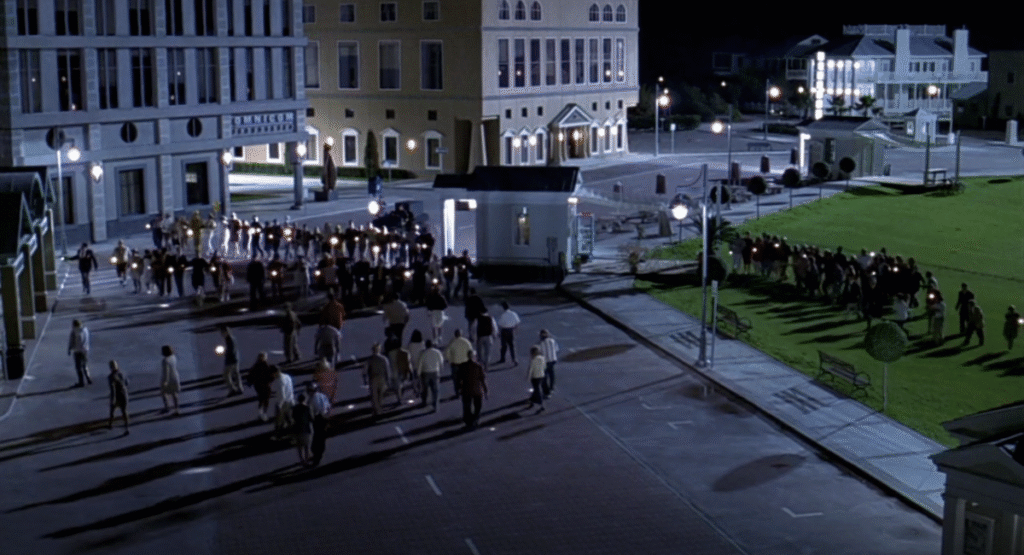
The film begins with a relatively restrictive plot centered around the main character, Truman. We as an audience are aware that he is in a television show through mild exposition in the opening, but for the first half of the film, we experience what Truman experiences. The film invites the audience to piece together the world of Seahaven and it’s intricacies by ourselves rather than exposition; from the sitcom-like interactions between Truman and the cast, to the oddities of glitching radios and falling lights hinting at the artifice. We are active participants of Truman’s gradual discovery that the world around him isn’t real.
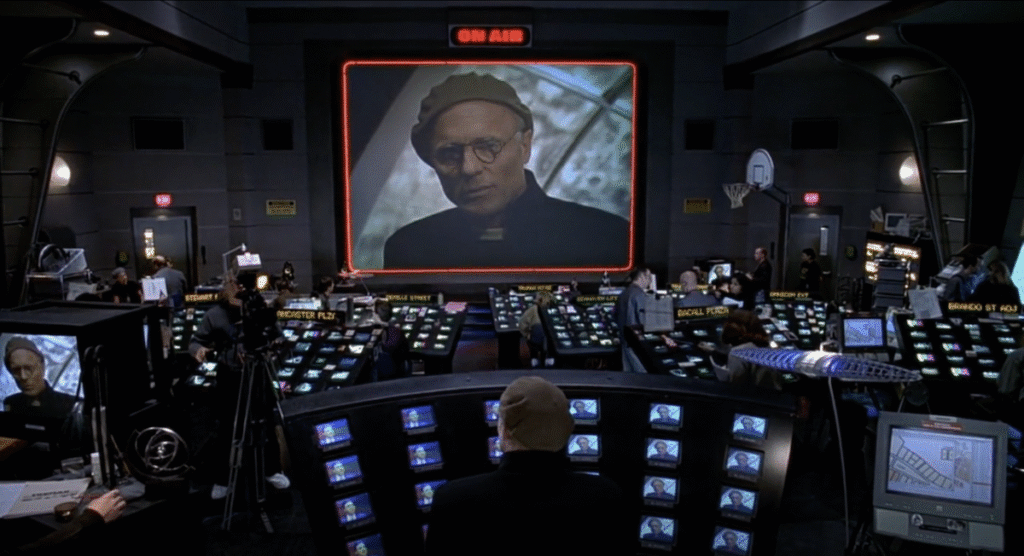
Around halfway through the movie, the degree of restriction drastically changes. During Truman and his “father’s” reunion, the film intercuts the perspective of Truman and the show’s control room. We meet Christof, the creator of the show, and his show-runners as they improvise the direction in real time. Shortly after, a news reel acts as exposition, fully fleshing out how The Truman Show came to be and operates. During an interview phone call between Christof and a former cast member Lauren, Christof tells her “we accept the world that is presented to us” when Lauren calls out the ethical injustice done to Truman.
Had the story began with an unrestrictive lens, Seahaven would simply appear less real from the beginning, and Christof’s thematic stance would appear more intellectual rather than emotional. Instead, the restrictivity allows us to emphasize with Truman, and make the central conflict –control verses freedom– grounded in Truman’s personal struggle instead of overarching ideology. For example, despite the Christof and the showrunners’ numerous attempts to present Seahaven and Truman’s life as “perfect,” we clearly see Truman’s emotional distress and desire for authenticity.
The climax of the film makes the most creative and powerful use of restriction. Truman decides to leave the island and conquers his fear of water as he sets sail. During the night, he sneaks out of the house, and none of the cameras –and by extension, we the audience– know where he is. The story is suddenly restrictive again, but with a reversal of power. We don’t follow Truman’s ignorance; we share the showrunners’. The film itself weaponizes restrictive narration against the audience, implicating us of the same voyeurism that it critiques.
The Truman Show ‘s manipulation of narrative perspective throughout its runtime ultimately becomes both its central storytelling device and its strongest moral statement.