I used to watch a lot of Studio Ghibli films when I was younger, so over break I gave The Boy and the Heron a try since Robert Pattinson had a voice role. I expected something soft and familiar, but the film moves through its world like a dream that keeps shifting shape. The story feels simple on the surface, but the images pull you into something deeper.
The animation creates that dream logic. Scenes drift from one environment to another without clear transitions. Characters appear and disappear as if the world rearranges itself based on emotion instead of cause and effect. I noticed how the colors change with Mahito’s mental state. Warm tones fade into colder ones the moment he enters the other world, and the creatures look strange but delicate, which made the environment feel both threatening and inviting.
This movie resists the usual Ghibli rhythm. It holds silence longer and lets images take over the narrative. I felt myself piecing together the emotional meaning instead of waiting for the plot to explain anything. The dream logic lets the film treat grief as something fluid rather than something a character solves.
By the end, I understood why people call this a late career reflection for Miyazaki. The film uses fantasy to explore memory and loss in a way only animation can. It left me with feelings that I could follow even when the story refused to guide me step by step.
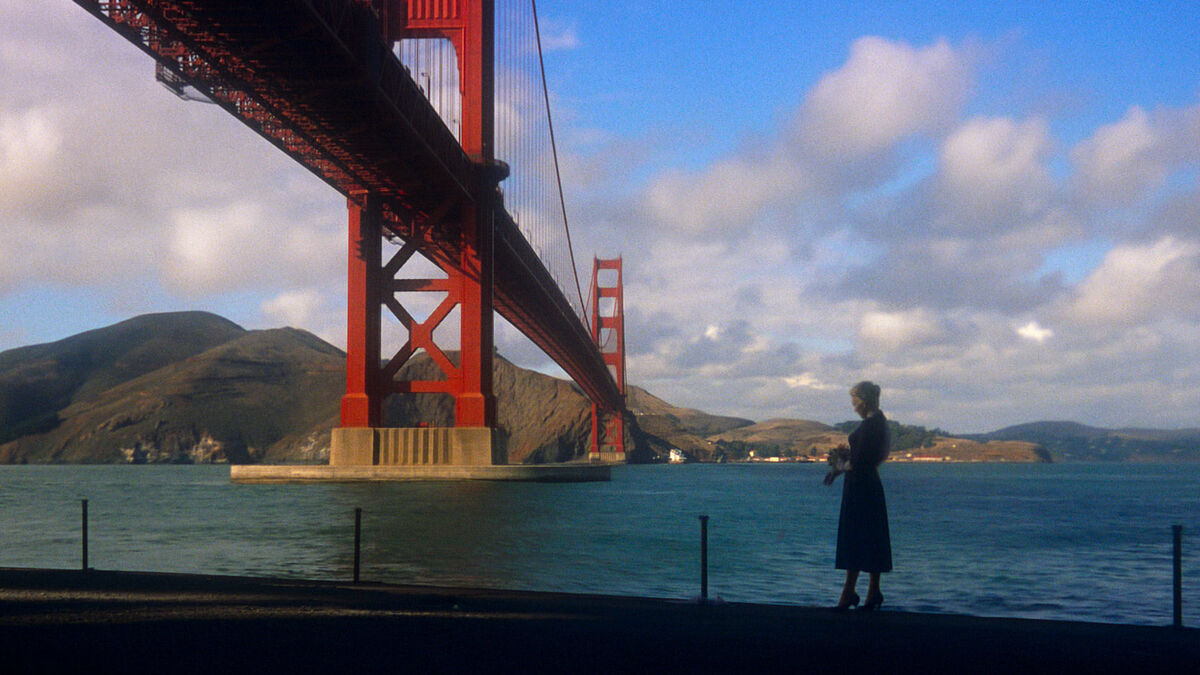
I wanted to get into more older films as we’ve seen them this semester, especially Hitchcock’s films, so I watched Vertigo. I knew it was famous, but I did not expect how strange and layered it feels. The movie moves between thriller, romance, and psychological drama, and each shift changes how I saw Scottie and Madeleine. Hitchcock keeps adjusting the tone until the viewer feels as unstable as Scottie does. The early sections play like a detective story, with wide shots of San Francisco and slow, careful movement. Then the film tilts into something more romantic and obsessive, and the framing tightens around Madeleine. I noticed how the colors grow more intense as Scottie falls deeper into his fixation. Green becomes this haunting presence. When she steps out of the hotel room surrounded by green light, the moment feels unreal.
The later part of the film surprised me the most. It turns into a story about control and identity. The shift in genre makes that control easier to see. Scottie becomes less of a detective and more of a director who tries to rebuild Judy into the fantasy he cannot let go. That change in tone makes the ending feel tragic instead of suspenseful. Watching Vertigo now, I realize how many films I’ve seen throughout my life that have borrowed from it. Hitchcock used genre as a way to expose obsession rather than hide it, and it was a bold shift.
My little cousins wanted to see Zootopia 2 over break, so I ended up in the theater. I went in expecting a simple sequel, but the film surprised me with how much it tried to update its ideas about prejudice and policing. The first movie created that whole “species equals race” metaphor, and the sequel pushes it into new territory by showing how public fear and political messaging shape the city’s identity. I kept noticing how the animation supports those ideas. When the city changes tone, the colors dim and the lighting gets sharper. The film uses that shift to show how tension spreads even when the characters do not talk about it. I paid a lot of attention to the crowd scenes because the animators fill them with tiny reactions that show anxiety moving through the population. Even kids around me gasped when everyone pulled away from each other.
But I will say, the movie does still struggle with the limits of its metaphor. Disney is the studio after all. It wants to teach tolerance, but it also avoids talking about who holds power in a system like this. Still, the animation and pacing made the emotional beats clear and easy to follow. I walked out thinking that the film communicates its ideas most clearly when it stops explaining them and lets the world design express the pressure the characters feel.
Not too long ago, I watched the horror film Weapons with my friends. I found the film to be very interesting in the way that it kept cutting to different characters and timelines. I had to try to order the events in my mind so that I could make sense of what was happening. It reminded me of Holy Motors in that way; both films make you create your own meaning instead of giving you a straightforward explanation.
While watching this documentary film, Grey Gardens, I felt like I was getting a look into the lives of the characters (Little Edie and Big Edie); their true personalities were being expressed without any filter. They said whatever came to mind and acted however they wanted. Women in the mid-1970s were not “supposed” to act this way on camera, which is why viewers originally thought the film must have been scripted. Their bickering even feels comedic. They are performing, but only because they like to perform, not for money. Long takes and no narration suggest a direct cinema style, but the actors’ performances turn it into a theater performance.
Like the decaying house, it is clear to the viewers that their lives are becoming less and less interesting. They are constantly talking about regrets and memories, reliving the moments again and again. Psychologically, the Edies live in a bubble of the past. Little Edie keeps saying she wants to leave, but the moment she’s with her mother, she becomes a “Little Girl”. They’re unreliable narrators of their own histories, but it is a part of the film’s attraction, making it more entertaining and theatrical.
The house and the chaos of objects inside it symbolize the internal chaos in their minds. The physical disarray mirrors the emotional chaos of their relationship, which includes dependency, resentment, affection, and nostalgia. Still, they stayed together.
Good Time begins with a jolt and never slows down. The film grabs you from the first scene and refuses to slow down, every shot and cut pushing the viewer deeper into Connie’s spiraling night. The style builds that tension. The handheld camera, the close-ups, the neon lights, and the nonstop movement trap the viewer inside Connie’s perspective. I felt myself reacting before I could think, which says a lot about how aggressively the movie pushes its pacing.
The style turns simple actions into moments of panic. Connie runs, begs, schemes, lies, and the camera follows him with almost no distance. The editing cuts before you can process what just happened. The sound also plays into this because the score pulses under everything and keeps the scenes tight. I noticed that the film uses almost no quiet moments, and when they appear, they only highlight how unstable Connie’s world is. What makes the style work is how it reflects the character.
Connie never stops moving because he has no real plan. I started to see the pacing as his mindset. The urgency is not just a thriller technique. It becomes the story of someone who builds disaster while trying to escape it. Pattinson’s performance fits perfectly with this because he plays Connie with total conviction, even when the choices make no sense. The movie kept me anxious the entire time, and I think that tension is the point.
Watching this movie reminded me of the story about Matt Reeves seeing this performance and instantly knowing Pattinson could carry The Batman. It makes sense now that I’ve finally seen Good Time, because the same restless energy that drives Connie feels so similar to the Bruce Wayne he later played in 2022.
The film Shampoo (1975) addresses the themes of politics, gender, and sexuality through comedy. It shows how the politics and the sexual revolution of the time were very disingenuous, and it shows this through the deceptive words of the main character (George) and through the use of irony. The film makes us feel as though we are guilty because we know of George’s promiscuous acts long before the women he is with do. It does this by using dramatic irony; we know the true nature of the main character, while the female character Jill is completely in the dark about him. At the same time as viewers, we are scared of her finding out the truth, as we do not want to soil her innocence and trust.
The movie depicts the messy and promiscuous love life of the main character, who is a hairdresser shown to be self-centered and oblivious. He is always trying to go somewhere (always chasing something), but we never know where or why. He is very dishonest, even with himself. The uncertainty of the times politically matches the uncertainty in his personal life, which makes his aimlessness feel even more intentional in the film’s narrative.
Many sexual innuendos appear throughout the film to bring comedy and further express his carefree nature. We dislike him at the beginning because he is with so many women behind his wife’s back and because he doesn’t seem to take anything anyone else says seriously. He even claims he felt “immortal” when sleeping with many people, which shows how disconnected he is from the emotional weight of his choices. However, by the end, we end up feeling bad for him. He loses everything that was actually important to him. He didn’t know what he wanted until it was too late, and it is very ironic that someone who was always chasing everything ends up completely alone.
My favorite scene of the movie was the party scene. The party scene is similar to the political and social chaos that was happening during the time of the film’s creation. The party scene is an example of how the film uses mise-en-scène to build tension. The loud music and the aggressive flashing lights create a sense of conflict and emotional overload. The loud atmosphere and hectic lighting reflect how unstable his life is becoming, with the women so close to finding out about his promiscuous ways. Viewers become very anxious, and the suspense builds as the truth about the main character is so close to be revealed to others, it is nerve-wreaking to watch, but it is hard to look away. The scene keeps shifting from George with a woman to his wife (Jill) slowly approaching. We feel anxious as she almost misses the truth, walking by the area where George is in the act of intercourse with another woman.
Over the last weekend, I watched Inside Out 2 again with my family. Inside Out 2 continues the exploration started in Inside Out into the internal states of mind that are anthropomorphized as characters. New emotions (such as Anxiety, Embarrassment, Nostalgia, and Boredom) are added to the core emotions from the first movie. They are more complex and in conflict with older emotions such as Joy, Sadness, Anger, Envy, and Fear. Riley, the main protagonist, is a girl coming of age and is not yet sure how to accept and regulate her emotions. She is yet to realize that even Anxiety at times is useful, but that it has to be kept from becoming overwhelming.
A dual narrative in the movie that helps connect the two worlds: the internal world of Riley’s emotions and her external world as a teen who wants to succeed at a hockey camp. Inside her, emotions are fighting, and Joy, with the help of Sadness and other emotions, has to stop Anxiety from controlling and ruining the internal balance in Riley’s mind.
One of the most memorable scenes in Inside Out 2 is the anxiety scene, when Anxiety frantically tries to “solve” Riley’s problem, and accelerates so quickly that she actually stops (or glitches). The animation shows her vibrating at a supernatural speed (like electrons, which are moving so fast that they are everywhere and nowhere at once). It’s a great visualization of cognitive overload when the emotions and thoughts overwhelm a person, and they become paralyzed. The scene uses cross-cutting to show how Riley’s internal emotional collapse affects her body on the hockey field. When Anxiety is out of control, there is an intense sound of Riley’s breathing that can be heard as she is spiraling due to anxiety during the hockey game (it is like she is having a panic attack).
Camera movements support an internal state Riley is in, with faster movements when Anger takes over, and slower movements when it is Sadness. The colors and shapes are used to represent emotions. Joy is round and light green-yellow, Anxiety is irregular-shaped and orange, Anger is red and square, Sadness is blue, Envy is green, as one would expect.
I had to watch Inside Out 2 because I am interested in cognitive psychology (especially memory formation and recall). The movie helps me visualize how memories become core beliefs (for example, the belief that “I’m not good enough”). A single bad moment drops into a machine to be processed and comes out as a judgment about oneself. Repeated negative experiences literally crystallize. Inside Out 2 is perhaps not as solid as a neuroscience textbook, but I think it can help people realize the role of emotions in their lives and how to cope with them and does it in a visually appealing and truthful manner. That makes the movie psychologically real. By using characters who portray the internal emotions of Riley, the movie helps viewers visualize her internal psychological states and internal conflicts that she faces, not just follow her external journey into adulthood.
Chungking Express throws you into a version of Hong Kong that feels alive and unstable at the same time. The film follows two loosely connected stories that drift through the city with a mix of romance, melancholy, and impulse. The editing is what stands out in this film. The step printing and the fragmented cuts make ordinary moments feel stretched out or compressed, almost like the characters experience the city in a different rhythm than everyone around them.
The style gave me a sense of drifting with them. The cops, the woman in the blonde wig, Faye in the snack bar, they all move through the city with a kind of emotional blur. The editing captures that feeling better than dialogue ever could. Even when nothing important happens, the images keep shifting. Faces smear across the screen and the city lights streak behind moving bodies. That technique turns loneliness into something visible.
I liked how the film breaks itself in half too. The two stories do not connect in a traditional way, but the editing creates a link through mood. Hong Kong feels crowded and bright but also strangely empty. The film makes that contradiction work because the cuts never let the viewer settle into a stable sense of time. I finished the movie with the feeling that its form expresses something the characters cannot say. The fractured structure becomes the story.
Pushpa has been a big name in my family for years. Everyone watched it when it first came out, but I never got around to it until this break. I grew up seeing Allu Arjun in roles that lean toward humor or charm, so this film felt like a shift. The movie builds Pushpa’s masculinity through “swagger,” labor, and defiance, and the style of the film supports that version of him.
The biggest thing I noticed how much the camera treats him like a star. It gives him controlled entrances, slow movements, and gestures that turn into instant signature moments. The film builds its rhythm around these beats. The songs also help with this because they highlight his confidence and turn simple actions into a sort of “mythmaking.” I watched this with the sense that I was supposed to admire him before I even learned everything about him, which fits how Telugu cinema often constructs larger-than-life heroes.
The film anchors his rise in physical labor and class struggle, but it also turns that struggle into a fantasy about what a man should look like. Pushpa never doubts himself and never loses control, and the movie treats that stability as strength. I found myself wanting the story to challenge him, because the version of masculinity on screen feels inflated.
Telugu cinema often does lift its male leads into myth, but here it feels a little too eager to protect him. Watching Allu Arjun play this harsher role made me think less about his transformation and more about how tightly the film holds onto a specific idea of manhood. It pushes the character upward without ever asking what that kind of masculinity costs.