Category: Recommended Reading/Viewing

  • Silence and Survival: The Pianist

    I watched The Pianist last weekend. What makes it different from other war movies isn’t just its subject — it’s how Roman Polanski uses stillness, sound, and point of view to make you feel trapped inside the experience instead of just watching it. This isn’t a movie about fighting or victory. It’s about surviving when there’s nothing left to fight with. And don’t forget, it is a 2002 film.
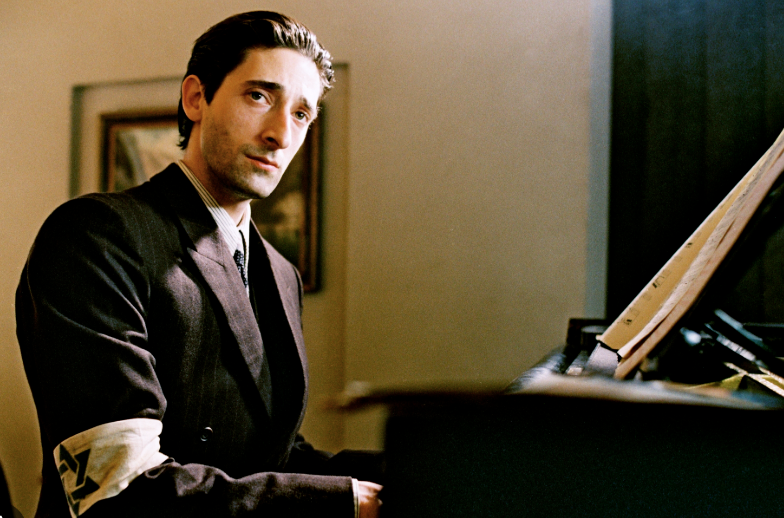
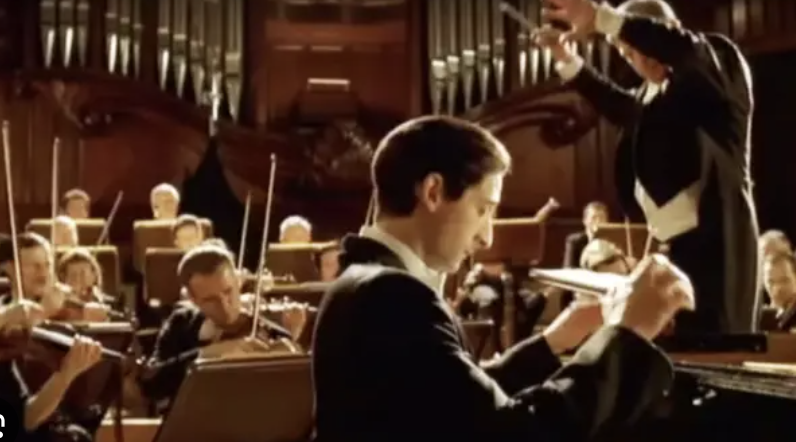
    One of the techniques we talked about in class — the use of sound, or sometimes the lack of it — is what gives this film its emotional weight. For long stretches, there’s no music at all, which feels ironic for a movie about a pianist. The silence becomes unbearable, like it’s pressing down on you. You hear every footstep, every creak in the floorboards, every breath he takes when he’s hiding. When the piano finally does return, it doesn’t sound like a triumphant comeback. It sounds like a whisper of the person he used to be. Polanski manipulates diegetic and non-diegetic sound to show how music transforms from a source of joy to one of survival.

    Below wee see Szpilman in the beginning of the war and when caught by the Nazi official and playing the Piano for him. Two different scenes, the same people tortured by
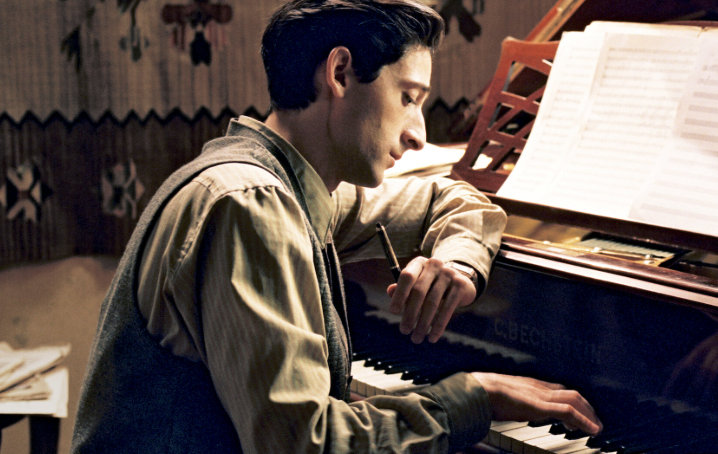
    Another technique that stood out to me was Polanski’s use of camera perspective. We rarely see wide, establishing shots of the war; instead, the camera stays close to Szpilman, forcing us to see through his eyes. This first-person framing makes the destruction of Warsaw feel more intimate and claustrophobic — it’s not about the scale of tragedy, but about how it feels to live through it. There’s a particular scene when he’s watching from a window as people are beaten in the streets below. The camera doesn’t cut to close-ups of the violence. It just stays with him, silently watching. That restraint, that distance, actually makes the moment more horrifying.
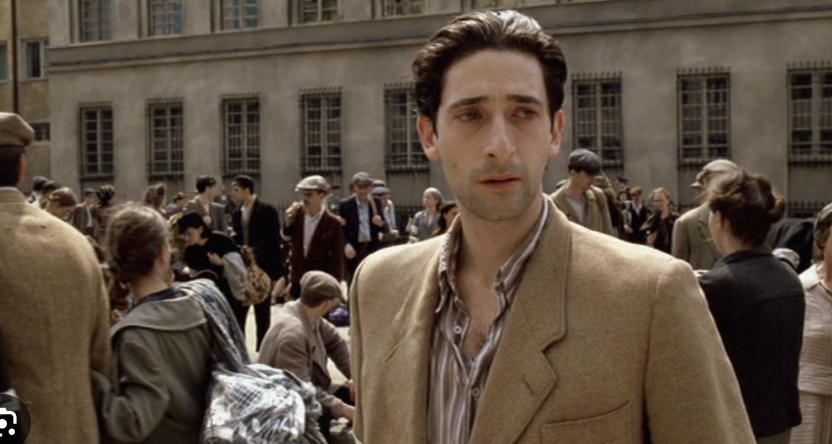
    Lighting also plays a huge role in setting the tone. Early in the movie, the lighting is natural and warm, almost nostalgic. But as the war progresses, it shifts toward shadows and muted grays. By the end, everything feels drained — not just visually, but emotionally. The loss of color mirrors Szpilman’s loss of hope, and by the time he’s finally rescued, the lighting doesn’t shift back. It stays cold, like survival isn’t victory, just continuation.
    The Pianist isn’t an easy film to watch, but it’s essential. It uses the language of film — sound, perspective, and light — to tell a story that words alone couldn’t capture. It’s not just about what happened, but how it felt to live through it. And that’s what makes it worth watching.

  • One Battle After Another Review: Viva La Revolution & Leonardo Dicaprio

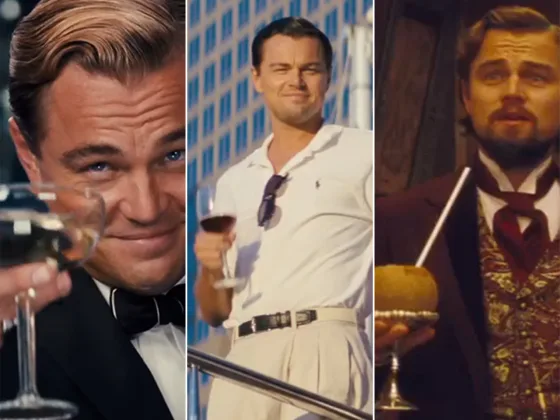
    Over break, I went to see One Battle After Another at North Dekalb. I walked into it well aware of my feelings about Leonardo Di-I only date women under 25-rio but I decided I would put those feelings aside and treat him as just any other actor. I walked out of it, still disliking him as a person but man can he act. His performance in this movie helped make the movie what it is. He was angry, depressed, chaotic, and surprisingly funny.

    Before I saw the movie I saw the scene of him screaming, “Viva la revolution” and believed that this must be coming from a scene that was powerful, however to my shock it was comedic. The whole theater busted out laughing and thats when I started to really understand the themes of this movie.

    The movie, despite being a blatant commentary about how every individual is constantly facing their own battles, was a movie about the people we put on the front lines of revolutions. If you look online you’ll quickly find memes of people saying “you know you’re safe at a protest if a white girl is there” or jokes about sending your white friend to talk to authoritative figures because you know they’ll be treated better. That’s what this movie felt like. Leonardo was the white friend.

    At the beginning of this movie there was a scene where he was kissing Teyana Taylor in a car full of people, and she said “do y’all think he likes black girls??” and he replied “I like black girls, you know I like black girls.” In the moment I cringed, and thought it was such a weird thing to say. It felt performative and weird and it had the same energy as him screaming, viva la revolution. It felt like his tastes, his preferences, his romantic relationships, how he approached his job in the revolution, was performative and defiant simply to be defiant, not for a greater cause. Because what revolution was he fighting for? He screams “Viva La Revolution” which in English means long live the revolution, to a Mexican man, it felt like being American and saying “gracias” at a Mexican restaurant. Despite him being the father of a black woman, he is hilariously detached in our eyes because what revolution is a straight white man in America fighting for? What revolution is Leonardo Dicaprio, a white man worth hundreds of millions of dollars known and loved around the world, screaming about? His whole character was ironic, casting him was deliberate.

    We as people have these preconceived ideas about gender and racial roles and how people should be doing certain things that correlate with those roles but this movie rips that apart. The sensei of a dojo in this movie is Mexican. The person who comes to save his daughter is a Black woman. The person who leaves Leonardo and Teyanas relationship, is Teyana. The people who save Leonardo are hispanic. This movie pokes fun at the ideas of what we believe a person should be doing, making us question why we have those ideas at all. So in that moment, where Leonardo was frantic because he had found out where his daughter was going, the police were raiding where he was, and he yelled out, “VIVA LA REVOLUTION” to the sensei who was helping a bunch of immigrants who he was housing not be seen by the police, in reality wasn’t a joke. He meant that. But it was comedic, it felt ridiculous, and as a person of color I laughed extra hard. Often times in revolutions it feels like white people get there last, it takes something happening to them for them to realize and have empathy for something many of us have been fighting for years. So it was perfect to me, that the sensei simply put his fist in the air. An acknowledgment of the fight, but a toned down one. Because in reality, white people are often given more space to be loud, to be defiant, while people of color are expected to be quieter in their revolts. Him silently putting his fist up while Leonardo screamed it, was telling of that.

    This movie was a great commentary on society and there was so much in it that it would literally be impossible to sum it up in one blog post because of how wonderfully layered it was. This one scene stood out to me because of the comedy and irony of a seemingly serious moment, I still laugh now seeing clips of it. This movie is worth the 3 hour watch, it’s riveting and a commentary on the world we live in now that people need to hear.

  • Cause and Effect in Fantastic Mr. Fox

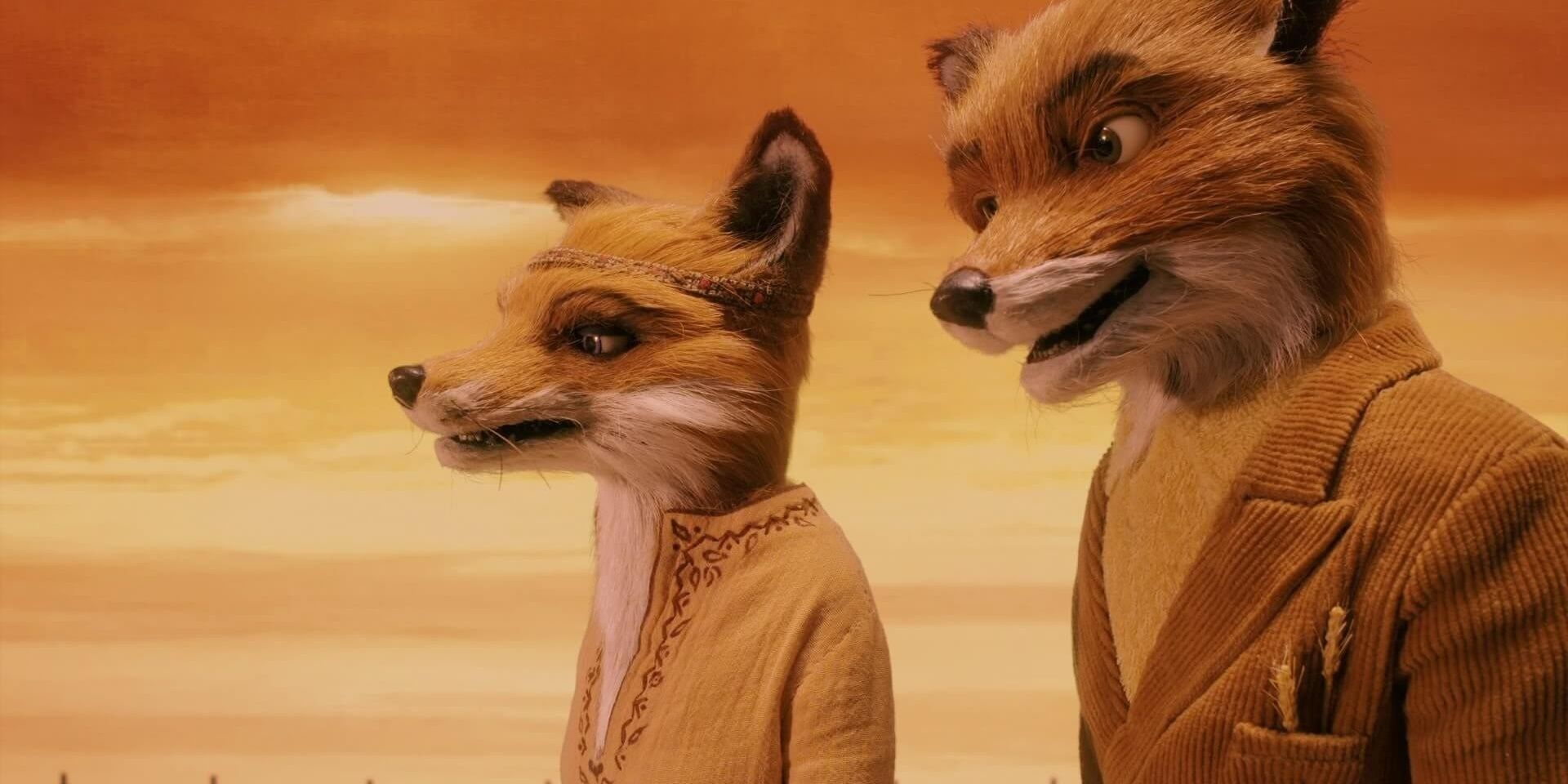
    This weekend, I sat down and finally watched Fantastic Mr. Fox (Wes Anderson 2009). This marks the second Wes Anderson film I have ever seen, and I must say, it was a delight to watch. As I sat through the film, it was impossible to ignore the causal role the characters played throughout the film.

    The plot is centered around Mr. Fox, a charismatic fellow who conspires to steal chickens and cider from the three mean farmers Boggis, Bunce, and Bean. This course of action directly goes against the promise Mr. Fox made to his wife, that he would never steal chickens again and find a new occupation.

    Fantastic Mr. Fox: 10 Behind-The-Scenes Facts About Wes Anderson's Movie
    Colorful Animation Expressions: Fantastic Mr. Fox: The Book (1/5)

    Robbing Boggis, Bunce, and Bean has consequences. In response to Mr. Fox’s thefts, the farmers go to his home and try to kill him, shooting off his tail and blowing up his house. Mr. Fox’s choices backfire on him. His lavish life is short-lived, and his family is forced back underground. Rather than call it quits, however, Mr. Fox decides to escalate the situation and steal everything from the farmers. The rest of the movie is spent dealing with the fallout of Mr. Fox’s thefts.

    wes anderson title cards | Title card, Fantastic mr fox, Wes anderson

    Fantastic Mr. Fox has an interesting way of showing the audience the passage of time. Usually, there will be a title card with text displaying how much time has passed. The way time is counted, however, varies. Sometimes, the time is displayed in normal hours or days, other times, in a special passage of time the movies calls “fox time”. These differences in the way the passage of time is shown convey the animals’ perception of time and contrast with the humans’ perception of time. It’s a gentle reminder that no matter how anthropomorphic the animals seem, they are not human.

    The idea that their true nature is that of a wild animal and that they can’t escape their natures is an overall theme woven into the action. We see this struggle particularly in Mr. Fox. He always wants more out of life, the desire to not live underground, the desire to steal chickens. His internal desires drive the story, and his actions affect his relationships. When his son barely escapes the farmers when trying to steal back his tail, Mr. Fox realizes his child is emulating him to try to gain his approval at the cost of his own safety. In some ways, Fantastic Mr. Fox is about selflessness vs. selfishness, putting the needs of others before yourself or giving into your desires. Mr. Fox’s choices connect the events of the film and create continuity by giving a clear line of cause and effect in the action and the narrative of the story.

  • I tried to pay attention to mise-en-scene in the Rocky Horror Picture Show (a story of failure)

    (Capture from “The Time Warp”).

    Last friday, I went to see the LDOD shadowcast production of The Rocky Horror Picture Show at the Plaza Theater. I’d seen this movie a few years ago, but that was back in pandemic times. I wanted to refresh my memory, and in browsing through the Plaza’s website I found my opportunity.

    For the uninitiated (“Rocky Horror Virgins”), RHPC is a “midnight movie”––it was terribly panned at release in 1975, but quickly gained an extreme cult following (largely through midnight showings). The movie is an incredibly cheesy sci-fi comedy musical with intense Queer themes (quite the shock for 1975), including crossdressing, bisexuality, lots of gay sex, trans and gender non-conforming characters, and more. It was also made on a budget of just over a million dollars and was shot in less than a month.

    Knowing details of the production in advance, I decided I’d try to pay attention to how the producers of RHPC scrimped with their costumes and production design; if Star Trek can put a horn on a dog and call it an alien, surely the good people of Rocky Horror can pull something off.

    (The aforementioned cone dog.)

    I was able to get in two observations before I mind fell into the time warp itself.

    1. They definitely blew the entire budget getting Tim Curry to agree to do this movie. There is none left for anything else. Observe this laser effect. Also the “laser” is the head of an actual pitchfork.

    2. These cheesy costumes and bad effects are somewhere in the realm of purposeful. Faced with a tiny budget and absurd production schedule, the filmmakers chose to lean-in to camp and cheese. These special effects are terrible––this is one frame, but as the camera shakes in the scene, the special effects stay static. They were clearly drawn on in a great rush. What’s stranger, though, is that it also doesn’t draw us out of the story. If you’re at all willing to believe in the absolutely absurd reality of this film, then an actor who forgot to smooth their contour or a group costume that is quite literally a pack of birthday hats won’t pull you out.

    You know what will? Dozens of people in the theater shouting at the screen. And shooting water guns at each other. And acting out the movie. And being incessantly horny.

    These shows are an absolute ton of fun. High art? Absolutely not. But a great blend of terrible cinema, live theater, and the power of fifty years of cult fandom? Absolutely.

    The Rocky Horror Picture Show runs every Friday at 11pm at the Plaza Theater. Tickets are about $18. Go see it.

    Also they have raffles and I won a set of the game Clue.

  • Blogging Sample

    The cycle of natural decay is both materially enacted and mirrored in the making of Jennifer Reeves’s Landfill 16 (2011), which takes up the idea of recycling, waste management, and the death of film. Reeves buried 16mm outtakes from her double-projection celebration of the natural world, When It Was Blue (2008), in a homemade landfill in Elkhart, Indiana. She then gave the exhumed film new purpose, hand-painting the corroded and soil-stained frames. The resultant imagery scans as densely textured terraforms, like pebbled plastic covered in mold. No photography was required to re-animate this celluloid originally consigned to the literal scrap heap. Images of animals briefly appear—a deer, an eagle, an ominous black widow—all barely recognizable through the garbage-battered frames, and seemingly buried under the decaying and dirty film. With its foreboding score, which mixes bulldozers, nature sounds, factory noise, and a trapped bird tweeting in pain, Reeves addresses not only the ways in which the media of analog moving images is literally and metaphorically being disposed as it approaches its industrial obsolescence, but also the disastrous environmental consequences of modern life.

    Brimming with alternatively mottled and lapidary images, Landfill 16 pulses like living thing, a horror film about, to use Jussi Parikka’s phrase, “zombie media”—here, discarded moving images coming back to life, deformed. And while she never conceived the work as a collaboration per se, Reeves acknowledges the way the project represents a conjoining of forces that includes, she says, “the world, her thinking mind, and her spiritual muse….I had a feeling it wasn’t all me…that something else was at work.”

    Furthermore, Reeves’ work illuminates a politics of process. It does not merely exhibit political engagement through content, but also describes a mode of deeper philosophical inquiry regarding the role and positioning of humanity vis-a-vis the world through methods of production. Landfill 16 demonstrates that how things are made matters, and that making carries ramifications for how we think about and conduct ourselves in relation to other people, objects, and things. Art therefore provides a useful model for broadening our approach to thinking about the nonhuman, about the limits of authorship, and about attributions of agency. Works like Landfill 16 show that when we decenter the human, that when ego gives way to an “at-oneness with whatever,” we ironically gain a better sense of humanity’s place in the world.

    Plants, insects, and people all die, but cinema lives, every time it is played. Is dead/is dying.; a reversal of time, a reversal of nature itself. This is what cinema can do—change time, change the way things look or appear, open us up to new kinds of sight, new kinds of visions.

    All photographs carry an indexical relationship to their referents—Roland Barthes notes that he “can never deny that the thing has been there.There is a superimposition here: of reality and of the past” (Camera Lucida, 76.  Emphasis in original).  Barthes labels this persistent presence of the referent the essence of photography and the “That-has-been.”  How does this change when there is not a camera?