I chose to focus on this article because it centers on the audience and their reactions to the film. What stood out to me most while watching RRR was my own audible reactions, as well as those of everyone around me. I kept catching myself gasping or laughing out loud, and nearly everyone else in the room was doing the same.
I don’t watch movies in theaters very often, but even when I do, there usually is not much of an audible response from the audience. The only other recent times I can remember this happening in a way that truly impacted my experience as a viewer were when I watched Top Gun: Maverick and Avengers: Endgame. I remember thinking how special that felt, and watching our class react so strongly to RRR gave me a very similar experience.
I think this only happens when a movie genuinely takes you on a journey. While watching RRR, I felt like I lived six different lives, and by the middle of the three-hour film, I was so invested that it felt impossible not to react to what was happening on screen. It really does feel like an explosion in your mind. There is so much happening at once, good, evil, frightening, and exciting, that you are forced to stay fully engaged and constantly process everything unfolding in front of you.
The article describes the film as “an epic action drama that feels like a ‘party’”, which I think captures it perfectly. The author includes audience reactions such as: “‘It felt like a Marvel movie,’ said another. “Marvel on steroids, perhaps?’ agreed the third. ‘I loved the characters with superhuman abilities; they just wouldn’t die,’ chimed in the fourth.” That was exactly how I felt while watching it, and it explains why RRR reminded me so strongly of my Avengers: Endgame viewing experience.
Overall, this resource is useful because it shows how RRR is not just a movie people watch, but a movie people experience together. The audience reaction becomes part of the film’s meaning, turning spectatorship itself into something worth analyzing.
We are all very familiar with the intense Hindu nationalist propaganda throughout RRR. There is an immense amount of very in-your-face Indian and Hindu pride, as well as a subversion of Islam, a very prominent religion in India both at the time during which the movie is set and in present times. What I thought was really interesting was how this staunchly anti-colonial film can still involve so much colonial/imperialist sentiment in its production. Professor Zinman mentioned that the film is originally done in Telugu, a prominent southern Indian language, but was dubbed over in Hindi for the Netflix version. The following Al Jazeera article delineates disputes raised by Prime Minister Modi, targeted at officials from the Tamil Nadu state.
This article centers the rising issue of Hindi imposition. Hindi is mainly spoken in north India, with other languages like Telugu being spoken in the southern part. The national government has pushed Hindi southwards for so long, incorporating it deeply into school curricula out of displayed intention of linguistically unifying India. Several Telugu, Tamil, Bengali, and Marathi speakers are completely against this, however. This Hindi imposition is less of a force for unification and moreso a vehicle of linguistic conformity and erasure of so many Indian subcultures.
This nationalistic desire of a fully Hindu, Hindi-speaking country is reflected in RRR. Bheem appears as a soft and fragile Muslim at first, but when he admits his Hinduism he is portrayed as a literal God. RRR bigoted-ly posits that Islam is delicate, but Hinduism is a source of true strength. In this related Hindi imposition, Telugu and other South Indian languages take that subverted role, facing propaganda and legislative action promoting the use of Hindi instead of the language of their own cultures. RRR was such an entertaining movie and I felt so horrible at times for leaning into the propaganda at times, because they show this Hinduism intertwined with Indian identity as such a powerful thing. This becomes a weapon against British colonizers, and I obviously love their opposition to their colonizers, but portraying India as a one dimensional, Hindi-speaking and Hinduism-practicing country is extremely problematic for such a populous diverse community.
For my Searcher post, I chose a New Yorker interview with S. S. Rajamouli, the director of RRR. I like this piece because it goes way beyond the usual “wow, what a fun action movie” take and really sits in the tension between RRR as a joyful, maximalist anti-colonial fantasy and RRR as a film loaded with uncomfortable politics. The interviewer brings up criticisms from Indian writers who see the movie as a kind of Hindu-nationalist, caste-flattening rewrite of history, especially in how it elevates Raju (from a dominant caste) over Bheem (an Adivasi leader) and in who gets celebrated in the patriotic finale. Rajamouli, meanwhile, keeps insisting he’s “just” making entertainment, distancing himself from ideology, and framing himself as someone who cares mostly about audience emotion and spectacle.What makes the resource especially worthwhile is that it kind of exposes the gap between what a filmmaker thinks they are doing and what their film actually ends up doing in the world. Rajamouli talks a lot about craft—how he builds action set pieces from emotional stakes, his love of epics like the Mahabharata and Ramayana, his admiration for Braveheart, Ayn Rand, and James Cameron, and his obsession with watching his movies repeatedly with audiences to read their reactions. At the same time, the article refuses to let him off the hook: it reminds us of his father’s work on an R.S.S.-commissioned film, the selective use of nationalist icons in RRR, and the way some viewers see Bheem as a “noble savage” figure. I think that tension—between Rajamouli’s self-image as an apolitical entertainer and the very political ways people read his films—is what makes this interview so useful. It’s not just a fan piece; it’s a reminder that style, myth, and spectacle are never neutral, especially when a movie is as massive and globally visible as RRR.
If you are taking Film 101, you have likely heard of the app Letterboxd. If you are a user of the app, you likely have felt the experience of watching a film and wondering at some point throughout the movie what your Letterboxd review would be, rather than fully enjoying the movie. Launched in 2011 in New Zealand by Matt Buchanan and Karl von Randow, Letterboxd serves as both a tool for cinephiles and casual movie-goers alike to log films they watch, stay up to date with their friends films, write their own reviews, and most famously users can post their top four favorite films on their profile. This top-four film feature has become an iconic marking of the Letterboxd platform, becoming the foundation of their red-carpet interviews or the new go-to icebreaker question amongst young film lovers.
Still, the demographic of the app is relatively young. The biggest age cohort for Letterboxd members is 18-24, followed by 25-35. The platform has also grown massively in recent years, with help from the isolated nature of the Covid-19 pandemic. In 2020, the app only had 1.8 million users, and in 2025 it reported 17 million users worldwide. Louis Chilton of The Independent examines how Letterboxd’s impact on younger generations can shape cinema in the future. Letterboxd has provided a way to see what movies younger generations are actually watching, and enjoying. The app’s top 250 most popular films “gives valuable insight into what sort of films will be considered the classics of the future, and indeed which classics from years past look set to endure” (Chilton). The app does more than tell users what to watch, however. It provides a chance for conversation and community to happen. In a world in which community spaces are constantly being diminished due to social media, Letterboxd allows a more informal style of cinema discussion. Any person can share their thought on a film, organize a list of their favorites, or comment on another review. Critiques are not exclusive to the critics anymore. This is not only exciting, but neccessary, because “if cinema is to survive into the future, it must adapt to a world that revolves around social media, and Letterboxd is, so far, the best attempt to reckon with this” (Chilton).
With any social media platform, there are concerns on how that can change the natural habits of a behavior. Rhys Hope, an A-level student studying film, expresses his concerns with the app on his blog Film East. While he acknowledges the app’s ability to connect cinephiles with each other and introduce new directors, writers, genres, and styles to users, he also shares how “since using Letterboxd, I have made a conscious effort to watch over 100 films each year, but I’m unsure who — or what — this goal is for.” (Hope). Hope’s sentiment stuck out to me because my 2025 new years goal was to watch 100 movies as well, a task I took as inspiration from a friend who completed the challenge in 2024. Due to a very film-heavy summer break and a convenient Film 101 course, I have already reached that goal, but I cannot help but wonder how the movies I chose to watch in this past year have been influenced by my Letterboxd account, and if I would have even given myself that goal in the first place if I did not have the app. I have always enjoyed the ability to organize and track my viewing habits, and compare with my peers our opinions on films, but I feel more influenced to choose a movie based on what is trending or what is deemed a good movie and not what I am in the mood to watch. After every Film 101 screening I have witnessed an immediate rush of Letterboxd reviews amongst other classmates accounts, but not once has there been a discussion after the screening. I am not criticizing myself or my classmates for getting up and moving on with our lives, but in a room full of people with ideas and excitement to talk about a piece of media we consumed, I find it fascinating that we love to log a few sentences into our phones and have not considered turning to the person sitting next to us and asking, “What did you think about that?”
The community power of Letterboxd holds power, but it still confines you to a screen. With that, “choosing your four favourite movies has gone from a fun way to show off the films you love to a meticulously crafted presentation of how well you appreciate, understand and respect the artform of filmmaking” (Hope). With any social media platform, theres a multitude of reasons for advancement in connectivity. You will find stories of families reuniting or failing businesses finding success again and much more. Letterboxd is simply about movies but it is also about creativity, self-expression, and exploration. The top-four feature can mean a multitude of things to different users, but just as Hope expresses, Letterboxd is not immune to the fact that it is a social media platform, and its impact on the self-esteem and effort put in by users, especially young users, is still seen in various ways. Letterboxd has been around for a decade and a half, but as it is expanding rapidly, I am curious to see how the app survives future social trends. I hope that it continues to boost a love for cinema in the younger cohort, but not at the cost of film becoming a performative art rather than a genuine interest.
In all honesty, I did not come into the screening for RRR with an open mind. Professor Zinman tried his best to hype the movie up to us in class but I already knew that there was no way that I would like, or more importantly even stay awake, during a three hour long film in a foreign language; so I brought a full water bottle of Diet Coke with me to help me try to get through it with caffeine. Little did I know how much of a banger this movie was going to be. Once again, Professor Zinman gave us an absolute gem and I loved all 187 minutes of it. I had a very skeptical idea of what the movie would be like, especially after the video we watched in class of the two men singing a song in another Indian film… wasn’t my cup of tea, and I didn’t think I could handle a whole screening of that. But every song and dance, war scene, bad CGI, everything was so beyond entertaining in RRR. I was smiling the whole time, and in hindsight, I would’ve been just fine without my caffeine. One of my favorite scenes was their big dance performance at the castle party, so for my searcher research I found a video of the director talking about the process of putting the Naatu Naatu scene together. It was so elaborate and exciting to watch, so I think it was super interesting to hear about the choreography and thoughts behind the creation of that specific scene. He talked about the use of costumes, like snapping the suspenders, and how even though it was a great upbeat song for the audience, that it was also a fight scene between the groups and how the choreographer used that concept. Just an incredibly interesting video about how much effort went into that moment and how many different aspects were intertwined to make it such a great movie.
While watching stranger things over the break I heard them say that the wiz was a flop. In my childhood it did numbers and I constantly rewatched it on DVD! Diana Ross and Michael Jackson in one movie you would think that it would be a success.
It is said that the expenses of the movie did not out do the ticket sells in the box office. The pacing and the unique style of the movie turned dozens of movie-goers away including the casting of Diana Ross due to her age. Dorthy is famously known to be a young teenaged girl. Which another actress Stephanie Mills had already been playing the role on broadway. She was originally in mind for the role, but was over looked by Diana’s star power and connection to get Michael to join the cast.
I have included a article by Luke macy sharing the critiques made about the movie! It truly is an interesting read of movie critic Robert Ebert having an opposing view to the general public.
Interesting how much the publics view can make or break a movie. Even though it didn’t get as much love in the 80’s, it is now considered a Cult classic and even mentioned in the #1 rated Tv show on Netflix in 2025!
As I went in to watch RRR, I was expecting to see a fun action movie, which it was in some parts, but it was also so much more. It felt bigger, louder, and more emotionally direct than most blockbusters I have seen, completely open about its political purpose. The New Yorker review I read points out that “blatant is better than insidious” when it comes to political filmmaking, and I completely agree after watching this. RRR never hides what it is trying to say. It embraces its message of resistance, unity, and national pride with over-the-top energy, and that makes it more honest and interesting compared to other movies that try to slip politics in quietly. The article also explains that RRR “turns history into legend,” which is exactly how it feels. The story is not meant to be accurate, but instead takes the real history of colonial oppression and brings out the emotions behind it so strongly and obviously that the message can’t be ignored. At first I thought the exaggerated fight scenes and the personality-heavy villains were too unrealistic, but after reading the review, I agree with the idea that the exaggeration is the point. It shows the intensity of the struggle artistically rather than telling a more literal version of it.
What stood out to me most was the way RRR mixes its political intensity with pure, wild entertainment. The feral action sequences, huge dance numbers, and dramatic plot twists keep the movie fun, but they also work to reinforce its message about resistance and perseverance. The review calls the film “giddy, exhilarating hyperbole,” and I think that captures the spirit of it exactly. In the end, RRR works because it refuses to tone anything down. It breaks out of the boxes that other action movies are inclined to stay within. It is emotional, loud, and confidently extravagant. Even though so much of it is unrealistic, the feelings behind it come across as completely genuine. This blend of fantasy and raw emotion is what will ensure that I will never forget the film.
This week, I revisited Baahubali in light of my earlier conversation about RRR and the troubling politics in the work of S. S. Rajamouli. I found a critical essay titled “The Problem With Baahubali’s Casteist, Supremacist Logic” in The Quint that argues the film normalizes hierarchy and caste-based supremacy. The writer claims the film portrays its fair-skinned heroes and heroines as civilized defenders of order, while dark-skinned tribal villains evoke “savage” barbarism. That contrast signals a clear racial and caste gradient embedded in the fantasy world. The article helped me see how spectacle and visual design in Baahubali do more than create fantasy: they reinforce a social order that treats inequality as natural.
The critique points out how the “tribal” Kalakeyas appear as monstrous, dark-skinned, and “other,” while protagonists align with Aryan-supremacist tropes. The film reportedly uses a harsh invented language for the Kalakeyas, modeled after Tamil, to imply primitiveness. Even female characters like the warrior heroine and the queen mother end up having their power defined by caste or by their role in supporting male lineage. Watching Baahubali again with this context made me realize how visuals, casting, and narrative all shape viewers’ sympathies toward “civilized” rulers and away from the “barbaric” outsiders.
The article does not engage much with the economic or production-side politics behind Baahubali, though that would be a valuable angle. Still, as someone from a Telugu background who has admired Rajamouli’s films for years without noticing casteism, I find this critique important. It provides a lens to question what I once accepted as mythic or heroic spectacle. After our class discussion of RRR’s politics, this piece shows that Baahubali too deserves scrutiny: behind its grandeur lies an inherited hierarchy that cinema packages in the name of myth and entertainment.
Hope that got your attention! Have you ever noticed someone on campus for the first time and then, suddenly, you keep seeing them everywhere? Or maybe you’ve noticed a specific number once, and afterward it seems to appear constantly. If so, you’ve experienced the Baader–Meinhof phenomenon, also known as the frequency illusion, which Psychology Today describes as a “cognitive bias in which someone learns a novel word or concept—and then ‘suddenly’ encounters it everywhere.” That phenomenon is essentially what I’m experiencing, but with every piece of media I consume.
Film and media have always been interests of mine since childhood. I used to beg my parents to take me to the movies, even though I wasn’t allowed to go out on school nights, and I would stay up late watching the behind-the-scenes features of almost every Disney Channel show released between 2002 and 2013. Without doing much analytical research on filmmaking, I assumed all that behind-the-scenes content I consumed would somehow turn me into a great movie critic. Combined with my growing passion for cinematography, cameras, and the evolving world of content creation, I truly thought I knew everything there was to know, not just about watching movies, but about eventually creating one of my own.
That belief remained strong until I took this class. Taking the time to read Film Art every week and diving deep into various genres has made me view all upcoming blockbusters in a completely different light. Movies I’ve watched in the past now feel changed when I revisit them with this new perspective on viewership. Even the slightest bit of cinematography I see in a TikTok or instagram post has me questioning the mise-en-scene of it all.
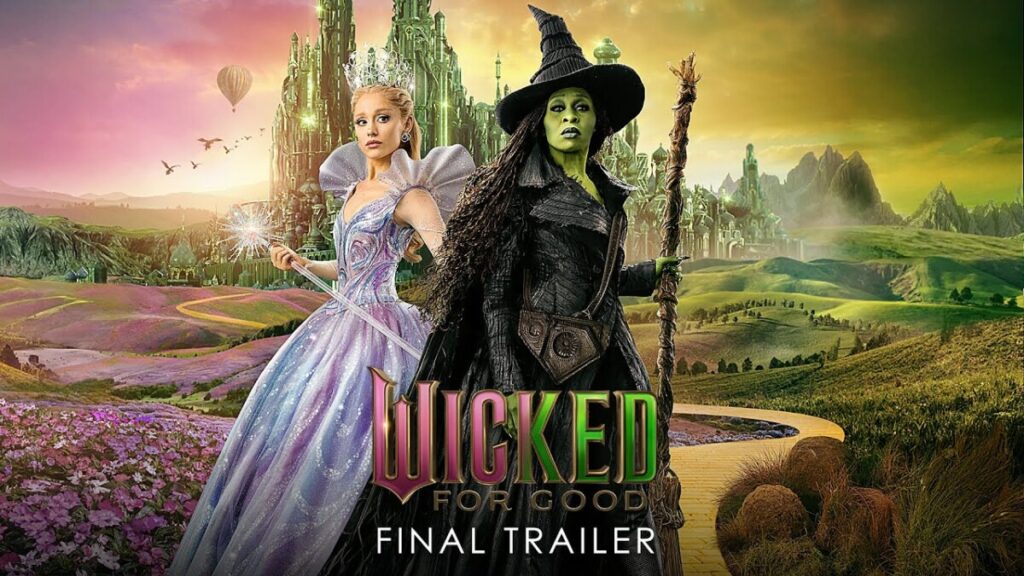
An experience that I had recently that reinforced this phenomenon was my when I watched the movie Wicked: For Good. Having studied the elements of a musical along with the mise-en-scene from Dancing In The Rain, I spent a good chunk of the movie hyper focusing on the costume choice, dialogue, and various whip pan transitions of Elphaba screamign about Fiyero while flying around Oz on her broomstick. In that moment, I realized how much this class really reshaped how I engage with storytelling. Every film, every scene, every quick-cut TikTok suddenly feels layered with intention, style, and technique that I never would have noticed before. The frequency illusion has ultimately enriched the way I see things, and while a part of me misses having the ability to watch things “just for fun” I’m grateful that I’m now able to analyze the craft I’ve had a passion for. The lessons taught within this course have shown me the artistry and patience woven into every frame, upholding the child in me.
To be honest, I didn’t love this movie as much as I thought I was going to. With 96% on rotten tomatoes, and over a 4 on Letterboxd, I thought that I would walk out of this movie thinking it was one of the best films I’d ever seen but instead I left with the ultimate consensus that I do not like action movies and some questions. After reading this article, I began to wonder how the writers thought including a love story subplot between the woman holding Malli captive and the man trying to get her back was a good idea. This film constantly is pushing this anti colonial message with both main characters fighting against the oppressive system they are in in their own ways, however during Rams revolutionary fight, he catches feelings for the woman holding Malli hostage. What made it harder to watch was the fact that they didn’t even speak the same language and there were countless scenes of her just talking..at him. He would frequently respond that he couldn’t understand her at all but she would keep talking, it was honestly sad. It felt like she caught those feelings because people don’t really listen to her so she enjoyed having someone who was “listening” to her. This article explores the dangers of watching this movie with a close eye because of the political issues within it that someone with no context would totally miss. It brought to my attention how violence is used in this movie, it makes note of the fact that when British characters are hit it is cartoonish and doesn’t have nearly as much realism as the violence against Indians, while also noting the hints of Hindu nationalism within the film. Overall, this article begs watchers to pay attention to the history and politics in India and pay attention to the messages being shown throughout the movie instead of just simply watching it.