Category: Searcher

  • The Role of Hansel and Gretel in The Zone of Focus

    Watching The Zone of Interest for this week, I was so drawn to the scenes of a girl under an x-ray, night vision filter placing apples and pears into the ground. These clips were so separate from the typical cinematography of the rest of the film. Jonathan Glazer maintains his pattern of long takes, but the difference in color is more than notable. What I also noticed in one of these sequences is that the audio is a continuation of Rudolf reading the story, Hansel and Gretel, to his children before bed. Then I was like–Woah. Is Hansel and Gretel Nazi propaganda? Here’s a link to the fairytale again for those who need a refresher. I had to look into this, because I had never heard about it being used in this way. There is no journalism focused on the use of Hansel and Gretel in the movie past a couple of Reddit posts, so here come some articles that touch on its usage:

    Embedded above is an article from Film Quarterly. It mentions that, “When crosscut with Höss reading Hansel and Gretel to his children, the scenes of resistance take on an ethereal, fairy-tale-like quality that seems at odds with the film’s overriding resistance to sentimentality” (Amy Herzog, Film Quarterly). I thought this was an interesting thought, and likely mirrors Glazer’s direct intention of including the fairytale. The act of resistance being leaving a trail of apples as a parallel to the trail of bread crumbs in Hansel and Gretel is such an interesting choice. In Nazi propaganda, Hansel and Gretel were made to represent two blond German children, and the witch a Jewish person who is ultimately burned alive in the oven she tries to cook the children in. By including this trail of apples, Glazer mocks that propaganda and creates an entirely different, benevolent narrative.

    Here’s an article from Vanity Fair. In this interview, Glazer reveals that the girl with the apples was a real person, whom he met when she was 90 years old! Although the film does not explicitly disclose what is based on a true story and what isn’t, there are many characters that are based on real people, including this hidden hero.

  • Under the Skin’s use of Non-Actors

    As we began to explore in class, Jonathon Glazer, to the best of his ability, implements a level of attempted reality in his films. In The Zone of Interest, Glazer used secret cameras and microphones to keep actors from acting in a certain direction, worrying about their positioning, etc. The sense of realism is extremely effective in the film, as it allows us to understand the fact that the Höss family, and especially Rudolf, were real people and not just puppets of the system following orders. Rudolf was a real individual who understood the implications of his actions and carried them out anyway. I believe that although some people criticize the film for being too sympathetic towards the family, the hidden microphones and cameras actually contribute to the better understanding of their atrocities. Glazer’s desire to attain a real, untouched feeling that distances itself from “acting” extends past The Zone of Interest, as his 2013 film Under the Skin actually takes it a step further. Under the Skin is an unsettling horror film starring Scarlett Johansson. The reason that the film is so unsettling is that many of the characters were being played by people who didn’t know they were being filmed. The film follows an alien (played by Scarlett Johansson) as she seduces and captures unsuspecting men (played by non-actors)

    This 1 minute 38 second long interview (https://www.youtube.com/watch?v=S8MbvKqHWM0) with Jonathon Glazer breaks down an individual scene in which Scarlett Johansson interacts with real people walking down a Glasgow street. Glazer describes his reasoning of using non-actors as to show “human kindness and how we help each other up when we fall”. However, another reason for his use of non-actors is to show human temptation and how easily we are willing to give into it. This is interesting to me because it is clearly mirrored in The Zone of Interest. I think a large part of why Glazer used similar techniques in The Zone of Interest was to establish an unsettling sense of kindness and family values that exist within the Höss family, but then at its core, the realism that exists within the Höss home also shows how unforgiving their actions are. So the realism that Glazer implements in both films demonstrates the double-edged sword that is humanity.

  • Douglas Sirk: The Great Melodramatic Philosopher

    The moment the end credits rolled in, All That Heaven Allows, I was fixated on two aspects of the film. The first being the implementation of the deer, which seemed to keep reappearing when I least expected it, and the second being my amazement at how powerful this tale of female individualism told in the 1950s was. I was curious to learn of the creative who put this together, and decided to do so in a melodramatic fashion. In a 2015 article, film critic Richard Brody writes about Sirk’s work as a director Sirk’s work as a director in The New Yorker Magazine, highlighting his thematic contributions to history as “crackpot philosophers and identity-shifters” (Brody). Sirk built a world in his films in which his characters were outsiders to their societies, but made monumental changes that took a philosophical stance on society and all of its dysfunctions. Sirk was known for his melodramas, and his comedic ability. He creates movies about widows, career oriented women, children, and racial injustice, among others.

    His stories are presented in this melodramatic fashion as a way to express complex and underrepresented realities, but with a genuine lesson attached to them. Take All That Heaven Allows for example, a film seemingly about a love affair between an older widow and her younger gardener. The scene where the film’s protagonist, Cary, finds a copy of Henry David Thoreau’s “Walden” and not only reads but discusses a portion of the book’s message to march at the beat of her own drum displays how “Sirk doubles Thoreau on himself, showing American philosophy not as an academic discipline but as the residue of a way of life, a trace of vital and ongoing experience” (Brody). Sirk is not only imparting life lessons on his characters, but he is doing so to his audience in a way that is tangible and relatable. American philosophy would be easier understood from a melodrama, rather than a textbook. Sirk is also giving Cary a permanent solution in this film, one where she and Ron choose to live away from both of their lifestyles in their new home, rather than a temporary rebellious moment for a happy movie ending that the audience knows would realistically never work.

    As Brody describes the different films that Sirk has created, the consistent theme of self-determination is apparent. He focuses on an American dream tale that is not commonly told, but still possible. In Week-End with Father (1951) there is representation of a woman wanting to continue her career even after marriage and having children. In Imitation of Life (1959), Sirk addresses the racial inequities in Hollywood cinema and calls out codes of silence. Brody states that he does not simply contribute to cinematic history, but to the history of thought as a whole.

    I wonder if the political climate of his time made a lot of the messaging in his films more subtle, or if you think that the use of melodrama helped Sirk to make his messages almost too glaringly obvious? Was the dramatic storytelling a way to share his philosophical ideas, or were they a deeper layer in his film?

    Link to article:

    https://www.newyorker.com/culture/richard-brody/douglas-sirks-glorious-cinema-of-outsiders

  • “Continuity is the only way”

    This week’s reading emphasized how editing shapes a film by manipulating the elements of time, space, and emotion through the arrangement of shots. Chapter 6 taught us the four relations that link one shot to the next (graphic, rhythmic, spatial, and temporal) and showed how these relations typically work to create continuity.

    Continuity is often treated as the “correct” outcome of editing. Breaks in continuity are usually labeled as mistakes because filmmakers are expected to maintain details and screen direction consistently so that the story feels seamless and believable. A film that is seamless is said to allow its viewers to follow the story and connect emotionally without distraction. This week’s feature, Douglas Sirk’s All That Heaven Allows, is a strong example of this system at work, using techniques like dissolves and fade-ins to maintain clarity and flow. While there are many examples of continuity, I wanted to explore the other techniques, such as the purpose of non-continuity, focusing on whether it could create the same emotional connection that continuity does.

    Although continuity rules mainstream cinema, many filmmakers decide to break continuity intentionally to serve meaning and express a certain mood. I came across this video by Thomas Flight, which explores how non-continuity can be as expressive as continuity itself.

    Flight argues that what looks like a “mistake” may actually highlight emotional intensity, realism, or psychological conflict. He explains how, in these moments, filmmakers sacrifice seamlessness to convey something more powerful.

    One example he mentions comes from The Bear. In a scene where Carmy is lost in the chaos of a high-pressure kitchen, the image suddenly cuts to a close-up of a small pilot flame, overlaid with the smiling face of his ex-girlfriend Claire. The shot disrupts continuity, but it visualizes Carmy’s inner turmoil. The flame embodies the heat and pressure of his career, while Claire represents the happiness he feels he has lost. This moment, brought by breaking continuity, deepens the audience’s understanding of his conflict more than a “seamless” edit could.

    (I included a screen recording of the scene since I could not find the clip on YouTube )

    My takeaway is that breaking continuity is not always an error, it is also a way for filmmakers to use editing to show emotions and guide the interpretation of a story. Therefore, the next time you spot a “mistake,” ask yourself if it was purposefully placed into the film to convey/explain a certain emotion.

  • Douglas Sirk’s Imagination Command

    While watching All that Heaven Allows (1955), I kept thinking about how it was supposed to be a “bad movie”. It is a “weepie”, it is unserious, it is “trash” (as director Sirk would positively call it later). I was so interested in the Sirk quote we looked at together—about crazy trash being much closer to high art than we’d like to think—that I went looking for more of his interviews.

    I found an absolutely fascinating 1-minute interview clip on the Criterion Collection’s website. It’s linked here: https://youtu.be/z02M_qbTbDA?si=-BiYflIbLpltSTne

    This interview, while not directly concerning All that Heaven Allows, is very much a commentary on it, and Sirk’s other “bad films”. He rebukes this “bad” claim, offering his own set of criteria as to what makes a film good or bad: it must have imagination, must be interesting, must have a theme, must be consistent, and must trust the audience just enough (which is to say, not at all).

    What I like the most about this clip, and his criteria, are how they end. Sirk moves from talking about imagination—that every film must have one, that a film without one is a waste, or not even a true film (piece of art) at all—to talking about why he makes “bad movies”. According to him, he makes “preaching” movies: the antithesis of bad.

    ”The moment you stop preaching in a film, the moment you want to teach your audience, you’re making a bad film.”

    Sirk seems, here, to be eschewing the concept of subtlety in film, and based on All that Heaven Allows, it seems that he followed that command. Whether it is the treacherousness and turn-facedness of the children, the incessant nature of the friends, or the unending charm of Mr. Kirby, nothing in AtHA is subtle. Every emotion and character is a metaphorical brick to the face of whatever emotion Sirk wants you to feel. It calls back to something else he said in the interview

    “[A movie] should have its own kind of finish, its own kind of theme”.

    All that Heaven Allows has finish. It has a theme. And it’s certainly enjoyable to watch. In the wake of AtHA, can we really deny Sirk’s definition of good and bad? And if we enjoy AtHA, why would we?

  • The Editing Mistakes Behind Bohemian Rhapsody

    This video essay serves as an excellent lesson on how not to edit a scene, and in doing so highlights the mistakes you should avoid. The creator, Thomas Flight, breaks down the editing of a dialogue sequence from the movie Bohemian Rhapsody.

    The three key mistakes Thomas points out in this scene are:

    • Lack of motivation
    • Broken spatial continuity
    • Poor pacing

    Lack of Motivation:
    Thomas shows that many of the cuts in this sequence lack motivation, since they don’t provide new information. Instead, we see the same reactions or actions repeated, which makes the cuts feel redundant and unnecessary.

    Broken Spatial Continuity:
    This scene makes clear how crucial spatial continuity is. Thomas demonstrates this with the example of inconsistent eye lines: characters often look in the wrong direction, or appear to be looking at one person while the next shot reveals someone completely different. He also demonstrates how rearranging or simplifying the sequence of shots can create better spatial continuity.

    Poor Pacing:
    The scene is 104 seconds long and contains 60 cuts, resulting in an average shot length of just 1.8 seconds. For comparison, an action scene from a Transformers – The last Knight is 136 seconds long with 49 cuts, concluding to an average shot length of 2.8 seconds. Therefore, Thomas shows that the pacing of this normal dialouge scene is way to quick, making it feel unnatural and rushed.

    The irony is that Bohemian Rhapsody actually won the Oscar for Best Editing. As this video essay illustrates, awards don’t always reflect quality in filmmaking.

  • Queer Identity and Rock Hudson in the 1950s

    I found an article from Film Comment called “Queer & Now & Then: 1955,” which examines All That Heaven Allows through a queer lens. It connects Rock Hudson’s closeted identity to the film’s themes of secrecy and social judgment, showing how later knowledge about Hudson reshapes the way we watch the movie. I think this perspective is valuable because it reveals how films can carry meanings beyond what their original audiences saw, especially when stars’ private lives come to light. The article is convincing because the movie already emphasizes the tension between private desire and public appearance, so Hudson’s real-life story deepens that theme. I appreciate reading a perspective that blends film history with cultural reinterpretation, making us see the film as more than just an exaggerated melodrama.

    What do you think about Cary and Ron’s struggle against social expectations being read as a metaphor for queer relationships hidden in the 1950s?

    Link: https://www.filmcomment.com/blog/queer-now-then-1955-rock-hudson-douglas-sirk-all-that-heaven-allows/

  • Animals, Mirrors, and Staircase Symbolisms: The Mise-En-Scène of a Melodrama

    Picture from mubi.com

    Douglas Sirk’s All That Heaven Allows is surely a classical demonstration of continuity editing, using lots of dissolves, fade-ins, and match-on-action, etc. The techniques of shooting/editing is also our main topic for this week.

    However, when I was watching the film, I cannot help myself from thinking about the mise-en-scène, particularly the symbolisms of each prop/object. There were lots of occasions when we see one’s facial features clearly but not the other one (due to lighting), when the two of them were having a conversation. Why is that? There were also different animals that appeared, including pigeon and dears. Why these animals? Mirrors also seem to be symbolic. Why did the production team make these choices?

    Hence, I searched up an analysis of the mise-en-scène in All That Heaven Allows and found a really interesting article: All That Mise En Scène Allows: Douglas Sirk’s Expressive Use of Gesture.

    Screenshot from the film at time 00:21:31.

    The Sirkian Staircase

    The article talked about the scene when Cary visits Ron’s mill for the first time. As she tries to ascend the stairs, a pigeon flies out, causing her to lose balance and fall into Ron’s arms. The article claims the half-climbed steps as a common device used by Sirk. Although Cary has made the decision to walk on a path that would deviate her from her previous Bourgeois lifestyle, she is only capable of proceeding halfway into Ron’s Bohemian lifestyle. This foreshadows how she had to give up marrying Ron for consideration of her children and her community’s comments.

    Ultimately though, she did fall back into Ron’s arms, in this mill which would later turn into a bedroom.

    Animals

    Speaking of pigeons, I was also confused of its possible symbolic meaning, as well as the deer that appeared multiple times. The article provides an insightful explanation.

    On Ron’s car, there is a scene when Cary hesitates her marriage with Ron. When Ron speaks how a man has to make his own decisions, Cary responds that “And you want me to be a man”. The article claims that what might be truer to say is that Cary wants Ron to be a woman. The movie ended with a shot of Ron laying on the bed then pivoting to a deer outside the window(an animal that is associated with Ron). If the pigeon represents Ron’s challenging sexuality, then the deer implies that the male has become a “meekly submissive creature, signaling Cary’s transition from passive object to dominant subject.”

    Mirror

    Screenshot from the film at time 00:06:22.

    In a review of All That Heaven Allows by criterion.com, All That Heaven Allows: An Articulate Screen, a specific occasion where mirror appears is discussed. This is when the audience first get introduced to the children. On the very right stands a vase containing the branches Ron cut for her earlier, where on the left we see Cary. However, between the branch and Cary intrudes the 2 children. This also acts as a foreshadow of how later in the film Kay and Ned would stand against the marriage between Cary and Ron.

    Screenshot from the film at time 01:15:36.

    Later when Cary and her children celebrates Christmas, Ned bought a television for Cary, with the deliveryman saying “Life’s parade at your fingertips,” but ultimately serves as the “last refuge for lonely women.”

    Library of Congress Film Essay, An academic paper published by the University of Kent, commented this scene by how accurately the deliveryman’s last line captured Cary’s state of emotion as she gazes emptily at the screen. “Yet to be turned on, the machine simply mirrors her own image: a woman lost, lonely and bereft, and something beyond a technological fix.”

    In conclusion, I think that the mirrors function as a reflection of the bourgeois culture. For the first mirror that got us to know Kay and Ned, the fact that Ron’s branches stood outside of the mirror’s frame tells that he is not part of the clubbing, partying culture. Having Cary emptily staring into the television screen, the film might also try to criticize the loneliness and solidarity beneath the bourgeoisie’s fancy socialization.

  • The Female Gaze in Film

    In contemplation of Portrait of a Lady on Fire, I thought a comparison to another recent movie which demonstrates the female gaze could be useful: Greta Gerwig’s Barbie

    If the Male Gaze envisions women as sexualized objects of desire, then the Female Gaze sees women as full, real human beings, as complex individuals. In adopting the Female Gaze, a difficulty that arises is how to navigate nudity, sexuality, and desire on screen. Gerwig’s Barbie sidesteps that issue and decides to emphasize that women (and men) are complete individuals who are not defined by their sexual or romantic relationships. Ken, in an obvious reversal of typical gender structures, tells Barbie, “I just don’t know who I am without you” and “I only exist within the warmth of your gaze.” Ken also cited the way others define him as part of a pair, saying, “it’s ‘Barbie and Ken.’” Barbie challenges that construct, saying, “Maybe it’s Barbie and it’s Ken.”

    The happy ending of the movie isn’t the boy and girl getting together, it’s the boy and the girl learning how to stand on their own and be happy independently. When Ruth took Barbie’s hands to show her what it means to be human, none of the images in the montage depicted relationships between men and women. There were children, there was a women laughing, a woman playfully kissing her friend on a couch, a woman playing in a pool, a woman skydiving, bowling, putting on makeup, and there was even a brief shot of a woman in what appeared to be a wedding dress— but there were no men. The implication seemed clear to me: there is more to life for a woman than heterosexual romantic love. The way Barbie talked about becoming a human rather than a doll also sounded a lot like breaking free from the limitations of the male gaze. She said she wanted to make meaning rather than being the thing that’s made. “I want to do the imagining. I don’t want to be the idea,” she continued. With all this in mind, I think Gerwig’s movie is a powerful denunciation of the male gaze.

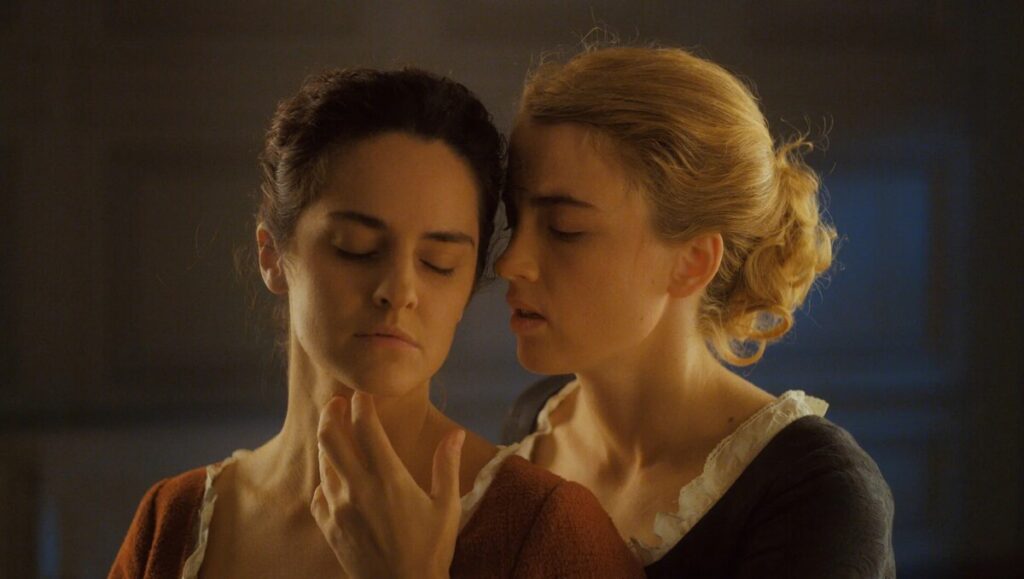
    I found the lack of nudity or sex scenes in Barbie refreshing, given film’s long tradition of stripping and sexualizing women under the male gaze. But Portrait of a Lady on Fire shows that that a film can maintain a feminist point of view and a female gaze while incorporating sexuality and nudity. The scene where Marianne sat naked in front of the fire initially worried me. It seemed unnecessary to have her be fully nude, and I wondered what the purpose was. She just sat by the fire, warming up, smoking a pipe— apparently at ease and comfortable in her own skin. I’m still not entirely clear on the point of this scene, but I suppose I appreciated that it showed her body outside of a sexual context. Putting this confusing take aside, I thought the way the relationship between Marianne and Héloïse was captured catered more to women than to men. The film showed their knowledge of each other and their emotional intimacy, and the more sexual scenes were slow, sensuous, reciprocal, and tender. The movie allowed both women to embody desire without degrading their agency. Actually, their sexual relationship seemed to be a powerful expression of their agency, as they seized upon a brief window of freedom and acted upon their own desires.

    In Barbie, the focus was independent identity and agency, and sexual desire wasn’t really dealt with. In Portrait of a Woman on Fire, a sapphic relationship allowed women to act upon their sexual desires in a way that enhanced their agency. After watching Portrait of a Lady on Fire, I wondered if there was a movie with both the female gaze and heterosexual desire as beautiful and feminist as Portrait of a Lady on Fire. No one movie title immediately sprung to mind. Is it even possible to fully realize the female gaze with a male-female relationship that may at some level always have inequality baked into it? I found this BBC article, “Top 100 films directed by women: What is the ‘female gaze’?,” and maybe there is such a movie listed therein— it bears further investigation! I hope my classmates might also enjoy pursuing this list! https://www.bbc.com/culture/article/20191127-the-100-films-directed-by-women-what-is-the-female-gaze 

  • Greig Fraser’s Cinematography in The Batman

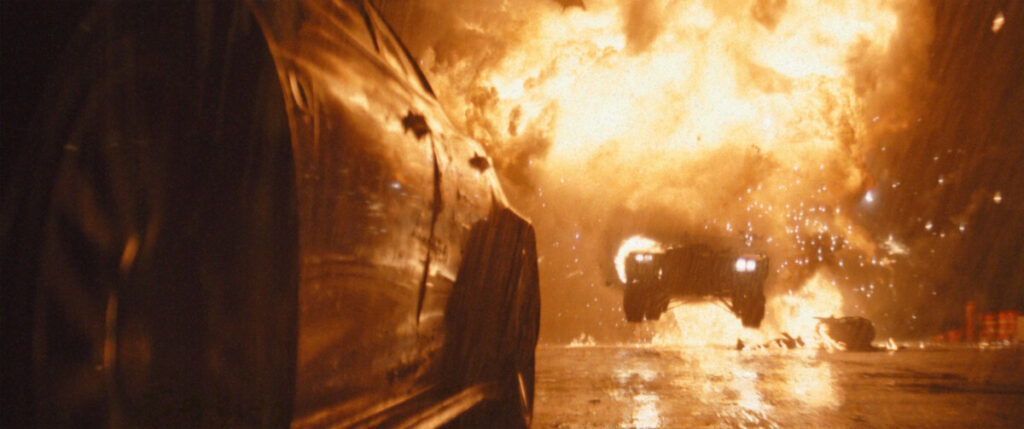
    This week’s reading focused on the idea of cinematography not only being a practice of recording an event but also making choices based on light, framing, exposure, or movement, affecting how we see and feel a story. This notion came to mind while I was reading an interview with Greig Fraser, the cinematographer for The Batman (TheWrap). Fraser discusses how he approached the film as an “urban noir” in which darkness is not an absence; it’s an environment that is punctured strategically with small pockets of light. These choices are almost a textual study of tonality and exposure. Batman, for example, often emerges from darkness not because the frame is crudely underlit, but because Fraser provides just enough light on the eyes or the texture of the suit that gives us a presence we can read.

    What I find remarkable is how these choices orient our understanding. The reading indicated how framing and lens selection can shift our relation to the space to make you feel more included or excluded. Fraser anchors even the action sequences in point of view, for example the car chase scene, which doesn’t overwhelm with spectacle but places us inside the Penguin’s perspective (which in turn enhances the fear Batman’s character is supposed to embody in this movie). As a result, we are not only spectators of the action, but we are also more connected to the characters.

    Some reviewers claimed that the film was “too dark,” which shows the risk of pushing contrast and shadow too far. But Fraser’s work strengthens the principle that cinematography’s role is not decoration but narration. Light, contrast, and framing all become instruments of meaning: Batman as a figure always partially obscured and disclosed, someone we can glimpse but never fully know. The interview reveals how much craft undergirds that sensation, and it offers a good embodiment of what our reading this week refers to as “writing in movement.”