Jean Jacket from Jordan Peele’s NOPE is nothing like anything we have seen or could even imagine; quite literally an out-of-this-world kaiju creature. It is worth noting, however, that Jordan Peele consulted a plethora of scientific experts, such as marine biologist Kelsi Rutledge, to create the creature.
Rutledge used many existing marine animals as inspiration for Peele’s creative vision. The general saucer shape is inspired by sand dollars, it’s camouflage from cuttlefish, unfurling from bigfin squids, and it’s square shaped eyes from octopuses. Rutledge even grounded the creature in taxonomical nomenclature by giving it a name: Occulonimbus edoequus, meaning “hidden dark cloud stallion eater.”
So why does a mythical, otherworldly character need to be so grounded within earth’s limits? It is to be noted that such real-life elements are not blatantly associated with Jean Jacket within the confines of the film’s narration (OJ, for example, doesn’t say “it looks like a sand dollar” or anything of the sort). It is, however, interesting how real life elements come together to make something so strange that a human mind free from any grounded influences could not make something stranger. I think this speaks to human nature and psychology. Historically, familiar mythical creatures did not come straight from imagination, but the misinterpretation of real life animal remains. Dragons, serpents, and cyclopses all originate from strange fossil remains. Hybrid creatures, or chimeras (which Jean Jacket arguably is) have existed for millennia. I think it says something interesting about human nature: our thoughts in a vacuum are surprisingly grounded in reality, but when confronted and inspired by reality itself, they go to unimaginable places. It humorously reminds me of the idea that crazy things happen in movies, but some things in movies are so crazy, they have to be inspired by reality.
As interesting to think about as all of this is, I think it is also interesting to think about fact that Jean Jacket, a creature Peele intentionally wants to be ambiguous, has “lore.” Just reflecting on my own actions, I curiously went online after the movie to learn more about Jean Jacket, found all of this information, and found like minded people who were as interested in Jean Jacket as I was. I even found this creative depiction of Jean Jacket-like creatures created by @monstatron, inciting a Jean Jacket fandom.
Why do we try to make sense of Jean Jacket at all? Why does Jean Jacket even have a scientific name? I think that subliminally, Peele’s understanding of human nature allows him to manipulate audience’s understanding of the creature inside and outside of the theatre. People want to make sense of what is not meant to be understood, and will look for ways to re-enforce a stable point of understanding. I also think that it speaks to the creation of fandom and how ambiguity allows the audience to fill in the gaps.
I have been a practicing Hindu from birth, and growing up with Hindu parents and being surrounded by Hindu culture, much of its imagery and teachings have been familiar with me for a long time. I would not consider myself a deeply “religious” person, but I do follow my own type of Hindu faith and I am familiar with most elements of Hinduism.
Watching RRR, and following the discussion we had in class, made me think of the use of Hinduism in film and politics more critically, especially as a nationalist tool to promote discrimination and oppression. Hinduism has close ties with entertainment for years and years, but it is interesting how Hinduism, more so than any other practicing religion, is used in this manner. It is true that many films incorporate elements from other religions, even in fiction (one film that comes to mind is Ben-Hur 1959), but few films fictionalize the religious elements of the films themselves as much as Hinduism. For example, Ben-Hur‘s narrative sticks closely with recorded and accurate events of the divine even if the rest of the plot is fictional. In RRR however, both Bheem and Ram (both characters symbolically, metaphorically, or physically reincarnations of the Pandava prince Bheem and the avatar of Vishnu Ram) are put in stories never depicted or imagined in the Mahabharata or Ramayana (in fact, according to most agreed studies of mythology, the two lived at least a few thousand years apart from each other).
All of this raises the question of why Hinduism is so malleable, and I think a lot of it has to do with its formation, structure and practice. Being several thousand years old and without a founder and unifying text, Hindu has long fostered an idea of individual interpretation amongst a collective Hindu culture. This is especially highlighted in two elements outlined in Hinduism: the ambiguity of the Divine and the different schools of thought fostered by Hindus. Hinduism itself presents its subjects and texts with moral ambiguity.The Mahabharata is a great example of this, in which a story in which a clear dharma and outlinable “heroes” and “villains” are challenged with the ethically questionable actions of those on both sides; heroes sometimes commit villainous actions and tactics, and villains sometimes show more dignity and principle than their “good” counterparts. Physical ambiguity is also present in Hindu texts; the Vedas question the universe’s coming to existence and even god’s involvement or knowledge of it, stating “He knows— or maybe He does not know ” (Rig Veda, X. 1291). Different Vedas even frequently contradict each other, yet at the same time coexist in harmony as part of Hinduism as a whole. Within the very framework of Hinduism, ambiguity and different interpretations are established and welcome, encouraging individuals to find god and interpret faith in their own way through their own practices. This is further emphasized by the different schools of thought created through subcultures and interpreters, from Buddhism’s compassion and detachment to Charvaka’s material ambition and atheism, all of which are valid and accepted practices by Hinduism (it’s to be noted that Hinduism in practice and theory aligns with all other religions, including monotheistic religions such as Christianity and Islam, to co-exist as equals).
With all of this in mind, it is interesting to see how Hinduism in RRR develops in the larger sphere of Hinduism in India, including political nationalism. India’s population is a Hindu majority (roughly 80%) and the religion has developed alongside Indian society as part of a cultural ecosystem for over three thousand years. Along with the creative and interpretative fluidity of Hinduism, it is no surprise how Hinduism has embedded itself in almost everything, including art, storytelling, lifestyle and politics. It is exactly this fluidity that enables Hinduism to be transformed into a nationalist tool in the modern era. Its origins stem from colonialism, as it was a method to unite the Indian people under a single unifying influence. The irony, of course, is that Hinduism isn’t really a “unifying” religion; as mentioned before, its vast interpretive heterogeneity suggest a more personal than national connection. Since 2014, the Bharatiya Janata Party (BJP) and prime minister Narendra Modi have employed this religious nationalism as part of a superconservative agenda, most specifically in the Rashtriya Swayamsevak Sangh (RSS), a volunteer paramilitary organization that has extremely close ties with fascist ideology. By cherry picking elements and re-interpreting Hindu tradition to justify actions, Hinduism can be weaponized. One of the most telling principles is the idea of “Cow Politics.” The idea, stemming from the Hindu reverence toward the cow, is used to mask political insufficiencies through religion. It encourages practicers to ignore societal and political problems and instead worship god, which will “remove all problems,” blurring the line between mythology and reality. This effectively silences political opposition of wrongdoings with the misguided appeal of nationalism. I have also seen the “how dare you insult religion!” argument used to quell critics of the national regime as well. RSS has been involved in multiple terror attacks and riots against Muslims, and has been the forefront societal and political influence on Hindu supremacy.
Seeing the religion that I love be twisted in such a way is terrifying. Yet the incredible thing is that, despite it’s hateful nature, Hinduism in theory considers such nationalism as a valid way to practice the religion— it is simply another interpretation, amongst several others, that contributes to the collective Hindu manifold. As stated earlier, Hinduism is accepting of other religions such as Islam, yet is also accepting of ideologies that degrade and disavow Islam as well. It highlights a weakness of the religion; without a clear moral framework, it can be manipulated in a way that both divides people and creates an agenda backed unity. I think that it is important for people to recognize the prejudice laced within modern Hindu nationalism and remember the importance of individualism. People have the ability to believe what they want, and do not need someone else to tell us what they must believe in. In fact, millions of Hindus interpret the faith in ways rooted in empathy, coexistence, and personal spirituality rather than nationalism. Re-embracing these interpretations, and encouraging open conversations about how power distorts religious meaning, can counteract the narrow vision promoted by extremism. If more people approach Hinduism with critical awareness and a commitment to its pluralistic spirit, the religion can continue to evolve without becoming a vessel for oppression.
Considering the complex and divisive nature of this topic, I may have overlooked some elements, misinterpreted some events, or provided a narrow or biased viewpoint on some topics. If so, or if any clarification is needed, please leave a comment.
In researching RRR and other Tollywood movies this week, I kept thinking about the ending section of the movie, in which Raju Rama is shown to be an incarnation of the actual Hindu God Rama. In a Western cultural context, this seemed absurd––if a character in an action movie turned out to secretly have been Jesus or Moses the entire time, it would undoubtedly be met with eye rolls and and bad reviews from the audience (if played straight).
In RRR, Raju Rama being Lord Rama just happens as part of the movie. Why? What? I needed to know.
There is no prohibition or social taboo against presenting Gods on screen in South India, and there is a concern that younger people do not relate to Hinduism or it’s Gods. Therefore, to get them back in the fold, and to present broadly-known cultural agendas on screen, there are Gods. A lot of Gods.
I’m currently watching a multi-episode documentary about the Nazi regime and the Second World War. It traces Adolf Hitler’s life from his birth in Braunau am Inn, through his years in the German army during World War I, and on to the rise of both his political career and his party, all the way to his death.
According to the article, the documentary is meant to appeal especially to a young audience through its combination of original archival footage and newly staged scenes. According to surveys, apparently 63% of Millennials and Gen Z in the United States do not know that over 6 million Jewish people were murdered in the Holocaust. The documentary was deliberately created to close this massive knowledge gap, especially among young people. However, this makes me wonder: in such a case, hasn’t the education system failed? Shouldn’t it be the responsibility of teachers to convey such a dark and important chapter of human history to students? That does not seem to be the case, and so a by Netflix produced documentary must now take over this job.
However, I see the problem that films and series cannot treat such a topic in a sufficiently thorough or approachable way. For such an important topic like this they should be used to build on existing knowledge and to gain new perspectives. Simply watching one documentary about National Socialism and thinking that this is enough is a misconception. A subject like this needs to be worked through carefully, and the historical background must be fully understood. I consider this knowledge extremely important, especially now that fascist tendencies in the politics of some Western countries are increasingly resurfacing.
I recently had the pleasure of rewatching Spike Lee’s Do the Right Thing (1989). Amidst the comedy, heartbreak, and social commentary, I was left asking one question–what is going on with Vito (left)?
Vito (played by Richard Edson) acts as a foil to his brother, Pino (played by John Turturro). Pino is brash, openly racist, and cruel to Mookie. He repeatedly says the n-word, bashes Bed-Stuy as a neighborhood, and more. Relatively soft-spoken Vito is the opposite: kind to Mookie, and defiantly anti-racist (by which I mean he is the one major white character in the film who never says the n-word).
Pino bullies Vito constantly, sometimes physically harassing him. He pushes back, but never majorly, especially granted the advice he’s being given by Mookie (namely to beat up his brother).
This refusal to push back is exemplified at the end of the movie–really, in this shot:
As Mookie is about to cross into the rioting crowd, we get a glimpse of Vito, looking sullen more than angry, yes, but sandwiched comfortably between his brother and father, his allegiance to his group––his race––never in question. Despite his friendship with Mookie and more positive view of the neighborhood than his brother and father (being the only one of the family to actually leave the pizzeria during the events of the movie), Vito’s final placement falls along racial lines.
This ties into the broader theme of the movie about race as an inescapable, inexplicable feature of personality and life. Vito may have been the best white person, but he was still a white person. I am curious, though, about what everyone else thinks––is that pivotal shot mostly an accident? Do I give Vito too much credit, even?
I found myself wondering while watching Do the Right Thing how a film is shot in one location and the challenges that accompany that. Dickerson answers this question in the interview, which I thought was really interesting:
“I knew our biggest challenge was going to be shooting over eight weeks and making it look like one day. We looked for a street that ran north-south. Since the sun travels east to west, one side would always be in shade. That way, when we had to shoot on cloudy days, I could just make it look like we were in the shaded side of the street. That really saved us, because the first two weeks we had a lot of rain. Some shots where it looks sunny – you can actually see rain if you look really hard.”
Dickerson also talked about the films that inspired him and Spike Lee in the making of this film: The Third Man (specifically for the canted angles), Black Narcissus, A Matter of Life and Death, and The Red Shoes. The final three movies were all worked on by cinematographer Jack Cardiff whose use of color inspired Dickerson.
Canted angle in The Third ManCanted angle in Do the Right Thing
On the other hand, Giancarlo Esposito speaks on the attitude of the film industry regarding race during the time of filming:
“My background is half-Italian and in those days, being a lighter-skinned black man, I couldn’t get cast as a white person or a black person. So I was playing Spanish roles. This follows me to this day: a lot of people are shocked to realise Buggin’ Out and Gus Fring [from Breaking Bad] are the same person. So Spike gave me the opportunity to play black.”
I thought this was particularly interesting as the film is about racial tension in two specific demographics but this highlights tensions and stereotypes beyond that.
This chapter of Film Art introduces documentary, experimental, and animated films. Documentary films interpret reality to tell what is meant to be a nonfiction story. This can be a nonpartisan organization of information or an attempt to persuade the viewer into believing something; these are defined as categorical and rhetorical. Experimental films do not follow traditional narrative rules, but rather may focus on patterns of sound or light and may have an unconventional narrative or no story at all.
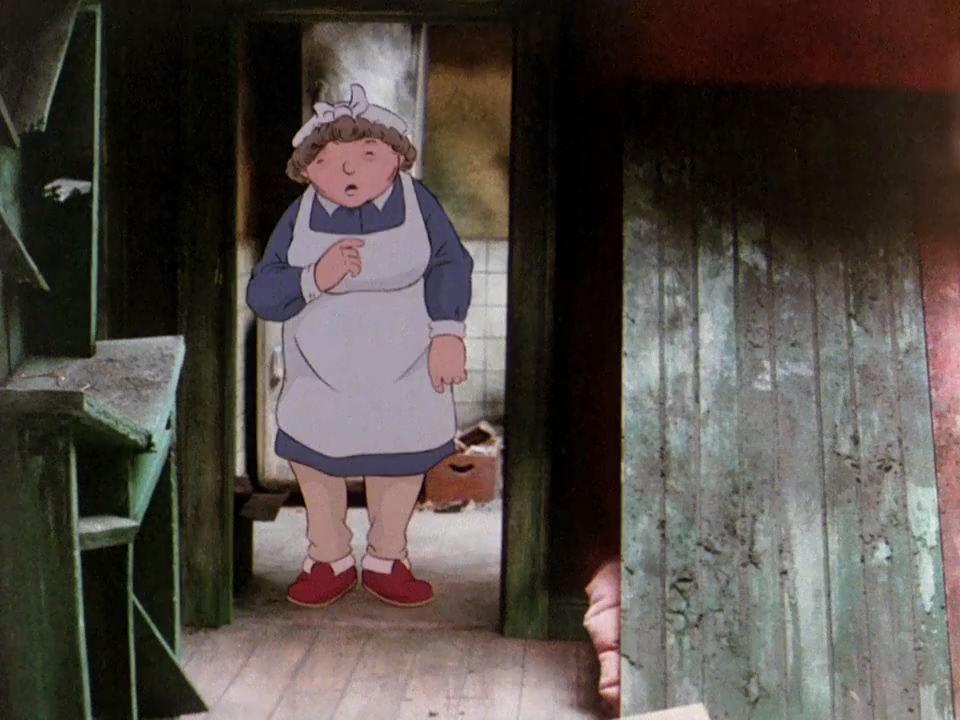
There are many types of animated films, but their defining characteristic is that it constructs reality by drawing, computer generating, or manipulating objects frame-by-frame. When I read this section in Film Art, I reflected on how a lot of animated media uses multiple forms of animation. One film that came to mind was Jimmy Murakami’s 1986 war film When the Wind Blows.
The film utilizes a mix of traditional and stop-motion animation, which creates a juxtaposing effect that is perfect for the message of the film. The two characters are drawn and animated with the process of cel animation. This is when clear sheets of celluloid (or “cels”) are drawn on and then layered and photographed. When these cels are shifted, it creates the illusion of movement. However, rather than a drawn background. This film uses sets made of real objects and adds the drawn characters in later. The objects in the set are animated to move as characters interact with them. This film is about the devastating impacts of nuclear warfare, but the characters are relatively oblivious to the danger they are in, which is displayed by the set around them mimicking reality as they remain drawn. There are even multiple live-action scenes in the film, such as when the bomb drops in the film. I don’t think this fully classifies as experimental but the use of mixed media definitely breaks traditional narrative rules.
Another animated movie that came to mind was one of my favorite animated films, Satoshi Kon’s Paprika. This film blends hand-drawn imagery (cel animation) with CGI, which is computer-generated imagery. This is an extremely surrealist film with an extreme amount of detail, and the CGI is used to aid the drawn animation to aid this effect and be more efficient. (https://www.tboake.com/manipulation/yeung/4films/paprika.html)
After reading the Guardian article about Paris is Burning, I think it raises a concern in documentary-making that I never considered. The documentary received backlash because the director is a white filmmaker making a film about a predominantly black/latino scene. This raised questions about cultural appropriation and lack of profit/recognition for participants in the film. This also highlights how, while documentaries are meant to be fully nonfiction, the experiences/identity of the filmmaker always matters as it can create bias.
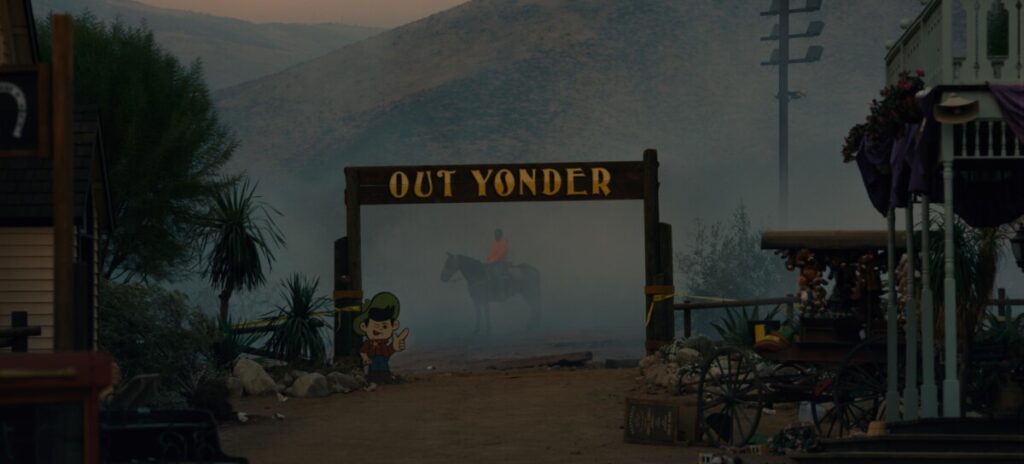
When discussing with a friend after class, there was a little bit of a debate on whether OJ was consumed by Jean Jacket or he miraculously got away in time. There was belief that OJ appearing at the end of the film in the hazy white smoke could be symbolic of his death, with the sine “out yonder” contributing to the belief of him being gone.
However, I believe that he is still alive mainly because of the trope “if you don’t see them die on screen, they are still alive”. This suggests not seeing any clips of OJ actually getting sucked up by Jean Jacket supports my claim that he is still alive.
In Portrait of a Lady on Fire, Schiamma uses cinematography to build an emotional world and this becomes very evident in the beach, a place with open framing and stunning landscapes that captures the brief freedom felt by Marianne and Heloise. A place where they can exist outside of the ticking clock that separates their romance and see each other freely.
The beach is more than a backdrop, it’s a constructed space that reflects freedom and intimacy. In contrast with the interior shots (tightly framed and dim lighting), the beach opens up into wider shots with natural lights and horizon lines. This shift in visual style matters as it crafts part of the tone of the narrative. It represents how their relationship is constrained indoors by social norms and surveillance while on the beach the cinematography offers expansiveness, mirroring their sense of freedom.
Additionally, the contrast between lighting can also be read into as one of the key features that build these converging atmospheres of freedom and constraint. On the beach, the light is diffuse, natural and less mediated, with a softness around characters. Compared to the effects of firelight indoors. The natural illumination makes their intimacy feel purer and almost utopian even though we know that this cannot last.
The beach is also a place for mutual observation where the female gaze becomes visible. The camera in these scenes mirror the equality through a centered framing. Staging also tends to be symmetrical and altogether this adds on to the utopian feel of that ambient where the characters can be seen without fear.
In essence, the beach in Portrait of a Lady on Fire is a visual embodiment of freedom, love and memory. Through open framing, natural lights and longer takes Schiamma transforms that landscape into an emotional space. When they return indoors the tone shifts back to restraint and surveillance, reminding us that what happens on the beach is real and temporary. A space of possibility that lives only through memory.
One of the most important elements within narrative is the degree of knowledge we as an audience are given as the plot progresses. This degree of knowledge often falls between restrictive, knowing as much as a character, and unrestrictive, seeing and understanding more than they do.
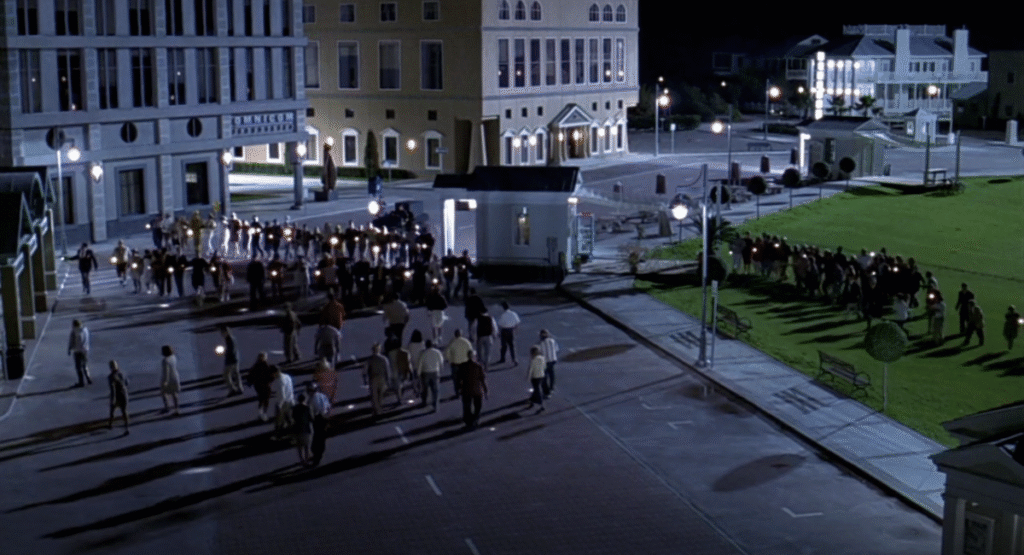
The film begins with a relatively restrictive plot centered around the main character, Truman. We as an audience are aware that he is in a television show through mild exposition in the opening, but for the first half of the film, we experience what Truman experiences. The film invites the audience to piece together the world of Seahaven and it’s intricacies by ourselves rather than exposition; from the sitcom-like interactions between Truman and the cast, to the oddities of glitching radios and falling lights hinting at the artifice. We are active participants of Truman’s gradual discovery that the world around him isn’t real.
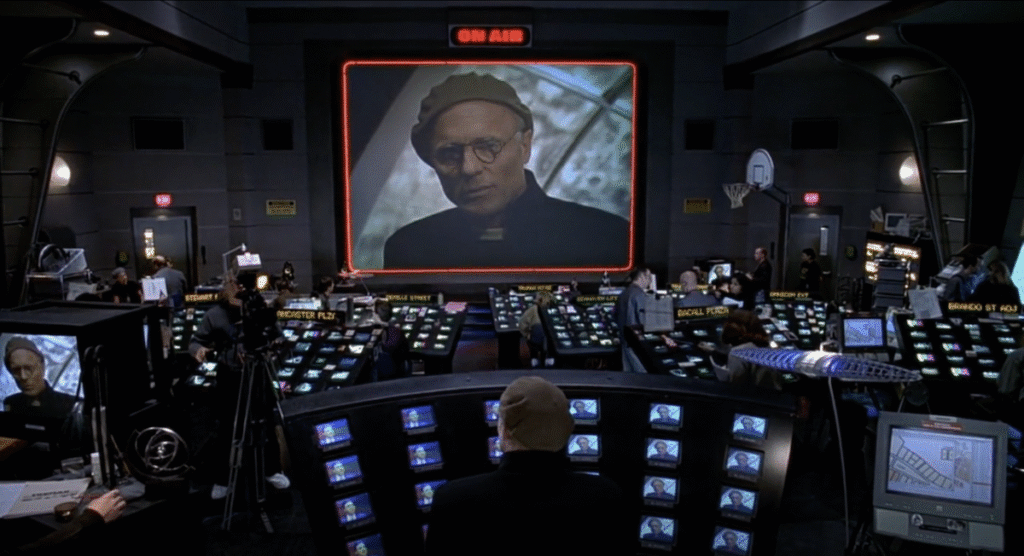
Around halfway through the movie, the degree of restriction drastically changes. During Truman and his “father’s” reunion, the film intercuts the perspective of Truman and the show’s control room. We meet Christof, the creator of the show, and his show-runners as they improvise the direction in real time. Shortly after, a news reel acts as exposition, fully fleshing out how The Truman Show came to be and operates. During an interview phone call between Christof and a former cast member Lauren, Christof tells her “we accept the world that is presented to us” when Lauren calls out the ethical injustice done to Truman.
Had the story began with an unrestrictive lens, Seahaven would simply appear less real from the beginning, and Christof’s thematic stance would appear more intellectual rather than emotional. Instead, the restrictivity allows us to emphasize with Truman, and make the central conflict –control verses freedom– grounded in Truman’s personal struggle instead of overarching ideology. For example, despite the Christof and the showrunners’ numerous attempts to present Seahaven and Truman’s life as “perfect,” we clearly see Truman’s emotional distress and desire for authenticity.
The climax of the film makes the most creative and powerful use of restriction. Truman decides to leave the island and conquers his fear of water as he sets sail. During the night, he sneaks out of the house, and none of the cameras –and by extension, we the audience– know where he is. The story is suddenly restrictive again, but with a reversal of power. We don’t follow Truman’s ignorance; we share the showrunners’. The film itself weaponizes restrictive narration against the audience, implicating us of the same voyeurism that it critiques.
The Truman Show ‘s manipulation of narrative perspective throughout its runtime ultimately becomes both its central storytelling device and its strongest moral statement.