I encountered an interesting video on YouTube of a more recent interview of Debbie Reynolds. She talks about how, surprisingly, she had no formal dancing experience when she was cast as Kathy. Thus, she had to undergo rigorous rehearsals, eight hours a day for two months, before shooting began.
I found this surprising because she plays such a convincing performance in the film, with her dancing being extremely technical and well-done. In the interview, she talks about her determination to keep up with her co-stars who had much more experience than her. I find this fascinating as it mirrors her character in the film; both are talented performers but had to work extra hard to prove themselves in an industry of veterans. Overall, knowing this detail now almost adds another layer of authenticity to the film.
screenshot from video
I also found it interesting in the video that they address there being two directors and how that worked in the making of the film. Reynolds talks about how Gene Kelly directed the actors while Stanley Donen mostly worked behind the scenes with the crew and cameras. Given the technicality both in the cinematography and the mise en scene, it is not surprising that they would divide and conquer.
screenshot from video
Ultimately, this video highlights the tedious work put into the making of such a grand film, reminding us how it has become such an acclaimed production.
Singin’ in the Rain (1952), directed by Gene Kelly and Stanley Donen, is a musical comedy about the fictitious Monumental Studios’ attempt to copy Warner Bros’ successful “talkie” movie. The movie is, in almost every way, about sound: the film is the story of a studio converting to movies with sound, it is itself a musical, and the second half of the plot concerns the dubbing of sound in a film. Singin’ in the Rain is also unique in using sound as a double metaphor: it is both representative of entertainment, and representative of real art––even as these things are seemingly put into conflict with each other.
Sound as Entertainment
Upon hearing the news that The Jazz Singer is a smashing sensation, studio head R.F. Simpson rushes to turn his in-production movies into talkies. This obviously frustrates the director, whose artistic vision is presumably compromised by this choice. At the very least, he’s clearly not thrilled to be taking on this new challenge. Simpson states that every studio is “getting on the bandwagon”, not even allowing his current productions to finish before making the switch. In this exemplative scene, we see sound in films running directly counter to art. Here, sound is for entertainment. It is for business.
Sound as Art
But sound isn’t only for business. Early in the film, we see the interaction between Don and Kathy, where she insists that silent movies are basically artless––that “when you’ve seen one, you’ve seen ’em all”. This sentiment is echoed later by Don’s friend Cosmo. Kathy, apparently a theater actress, argues that the conventions of silent film make it inherently less artful then theater, because theater has lines––spoken word. Shakespeare, she mentions, was a master of the line, and his plays are definitionally art.
Don, at first, denies this––then quickly comes to accept it. Sound eventually brings the movies closer to theater. Don’s terrible improvising is replaced with more soliloquy-type dialogue. The sound of the talkie makes the film more into art.
So is sound––talking––a force for entertainment, for art, or both? For a film that seems to pit these two forces against each other, I think it’s principle plot topic points to art and entertainment being far more aligned than they seem. I’d be curious to see what other films say about the matter, and what the writers and directors of Singin’ in the Rain say too; this middle-ground, both-can-work approach is interesting, unexpected, and possibly completely based in unreality.
This week’s readings, Sergei Eisenstein’s “A Dialectic Approach to Film Form” and Andre Bazin’s “The Myth of Total Cinema” both attempt to define the meaning of cinema. The two perspectives present very different ideas about the origins and purpose of film.
In “A Dialectic Approach to Film Form”, Eisenstein argues that the essence of cinema is conflict. He writes about how all art (poetry, music, architecture, etc) expresses conflict, and in cinema this is created through montage. Eisenstein’s view is that rhythm, dynamism, and intellectual engagement arise not from perfect representation of reality on a screen, but from intentional juxtaposition. In the text he uses the example of how a shot of workers being killed crosscut with a bull’s slaughter in Strike is more powerful because it transforms, rather than simply replicates, reality.
Bazin, on the other hand, believes that cinema is driven by the impulse to perfectly replicate reality, what is referred to as “the myth of total cinema”. His opinion is that each new technological development brings us one step closer to achieving total realism. He writes, “In short, cinema has not yet been invented!”. He claims that the better the technical aspects get, the closer cinema gets to its origins: the dream of recreating the world in its own image, with sound, color, and relief. So, in Bazin’s view, cinema’s history (silent film, black and white film) is a gradual fulfillment of this myth.
When thinking about these theories in relation to a film I recently watched, Cruel Intentions (1999), I can see both perspectives at play. In line with Bazin’s notion of total realism, the movie leans heavily into aesthetics, attempting to completely immerse the viewer in the late-90s New York City prep school world. Lavish penthouses, Hamptons mansions, and the intricate webs of manipulation among characters create a convincing and recognizable social reality. The authenticity of the setting and behaviors allows viewers to feel as though they are peering into the ridiculous lives of the privileged elite.
At the same time, the film’s editing and symbols throughout heighten the audience’s emotional responses and ideological tension while watching, underscoring Eisenstein’s idea of conflict and montage as the core of cinema. A representation of this is Sebastian’s journal which has many purposes throughout the movie. It functions as narration, revealing his manipulative schemes while also charting his vulnerability toward Annette. The film intercuts his reflections with images of his changing relationships, creating a clash between self-interest and sincerity that ultimately transforms his character.
Overall, the movie embodies Bazin’s myth by immersing us in a believable social world, while simultaneously relying on Eisenstein’s principle of montage to provoke thought and sharpen the film’s critique of privilege, morality, and manipulation.
The film, All That Heaven Allows, was at first seen as a melodramatic love story that was catered to women during the 1950s. However, unlike many other romcom titles during the 1950s like Singin’ in the Rain (1952) and Roman Holiday (1953), the title All That Heaven Allows, poses narratives and societal questions that may not appear to the average viewer on first watch.
With the film officially releasing in 1955, it is important to preface that All That Heaven Allows takes place within the 1950s. Just years following the Second World War, the United States saw a massive economic boom and a sense of optimism (Why the 1950s Are Called the Golden Era – Vintage Lifestyle). This sense of greatness that existed in 1950s America seems to be contrasted by the repressive and constraining narrative that is portrayed in All That Heaven Allows. The seemingly “perfect” society of the 1950s is portrayed in a toxic light according to Douglas Sirk. In this film, all instances of American society seem to be portrayed in a negative light. The love between Ron and Cary, an innately problematic relationship by 1950s standards, is only attacked when in an urban setting. When in the natural countryside, all members of Ron’s family are completely accepting of Cary’s relationship.
A clear difference is established between the human experience of that in an urban and rural setting. In my point of view, Sirk establishes the natural countryside as a sort of “Heaven” where both Ron and Cary can choose to be themselves and live life to their fullest, whereas the urban lifestyle is resemblant of a “Hell” that represses Cary and her desires.
Overall, even though it may be a stretch to compare the idea of optimism and greatness during the 1950s to a sort of “Hell,” how do you consider the dichotomy between nature and urban culture in relation to the title? Is Sirk making a broader commentary towards the culture of the 1950s?
The Portrait of a Lady on Fire is a film dedicated to the fixation of the female gaze; two women, one a painter, Marianne, the other a muse, Héloïse, fall deeply in love after the painter was initially hired by the muse’s mother to follow her around and paint a portrait of her. Following her around was the main task due to the muse’s main issue: she hated being painted.
With the introduction of the film, I was immediately presented with close-ups of several little girls with a heavy depth of view to focus closely on their features. They were being instructed by a voice: “Not too fast,” “Take time to look at me.” Without yet seeing the instructor, the audience can still identify it was a woman speaking. While this plays a huge role in contributing to the overall theme, the female gaze, a classroom filled with little girls trying their best to capture every single detail of their female muse, that is not the premise of this blog. It is to analyze and understand how color theory heavily contributes to the plot and emotions of the main characters.
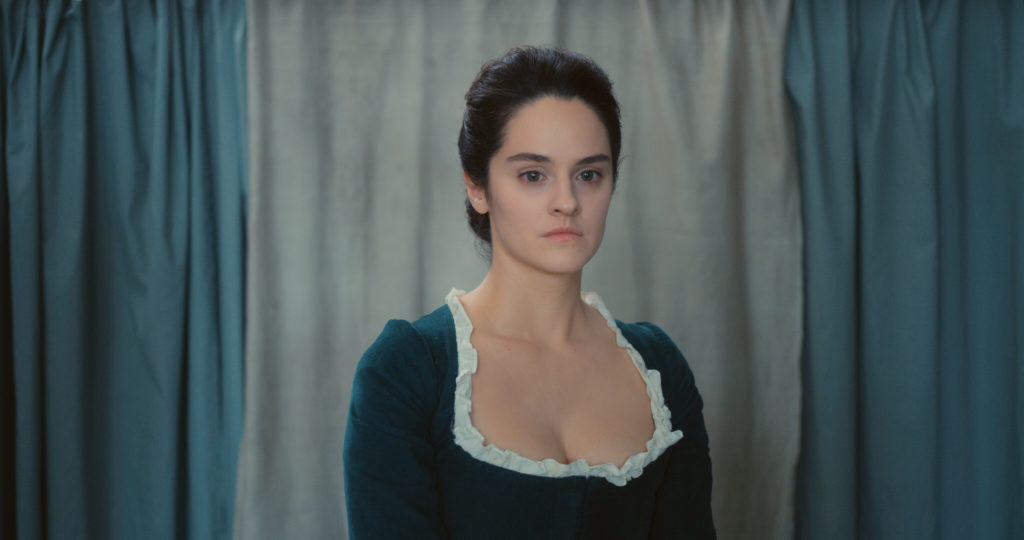
Once the camera shifted from the perspective of the muse to the perspective of the painter’s, there was a silent moment of the muse sitting still in a deep blue gown in front of blue drapes. As if her head and arms were floating in an open sea. This scene and color scheme evoke a sense of yearning and sadness, as this is often associated with the color. After doing a deep dive into the science of color theory, Forbes magazine produced an article on How The Neuroscience Of Color Impacts Consumer Behavior that stated, “Blue has been shown to increase productivity and focus, making it a popular choice for office spaces and study environments.” This invites a new way of thinking, as it places the little girls painting the muse into a state of focus. Marianne gaining all the attention from their gaze while inducing a sense of despair in the audience.
From this point on, Marianne begins to tell the story of one of her paintings, where we travel back in time to a point when she went to the home of a mother, anguished at the fact that she couldn’t get a portrait of her daughter. Throughout the film, the daughter, Héloïse, is wearing a blue gown similar to the one Marianne had on in the opening scene, which contributes to her overall task at hand. She was hired to follow Héloïse around and create a portrait of her. Based on the plot, she is just doing her job, but incorporating the knowledge of what certain colors can do to your brain, she quite literally is focusing on Héloïse not only for her beauty, but because of the color she wears. At the time the story is being told, Marianne is wearing a red gown, “shown to increase heart rate and arousal in the brain,” while representing passion and love. While watching the movie, I can say I did not feel that initial arousal from Marianne, but it certainly puts me in the position to understand the thoughts and feelings Héloïse felt throughout the movie as her admiration for Marianne grew stronger.
Color theory within the media industry plays a huge role in developing a deep connection to what is being presented to society. Colors that evoke a sense of wanting are what grab people’s attention and draw them in to consume.
An example of this being used within a different medium is in the song Burning Blue by Mariah the Scientist, a popular singer among the younger generation. She released this song, singing the post-chorus: “I couldn’t care less as long as you’re burning blue… I’m burning blue.” She sings of a significant other being her main focus: “I’ll forget what everyone else said.” She implies her lover represents the embodiment of the color blue, increasing her focus on them while having a burning passion for them.
While deviating from the film, this connection sat heavy on my mind as I watched the scene of Héloïse burning in her blue dress.
I recently was able to see Barry Lyndon (1975, Stanley Kubrick) through the Emory Cinematheque. Riddled with powdered wigs, layers and layers of makeup, paintings that fill entire walls, and shots that actually resemble real paintings from the era, Barry Lyndon’s use of mise en scène transports us directly into the late 1700’s. However, that is not what I want to talk about in this blog post. Instead, I was intrigued by a certain recurring motif in the film: Playing Cards.
The film as a whole is an argument between fate and self-determination, with Redmond Barry’s life-altering adventure seemingly starting from one lustful, impulsive decision. Playing Cards and Barry’s cheating habits act as a miniature representation of his own life, representing how one often has little control over their own destiny, yet must risk it all anyway. What confused me however is that every time anyone is seen playing cards in the film (which is quite a few times), they seem absolutely miserable. While it is not the happiest film of all time, there are many moments of comedy and smiles. None of these ever occur during a game of cards. I believe that this is probably to communicate how even though Barry tends to win at cards, they are a marker of inevitable doom and demonstrate the futility of trying to climb the social ladder of life. I would be curious to whether this is entirely purposeful by Kubrick or if it just shook out to be that way.
Reading about mise-en-scene drastically changed my second viewing of The Grand Budapest Hotel. In the past, I brushed off Wes Anderson’s unique style as simply aesthetics, not completely understanding the importance of mise-en-scene. Now after a deeper look into what many consider Anderson’s magnum opus, I have learned about the essentiality of the coloring within these uniquely created movies. Specifically, the theming of nostalgia in The Grand Budapest Hotel, goes hand-in-hand with the coloring of the overall narrative. This idea of nostalgia and storytelling is explained explicitly in the video above. The video details the fact that the opening scene is gray and monotonous for a certain purpose…to mirror the actual universe of the viewer. It is only when reality get turned to stories and then to memories does more and more color get imbued. In the 1980s (the period that the intro scene takes place in) there is little color variety whatsoever, just focusing on the bland white, gray, and brown aspects of the scene.
The second layer of the story takes place in the 1960s, even though this era of the story is still largely depressing, color is imbued to the story through the morose orange in the hotel and yellow trees outside. This increase of color, as the video explains, can be attributed towards the theming of storytelling and nostalgia within The Grand Budapest Hotel. The original author that writes the book about the hotel is still recalling a story that he experienced over 20 years ago. It is simply human nature to romanticize and associate past memories in the positive, even if they weren’t.
This idea is even further supported with the 1930s version of the hotel, the third and final layer that is narrated to the viewer by Zero.
In just a 30-year timespan, the entire coloring of both the hotel and its surroundings have completely changed from a colorful and vibrant landscape to a dull, orange, and dying environment. Overall, I find a great argument from the video above regarding the theme of nostalgia and facades within The Grand Budapest Hotel. Instances of facades such as Gustave living through a false existence as a cultured savant, Zero hiding his traumatic past through acting as a silent lobby boy, or the film hiding its fascist subplot to focus on trivial matters like the painting “Boy with Apple” are all examples in accordance with the facade theming. The hotel and surrounding environment didn’t magically change in 30 years, it is a purposeful addition to the mise-en-scene to demonstrate the idea that we romanticize the past.
Before I say anything remotely analytical about this movie, I wanted to note that this is one of the most visually appealing films of all time. On par with some of my favorite movies to just look at like Under the Skin(2013), 2001: A Space Odyssey(1968), and Drive (2011), Wes Anderson’s use of painting-like imagery with the background compressed against the foreground makes this a simply stunning movie.
Throughout the movie, I feel like Wes Anderson was screaming at me that this film is about loyalty. But although there is the obvious loyal relationship between Zero and Gustave, the theme extends far past an individual’s loyalty for another. I think this film is really trying to communicate how as individuals, we tend to be ferociously loyal to the things that have always been; the constants in our lives. We see this every day in the United States. According to the Pew Research Center, 89% of teens from Democratic households also vote for Democratic candidates (81% for Republican households). I believe that this is not actually about the values of the child, but about an individual’s loyalty to their parent’s values, since that is all they have known since birth. Wes Anderson throws this theme in our face throughout Grand Budapest Hotel. Introduced early in the film, Zero is alone. When asked whether he has a family, he replies with ‘none’. Immediately, Gustave is a father figure. Whether he likes it or not, Gustave is in a position of instructional and literal power over Zero, causing Zero to latch on almost instantaneously. I don’t believe that this is because Zero respects Gustave (Gustave is a deeply flawed and sometimes ridiculous person), rather that Gustave and the values he stands for becomes literally the only thing in Zero’s life, and therefore the only thing he has to learn from.
However, this theme of loyalty extends past Zero’s relationship to Gustave. Gustave himself is a character literally defined by his loyalty. All we ever know about his character is his mastery of the concierge arts. For all the audience knows, this is all Gustave has been, and all he ever will be. His loyalty is not only to the women he takes care of and the young men he takes under his wing, but the literal act of being a concierge. In prison of all places, Gustave brings a cart around from cell to cell handing out soup. He won’t ever stop being a concierge because he literally can’t. Like Zero’s relationship to him, Gustave can’t give up being a concierge because it is actually the only thing he knows. Again, towards the end, when the hotel is crawling with policemen looking for him and a psycho killer trying to take his life, Gustave enters the Grand Budapest Hotel disguised as a bakery delivery man. It is possible to look at this from the perspective of his loyalty to Zero and Zero’s relationship to Agatha, but I think Wes Anderson intended this to be a representation of Gustave’s inability to part with the hotel. The hotel is his life, and he would rather die than be apart from the only thing he has ever known.
This is not a film about love or belonging, but instead about humans’ loyalty and almost obsession with retaining constants in our lives. Zero, even in his old age and the Grand Budapest’s failure, is fiercely loyal to it and Gustave. My one question about this film is: Does Wes Anderson hate Zero and Gustave for being so loyal, eventually killing one of them and dooming the other to eternal loneliness? Or does he actually respect and value their obsessions?