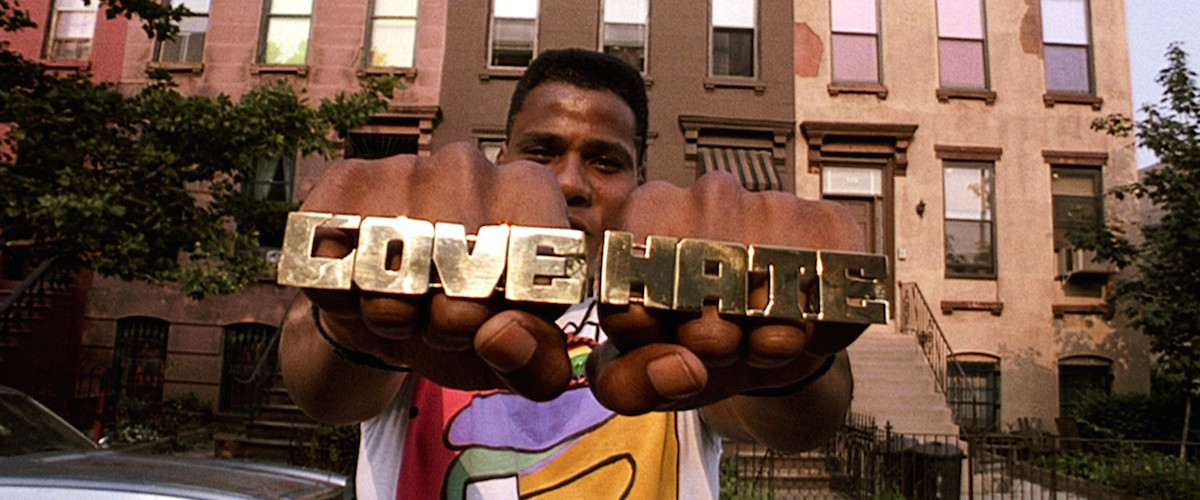
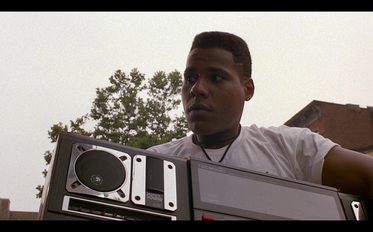
Before watching Do the Right Thing, I assumed the film would give a clear sense of who was “right” and who was “wrong” in the neighborhood’s conflicts. Instead, Spike Lee presents a community full of contradictions, loyalties, tensions, and shifting emotions. One moment that especially challenged me was the neighborhood’s relationship with Sal’s Pizzeria. Residents of the community called it a beloved staple of the block early in the day, yet later destroyed it. That raised a question: Did the residents ever truly value Sal and his business, or were they being hypocritical when everything turned violent?
Early in the film, multiple residents discuss their affection for Sal, recalling how they grew up eating there and how his shop has been a part of the block for years. The loyalty and “love” feel genuine, supported when Buggin’ Out tries to start a boycott, and people brush him off. If the community was so committed to Sal’s, then why does everything flip at the end? Why do the same people who defended him early in the day watch his business burn?
The more I thought about it, the more it became clear that the film is not showing hypocrisy, but rather the difference between everyday relationships and the deeper realities of power. The neighborhood did appreciate Sal’s, however, the film reveals how personal fondness can only stretch so far when a much larger system of racism, disrespect, and inequality erupts into view.
Sal may have been part of the community, but he was not of the community. That difference matters. His success relied on Black residents’ money and presence, yet he still controlled the space, the rules, and the images on the walls. The community accepted this dynamic most of the time because nothing “major” challenged it. However, when the conflict escalates with Radio Raheem, that balance collapses. Sal’s violent outburst exposes a truth that was always simmering, which is that his respect for the community had limits.
So were they hypocritical? I don’t think the film wants us to see it that way. The earlier “love” for Sal and the later destruction of his pizzeria are not contradictions. Both are true, as the community could appreciate his years on the block, and still recognize that his business existed within a structure that didn’t value them in the same way they valued it. Lee argues that people can maintain surface-level harmony within unequal systems until something exposes the imbalance too clearly to ignore. When pushed to their limit, the residents act not out of personal betrayal but out of collective grief and rage.
In the end, I think the film pushes us to question the conditions that make such explosions inevitable, and why people must often choose between personal relationships and collective survival.
Normally, after watching a movie, I would have some form of judgement towards it, whether by agreeing with the central arguments of the film, or at least have some understanding of which side of the moral dilemma I would stand on. However, “Do the Right Thing” is that one film that even after I understand what is happening, I could not really set my mind on a specific stance.
Spike Lee demonstrated the complexity of humanity around the topic of racism so thoroughly but also so objectively that I see flaws with almost every character in the film such that I really dare not debate firmly who’s right or who’s wrong.
The narrative form is also not conventional, as it does not follow a single protagonist, but rather focuses on the ongoing interactions throughout the Brooklyn community, so that the audience see the life and personalities of so many different individuals. It also reminded me of the Aristotelian unities of action and time that I learned in high school, where the main plot should take place within a single day within a constant location. This “tragedy” follows such unities of action, starting from the start of a day to the morning of the next day, within the Brooklyn community (mainly focusing on Sal’s Famous Pizzeria).
I guess one of the main questions I was reflecting on was whether Mookie did the right thing or not as he smacked the Pizzeria’s window panes with the trash can. What seemed absurd to me was how Mookie still asked for his $250 pay the next day, knowing it was him who started releasing fury onto Sal. Even though he said that the costs could be covered by insurances, I could not understand how that is a valid reason for him to destroy other’s property. But on the other hand, I also felt bad about the death of Radio Raheem.
Sal’s destruction of his radio really is a symbolic provocation that challenges Raheem’s identity as a black man, but practically, it also is just a radio (given that Raheem did disturb other people in the restaurant and was not paying any respect to Sal).
The movie also did not just illustrate the conflict between Italians and the Black community, but also incorporated perspectives from the Latino and Korean residents of the neighborhood. There is no heroes of this story, and I guess Spike intended to leave the decision to the audience of this film. What do we think? Did people “do the right thing”? Was the development of the plot inevitable?
The ending of Do the Right Thing feels deliberately unresolved, and I think that uncertainty is the point. Instead of offering a clear moment of reconciliation between Sal and Mookie, Spike Lee frames their final interaction as something uneasy yet realistic considering the violence that had just occurred. They start on opposite sides of the frame, both carrying the weight of the night before, and they only move toward each other when Mookie requests his paycheck. Their proximity at the end feels like it’s out of necessity rather than forgiveness. The blocking further suggests that survival in this neighborhood depends on navigating relationships that are never fully repaired but still necessary, showing how daily life will continue even when trust has been broken.
The decision to show the photo of Malcolm X and Martin Luther King Jr. being pinned on the Wall of Fame deepens this tension but does offer a slight sense of resolve in my opinion. Sal’s wall has functioned as a literal barrier between understanding and representation throughout the film and was the actual trigger for the violent and unjust ending. By adding the photo, the pizzeria, despite having been burned down, is finally acknowledging the broader cultural reality that Sal and his family resisted: that different cultures can coexist in the same space, and that tension does not always have to escalate into violence. It becomes a quiet but powerful image that complicates the idea of whose stories get displayed and validated.
Because of this, I do not read the ending as Spike Lee successfully working the system. It feels more like an honest recognition that harmony is difficult to achieve and takes time, even when people of different races and backgrounds are living and working alongside one another. I’m still left wondering: does the film go against a complete sense of closure because repairing systemic harm is never simple/straightforward, or is it asking us to rethink why we expect reconciliation in the first place?
Spike Lee exhibits the simple manipulation of truth in a less than three minute sequence in Do The Right Thing (Lee, 1989) that barely stands out in a film rich in commentary on American race relations. The scene unfolds as a young boy runs in front of a car excited for ice cream, and Da Mayor jumps out to save him, toppling both the child and himself. What the boy’s mother and other viewers of the incident see is the drunk mayor attacking a small child, and when the mother asks her son what happened, he does not want to admit that he ran in front of a car, so he lies and allows the belief that he was attacked to ensue. Da Mayor defends himself, and to his luck the mother believes him, but this simple scene represents exactly what historians, or anyone listening to a story for that matter, have to grapple with when understanding the past. The third party viewer, the mother, has to examine the evidence given to her, one that is true and one that is not, and determine what she believes to be true. If she believed her son, than that would be known as the perceived truth, regardless of what the actual truth of the story was.
Da Mayor in Do The Right Thing
This filmed is filled with examples of stories that can be easily manipulated, and have been. Each character’s perception, biases, and lived experiences influence how their outlook on society is. This is why Lee so urgently addresses throughout the film that the notion of a monolithic African American experience is not true, and that the idea of the “right thing” to do varies in generation, gender, class, age, and relation to those around you. It can be argued that many of the actions throughout this film were not the correct thing to do, because of what they led up to, but it can very well be argued with the contextualization of their singular perspective that they did the only “right” thing that they could in that moment.
Furthermore, Spike Lee shows the manipulation of truth and justice through music, physical objects, and celebrities in media. The distinct differences in how characters view the world around them, both contrasted between races and within races, highlights how stereotypes are harmfully used to categorize groups, while remaining inaccurate. One person cannot represent all stereotypes at once. Still, this film is brimming with a multitude of themes and representation. There are moments of action and tension coupled with moments of connection and romance. This display of African American representation in film is still rare in today’s standards, and incredibly rare at the time of this film’s release. Lee is able to “fight the power” in his own medium, film, by directly addressing the large extent of experiences and attitudes held by communities in this neighborhood.
My questions while watching this film were: what do you think the public reaction to this film was after its initial release, and how do you think that it translates to today’s society? Do you think that watching this film a second time would lead to a different perspective or clearer understanding on the character’s internal motivations, especially regarding the incidents leading up to the riot at the end? When do you know something in history is a complete objective truth, and when does this film feel like a commentary on the objective truths of its time and subjective truths of its time?
Do the Right Thing is a film about idols. In this case, especially those who share the same skin color as the person looking up to them. Sal clearly reveres Italian Americans like Sinatra, Al Pacino, and De Niro. Smiley looks up to Malcolm X and MLK. Mookie seemingly is a fan of Brooklyn Dodgers player Jackie Robinson and the white byciclist who bumps into Buggin’ Out doesn’t mind Larry Bird. This is actually something beautiful. Having a role model or someone to look up to is a good thing. However, here it becomes the trigger for the catastrophe.
Buggin’ Out wants Sal to put up a picture of a successful black person in his restaurant, because he is bothered that only white people are represented. I then asked myself: Does he do the right thing to demand this?
This question can be posed to almost all the characters in this film. Did Sal do the right thing destroying the boombox? Did Radio Raheem do the right thing storming into Sal’s restaurant playing loud music? Did Mookie do the right thing smashing the restaurant window, or or by being an unreliable partner and father? And what actually is the right thing to do?
In my opinion, most of the characters do not do the right thing. They fuel prejudice, hatred, and violence against one another. And yet, the film powerfully allows the viewer to understand the emotions and intentions behind their actions. Concerning the black community largely because of the visible frustration built up by systemic racism. The film shows that throughout the neighborhood, white people own businesses and drive cars while the black community must work for them just to get by. The oppressive atmosphere is further highlighted by the police officers, who are shown looking at the three men against the red wall from their car as if they were about to commit a crime at any moment. Ultimately, the racially motivated murder of Radio Raheem brings everything to a head: Sal and his restaurant become the target of the retaliation.
All of this violence and hatred, coming from all of the groups, makes communal coexistence increasingly difficult.
“All the world’s a stage,/ And all the men and women merely players;/ They have their exits and their entrances;/ And one man in his time plays many parts” (Shakespeare, As You Like It).
I think the world is a stage in Holy Motors. The limo is like backstage, with the Hollywood vanity mirror, costumes, and makeup. We even hear Oscar practicing a line that he later says in the hilarious death scene with “Léa” (Élise). Maybe hilarious isn’t the right word, but I enjoyed a hearty snigger at the obvious theatricality and melodrama of the interaction. Once I got into it, I liked this movie a lot. I could start to predict things— of course Oscar was going to get up and go on after being shot multiple times in the torso! After all, he had just come back from being stabbed in the neck. I saw echoes— while the connecting door in the hotel wasn’t technically a hidden door, it had a similar feel. Add a man, in bed, with a dog? It reminded me of the opening sequence. I felt like I was playing a video game where I was finally starting to make sense of the world, the rules, and the themes. For me, watching this film was a weird and wonderful experience.
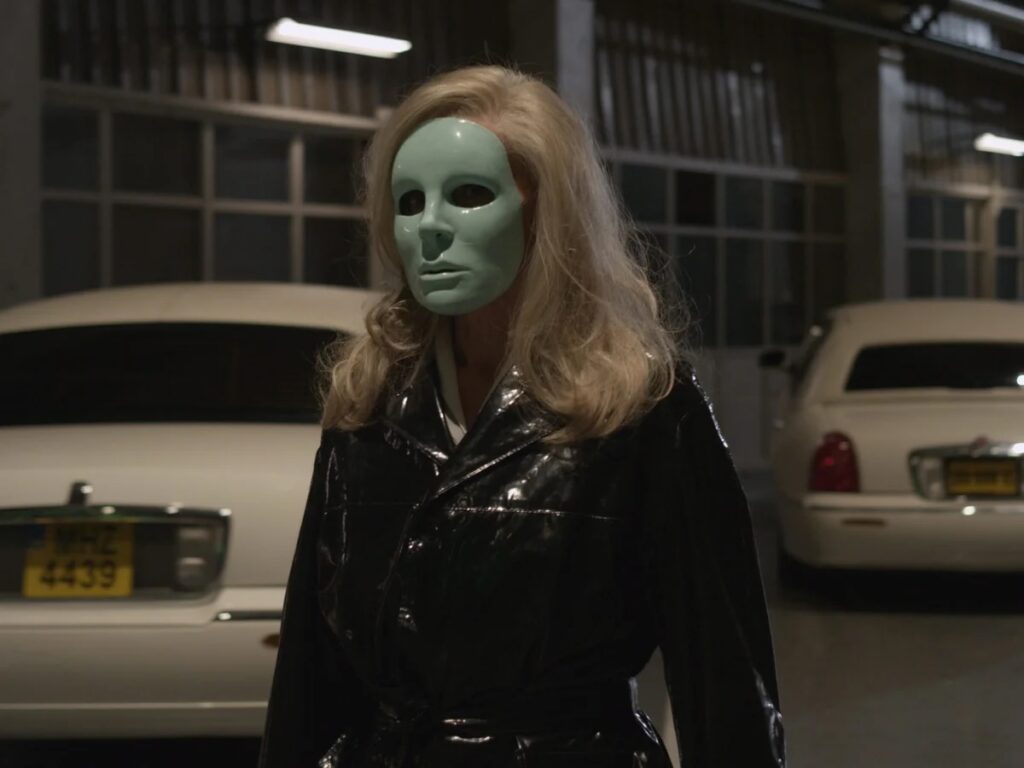
A scene that stood out to me was when Oscar and the concerned guy from the agency talked in the limo. According to my notes, they discussed how small and imperceptible cameras have become, Oscar’s believability to his watchers, and the idea that beauty is in the eye of the beholder. I started to watch this movie as if every time Oscar stepped out of the limo, out of the liminal, interior space where he could be honest and authentic, he was participating in a piece of performance art— perhaps even acting for a camera we can’t see. We as watchers had a choice to believe or not to believe what we were seeing. And while I think I constructed a somewhat plausible explanation for what was literally happening in the movie— a professional actor going from gig to gig to film short scenes— that was just a way to force the film into a narrative I could wrap my head around. But the “literally,” the what’s-really-happening, my made-up, interpretive narrative isn’t what matters. I think the limo driver putting on a mask before stepping out asks us to recognize that all humans grapple with the actor’s struggle: we all struggle to define ourselves, to disentangle and distinguish ourselves from the many roles we play.
Holy Motors feels like a film about film itself, or maybe about what’s left of it. Léos Carax immerses us in a world where the boundaries between performance and reality are blurred. Mr. Oscar (played by Denis Lavant) moves from one “appointment” to another, assuming new identities in each, yet there’s no visible audience or camera to justify his transformations. That absence makes the performances feel strangely hollow, as if he’s acting purely because he has to – a slave to the “invisible machines” Carax mentions in his interview.
Carax’s distrust of digital technology seems to haunt every scene. The old “visible machines” of cinema (cameras, projectors, cars) are fading, replaced by something more virtual, impersonal. Even the limo, which carries Oscar between his appointments, becomes a symbol of this transition: a kind of impossible, in-between space where he prepares to become someone else. It’s home, but not in the comforting sense. It’s more like a place of regression or exhaustion after too many lives lived.
As an experimental film, Holy Motors rejects conventional storytelling. It doesn’t explain itself. Instead, it drifts through moods and genres (e.g., tragedy, absurdity, musical, horror) like flipping through channels on TV. The accordion interlude midway through feels like the only true burst of life. It’s spontaneous and rhythmic, feels almost rebellious against the film’s growing artificiality.
Is Mr. Oscar an actor, or just a person conditioned by an over-mediated world? How does the film comment on our relationship to technology and authenticity? If the limo is “home,” what does that say about the way we live between screens, constantly switching roles?
Holy Motors was 100x more strange & confusing than I imagined it would be, even after Professor Zinman’s cautionary introduction of the film. I can genuinely recall at least a dozen times where I out loud said to myself while watching “what the heck is going on”; & honestly, I still don’t know. Maybe that’s why I found the film so entertaining to watch – because I was so utterly lost the entire time that all I could do was laugh. I’m guessing that wasn’t everyone else’s first impression, which is valid since there was obviously a lot of violent & strangely dark stuff occurring throughout the movie as well, but around half way through the movie I accepted that it wouldn’t make any sense to me, so I just decided to laugh through the confusion. In honor of that, instead of attempting to do a probably unsuccessful analysis of what Carax was trying to say with this film, I thought it would be more enjoyable to reflect on some of my favorite funny (kind of) moments of Holy Motors that I had from our viewing.
This scene for me definitely set the stage for the rest of the weirdness that I was about to witness in this movie. I was quite uncomfortable watching the other parts of this scene, but when the animation came on I just lost it. This was my first memorable “what the heck is happening?” & laugh it off, because still thinking back to it, what the heck was I watching.
This scene was actually funny; certainly strange, but funny. Other parts got a quick laugh out of me, but Monsieur Oscar eating the flowers & then eating the girls fingers was so uncalled for that I was laughing the entire time. Was the girls fingers getting eaten funny? No. But the randomness of it? Absolutely. I’ve got to hand it to Carax because this was by far one of the oddest scenes that I’ve ever seen but I loved it.
Like any typical movie, what do we do after a long hour & a half of fake killing people & slowly dying? Break out into singing of course! Just when I felt like I had a grip on what kind of movie this was, I get caught off guard by a musical number. I definitely didn’t hate it, but just another “where did this come from” with a laugh.
I felt like this was a fabulous ending to the movie & it definitely helped me put into perspective what message that Carax was trying to convey, but talking cars was far from how I imagined he would do it. Very clever, & it got a chuckle out of me too – 10/10, no notes.
My biggest question throughout the duration of the whole film was how were we supposed to differentiate between what was real or not? Or was any of it real? Specifically in the scene with his daughter in the car, it felt real & I thought that it was him outside of his work life, but who actually knows because there weren’t any cameras to be seen to help me figure out what was acting & what wasn’t.
When watching this film, the only question circling through my mind consistently was – “What is going on right now.” Before the film we were all prepped with the notion that you may leave this film having absolutely no clue what the point of it was, instead of taking that as a suggestion I took it as a challenge. Throughout the screening I consistently wrote in my notes what I thought it was about and where it could possibly be going and every time I did that, the next scene would be something I would have never expected. This feeling of shock after feeling like I was getting a grip on what was going on stood out to me the most when he was dressed as a leprechaun and then genuinely bit that woman’s finger off. I was appalled and totally confused.
After the screening, I walked back to my dorm in the cold and I still was trying to wrap my head around what I just saw. I came to 3 conclusions. The only consistent thing in that movie was his emotions in the car. We saw this through the moments where he was taking off his masks and clothes and he would smoke a cigarette or just simply look pretty aimless. It was clear that he was simply a prop. At the beginning of this screening I remember hearing that this was a movie about an actor, post screening I thought that this was a film that tried to encompass the emotions performers feel as the characters they portray consume their lives. Because if you think about it, how many times have you watched a movie with an actor and simply started to refer to that actor as the character they played. Even though the filming is “over” they cannot escape the role, which probably leads to identity issues like he faced within the car and spells of depression.
My next conclusion was that he was able to play these roles by murdering these people who looked like him and taking their spots but the death of one of his roles comes from framing the dead character he is taking to look like how he looked before. That became clear to me after we watched him kill the guy and started framing him to look like how he looked currently. That was trippy. In that moment I felt like I was watching someone try to explain phases of emotions and life. When someone is “reborn”, which is a common phrase nowadays as people seek restarting more and more, what does that entail? Does it mean completely killing that version of yourself and beginning to be someone new? Thats the question that swirled through my head while watching him lie next to himself while bleeding out.
My final conclusion was that this was a commentary on beauty standards and unrealistic expectations. While watching the VERY weird scene with the leprechaun and then finally seeing the dedication at the end, it was like a lightbulb went off in my head. Every character that he played was distinctly different, some were crazy, some were completely normal, and some were old rich men and gangsters, he put himself in every “shoe” possible; while still at his core being the same guy. When I saw the scene of him smoking a cigarette with this model and her taking off her wig and letting her hair out while being literally underground, it made me think that this movie was about who we would be if nobody knew who we were? We technically would be free to be whoever we wanted, we could be deranged or rich or an accordion player, because nobody would be there to police us or critique us on how we live our lives. As he covered the model in a traditional burqa I thought, “now this is insane, because he saw her a bit nude he decided she would look best fully covered? ” Unfortunately upon further thinking I believe I missed the mark initially. I believe this scene was about expectation and recognizing the comfort in not having to worry about how you look since you are covered, something that directly contrasted her entire livelihood as a model. When he laid next to her nude and she sang to him, I thought it was a continuation of the “search for a perfect photo” with both of them that was previously brought up as the photographer tried to pull him from the crowd. Two very different people, however at the core, not very different at all. Both are covered, one by a burqa and one by an absolutely fake persona. Both underground, both vulnerable, and two people who (based off how quickly she took off her wig) don’t feel like themselves during their jobs.
Based on my conclusions and the dedication, I feel a bit qualified to take a shot at what I believe this movie is about. Though I believe it does touch on multiple things, I think it was about how one can find comfort in not having any harsh expectations set for them, and in turn who we become when we are being watched vs we feel like we aren’t being watched at all. We hear this when Mr.Oscar expresses disinterest in his job because he feels like the cameras are “too small”, how they used to be bigger than our heads, but now they are so small we can’t even see them anymore. I believe this was also a comment about being watched/ judged, I think his company wasn’t for movies- I think it was to create spectacle for people so they could have something to film and post. I think the “too small cameras” are eyes. A part of me thinks he is also being exploited. Which could be another theme of this movie(actor exploitation) since he talks about how he once acted and is met with a lack of interest. Confirming that the world now is his “stage” meaning he is performing all the time. Many actors face this as they get bombarded by paparazzi just going on walks. He faces an extreme lack of comfort, based on the movie we never see him stop. We saw him only really relax when he was underground with the model, in bed playing an old dying man, and when he was inside the car. Whenever he came out the car, peopled filmed what he did, stared at him, or left with a story to tell. So to conclude, even though I could talk about this longer, I believe this was a critique on what we as people do when we are being viewed, it also implores you to think about who you would be if nobody saw you at all.
Holy Motors is a film that takes the concept of perception and viewing yourself from someone else’s point of view, analyzing how differently your behaviors and mannerisms change based on who you are interacting with. Upon viewing the first couple of minutes of the movie, I thought the plot and understanding of the movie’s progression would be easy to follow. However, as the movie continued past its opening scene, things started to get a little interesting. The main character is tasked with juggling nine appointments throughout the film, where each appointment requires him to not only drastically change his appearance but also shift the way he carries himself and interacts with each individual.
We see him go from an actor in a developing video game to a hostile leprechaun, all while only making these adjustments in the limo he is being driven around in. One thing that truly stuck out to me was the scene when he was tasked with essentially assassinating someone, and in the end, the person ended up being himself in a different costume. After completing the task, he proceeds to change the seemingly lifeless body out of its current attire and make it look more like what he was currently wearing. In the end, the body ends up coming back to life and killing him. While a lot of things in this movie did not make much sense to me, the question I propose is: throughout all the appointments and costume changes, what do you think him essentially killing himself represents in the context of this movie being based on one’s perspective of you?