Category: Viewer

  • Jupiter’s Spectacle

    Rewatching Nope today was a blast. It was really fun seeing the reactions of people who had never seen it before, and how similar their reactions were to mine when I first saw the movie a few years ago. One theme of the film that stood out to me during this second viewing, though, is how the need for a spectacle is constant throughout the entire movie.

    Before the film even begins, Jordan Peele shows an epigraph of a Bible quote, specifically Nahum 3:6: I will cast abominable filth upon you, make you vile, and make you a spectacle.

    The theme of spectacle continues during the rest of the film. For example, Steven Yeun’s character, Jupe, turns his childhood trauma from “Gordy’s Home” into a camp museum exhibit. The blood-soaked shoe we see at the beginning of the film can be seen on a glass plaque in the room, along with several fan-made posters that seem to glorify the horrible attack that occurred.

    On the topic of Jupe’s childhood trauma, a scene that stands out to me is immediately after Jupe reveals the museum exhibit in his office. When Emerald asks him what really happened on set, Jupe isn’t able to explain it through a firsthand account. He has to use an SNL skit, a spectacle itself, as a medium to describe the events that took place. Spectacle is almost like a coping mechanism for Jupe: he uses it to avoid direct confrontation with his past and to downplay the damage it did to his mental state. He almost frames Gordy’s killings as an act in a show.

    Going back to the quote from Nahum, and some things we discussed in class, we determined that what makes something a spectacle is if it catches your eye. In other words, the content needs to be shocking enough to make you stop (scrolling) and watch. The quote from Nahum implies something very similar. Only after “filth” is cast on the subject (in the context of Nahum, God is casting filth upon the Assyrian capital of Nineveh) is the subject a spectacle.

    This is why Jupe has capitalized on Gordy so much. It’s an event so violent and shocking that people can’t help but watch it unfold and become obsessed with it. Jupe even says it himself, how there is a growing fanbase for the show and most importantly, for its violent ending.

    Jupe also tries to do the same thing with Jean Jacket. Though he doesn’t necessarily paint Jean Jacket in a very violent light, he buys the Haywoods’ horses for the sole purpose of luring the alien down from its cloud and turning its hunt into a spectacle.

    Though spectacle is an obvious theme throughout the film, there are many different ways of looking at it. Though I talked about spectacle purely from Jupe’s point of view, you can also analyze the Haywoods or even Antlers Holst. I’m curious to see how their ideas of spectacle differ or coincide. Is their fixation on spectacle also originating from past events like Jupe’s?

  • Saying “NOPE” to terror

    Jordan Peele’s NOPE (2022) is a film that has a very simple categorization, but it thrives because of its genre complexity.

    To be honest, I am scared. At the first glance, NOPE seems like a straightforward science-fiction horror film about this unknown UFO from the other world terrorizing a California horse ranch and the people that connects with it. Peele blends in the elements from Western, horror and science fiction genres to question not just our fear, but the way we perceive horror and spectacle.

    The Western genre influence is the most visible. We see that the setting is located at a desert valley, which is similar to the most classical cowboy movies that happen in a small town in the middle of the desert. Here, the setting and the background knowledge of we knowing the main character’s family all tame horses adds on to the Western genre influence.

    At the same time, horror is also deeply rooted in NOPE. Peele used fear through sound and silence. This echos the horror through sensory orientation to the audience. The UFO is both a top predator and a symbol of unknown and violence. Like the best horror films, NOPE exposes our psychological vulnerability — in this case, our obsession with witnessing spectacle even at our own danger. In addition to the UFO as horror, the flashback of the Chimp killing three people, and OJ’s father killed by plane crash remnants is also killing me and really scared the guts out of me.

    I REALLY DON’T WANT PICTURES HERE IT SCARES ME SO MUCH


    Nope also employs a lot of science fiction conventions to explore the curiosity of human and the approach of the unknown. The idea of meeting an alien culture becomes a indication of these people trying to catch the impossible. Just like most sci-fi films, there is a desperate attempt to take control, which may suggest how technology shape our relationship with the reality (as suggested by the lights out and all technology stuff)

    The fusion of these three genres redefine its boundaries. NOPE is a perfect example of genre hybrid. We can see the familiarness of other films we watch before of the same genre, but we can also see the influence of the three on each other. It is not just about the giant terror alien flying in the sky, but it is about the cost of observation, and the price of the spectacle.

    One thing I noticed while watching, is that why these people, though fear of the UFO, still wants to approach and get a shot of it, even knowing its destructiveness? Peele turns that fascination back on us, making viewers question their own role as spectators.

  • The beach as more than a backdrop in Portraif of a Lady on Fire

    Portrait of a Lady on Fire at Beach of Port Blanc - filming location

    In Portrait of a Lady on Fire, Schiamma uses cinematography to build an emotional world and this becomes very evident in the beach, a place with open framing and stunning landscapes that captures the brief freedom felt by Marianne and Heloise. A place where they can exist outside of the ticking clock that separates their romance and see each other freely. 

    The beach is more than a backdrop, it’s a constructed space that reflects freedom and intimacy. In contrast with the interior shots (tightly framed and dim lighting), the beach opens up into wider shots with natural lights and horizon lines. This shift in visual style matters as it crafts part of the tone of the narrative. It represents how their relationship is constrained indoors by social norms and surveillance while on the beach the cinematography offers expansiveness, mirroring their sense of freedom. 

    Additionally, the contrast between lighting can also be read into as one of the key features that build these converging atmospheres of freedom and constraint. On the beach, the light is diffuse, natural and less mediated, with a softness around characters. Compared to the effects of firelight indoors. The natural illumination makes their intimacy feel purer and almost utopian even though we know that this cannot last. 

    The beach is also a place for mutual observation where the female gaze becomes visible. The camera in these scenes mirror the equality through a centered framing. Staging also tends to be symmetrical and altogether this adds on to the utopian feel of that ambient where the characters can be seen without fear. 

    In essence, the beach in Portrait of a Lady on Fire is a visual embodiment of freedom, love and memory. Through open framing, natural lights and longer takes Schiamma transforms that landscape into an emotional space. When they return indoors the tone shifts back to restraint and surveillance, reminding us that what happens on the beach is real and temporary. A space of possibility that lives only through memory.

  • The use of mirrors in Citizen Kane

    The famous final sequence, when Kane walks through the corridor of mirrors, is not simply a stylistic and aesthetic choice. Instead, this choice actually resembles one of the primary themes of the films, which is the presence of fractured and fabricated identity. The “many Kanes” that appear because of the mirrored hall shows that there is no true Charles Kane, but instead countless versions of himself that he has portrayed to the general public and been interpreted as. Even Jerry Thompson, who spent weeks studying the life of Kane, could only ever understand him through the fragmented and often unreliable tales told to him by the people closest to Kane.

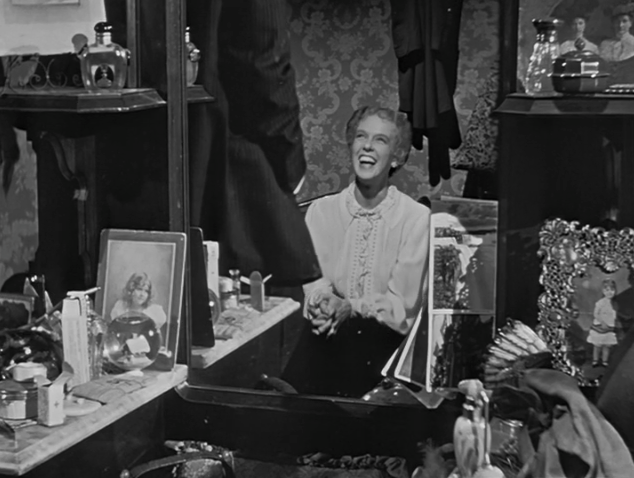
    The mirrors also offer a deep sense of isolation. In Kane’s final days, he spends time not surrounded by loved ones and friends, but by reflections of himself. He has spent years trying to surround himself with people who “love” him, accidentally surrounding himself with people who try and praise him in exchange for power. This isolation can be seen earlier in the film as well, when Susan Alexander sits at her wardrobe, we gaze at her reflection through a mirror. The reflection stands as a confrontation of her loneliness and isolation.

    In totality, mirrors and reflections are used throughout Citizen Kane to establish the distorted nature of life these characters are experiencing. Nothing is genuine, not the people they surround themselves with or the stories they tell. Even the story itself goes through multiple levels of connection (a friend, a manager, etc), leading to a convoluted tale that never truly lets us get a good look at who Charles Kane was. And in his final days, he understands that he doesn’t know either.

  • Cinematography and Plot Structure in Citizen Kane

    I really get the hype around this movie! Citizen Kane seems to have it all, with a lot of elements that I wouldn’t imagine were typical for other films at the time. This movie is an extremely successful experiment of plot, editing, and cinematography, and features a talented cast of emerging actors–which is such a successful debut to have.

    One of the first technical elements I noticed about Citizen Kane was the transitions. Welles keeps transitions constant between shots–there is a tendency to maintain similar silhouettes of subjects within shots between the transition as one dissolves into the next. He also sometimes takes a more dynamic approach, like when it cuts to a kid holding a newspaper that covers the frame, then properly entering the scene as he puts it down. Either way, every transition was clean and calculated, and made this film a much more enjoyable watch. The music, as well, was very enhancing. In many cases, dramatic and comedic, it was sort of cartoon-ish and had the interesting effect of detracting from the seriousness of a more dramatic plot point, but still maintaining the tone. This cartoon-ish tendency certainly enhanced the comedic points as well, to give into the more borderline slapstick moments. Lastly, in regards to cinematography, I noticed that the camera frame is frequently moving. Whether it’s a zoom (which is very frequent in this film relative to others) or a mobile frame, the cinematography became much more dynamic through this active handling of the camera.

    As for plot structure, the time of the movie seemed very confusing–in a very engaging way. The plot is somewhat structured by each interview with a different person speculating who/what Rosebud is. In many cases, these responses in the interviews only confuse the search for Rosebud. I found this to be reflected in the plot, since there were many points that seemed to divert from this main objective, particularly the opera arc, among others. In doing this, the film throws a lot at you, in a sort of watered-down, super early-on postmodernist way. I thought it was really cool how they played around with so many aspects of this movie, which made it all the more entertaining to watch!

  • Does Emotion Exist Only Because of Sound?

    Singin’ in the Rain brilliantly explores the power of sound in shaping emotion and storytelling. As I watched the film, I began to notice how much sound influences the way we feel, not just through dialogue or lyrics, but through rhythm and tone. It was not until the moments when sound became the film’s only guide that I realized how deeply it directs emotion. Even without clear words, I could sense what the characters were feeling. This raised the question: do emotions in film exist because of sound, or does sound simply amplify emotions that are already present?

    Early in the film, we see how sound “does the talking” during the premiere of Don and Lina’s silent film. With no dialogue, the emotions rely entirely on music. Every sound gives meaning to facial expressions and gestures, allowing viewers to interpret joy, tension, or embarrassment.

    Later in the film, during Don’s imagined sequence of his new musical ending, this relationship between sound and emotion becomes even clearer. In the “Broadway Melody” number, where Don dances with a woman dressed in green, there is no dialogue, only music. Yet through the tempo, harmonies, and overall sound, we understand everything the characters felt. The sound became their emotional language.

    These scenes reminded me of how sound alone can evoke feeling even outside of film. When I listen to songs in languages I do not understand, such as the French song “Je te laisserai des mots,” I can still sense the emotion behind them. The melody itself communicates love and nostalgia without needing translation. It shows that sound acts as a universal emotional bridge.

    Ultimately, Singin’ in the Rain suggests that while emotion does not exist only because of sound, sound gives emotion form and direction. It transforms silent images into experiences we can feel. Without sound, emotion might still exist, but it would lose one of its most powerful voices.

  • Comedic Elements and the Bitter Truth in Singin’ in the Rain

    While watching Singin’ in the Rain, I couldn’t help but feel as If I were watching a live-action version of a Looney Tunes cartoon. The film’s vibrant colors and playful energy evoke that same exaggerated, animated feeling. In a lot of scenes movement and facial expression seem exaggerated to a cartoonish degree—whether it’s Don’s happy walk after his “Singin’ in the Rain” performance or Cosmo’s slapstick attempt to “fix” his face after crashing into a brick wall during “Make ’Em Laugh.”

    But most importantly, the sound design adds to this cartoon-like feeling. Realistic ambient sounds are rare in the film, and when they do appear, they’re almost muted. The best example of this is when Don and Cosmo walk through the studio set early in the movie. Multiple films are being shot on the same stage while new sets are being built, creating an extremely busy environment—yet we don’t hear a single background noise unless the focus briefly shifts to it. This choice draws all attention to Don and Cosmo’s conversation and pulls the audience out of reality. The scene feels deliberately staged, almost like a performance within a performance. In the end, that’s what Singin’ in the Rain is—a performance within a performance.
    During several musical numbers—but most prominently in Cosmo’s “Make ’Em Laugh” performance—sound is used to emphasize movement and add an extra layer of comedy. Each time he falls, a brief drum roll and crash punctuate the action, transforming his stumbles into part of the rhythm.. Even small gestures, like when he sits on the couch and adjusts his legs, are matched with exaggerated cracking noises.

    Yet, besides all the fun musical numbers and slapstick comedy, the film also addresses the harsh reality faced by some actors when sound was introduced to cinema. Lina Lamont, once a major silent film star, is unable to adapt to the new technology of sound. In the end—though unwillingly—she is forced to end her career. The most famous real-life parallel is probably John Gilbert, whose career declined for similar reasons.
    In this sense, Singin’ in the Rain reminded me a lot of Babylon (Damien Chazelle, 2022), which likewise explores the industry’s transition to sound and the downfall of an actor unable to adjust to it.

  • Singin’ in the Rain: Encapsulating a Feeling

    While regarded as “pure entertainment” without much substance, musicals are equipped with capabilities that traditional films are not. The characters in musicals can express themselves fully through song and dance, in a way that is unnatural in any other setting. They can profess their love, declare their passions, and reveal their innermost thoughts. Throughout Singin’ in the Rain (1952), the use of musical numbers is vital to contrasting the theme of superficiality and allows characters to translate their innermost feelings through song and dance.

    From “Good Morning,” a number key to signifying the optimistic outcome of the film

    As a group of performers, the characters in this film know how to best express themselves through the extravagant means of large sets, flashy costumes, or big show-stopping numbers. When Don Lockwood expresses his love for Kathy Selden during “You Were Meant For Me” he takes her to an empty soundstage, illuminating her with lights, a blowing wind, and a hazy pinkish purple background. The mise-en-scene is vital in this scene, as it places the viewer into the consciousness of the film being a film, reminding them of the aspects of a soundstage. The sound, however, works to transform this conscious realization, as the song takes over and the couple then sings together and dances as if their romance had been a choreographed routine that feels just right. The contrast of the soundstage to the genuine feelings of Don and Kathy represent the films overarching theme of being “in” and “out” of sync, they dance in sync, yet Don still needs his artificial setting to express his authentic emotions to Kathy.

    From “You Were Meant For Me”

    Later in the movie, during the over-the-top “Broadway Melody” that reflects on Don’s past career, a ballet dream sequence is employed, and is incredibly similar to that of “You Were Meant For Me.” What is noticeably different in this number is the lack of sound stage equipment. This could be because this is how Don remembers this moment in his past, not as a scene in a film but a true representation of his love for Kathy. It could also serve as a way to remind viewers of this scene, without reminding them of the film within a film aspect at all, and let themselves get swept away in the theatrics and emotions of it all. Regardless, this entire sequence of the film is supposed to take place in the mind of Don, showing his true memories of his success story, his love story, and how he envisions himself.

    From “Broadway Melody”

    Feelings of true love are not the only ones evoked through song throughout this film. The slapstick number “Make ‘Em Laugh” utilizes sound effects to both provide comedic effect and help the viewers visualization. Using Cosmo’s language of song to give a pep talk to his friend, and make the actual film viewers laugh, actor Donald O’Connor is able to express through his character and himself a translation of comedy. The non-diegetic implementation of music throughout the film both reminds the viewers of the artificial element that this film has in its nature, being a film, but evokes feelings throughout that allow viewers to forget these realizations and again lose themselves in the entertainment.

    What can we learn about the significance of movie musicals after watching Singin’ in the Rain? How would Singin’ in the Rain have been changed if not for the dramatic, cheesy songs and dance numbers, and had instead focused on a more realistic interpretation of reality?

  • The Comedy and Critique of Sound in Singin’ in the Rain

    Singin’ in the Rain (1952) is a musical about making a musical, using sound to express the ironic elements of cinema. The biggest joke of the film is that it exposes how deceptive show business really is, using sound itself as the tool of critique. This is clear in the disastrous preview of The Dueling Cavalier, where every element of sound is transformed into a punchline. For example, the dialogue is out of sync, the microphone is awkwardly hidden in Lina’s costume, and even her high-pitched voice makes us question the concept of fidelity: was this sound what we expected? The mismatched timing between sound and image makes the scene feel chaotic, but that chaos is literally the point.

    The audience’s laughter within the film mirrors our own. We are invited to find pleasure in the failure of movie magic, to enjoy the breakdown of the very systems that usually keep us immersed in a fictional world. This self-awareness turns Singin’ in the Rain into both a celebration and a critique of sound’s role in film, showing how cinema can use its own tools to question the illusion it depends on.

    Furthermore, the irony continues in the scene where Kathy secretly provides the singing voice for Lina. The timbre of Kathy’s warm and smooth tone is a stark contrast against Lina’s shrill, artificial one. The scene not only jokes about vocal authenticity and giving artists credit, but it also hints at a deeper truth: what audiences perceive as “real” emotion in many films is often a construction of layered sound, synchronization, and careful editing designed to produce the most pleasing result.

    Singin’ in the Rain turns what was once seen as cinematic progress—the introduction of sound in pictures—into both a source of comedy and a form of commentary. It’s a movie that makes us laugh at the errors of sound while also making us listen more closely to how those sounds shape our experience of film itself. This leaves us with a question: does our idea of an “authentic performance” lie in the voice we hear or in the illusion we believe?

  • Singing’ in the Rain–A Satirical (?) Revisit of the Birth of Sound Film

    As an all-time musical-lover, Singin’ in the Rain is perhaps the most entertaining and enjoyable film I watched so far through the semester. I remembered how in class today we discussed that one of the major approaches of musicals is pure entertainment. It is not only an escape from reality, but an exploration of what humanity could potentially look like.

    However, as the film progresses, I started sensing something deep within the film, something that did not just make me laugh over–the narration over film’s development from silent to sound.

    Screenshot from Singin’ in the Rain, beginning scene screening The Royal Rascal

    Silent Films

    We could take a peek at how silent movies were screened from an establishing shot in the film. This picture is from the beginning of Singin’ in the Rain, where audiences watch The Royal Rascal casted by Don and Lina. Beneath the cinema stage, we see an ensemble instrumenting for the silent film, which is displayed on a large screen. This was a classic characteristic when silent films were popular, where the cinema’s director would hire a playlist to be played during screening that does not necessarily has to be related to the film. I suppose that its primary purpose is to block the noises generated by the projector during screening.

    As film develops, there comes a special playroom for projectors, which separates its loud noises from the audience, which was also when people started realizing how sound could be incorporated in film.

    In Singin’ in the Rain, we see that starting to appear when the first talking picture, The Jazz Singer, gains popularity, forcing The Duelling Cavalier to also be changed to a talking picture. Prior to that, the actors have been utilizing the privileges of a silent picture to make films.

    In this scene when Don and Lina acts out The Duelling Cavalier as a silent picture, they were having an argument over Kathy Seldon, despite acting as romantic lovers. They both know that their conversation would not be in the final film version, exploiting that particular advantage. Later, we know that Don’s repeated “I love you”‘s and Lina’s odd voice pickup would make the movie to be commented as “the worst picture ever made.”

    Of course, the film shows us a lot of other difficult issues encountered with talking picture productions in its beginning: voice synchronization, the balance of sound between volume of dialogue, props, and noises, as well as the training required for actors and the need for scriptwriters, etc. The birth of talking pictures allows a greater degree to approach realism, but raises the bar of work for almost every part of production.

    The Satire

    All this eventually makes me recall how Don and Cosmo were treated before they were discovered by Mr. Simpson, along with that Don’s repeated motto, “Dignity. Always dignity.”

    Screenshot from the film, Don describes his road to fame.

    Don and Cosmo had been practicing dancing, singing, and performance from a very young age. As the only true audience that are able to understand his true stories, we know that he has been ironic about his stories because of maintaining his dignity with the current trend in the film industry. He was not well-treated before being heard by Mr. Simpson. People cared less about his music performances, but more on Lina, who we know is the actual actress who doesn’t know how to sing or speak formally. Yet, when talking pictures become trending, which is also when Don has decided to turn The Dancing Cavalier into a musical, he starts to pick up what he used to do as a teen–singing and dancing to music.

    I think this mirrors how the public commentaries on sound film were when it first came out. In class Professor Zinman talked about how critics challenged the integration of picture and sound, as if sound would destroy the “original” meaning of film as a newer medium at that time. However, when people started liking it, the films start to earn money, and the entire film industry would operate toward this more profitable goal, which many times contradict with our wish to really explore the bounds of film.

    Before, I did only enjoy musical in a more entertaining way. But from now on, I guess I want to treat each musical film more seriously, as there would always be something in its sound that reminds me of Singin’ in the Rain, and the histories that it is trying to teach.