Category: Viewer

  • The Zone of Interest, The Sound of Interest, And The Importance of Children In Holocaust Movies

    The Zone of Interest will probably be a one-time watch for me; not because I didn’t think the movie was good, but on the contrary, because it was too well done. That was truly one of the more chilling films that I’ve ever seen, but it was also just so original and wonderfully made, I couldn’t keep my eyes off of it even though it was about such a hard topic.

    I thought that it had to be an exaggeration that the sound would have such a large impact on the movie, but to my surprise it actually did; it made the entire film. The movie itself and the sound in it are two stories in complete opposition of each other. What is mostly shown on the screen is just a regular seeming family in a regular looking home. Emphasis on mostly, as there are obviously wide shots and quick moments where we see the horrors happening next door too. The sound however, leaves you with a sick, scary feeling as soon as the movie starts. I like the way that the director chose to leave the screen black at the beginning of the film and have just the sound playing, because it sets the tone and creates that eerie feeling right off of the bat for us. This way, even with the most regular and simple of scenes, you always feel aware of the presence of the camp, even if you can’t see it. That’s what I think I liked most about this whole movie – it reminded us that it’s always going to be there, even if we don’t want to see it or acknowledge it. When we talk about an artist’s responsibility to history and making artwork about events like the Holocaust, I think this film did a beautiful job of it and left an important impression. It’s an ugly part of history, and we don’t want to see it or even think about it at times because of how horrible it was; but even if we don’t want to see it, it will always be there. Even when we couldn’t see anything happening in the camps throughout the film, we could hear it, and worse, we could feel it. They couldn’t have done a better job approaching it in my opinion, and the sound is what keeps you with that feeling throughout the entire thing.

    During the film, I also saw a scene that reminded me of another one of my only-one-watch favorites, The Boy In The Striped Pajamas. Both scenes are of the family’s children in their rooms with Hitler / Nazi symbols present. For The Zone of Interest, the son is wearing an outfit with the Swastika on it, and for The Boy In The Striped Pajamas, the daughter had put up posters with Nazi propaganda on it. It always feels like such an interesting part of these movies to add in scenes with children, because it shows how negatively those beliefs can spread to the next generations, especially in households where their families were involved in running the camps. However, the one scene with children that stood out in this movie from every other Holocaust-related one that I have seen, was the garden room scene with the two brothers. The older brother in his usual outfit picks his screaming little brother up, throws him in the garden room, and locks him in as he’s begging to get out. Meanwhile in the background, you can see the smoke coming out of the camp, where literally that exact same situation is happening, but in a much more serious sense. Seeing them doing that playfully, repeating what their parents have done, with it occurring in real time only a couple yards or so away, spoke volumes. It was a perfect parallel and honestly, one of the most terrifying scenes out of the whole movie for me.

    In terms of lingering questions, I’d love to figure out more about the significance of the Hansel and Gretel story in the film. It’s been a while since I brushed up on my fairytale knowledge, but it was clearly a very important part of the movie that I have yet to fully understand.

  • The Second Zone of Interest

    How Diegetic Sound Shaped This Film

    This film opened with a piercing sound sequence that set the stage for this film. At first, I watched this scene thinking that the screen in White Hall 105 had failed us and that we weren’t seeing the visuals, because of course, for a sound this intimidating there had to be visuals. However, I was wrong and for about 2 minutes the room was pitch black and filled with this horrifying siren noise that then, turned into the sounds of birds singing. The sound in this film is impossible to ignore, horrific to hear, and hard to talk about. It’s hard to call the depictions of such a horrifying event “a well done piece of work,” it feels wrong knowing these were the sounds of real people. However, to pick apart this movie we must acknowledge such a strong piece of it and the fact that they managed to paint a completely vivid image of something we never saw.

    “I wanted viewers to realise that they’re submerging,” the director, Jonathan Glazer, told Rolling Stone about the intro of this film, “It was a way of tuning your ears [in] before you tune your eyes to what you’re about to view.”

    Sound shaped how we all viewed this movie, if it weren’t for the sound we would believe that this film was about a happyish family who just got a nice new house. However, the message becomes clear to us in the scenes where we are showed a pretty flower but the background audio is people screaming or when we would see the family going through daily actions and the sound would be replaced by an overwhelming sound of pain. This movie made it impossible to feel comfortable with anything that this family was doing, it made their ignorance apparent and made it clear that despite the “happy” atomic family imagery, there was a true horror happening across that wall.

    While watching it, it also felt like the director was almost making a commentary on the viewers as well, it felt like I was complicit. I was sat there, watching a family go through mundane actions, while people were genuinely suffering, and all we could do was listen. It added onto the overall feeling that this movie was a massive political commentary on how we as people often excuse horrors simply because we do not see them first hand. We too are complicit in horrors when we become indifferent to blatant pain and suffering, and this movie felt like it was screaming that in our faces. Because as these people were being burned alive across the wall, despite breathing in their ashes constantly, this family remained disgustingly indifferent.

    Throughout this movie there were 2 other scenes with the overwhelming sounds we heard in the intro, except they weren’t black outs- they were a red and white out. Although these scenes were also used to direct our attention back to the sound in these moments, they were also used to symbolize the atrocities happening off screen. The white out was used after they talked about expanding the camps so they could burn more people, and the director noted that it was supposed to be used to direct our attention back to the sounds of people screaming. Then they used the red out after a close up of a red rose, this seemingly beautiful thing is actually born out of misery. In this garden we are shown a scene of a boy using ashes to fertilize the garden, so even a simple thing in nature we would normally look at and enjoy- is a genuine representation of blood and suffrage. So when the scene goes to the red out, we hear the screams of these people, we hear the pain.

    The sound is the movie, The Zone of Interest pushed the boundaries of how to portray something historically devastating and still managed to leave viewers with a feeling of deep reflection. Are we doing this everyday? Do we too sit in a nice house while ignoring the blatant suffrage of others across the walls?

  • What We Don’t See in The Zone of Interest

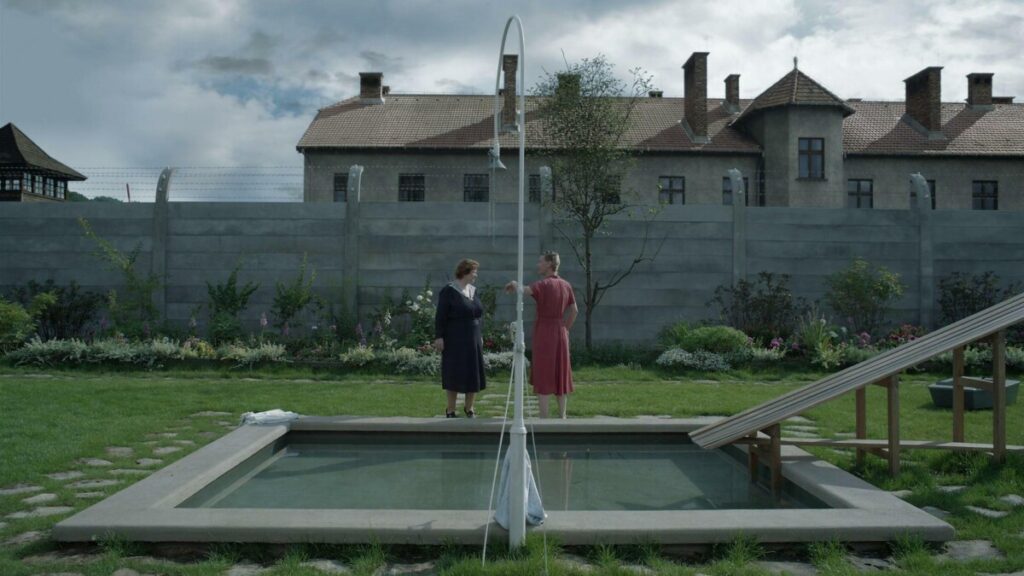
    I found The Zone of Interest upsetting, not for what we see, but for what it doesn’t show us. Although Holocaust movies generally face us with horror, Jonathan Glazer’s film creates much of its tension through absence or omission. The mise-en-scène is dominated by the family garden that has neat flower beds, a swimming pool, and bright summer light. It appears bucolic, almost rural advertisements for a country retreat. However, just beyond the wall of the garden, and out of view but heard, the machinery of Auschwitz operates. Perhaps the wall is the single most important “prop” in the film. It turns the setting into a “space of denial”: everything inside of it becomes a performance of normality, and everything outside of it becomes an unasked truth. It invites the viewer to divide attention between what is seen and what is only imagined.

    The cinematography really elevates this experience. The camera usually remains distant, presenting the Höss family in wide, static compositions. These extended, sweeping shots allow us to take in the entire composition, unlike the quick edits that usually direct or engage our focus, with our gaze wandering between, for example, the children and then the barely-there smoke in the back. The smoke stays in the distance, but we can’t escape its presence.

    The editing, or the lack of it, is just as remarkable. Several scenes play out in long takes, which invites a much heavier sensibility to time than we might expect from typical Hollywood filmmakers, who usually give us some rhythmic ‘relief’ by cutting scenes. When we do come to the cuts, they feel, and are, really jarring. For instance, consider the nighttime sey-gogging sequences, captured in infrared. The tonal shift creates a ghostly, documentary feel. These interruptions make us hyperaware of the film’s structure, like the director is forcing us to question how we are watching. Are we complicit, sitting comfortably on the inside of that wall?

    What struck me most in this movie was how ordinary the scenes inside the house felt. A mother selecting wallpaper, children splashing in a pool, a father leaving for work. The horror is how effortlessly those images are drawn into “normal” living, and how those same images coexist with mass murder. That is the film’s success: it doesn’t visually allow us to “see” the atrocity, but returns us to consider the comforts that enable it to happen.

  • Zone of Focus

    The film Zone of Interest opens with a long black screen accompanied only by background noises. The extended black screen at the start left me momentarily confused, thinking, “Professor Zinman should check if the site is working,” until the image of a family sitting in the grass appeared. That was the moment I realized the film demanded a deeper level of attention to be fully understood.

    Much of the movie consists of wide long shots, often framed in the same setting from different angles. With minimal sound, the only noises come from the subjects within each scene. With prior knowledge of the Holocaust, the silences felt overwhelmingly loud. Everyday details, the greenhouse, white picket fence, and breakfast on the table, revealed the unsettling coexistence of ordinary life with unspeakable horror. What seemed silent was never truly silent. The depth of realism within this film creates a space for the viewer that refuses to acknowledge the events happening around them. One scene shows an older woman lying in bed as the entire room becomes submerged in a red tint, followed by her sitting at the window, looking out at the camp located in the backyard of the home. All that could be heard was the noises of misery in the distance.

    Making Zone of Interest: Framing Holocaust Through 21st Century Lens:
    not the scene mentioned in the paragraph***

    Do you believe that individuals without much prior knowledge of the events of this time period would still be able to understand the severity of the quiet moments?

  • Windows and Mirrors in All That Heaven Allows

    All That Heaven Allows, directed by Douglas Sirk, utilizes the window and mirror as tools to highlight the contrast between the two characters, Cary Scott and Ron Kirby.

    The window in Cary Scott’s house is small, and when Cary is depicted from outside the building, the window appears like a lattice. The window traps her in societal expectations, leaving her yearning for freedom from people’s gaze. People around her also leave her behind the window, and even push her back into her place whenever she tries to break free from it.

    Screenshot from the film

    However, the window in Ron Kirby’s house is different, starting from its size. It is larger and frames the beautiful scenery of nature. When any character stands in front of this window, we feel a sense of freedom rather than suffocation. The movie ends with Ron and Cary standing in front of the giant window, showing how Cary finally freed herself from the people’s gaze and made a choice for herself. The choices she had made up to now were always for others. However, by choosing to be with Ron, viewers can realize that Cary overcame her fear of society’s judgment and made a decision she truly wanted—for herself.

    The director also uses a mirror as a tool to show how Cary shapes herself to conform to societal expectations. She doesn’t look into her ego, but rather uses the mirror to see how others might view her. Every time she attempts self-reflection, external interference interrupts her, forcing her back into the role she is expected to play.

    Screenshot from the film

    The question that I want the class to pose is
    1. How does the eyeline match from the mirror scene highlight Cary’s character?
    2. How does the wide shot and deep space amplify Ron’s character?

  • All That Heaven Allows and its Title

    The film, All That Heaven Allows, was at first seen as a melodramatic love story that was catered to women during the 1950s. However, unlike many other romcom titles during the 1950s like Singin’ in the Rain (1952) and Roman Holiday (1953), the title All That Heaven Allows, poses narratives and societal questions that may not appear to the average viewer on first watch.

    With the film officially releasing in 1955, it is important to preface that All That Heaven Allows takes place within the 1950s. Just years following the Second World War, the United States saw a massive economic boom and a sense of optimism (Why the 1950s Are Called the Golden Era – Vintage Lifestyle). This sense of greatness that existed in 1950s America seems to be contrasted by the repressive and constraining narrative that is portrayed in All That Heaven Allows. The seemingly “perfect” society of the 1950s is portrayed in a toxic light according to Douglas Sirk. In this film, all instances of American society seem to be portrayed in a negative light. The love between Ron and Cary, an innately problematic relationship by 1950s standards, is only attacked when in an urban setting. When in the natural countryside, all members of Ron’s family are completely accepting of Cary’s relationship.

    A clear difference is established between the human experience of that in an urban and rural setting. In my point of view, Sirk establishes the natural countryside as a sort of “Heaven” where both Ron and Cary can choose to be themselves and live life to their fullest, whereas the urban lifestyle is resemblant of a “Hell” that represses Cary and her desires.

    Overall, even though it may be a stretch to compare the idea of optimism and greatness during the 1950s to a sort of “Hell,” how do you consider the dichotomy between nature and urban culture in relation to the title? Is Sirk making a broader commentary towards the culture of the 1950s?

  • All That Heaven Allows: Transitions and Themes

    Douglas Sirk’s All That Heaven Allows, set in a small New England town in the 1950s, tells the story of Cary, a wealthy widow, and her budding romance with Ron, a much younger, less well-off gardener. This love affair causes an uproar among Cary’s superficial country club friends and, more sensitively, her children, who deeply disapprove of Ron.

    The editing throughout the film is very impressive, especially considering the fact that the film was made decades before digital editing existed. Sirk employs plenty of continuity editing to maintain a clear, easy-to-follow narrative. I specifically noticed the use of elliptical editing to condense time. The film transitions us through season after season seamlessly, although the entire movie is only an hour and a half long.

    One specific example that stood out to me was the dissolve on a tree in Cary’s backyard. The shot focuses on the tree in the fall full of bright red leaves, and slowly dissolves into a shot of the same tree, now nearly bare, marking the shift from autumn to winter.

    It’s a subtle but effective way to cue viewers that time has passed, and, in addition, it is a satisfying visual for the audience.

    Beyond editing, the film raises many questions about gender roles. The entire movie is clearly a commentary of the role of being a woman and mother in 1950s society. On the surface, Cary is boxed in by the expectations of being a mother and a respectable, upper-class woman. However, to me, the message seems to goes beyond just pointing out the freedoms that Cary is limited to as a single woman and hypocrisy she is faced with by society.

    In an ironic way, within her relationship with Ron, Cary almost seems to be playing “the man”. She often seems to hold more power between the two of them. Cary is the is the one with money, and social status, not to mention she’s also actually older than Ron. Even though Ron doesn’t seem to care about these things, it still seemed to establish a slight dominance in the relationship. At one point she even asks him, “Do you want me to be a man?”, to which he replies (jokingly), “Only in one way.” This is even visually represented when Ron has his accident and is physically emasculated. He is bedridden, unable to move, while Cary is watches over and takes care of him.

    This scene reminded me of the ending of Rear Window, where Jeff is immobilized and Lisa becomes the active, capable partner. Overall, the ending of the film made me think about what Sirk is trying to suggest about happy endings/happy relationships. In this scene, the entire setting of the house looks like a fantasy world. This is enhanced by the deer in the snow right outside of the window looking in at them.

  • All That Heaven Allows – Colors and Windows

    As a viewer, I noticed that Cary’s emotions would often be expressed through the colors on screen. When things were romantically well and hopeful between her and Ron, the world seemed warmer and brighter (almost glowing). But when they had conflict and Cary herself had inner conflict, the color scheme would turn cold and shadowy.

    The window is continually used to express Cary’s trapped feelings; she is always separated from what she really wants by glass. It is like she is watching her own life from the outside; she is so caught up in worrying about how her neighbors and her family will see and think about her (trying to keep everyone else happy), that she can not fully live in the moment. She is not able to express how she really feels because her life is being framed like a window. The windows are often depicted as frosted, suggesting her struggle to break free from the life she has always known.

    The scene with the rainbow of colors shining through the window is very interesting. In that scene, Cary is listening to her daughter, trying to take in someone else’s view of her relationship with Ron. The rainbow lighting is symbolic; it is showing just how many conflicting feelings and perspectives Cary is experiencing all at once.

    When Cary looks at the empty landscape outside the window, it seems to reflect her isolation and longing for connection. When the film changes to winter, the snow also seems to reflect her loneliness after she loses Ron. However, in the last scene, even though Ron is hurt, the color scheme became brighter (and maybe even more dream-like), and a deer appeared, which seems to symbolize hope.

    Questions to consider: 

    Did you notice any other recurring objects or symbols besides windows and snow that seemed important?

    How did you interpret the use of color changes throughout the film? Did any moment stand out to you visually?

  • All That Heaven Allows: Eliptical Illusion

    All That Heaven Allows tells the forbidden love story of the older woman, Cary, and the younger man, Ron. This story is about an age gap and a social class gap as well. Rumors are spread quickly about their atypical interests in each other.

    The director chooses to move us very quickly through this story. Many dissolves, fade-ins, and fade-outs transition us between places and the months. We begin in the fall, and by the end of the movie, they are reunited in the winter. The question I pose is, because of the continuity of months that passed, did the movie rush the film? Though we know months have passed due to the mise-en-scene, they are dressed in warmer clothes, the snow has packed, and she picks out a tree to take home and decorate, even presents are being received as her children return home.

    Amazon.com: All That Heaven Allows (Blu-ray + DVD) : Jane Wyman, Rock  Hudson, Agnes Moorehead, Douglas Sirk: Movies & TV

    When it comes to their love, did we, as watchers, have enough time to fall in love with them just as fast as they did? Do you think this editing choice was done on purpose? Does it move the story along smoothly enough for us to know it’s been months, but also feel the growth between their relationship and the distance when they reunite?

  • All That Heaven Allows: Through the Feminist Lens

    All That Heaven Allows is a melodrama and in Britannica’s definition: “a sentimental drama with an improbable plot that concerns the virtuous suffered by the villainous but ends happily triumphant.” Although All That Heaven Allows has certain melodramatic elements, the plot is far from improbable and instead concerns many women of the time and today in its critique of patriarchal and heteronormative society.

    Cary’s love for Ron is not only a romantic love, but can also be interpreted as the desire for autonomy in the surburban expectations that defines her worth through marriage and motherhood. Most of the discussion involving Cary from other characters has to do with her marriage or asking how her kids are, with the former even becoming the talk of the town after she defies expectations to marry within her class or age. This desire is condemned, with her kids accusing her of selfishness and shallowness, as they suspect her to see Ron as a “set of muscles.”

    The toxicity of the male-centered high society is most exemplified in Howard’s multiple assaults of Cary, as he forcefully kisses her twice while being married. Cary’s first assault was brushed under the rug as she “pretends it never happened” to avoid causing a stir- and likely because most would not be on her side. This is proved in Cary’s second assault, as most people were concerned with the way Ron protected Cary rather than Howard, the actual assailant. Cary is expected to deal with a terrifying and humiliating situation in a demure fashion.

    Although I found many of the romantic parts pretty corny, I can appreciate the deeper themes of female isolation and societal expectations just below the glossy Hollywood romance surface. However, one critique that I do have for the feminist interpretation of this movie is that although it delves into the struggles of womanhood in surburban America, the solution to Cary’s problems is still a man.

    This movie almost completely fails the Bechdel test, as almost all the substantial conversations in the movie either involve a man, or are two women talking about men or theories about men. (Though surprisingly, Mona’s conversation topics with Cary don’t involve men) Even though there are many interesting female characters in this movie, somehow the interactions between them almost always evolve into talking and contemplating about men. In the picture above, the daughter Kay delivers an interesting monologue about misogynistic Egyptian customs, but begins it with an even longer monologue completely focused on Harvey. Although this reflects the male-centered society that was the mid 1900’s, I wish that the female characters were able to do some introspection that didn’t have to use romance or men as a crutch.