Category: Viewer

  • Utopia

    Celine Sciamma’s Portrait of a Lady on Fire (2019) is a wonderfully wistful film, following the painter Marianne as she paints and begins a love affair with the reclusive bride-to-be, Heloise. Through long takes and the almost exclusive usage of diegetic sound, we viewers are transported into this quiet world of longing.

    Typically, a utopian film portrays “a setting that is idyllic or a society that strives for perfection” (Hellerman, No Film School – https://nofilmschool.com/utopian-fiction). A good example of a utopia within a film is The Truman Show, where Truman lives in a perfect, scenic neighborhood. Though Portrait of a Woman on Fire doesn’t depict a perfect society –

    (sidebar) In fact, Sciamma makes a point of highlighting the imperfections of the society in the film, especially when Marianne discusses her inability to paint male nudes due to her gender.

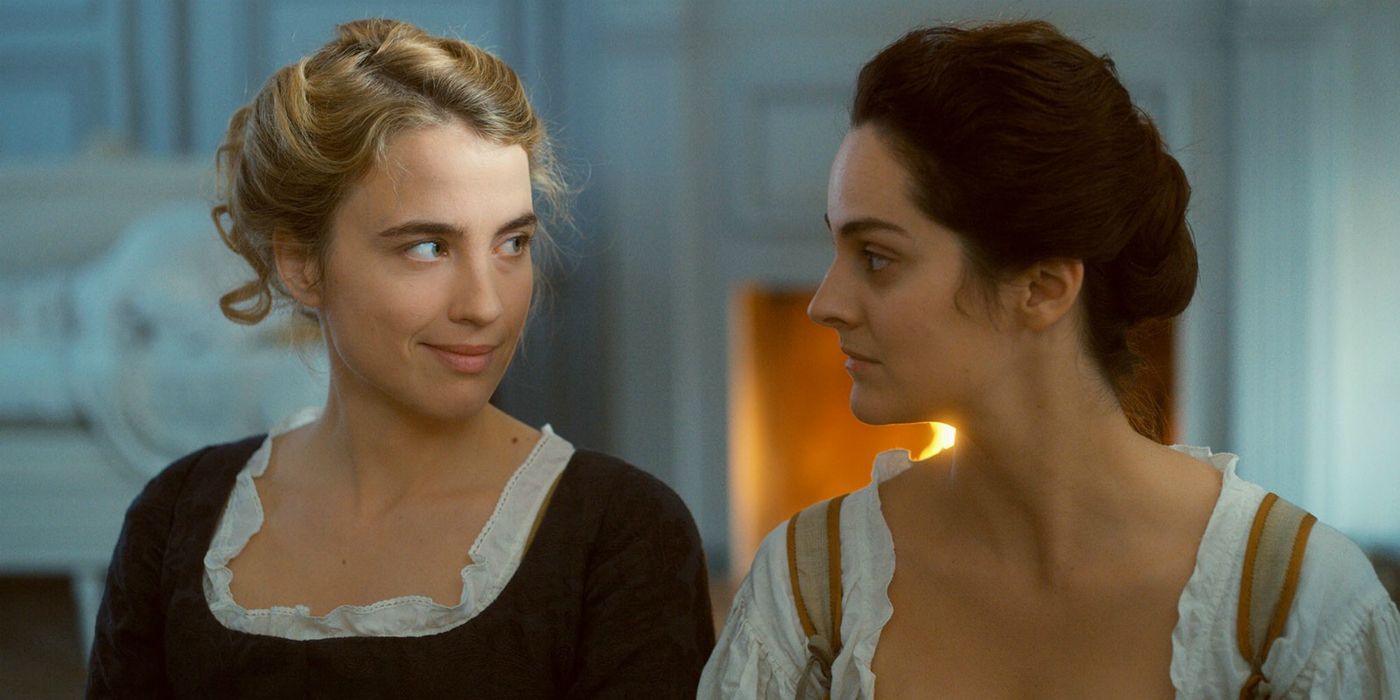
    – The film does take place in the idyllic setting of an isolated island off the coast of France. The color and mise-en-scène of this film reinforce this picturesque setting as well. Sciamma utilizes many softer colors throughout the film, such as the blues, reds, and greens of the women’s dresses, or the offwhite/cream colored walls of the mansion. This muted color scheme is often associated with feelings of gentleness and tranquility. The sound design is the same, with the avoidance of non-diegetic sound. We’re fully immersed in the story and feel as though we’re walking the cliffs with Marienne and Heloise ourselves. This also makes the scenes that utilize non-diegetic sound more meaningful and attention-grabbing, such as the bonfire scene. Lastly, each character’s positioning and blocking is done so intentionally in this film, and makes every frame a painting. These three aspects of the movie make Portrait of a Lady on Fire as utopian as possible.

    The utopia is also shown through the film’s material. Left alone on their own island, Marienne and Heloise are given a utopian freedom like never before. As Michael Brzezinski writes for The DePaulia, “she [Sciamma] makes a utopia of femininity for her characters in this world…even though it’s temporary…it’s almost elegiac in that nature”(https://depauliaonline.com/46466/artslife/film-tv/review-portrait-of-a-lady-on-fire-is-utopia-of-femininity/).

    An example that stands out to me is the unwanted pregnancy section of the film, where Sophie (the maid) chooses between keeping or aborting her baby. It was very meaningful to see a world in the 1700s where woman could make their own choices regarding their body and sexuality. Ultimately, this utopia is shown as temporary when Marianne leaves her room on her last day on the island and sees a man eating at the dinner table while Sophie serves him.

    Ultimately, the two women must leave their feminist utopia and return to the oppressive patriarchal society that they came from, where women lack autonomy and equality.

    Portrait of a Lady on Fire provides us with a look into a utopian world, where women are given freedom over their own decisions and health. Sciamma further emphasizes this through using almost unrealistic, picturesque colors in setting, set, and costume to make this world feel perfect and otherworldly.

  • Cinematography, Sound, and Symbolism in Portrait of a Lady on Fire

    Portrait of a Lady on Fire (2019), directed by Céline Sciamma, is a wonderfully beautiful film, capturing the longing and searching looks shared between the two main characters, Marianne and Héloïse. The film has long takes that give the story room to breathe and establish a quiet, poignant atmosphere. The framing of the shots is usually focused on the two women and their shifts in facial expression and emotion. In the scenes where Marianne and Héloïse are playing the harpsichord and playing a card game, the framing is deliberate, only showing their faces in medium close ups and close ups.

    Review portrait of a lady on fire is a sumptuous devastating film – Artofit
    Portrait Of A Lady On Fire Ending & Final Scene Meaning Explained

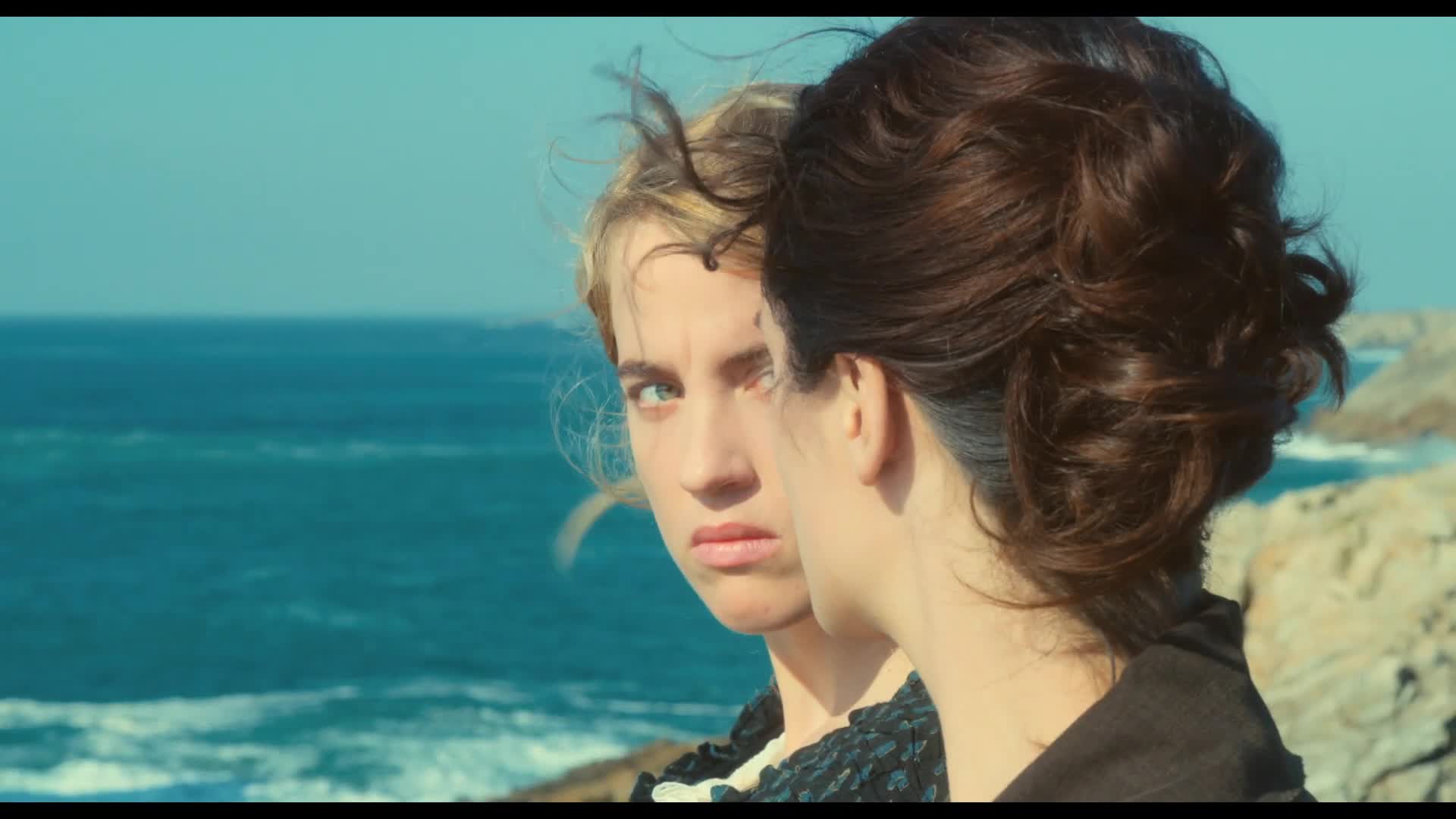
    The intentional framing drives the narrative by showing the viewers the emotional journey of the characters. In one scene by the coastline, Marianne and Héloïse are standing side by side. Marianne’s face is covering Héloïse’s face in the frame but reveals Héloïse’s face every time she turns her head to look at her. I thought this was a genius use of framing because it cues the audience in on Marianne’s inner thoughts and her curiosity about Héloïse. We glimpse Héloïse as Marianne does, quick and fleeting.

    Portrait Of A Lady On Fire Wallpapers - Top Free Portrait Of A Lady On ...

    The long shots throughout Portrait of a Lady on Fire are broken up by a generous helping of close ups, most notably used to emphasize important props. One example is the insert shot on the vase of flowers the maid is using as a subject for her needle work. An earlier shot shows the flowers blooming and flourishing with vibrant colors, but towards the end of the film, the flowers are shown in another shot as dead and withering.

    Portrait of a Lady on Fire (2019)

    We can take the flowers and extend their physical status to the relationship status of Marianne and Héloïse. Mise-en-scene and cinematography are working in tandem to enforce the mood and themes presented. It’s also worth noting that Marianne is in red throughout the duration of the film, indicating her as the object of desire for Héloïse.

    Portrait of a Lady on Fire: the act of looking - peachful - Medium

    The distinct lack of non-diegetic sound emphasizes the current action and brings the viewer into the fold of the setting. When there is music, however, the emotional effect is greatly increased and has a greater symbolic meaning when taken in the context of the relationship between the two women. The bonfire scene is an emotional moment for both women, and the fire acts as a metaphor for their attraction and desire.

    Portrait of a Lady on Fire Bonfire Song Explained: Best Musical Moment
    From Cannes: Céline Sciamma Paints a Captivating Romance in ‘Portrait ...

    The ending of the film was especially interesting because Marianne and Héloïse were both at the same orchestra concert listening to a piece that held emotional significance during their relationship. Héloïse was lost in the beauty of the orchestra, oblivious to Marianne sitting on the other side of the room. The camera moves in, and we see tears roll down Héloïse’s face.

    Portrait of a Lady on Fire – [FILMGRAB]

    While talking with several people about this scene, they mentioned being thinking Héloïse would look over and see Marianne or acknowledge the audience in some way. It was an interesting take, especially if you take the story of Orpheus and Eurydice, as told earlier in the film, as a metaphor for the affair.

    Was Héloïse truly ignorant to Marianne or was she instead choosing to keep the memory of Marianne that she created? How does the cinematography cater to the feminine gaze? What do you think of how the cinematography impacted the pacing of the film?

  • The Use of Color and Framing in Portrait of a Lady on Fire

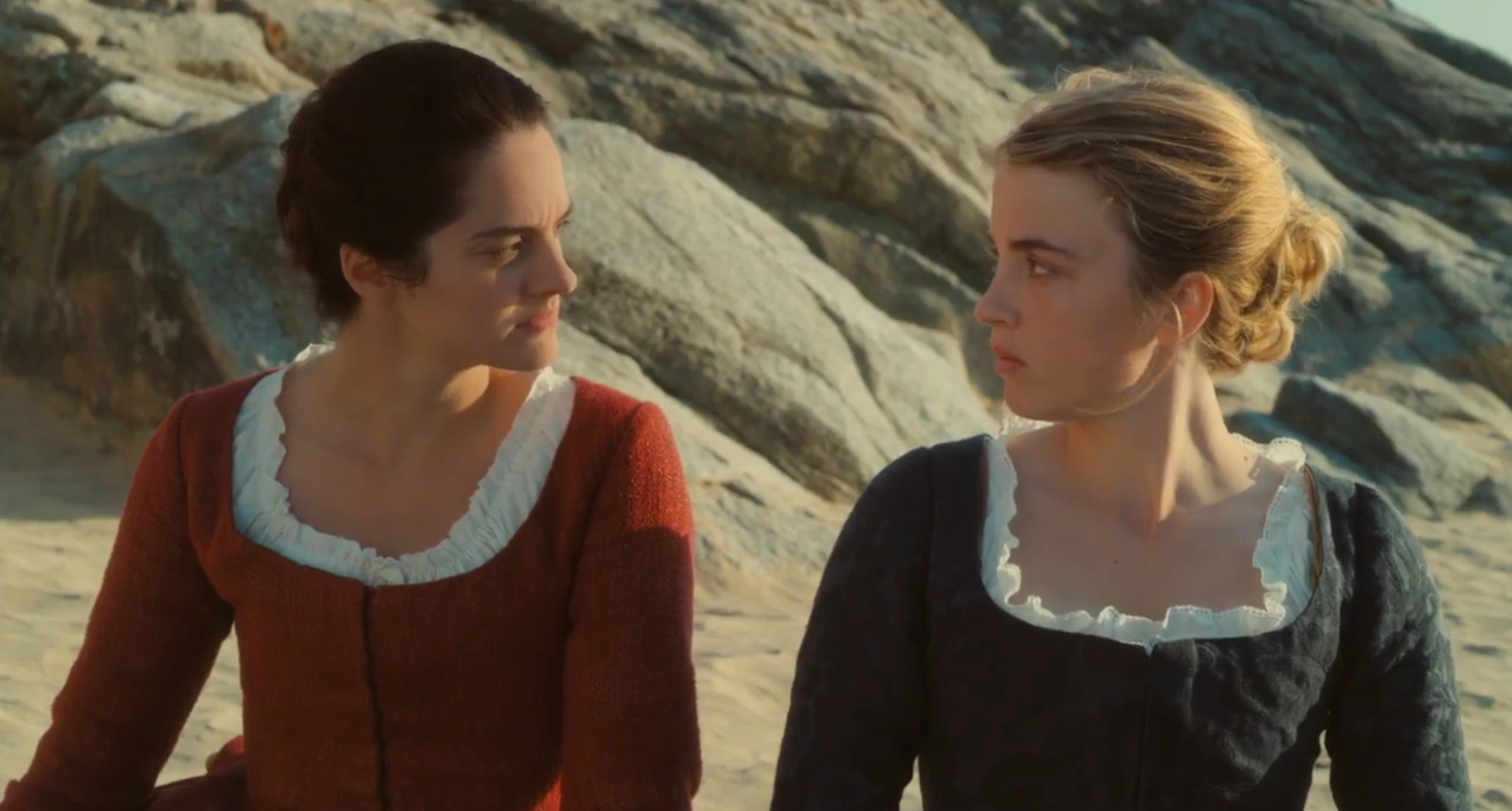
    We looked at two examples in class where red was used as a motif of passion, and this film utilized a similar system to convey the characters’ desires. Marianne was always clothed in red, characterizing not only her passion but her defiance and freedom. Unlike Héloïse, she has has the autonomy to pursue her interests and travel the world, as well as choose whether or not to marry. Conversely, Héloïse wears blue, which mirrors the sea. This reflects her desire for freedom from her social constraints, as well as a parallel to her sister and their sadness. However, when she wears the green dress, it reflects her submitting to her social role.

    Either way, the two characters wear opposing colors of clothing; Héloïse wears cool colors while Marianne wears warm colors. This suggests their inability to be together due to society’s standards. Additionally, it serves as foreshadowing for their separation at the end of the film.

    Sciamma utilizes many long and extreme long shots throughout the film, most of the time with the characters being the center focus of the frame, which emphasizes the film’s nostalgic nature as it is through the memory of Marianne; this is reminiscent of The Grand Budapest Hotel. This film is about observation, which is very prevalent through this framing. As a painter, Marianne is constantly observing, and we are observing with her through her point of view. This is first because she is painting Héloïse and later because she falls in love with her. However, the emptiness of the background in many of the scenes invokes a feeling of solitude and longing as Marianne is melancholy when she looks back at these memories.

    Questions:

    1. What is the significance of the low contrast in many scenes between Héloïse and Marianne? What does this say about scenes of high contrast?
    2. What are the functions of the framing in this film, especially when considering we are viewing this story through Marianne’s point of view?
    3. What is the significance of the scene when Marianne literally turns Héloïse’s heart on fire (when she lights the old painting)?
    4. What is the significance of the story of Sophie in relation to the romance plot of the film?
  • Lens and sense. How the usage of 70mm affect how we view Portrait of a Lady on Fire?

    While watching the film, I find out that there are often times two people in the frame.

    Before getting into the cinematography of Portrait of a Lady on Fire, we can first see a quote from Claire Mathon, the cinematographer of Portrait of a Lady on Fire. “The THALIA 70mm T2.6 Prime was one of our favorite focal lengths to capture this film about the looks and the proximity of these women.” (https://www.red.com/news/claire-mathon-afc)

    We must first know how wide different lens with different focal length capture before analyzing. In actual usage, photographers often use 35mm or less to capture the environment and create a overall livelier mood and add more context. These shots include more background, and characters are more of an element rather than the main component. The 50mm, are close to the view of the human eye, and most commonly used in POV shots.(https://www.youtube.com/watch?v=ImFXpyAA1b8)⬇️

    As a result, the persistent use of a 70mm lens by fixing the film at a human-scaled distance from the two women the director is letting us to observe.

    The persistent use of 70mm gives us the relaxing compression and at the same time give minimal edge distortion, and make the camera less intruding while giving us all the necessary details. It captures the expressions of Marianne and Heloise, and allow the audience to have their attention on both of them rather than one at a time.

    Both their faces are evenly proportioned, paired with the smooth and warm lighting, the 70mm will give the audience enough emphasize on the character while at the same time not so much isolation among the two women.

    By locking the film into a 70mm perspective, the director visually compresses characters within their surroundings. This reinforce one of the themes, which is freedom, and the 70mm technique visualize the character’s lack of freedom. As a result, the 70mm lens transform isolation into actual experiences for the viewer, turning form into an extension of theme.


    My question is:

    Does the director use all these techniques, such as the 70mm, lighting, and all the mise-en-scene elements to frame the love between Marianne and Heloise as a rebellion (maybe the large usage of 70mm is a rebellion against the common used 35mm), that is destined to fade after they are separated and can only be kept in their memories, or a durable, long lasting relationship that persists through history? Which kind of relationship he is trying to present.


  • It’s the little things that count with Wes Anderson

    The Grand Budapest Hotel is an incredible example of what we read about mise-en-scène. The shapes and actions performed by the actors and set pieces contribute significantly to the film’s themes of culture, violence, and absurdism. I noticed great contrasts between costume and setting that made the experience of watching The Grand Budapest Hotel that much more engaging. The designers, in tandem with Wes Anderson’s directorial vision, created an incredible, avant-garde world that draws audiences in more and more with each frame.

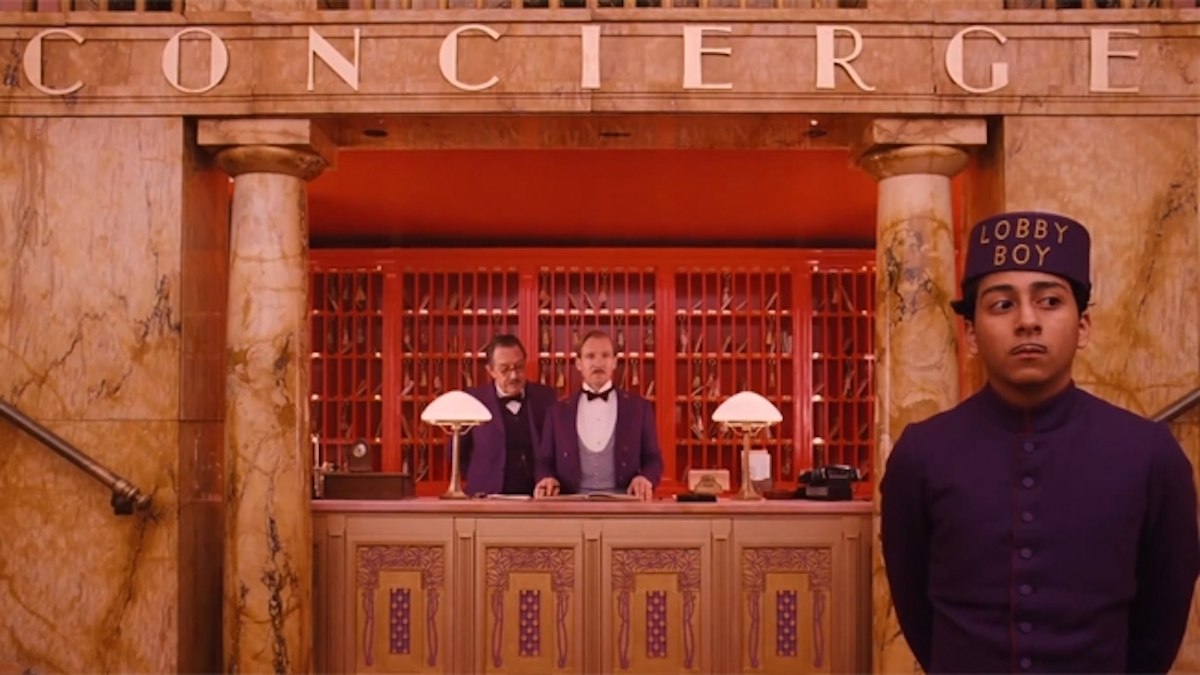
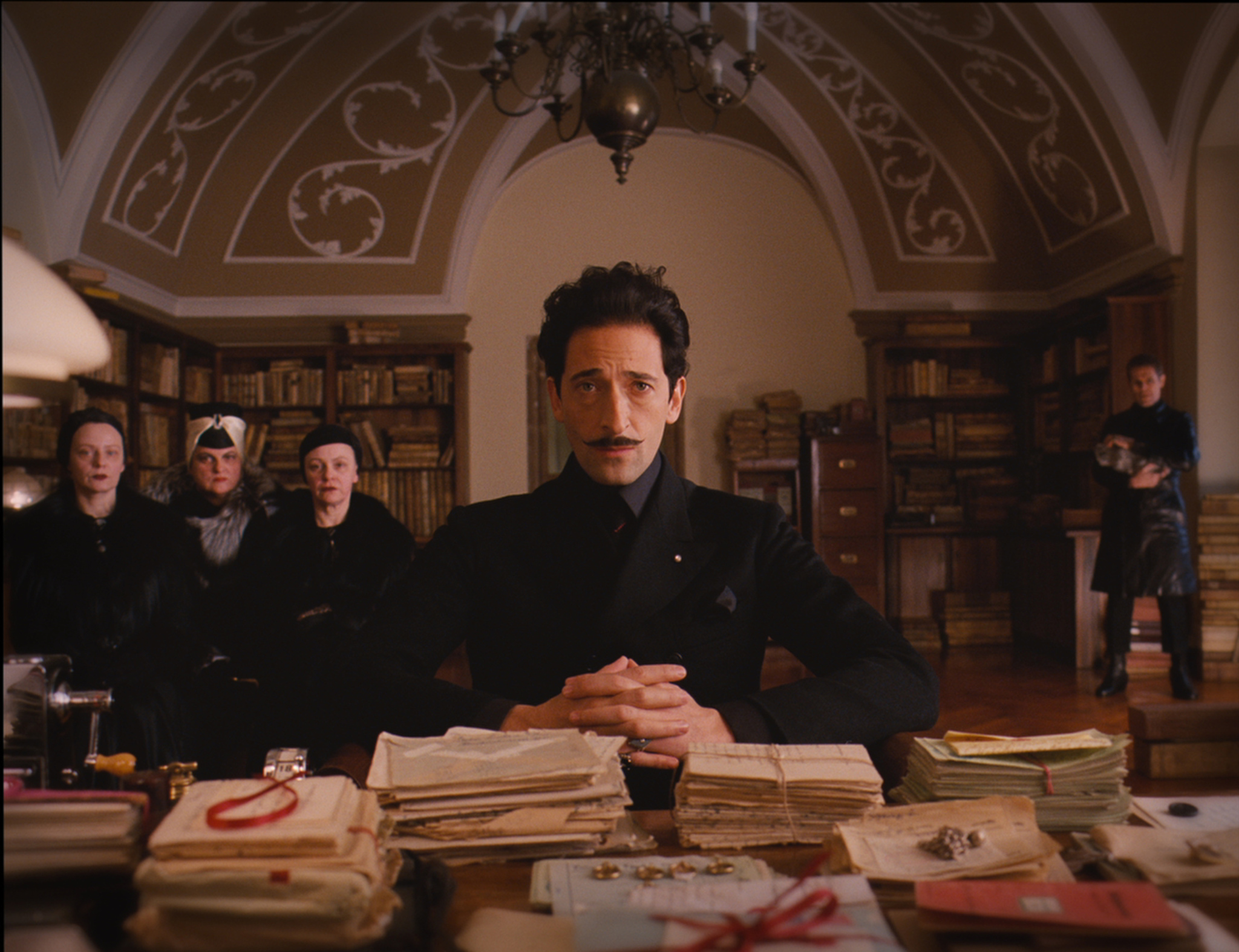
    Watching this movie, I, much like every other viewer, was immediately drawn to the color schemes present in each shot. The titular Grand Budapest Hotel is filled with oranges of different shades, interspersed by hotel staff and Monsieur Gustave’s consistently purple clothing. The narrator outside of M. Gustave’s story wears a pale pink suit, himself. All of this shows vibrancy–and perhaps happiness or lightheartedness. As we progress through the film, we are introduced to a much more contrastive and brooding color palette. With the introduction of Dmitri in his home, the viewer is inundated with brown, black, and dark red, all of which denoting danger. Dmitri himself wears black, blending in with his surroundings while Gustave and Zero stick out wherever they go. The world of the film dips further into an ever-increasing fascist government as we see the beginning of the Lutz Blitz. By this point, the film is in black and white. It is reminiscent of the story of The Giver, both in the novel and the film adaptation. Both of these works depict the loss of ROY G. BIV colors as a loss of freedom, joy and individuality, being replaced by grayscale hues as conformity and evil dominate the world.

    I also noted the minuteness of action on-screen. I remember the particular act of creating the escape tunnel through the prison’s floor being so small by volume: none of the escapees wanted to be heard. Additionally, when Zero and M. Gustave reach Checkpoint 19 and they are met by a giant wall. Outside of the frame, we hear a guard whistling to them. The camera pans to his relatively microscopic body as he motions them through the once non-visible door.

    In directing this film, Anderson paid great attention to detail–particularly the tiny ones. It is through this work that films like The Grand Budapest Hotel captivate audiences. In watching this, the viewer, too, pays attention to even the smallest details.

  • Wes Anderson’s Grand Budapest Hotel and our loyalty to “all we know”

    Before I say anything remotely analytical about this movie, I wanted to note that this is one of the most visually appealing films of all time. On par with some of my favorite movies to just look at like Under the Skin(2013), 2001: A Space Odyssey(1968), and Drive (2011), Wes Anderson’s use of painting-like imagery with the background compressed against the foreground makes this a simply stunning movie.

    Throughout the movie, I feel like Wes Anderson was screaming at me that this film is about loyalty. But although there is the obvious loyal relationship between Zero and Gustave, the theme extends far past an individual’s loyalty for another. I think this film is really trying to communicate how as individuals, we tend to be ferociously loyal to the things that have always been; the constants in our lives. We see this every day in the United States. According to the Pew Research Center, 89% of teens from Democratic households also vote for Democratic candidates (81% for Republican households). I believe that this is not actually about the values of the child, but about an individual’s loyalty to their parent’s values, since that is all they have known since birth. Wes Anderson throws this theme in our face throughout Grand Budapest Hotel. Introduced early in the film, Zero is alone. When asked whether he has a family, he replies with ‘none’. Immediately, Gustave is a father figure. Whether he likes it or not, Gustave is in a position of instructional and literal power over Zero, causing Zero to latch on almost instantaneously. I don’t believe that this is because Zero respects Gustave (Gustave is a deeply flawed and sometimes ridiculous person), rather that Gustave and the values he stands for becomes literally the only thing in Zero’s life, and therefore the only thing he has to learn from.

    However, this theme of loyalty extends past Zero’s relationship to Gustave. Gustave himself is a character literally defined by his loyalty. All we ever know about his character is his mastery of the concierge arts. For all the audience knows, this is all Gustave has been, and all he ever will be. His loyalty is not only to the women he takes care of and the young men he takes under his wing, but the literal act of being a concierge. In prison of all places, Gustave brings a cart around from cell to cell handing out soup. He won’t ever stop being a concierge because he literally can’t. Like Zero’s relationship to him, Gustave can’t give up being a concierge because it is actually the only thing he knows. Again, towards the end, when the hotel is crawling with policemen looking for him and a psycho killer trying to take his life, Gustave enters the Grand Budapest Hotel disguised as a bakery delivery man. It is possible to look at this from the perspective of his loyalty to Zero and Zero’s relationship to Agatha, but I think Wes Anderson intended this to be a representation of Gustave’s inability to part with the hotel. The hotel is his life, and he would rather die than be apart from the only thing he has ever known.

    This is not a film about love or belonging, but instead about humans’ loyalty and almost obsession with retaining constants in our lives. Zero, even in his old age and the Grand Budapest’s failure, is fiercely loyal to it and Gustave. My one question about this film is: Does Wes Anderson hate Zero and Gustave for being so loyal, eventually killing one of them and dooming the other to eternal loneliness? Or does he actually respect and value their obsessions?

  • How does Anderson’s filming approach affect the way we understand this film’s theme?

    In the Grand Budapest Hotel, as I searched the background of its creation, the film’s director Wes Anderson was partly inspired by the novels and memoirs of Austrian writer Stefan Zweig, whose work often talks about the disappearance of old European culture. I believe it influences the tone of the film and its focus on the decline of an era. Also, the film style especially emphasize symmetry, and the camera is almost always positioned directly from the front, side or back. Shots taken from an oblique angle is almost not exist, which always create a sense of precision and this strict formalism gives audience the feeling that the film is almost like a painting or a stage.


    Also, another detail I noticed while watching is that Anderson uses three distinct aspect ratios in the film to visually separate the timelines. The first two parts use 1.85:1(1980s), the third part adopts the widescreen format of 2.35:1(1960s), and the most important final part uses the classic industrial standard of old films, 1.37:1(1930s).(https://b23.tv/JTTba6Q, 拉片实验室,2020)

    Screenshot

    In the end, I think one of the most striking scenes for me is the train inspection. In the first inspection, the inspection is conducted by local policemen who still remain some sense of civility, wearing classical uniforms, and Gustave is able to resolve the situation through his personal connections. However, in the second inspection, Zubrowka is no longer an independent state, and the temporary pass that previously was issued by Norton is not working. The policemen are now armed soldiers in identical uniforms. I believe Anderson was using costume, this element of Mise-en-scène to strengthen the contrast. In the end, the film shift to black-and-white imagery which I may consider as a metaphor for Nazi Germany.


    My question is: How does Anderson’s stylized filming approach, which are his symmetry, colors, and changing aspect ratios affect the way we understand this film’s themes-cultural decline?

  • The Grand Budapest Hotel_ Viewer’s Comment

    The use of Mise-en-Scene in The Grand Budapest Hotel


    Hello classmates, it was great to watch this interesting movie with you all this afternoon. I don’t know how you felt about this movie, but personally speaking, I loved it. The plots are so tight, and I got fully immersed in it! Besides the fantastic storytelling, I believe that this movie effectively shows the power of Mise-en-Scene. The smart uses of setting, costume and makeup, lighting, and staging not only help the audience engage better, but also gives us more space to explain the film further and taste it deeper.

    In this post, I’d love to share with you some of my findings while watching and also share initial questions I have, so we can further discuss them.

    Insights:

    1. In the scene of reading Madame D.’s will, Gustave and Zero are standing at the door of the entire room, on the opposite side, wearing purple suits, while almost all of the other people in the same scene were in black. By contrasting standing position and clothes’ color, I think that the director is trying to emphasize the contrast of their personalities: Gustave and Zero embody individuality, elegance, visually marked by their purple uniforms. The others dressed uniformly in black represent conformity, rigidity, and the coldness of aristocratic tradition. (Costume & Makeup + Staging)
    2. Jopling: This ruthless killer is depicted by using a combination of costume and lighting techniques. If I remember correctly, he is always dressed in black throughout the entire movie, often wearing black sunglasses or having shadowed eyes due to the lighting effect. For example, in the snow mountain scene, he chases after Zero and Agatha on a sled after Gustave and Zero escape. The stark white snow, contrasted with Jopling’s dark figure, strengthens his dark side and ruthless personality. (Costume + Llighting)
    3. In the prison escape tunnel, light becomes symbolic: the small window glows brightly while everything else is engulfed in darkness. This stark contrast emphasizes freedom as a distant possibility, a fragile opening amid confinement. (Lighting + Setting)


    Questions:

    1. Why does Anderson begin the film in a cemetery filled with crosses? How does this opening frame set the tone of memory and loss? (Setting)
    2. What’s the implication of the children with weapons in the second scene? Is Anderson suggesting that violence disrupts innocence and order? (Staging + Setting)
    3. How does Anderson’s pastel palette (pink hotel exterior, purple uniforms, candy-colored props) evoke nostalgia? Does it make the story feel like a memory or a fairy tale? (Costume & Makeup + Setting)
    4. What are the symbolic meanings of the painting Boy with Apple? Why did Anderson choose this painting instead of others? (Props/Costume & Makeup)
    5. Why does Anderson often isolate characters in their own shots during dialogue (like Gustave and Zero on the train), instead of framing them together? (Staging)

    Hope we can discuss further in the comment area or in class!

  • Blogging Sample

    The cycle of natural decay is both materially enacted and mirrored in the making of Jennifer Reeves’s Landfill 16 (2011), which takes up the idea of recycling, waste management, and the death of film. Reeves buried 16mm outtakes from her double-projection celebration of the natural world, When It Was Blue (2008), in a homemade landfill in Elkhart, Indiana. She then gave the exhumed film new purpose, hand-painting the corroded and soil-stained frames. The resultant imagery scans as densely textured terraforms, like pebbled plastic covered in mold. No photography was required to re-animate this celluloid originally consigned to the literal scrap heap. Images of animals briefly appear—a deer, an eagle, an ominous black widow—all barely recognizable through the garbage-battered frames, and seemingly buried under the decaying and dirty film. With its foreboding score, which mixes bulldozers, nature sounds, factory noise, and a trapped bird tweeting in pain, Reeves addresses not only the ways in which the media of analog moving images is literally and metaphorically being disposed as it approaches its industrial obsolescence, but also the disastrous environmental consequences of modern life.

    Brimming with alternatively mottled and lapidary images, Landfill 16 pulses like living thing, a horror film about, to use Jussi Parikka’s phrase, “zombie media”—here, discarded moving images coming back to life, deformed. And while she never conceived the work as a collaboration per se, Reeves acknowledges the way the project represents a conjoining of forces that includes, she says, “the world, her thinking mind, and her spiritual muse….I had a feeling it wasn’t all me…that something else was at work.”

    Furthermore, Reeves’ work illuminates a politics of process. It does not merely exhibit political engagement through content, but also describes a mode of deeper philosophical inquiry regarding the role and positioning of humanity vis-a-vis the world through methods of production. Landfill 16 demonstrates that how things are made matters, and that making carries ramifications for how we think about and conduct ourselves in relation to other people, objects, and things. Art therefore provides a useful model for broadening our approach to thinking about the nonhuman, about the limits of authorship, and about attributions of agency. Works like Landfill 16 show that when we decenter the human, that when ego gives way to an “at-oneness with whatever,” we ironically gain a better sense of humanity’s place in the world.

    Plants, insects, and people all die, but cinema lives, every time it is played. Is dead/is dying.; a reversal of time, a reversal of nature itself. This is what cinema can do—change time, change the way things look or appear, open us up to new kinds of sight, new kinds of visions.

    All photographs carry an indexical relationship to their referents—Roland Barthes notes that he “can never deny that the thing has been there.There is a superimposition here: of reality and of the past” (Camera Lucida, 76.  Emphasis in original).  Barthes labels this persistent presence of the referent the essence of photography and the “That-has-been.”  How does this change when there is not a camera?