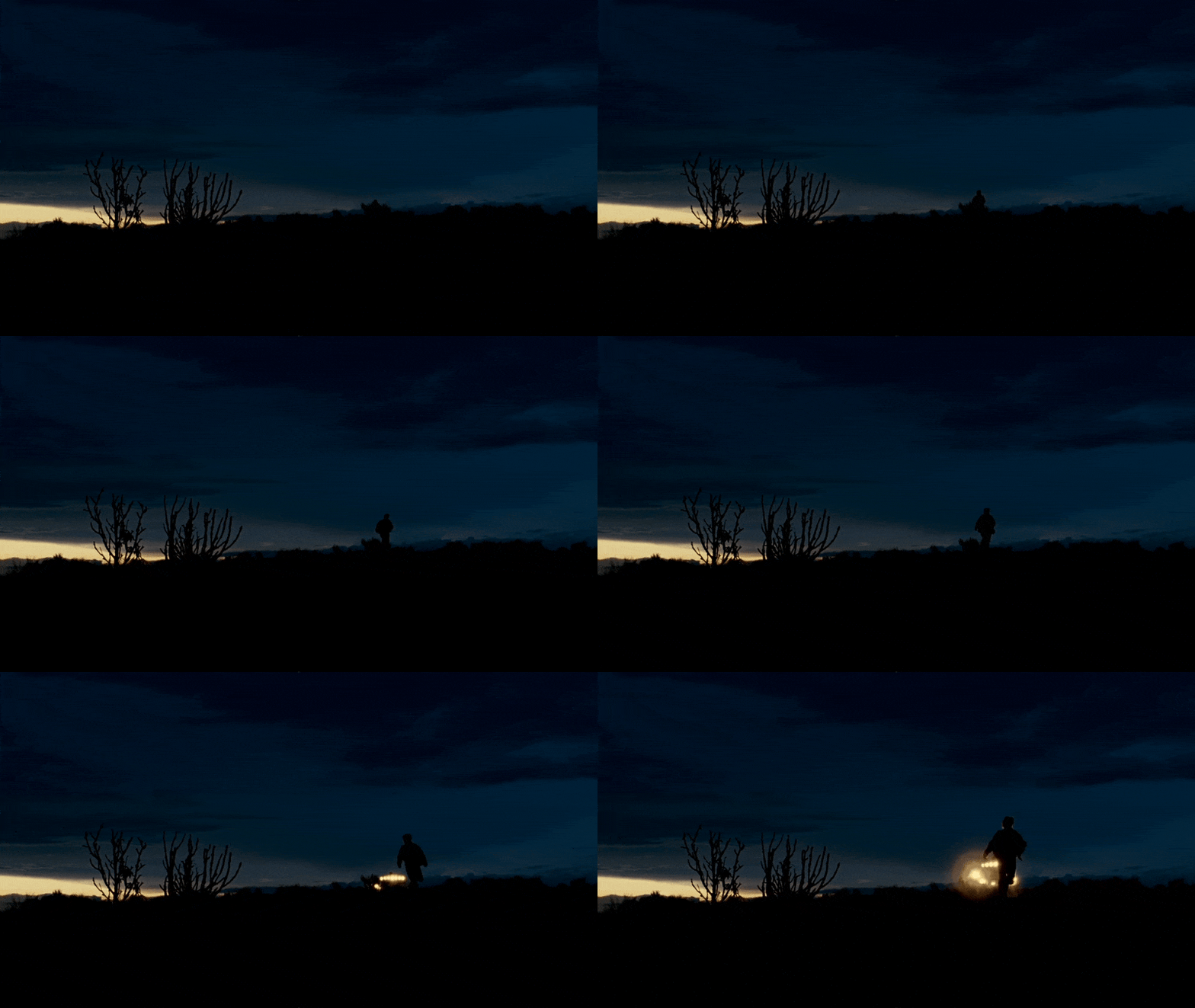
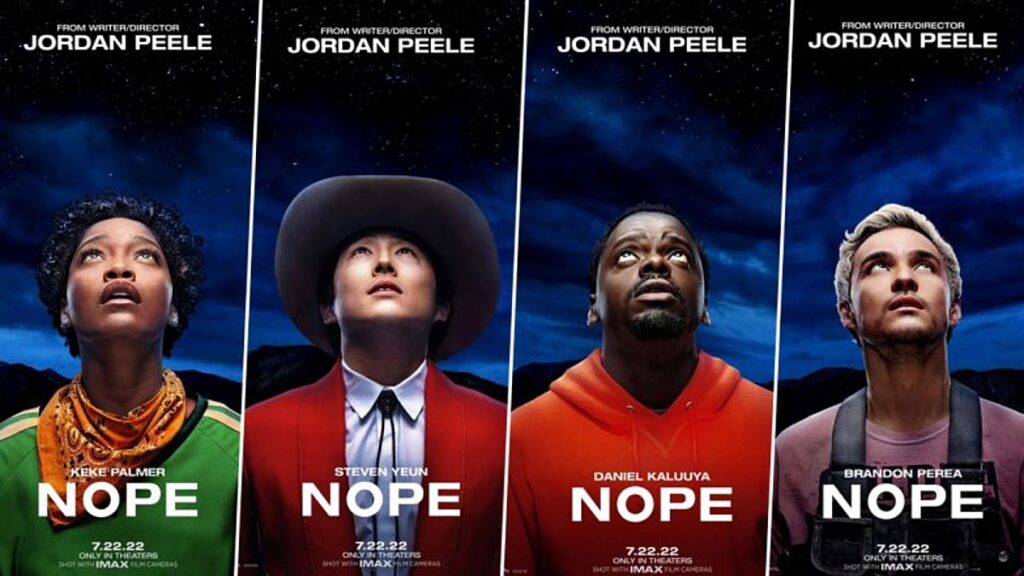
While doing my searching this week for Nope, I stumbled along this video of Jordan Peele himself breaking down what he believes the central theme of his movie “Nope” is.
Within this video he breaks down how he believes Nope to not just be about race, but to also be acknowledgement to the people who came before them in this industry. He speaks about how this movie could not have been made 5 years ago and it brings into question as a viewer if by simply existing are you defying stereotypes. Jordan Peele would say yes. He believes that this movie is defiance against norms in the film industry. By having this movie star mainly people of color while also being created by people of color, its credit scene alone is acknowledgment of the fact that they are pushing boundaries. Jordan Peele challenges us to go beyond thinking that this movie is strictly about what’s in front of our face and asks us to look deeper in the fact that every single characters role and meaning to the movie is a commentary on the film industry’s stereotypes and restrictions.
For him he feels as if this movie is a nod to all the black entertainers who have been snubbed while their white counterparts get the spotlight. Along with this theme he talks about how this movie isn’t just about spectacles and what we will do to see them, but also about what we will do to be seen. It’s a reminder that there is always someone behind the camera and what they went through to get the shot they desired should not be ignored. We see this continuously throughout the movie as they Em and Oj talk about wanting to get the shot for the money, they want the recognition that comes along with capturing something otherworldly on film. You also blatantly see it when the TMZ reporter asks to be filmed despite having broken numerous bones.
Finally he ends the video by saying he really hoped to have immersed people in the film, and that he wishes that everyone would have left the movie feeling as if they had been near a UFO because it is something so many of us have thought about before. Although he is unable to pinpoint one central theme, he highlights that no movie is really able to be summed up into one jist, there are multiple layers to every good movie. Whether it be about breaking stereotypes or immersing people fully into something genuinely horrifying,
I went into this week’s screening thinking that maybe this would be the day where I would start liking terror or at least understanding why so many people love it. Long story short, it wasn’t… But it got me thinking that maybe this is the point. Keke Palmer herself says that “Nope is not a movie that you can really explain, It’s a movie that is meant to be perceived. It’s a movie meant to make you think and bring out some of your innermost thoughts of your subconscious and trigger you“.
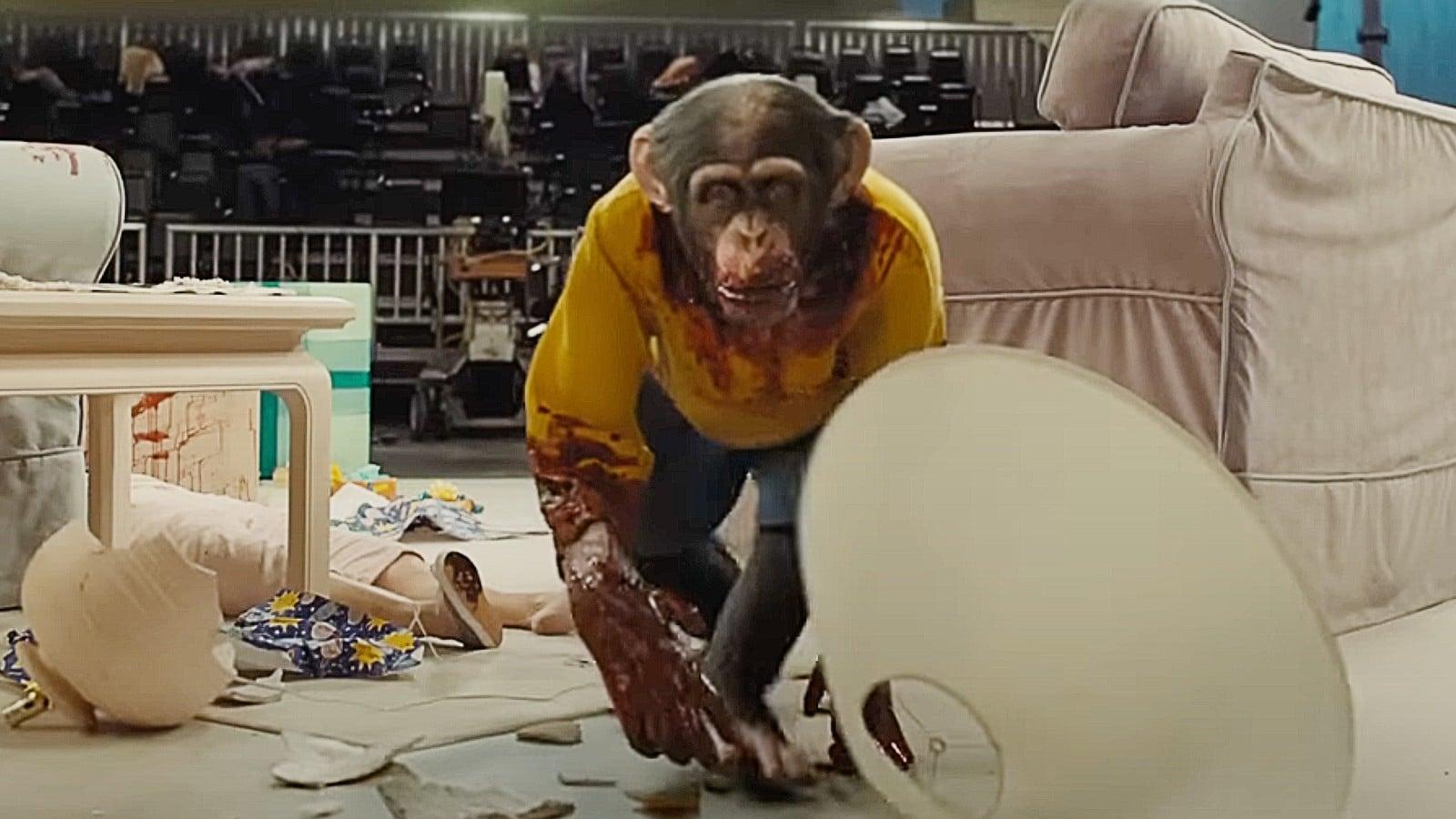
Going into that idea that this is a movie meant to be perceived, my perception is that Nope e is not about the horror or the scary things we don’t know about reality, it’s about people’s greater desire to be a part of something greater, a spectacle. To that end, Peele exposes this desire as he connects it directly to Hollywood’s history of turning people and animals into objects of consumption. Jordan Peele is throwing at our faces at all times a parallel between Jean Jacket and Gordy, and how these 2 characters have been pushed into performance roles that are outside their nature. In essence, it is hard to learn about a thing when you are learning about it in a context where it shouldn’t be in in the first place, which is the case for the chimpanzee in the sitcom and Jean Jacket in the Starlight lasso show. Gordy is made to act human and JJ is turned into a profitable attraction – both stripped of autonomy in the name of entertainment.
Both Gordy and Jean jacket are creatures that cannot be controlled. Peele suggests that once you turn something uncontrollable into a product of mass viewing, you invite destruction. Hollywood in this sense is the real monster. Which is why I understand both creatures to be symbols that represent Hollywood in this context, and this idea that the spectacle pays off. Hollywood is this unpredictable beast, and spectacle is always a currency of high value.
Besides Gordy and Jean Jacket, all of the other characters also serve as symbols. The TMZ reporter and the cinematographer are also unmistakable symbols for this obsessive culture and the neverending gaze for the perfect shot. In contrast, OJ is the only one who sees animals not as tools but as living beings and he is therefore the only one who’s able to “tame” JEan Jacket as he understands the creatures mechanisms.
Ultimately, Nope becomes a criticism of the exploitation disguised as entertainment. A movie that uses the conventions of horror, sci-fi and western genres to critique the industry that birthed them.
Says Rooster Cogburn as he bravely charges four-on-one against Ned Pepper and his outlaws. Retied and an alcoholic at the start of the film, Cogburn’s resolve on the side of moral justice and duty marks the completion of his arc, a moment of western catharsis that the audience cheers for. True Grit (1969) is an excellent exemplification of the Western genre, an adventure about a morally complex character between clear moral boundaries and all the guns, wild west environments, and exciting score to boot. However, the 2008 film No Country for Old Men approaches westerns very differently. Rather than embracing familiar themes of redemption and bravery, the Coen brothers twist these themes on their head in order to expose Hollywood and the audience’s expectations of genre.
Genre, as outlined in Film Art: An Introduction, are systems and conventions of similar iconography, plots, themes, and characters that are employed to help filmmakers structure stories and audiences form expectations. Hollywood’s relationship with its audiences are largely built off of genre; our expectations and ritualistic nature urge us toward specific films to create specific emotions. Genre differences can arise when filmmakers take old elements and present them in new ways. But it is especially rare when a film violates genre conventions entirely; taking each and every element and breaking it over its knee.
No Country for Old Men is set desert landscape with the guns, sheriffs and outlaws all exemplifying the western genre, but much of the iconography is tainted with an uneasy emptiness. One shot that sticks in my head is the establishing shot as Anton walks into the gas station. The long shot’s desert landscape looks dead and dry, both sky and earth devoid of the color that gave the American West’s adventurous look from films in the 60s. The marks of civilization that signified the “boom town” in typical westerns look rusted, old, and yet uncomfortably modern; the car, power lines, and gas station somehow look older than the environment around them. The Coen’s opt for still shots rather than pans, letting the audience sit in the dinginess of the environment rather than projecting spectacle and grandeur.
No Country for Old Men‘s wastelands, both desert and urban, convey a sentiment of a time long gone and an uneasiness that sets this film apart from other Westerns.
The score of the film is also notable, mostly because the film doesn’t really have much of score, or any music for that matter. Rather than the adventurous overtures of typical westerns, an empty sounding film creates tension that betrays the audience’s expectations. The use of sound is incredible, from the “blip” of the transponder to Carter Burwell’s subtle, almost unnoticeable swells of ambient music, sound is integral to the film’s mise en scene and the emotion it conveys.
Sheriff Bell isn’t the “main character” but certainly the protagonist in which the central theme revolves around. Nostalgic for a past that no longer exists, he retires at the end of the film once the morally straightforward, “good vs. evil” perspective, his kind demeanor, and solid wits akin to an old detective no longer hold up in the modern world. It’s notable that the Sheriff and his deputy ride horses, iconography that Film Art: An Introduction attributes to the “outlaws” of westerns, as opposed to the criminal’s use of modern automobiles. Bell’s most powerful scene, in my opinion, is when he sits down with Carla Jean to discuss Moss’ unwillingness to get help from the police. When Carla Jean tells Bell how determined and resourceful Moss is, Bell breaks into a metaphorical story, about how one of friends Charlie, when trying to kill livestock for slaughter, was himself injured when his bullet missed and ricocheted. He concludes with “even in the contest between man and steer, the issue is not certain.” Then Bell sighs and laments, “‘course they slaughter steers a lot different these days. They use an air gun, shoots a little rod… animal never knows what hit him.” This scene is written so tragically, and you along with Bell can feel the way a little bit of cathartic justice that Bell believes in is long dead. https://www.youtube.com/watch?v=WHnMFX2OuhM
Our main character Llewelyn Moss is a rough and tough lone wolf squarely placed between the moral framework common amongst other Western characters. But he doesn’t get a redemption or heroic death; the Coen brothers kill him offscreen by some unknown and unseen gang members. Breaking one of the Western’s most fundamental conventions, the audience is let down in an anticlimactic whimper as the old-time, unconventional traits that positively serve past western characters, such as True Grit’s Cogburn, instead leave Moss dead. It’s to note that Moss’ adversaries throughout the film are portrayed as unseen, and filmed as a tension building thriller. In a genre that pits the hero and villain, along with their moral qualms, at eye-line-match from one another, there is not a single “face-off” or “final confrontation” between antagonist and protagonist. Moss’ two deadly encounters with the gang are a good example: none of them are ever pictured in detail, just silhouetted in suggestion, like a force of nature rather than a human antagonist.
However, nothing really feels like a force of nature more than Anton Chigurh, the film’s central antagonist. Across the novel and film, Anton is a character who is physically unexplainable; his name and appearance tell nothing about who he is, and his characterization by Javier Bardem brilliantly leaves the audience with more questions than answers. He is without remorse, compassion, or emotion, yet has an unexplainable moral code seen when confronting the gas station owner and Llewelyn’s landlord; this complexity underlines the futility in understanding his character. The Coens write Anton as a looming force of nature. Sheriff Bell and Anton never even meet, let alone an old fashioned stand-off, yet his presence overshadows the entire film, leaving a trail of dead in his wake. He kills not through a bad-ass gunfight or a confrontation of moral differences, but through happenstance and causality, as best illustrated in the scene between him and Carson Wells. I think a brilliant decision the Coen brothers make is leaving the fates of the accountant and Carla Jean uncertain; denying narrative closure and further complexifying Anton’s moral standpoint further play with the audience’s expectations. At the end of the film, Anton is suddenly hit by a car, leaving him gravely injured but his overall end unknown. I have always interpreted this as the ambiguity of fate, how calamity befalls him not in the middle of committing a villainous deed, but simply being in the wrong place at the wrong time. At the same time, fate isn’t justice bound, as Anton simply gets help from some bystanders and walks away. It speaks to the expectations we have onto what befalls those who are good verses evil.
The Coen brothers have a lot to say about Hollywood’s use of genre. Audiences have been trained to expect certain things through repetitive use of genre patterns, something especially appealing to larger studios and cinematic universes. One of the oldest genres in filmmaking, westerns have been reflexively rebranded and redone in order to appeal to a continuously shifting audience. No Country for Old Men, for lack of a better word, slaps you across the face, and exposes our dependency on familiar patterns and our innate impulse to seek new thrills from set expectations.
When I first watched Nope by Jordan Peele, I went in completely blind. I didn’t even take the chance to watch the trailer. I just got in the car with my brother and sat in the theater, expecting something similar to Peele’s previous projects, Get Out and Us: a psychological thriller. After the first viewing, I was blown away by his shift toward an astrological horror theme. However, taking into account count the deeper meaning of having two black leads and reflecting on the film’s exploration of “spectacle” and Black visibility in Hollywood, I began to see it as a powerful commentary on what it truly means to be Black in Show Business.
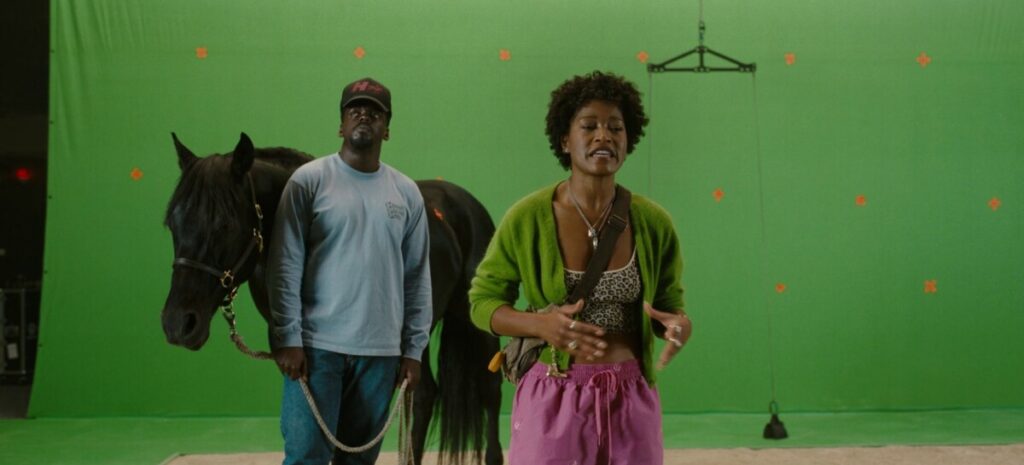
In one of the major scenes where both protagonists stand in front of a green screen, we get an early glimpse into how Black performers are often treated within the film industry. Taking into account the main characters’ family history, particularly their connection to one of the first moving pictures, featuring their great (3x) grandfather riding a horse, the crew’s reaction to their presence feels heavily anticlimactic. This moment of what seems like simple oversight, is rooted in the historical disregard of Black contributions to cinema, aligned with the siblings’ late father’s horse ranch, which serves as a foundation for the two. The way their labor and resources are used with minimal acknowledgement or recognition encapsulates the broader experience of many Black and minority group whose efforts often go unseen beyond the screen.
This theme of exploitation and invisibility is further explored in articles like WATCH: THE MEANING BEHIND JORDAN PEELE’S ‘NOPE’: THE DANGERS OF PURSUING SPECTACLE which provides insight into Peele’s effort to create a film that ultimately subverts the minds of the audience and plants several ideas how a spectacle can change one’s perception.
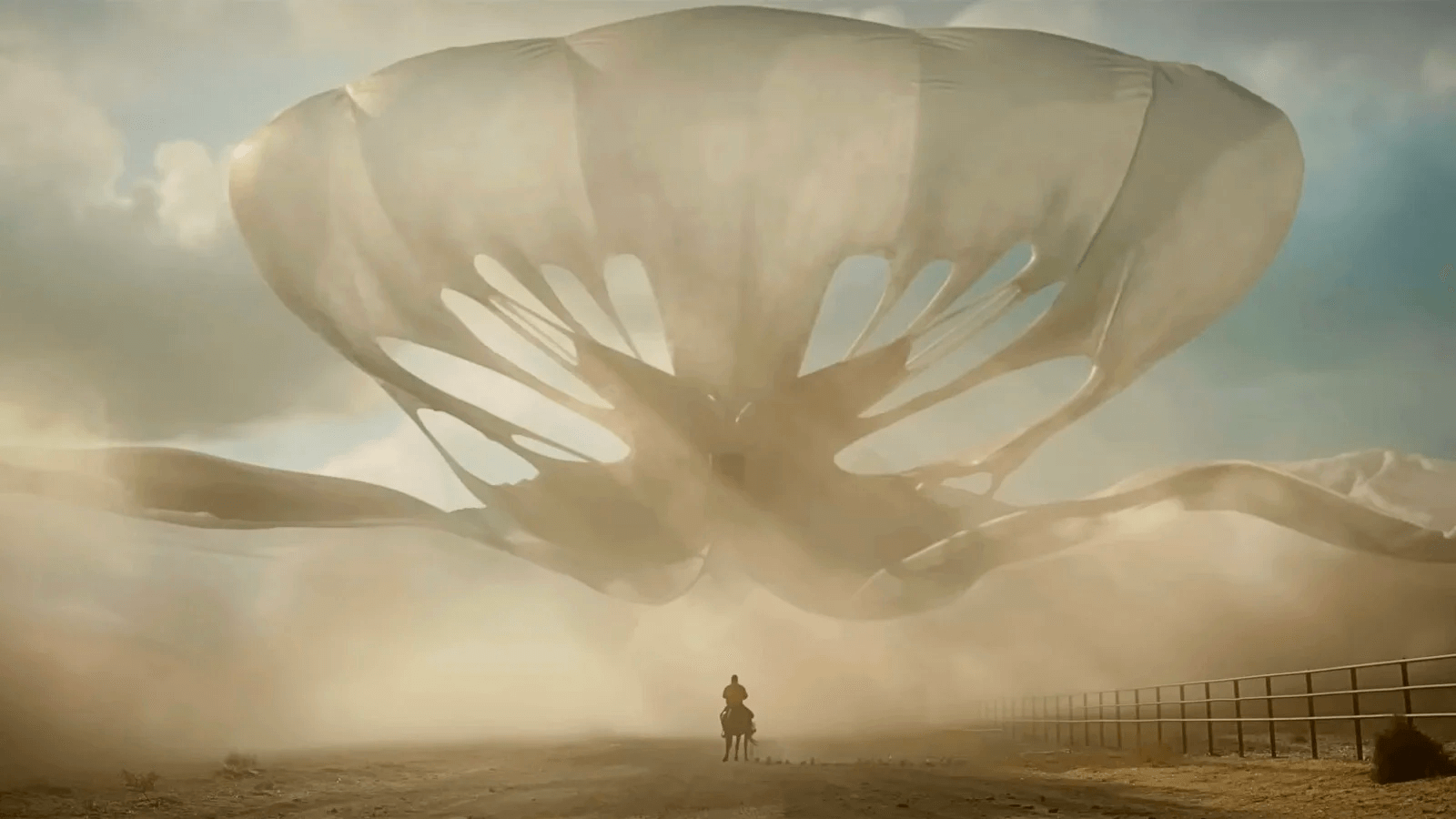
Using the characters as hosts to display the different elements that can stem from spectating. With Jean Jacket, the flying alien entity being the main spectacle, there is an understanding of what the inevitable path is when accepting a greater power which is symbolic of the not only the film industry, but the Industry as a whole.
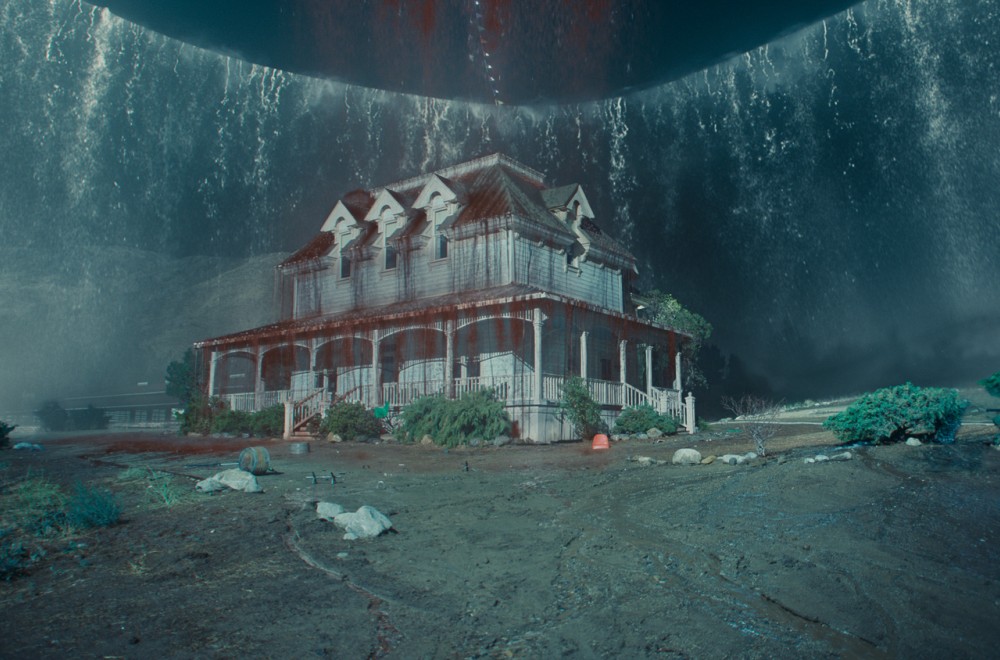
The article goes on to discuss characters like Emerald, who tries to use the spectacle for money, Ricky, who uses it for fame, and Angel, who seeks recognition. These motivations reflect what often drives viewers and people within minority groups. The film suggests that when you focus too much on proving yourself or showcasing your worth to the industry, you risk being consumed and discarded, which is shown in the scene where Jean Jacket rains blood over the ranch house
In one of his interviews, Jordan Peele claims that he got a lot of inspiration from Steven Spielberg’s “Jaws” for his movie “Nope”. The correlation between the two films didn’t quite register with me at first, but after watching this YouTube video that breaks down specific scenes and sounds from both movies, it’s a super cool comparison and you can definitely see the similarities that they share.
A major focus of the video is the sound aspect of Nope – it consists of mostly diegetic sound throughout the film, which adds to the realistic feel of the movie and makes us feel more immersed in the events that take place. During the beach scene in Jaws, the audience is on edge knowing that there is a shark attack brewing. The background noise consists of normal sounds that you would hear on a beach, people talking, waves crashing, radios playing, etc. But then we hear a scream coming from the water and our anxiety rises, thinking that it’s the shark’s new victim. We quickly find out that it’s just a girl screaming because her boyfriend lifted her up out of the water, but that sound triggers us to think of the worst and adds to the suspense. The same can be said about the scene in Nope where OJ is standing outside in the dark with Ghost. It has an eerie wind sound, the horse sneezing, and overall it’s quiet but diegetic and normal; then a loud noise comes from the house, which again makes us frightened about what that means. We see that it’s just Emerald playing music to dance to, but that sudden introduction of a new sound scares the audience and keeps them on edge for something horrible to occur. The diegetic sound and focus on otherwise overlooked day-to-day noises heightens our senses and gives us a “calm before the storm”.
Another cool part of the sound in Nope was the creation of the noise coming from the alien thing (I’m still not exactly sure what to call that creature). It was supposedly a combination of screams like you are on a roller coaster, and screams like you are getting eaten by some mysterious entity that flies around like a hungry UFO, which makes for a very uncomfortable noise. At first from a distance the sound could be interpreted as just wind, or the normal noise that a flying saucer would make, but as the story goes on, we learn that it’s much more than that and gives the sound more attention and meaning. It eventually conditions the audience to start to feel anxious whenever that noise sounds in the film and it’s a super cool addition to the already creepy creature.
Overall, the video has great insight into the movie and certain elements that I definitely missed on the first watch, so I highly recommend watching it!
This week’s reading described genres as living systems that balance convention and innovation. That idea came to mind while reading Alex Sergeant’s essay “Scrutinizing the Rainbow: Fantastic Space in The Wizard of Oz (1939)” (Alphaville: Journal of Film and Screen Media). Sergeant argues that The Wizard of Oz didn’t just use genre conventions, but that it invented the grammar of hybrid genre filmmaking. The film’s split between Kansas and Oz, realism and fantasy, black-and-white and Technicolor, turns genre into a kind of motion. Its “dual spatial focus,” as Sergeant calls it, grounds the viewer in the familiar before releasing them into wonder. That structure became Hollywood’s model for how to blend fantasy, musical, and adventure without losing coherence.
Sergeant’s analysis captures what our reading describes as the “interplay of convention and innovation.” Oz takes familiar ingredients—the musical number, the quest, the fairytale moral—and merges them into one story of transformation. We recognize the comfort of genre, yet feel its edges blur. Looking at Oz in this way, I realized it’s the blueprint for so many “journey” films that bridge worlds: Star Wars, Pan’s Labyrinth, Harry Potter. Each one restages Dorothy’s passage through spectacle toward self-discovery. Sergeant calls Oz “perhaps the most watched example of classical Hollywood cinema,” but what keeps it alive is how it shows that genre moves. It isn’t a fixed category. It’s a rainbow that bends meaning across forms.
That insight also ties directly to our feature, Nope (2022). Jordan Peele reworks genre the way Oz once did. He fuses the Western’s open landscape, the sci-fi invasion, and the horror monster movie into a single story about spectacle and control. Both films ask: what happens when wonder turns on the spectator? Sergeant’s essay, though written about 1939, helps explain why Nope feels familiar yet new. It’s the same path Dorothy walked, only now it’s lined with clouds and cameras instead of poppies and tin men. Genre, for Peele and Fleming alike, isn’t a set of boundaries, but a language that keeps rewriting itself.
Jordan Peele’s Nope was an intriguing multi-genre film that was not only entertaining but also full of historical and social commentary. When viewing Nope’s genres through a “reflectionist approach”, it becomes clear that they function together to tell a story about he history of Hollywood. Near the beginning of the movie, we see OJ and Emerald on a film set, surrounded by all white workers. While OJ tries to tell them about the safety precautions for the horse, they brush him off, ignoring his voice. Simultaneously, they ignore the needs of Lucky, not treating him like a real breathing animal but rather a prop. Emerald also tries to promote her directing and acting to he white audience but is not taken seriously. All of this highlights the exploitation of animals and marginalized groups throughout the history of Hollywood.
This is where the Western genre present in the film is so crucial to its message. Unlike the white-dominated industry, OJ has the ability to understand that the horses are worthy of respect as much as humans are because he understands them due to his job. He does not attempt to exploit them for the purpose of entertainment or a “spectacle” like Jupe.
However, while Jupe’s character functions as both an example of those who exploit and those who were exploited. This is where the horror genre comes into play. As a child actor, Jupe faced a traumatic experience on set which was then brushed under the rug- it was even flipped into a comical incident and put on SNL. It is clear throughout the film that this experience still affects him. However, possibly as a way to cope with it, he exploits the incident for money, charging tourists to enter the small museum he has built dedicated to it.
Finally, the idea of exploitation ties into the sci-fi genre of the film. At one point, OJ thinks back to how Lucky became aggravated when looked at and realized that also applied to the alien. Just as the horse had to be treated with respect on the film set, the alien could not be “domesticated” as Jupe tried to accomplish because he treated it as a prop without attempting to understand it. The idea that a catastrophe could be prevented if only you don’t look is analogous to how exploitation could be prevented if only people were not so eager to see a “spectacle”.
What are other examples of exploitation in the film? How does Peele combine genres to make other commentary about society? What is the significance of Jean Jacket?
Nope(Jordan Peele, 2022) is a movie that has been on my watchlist since it came out. Many people have told me it’s one of their favorite movies, and I get it now. This is a film that is very good as creating feelings of tension with genuinely good jump scares, truly spine-chilling suspense, and beautifully disturbing imagery.
In Nope, there are so many of the tropes we’ve come to know from horror. Danger at a house, a fake out scene, the final girl, and jump scares are just some examples of such cliches. The conventions drive our expectations as viewers and present some familiarity to grasp onto. It’s the subject content of the horror, however, that really draws out those feelings of dread. Peele doesn’t rely on cheap scares; he draws out the suspense and lets the audience stew in the disturbing events onscreen. The scene of Gordy’s Birthday Massacre and the Raining Blood scene leave particularly strong impressions, mainly due to the copious amount of onscreen blood. This contrasts with the rest of the film, which has almost no gore at all.
The relatively slow cutting allows the audience to slowly take in the scene, as the realization of what is actually happening hits. Furthermore, the long takes and sound design work together to keep the audience in a suspended state of tension. During Gordy’s Birthday Massacre, it was truly terrifying to watch the ape, blood on its face and hands, kill the people on set in such an animalistic way. No emotion, no remorse. Just violence. The fact that we saw the slaughter through the eyes of a young Ricky Park just added to the fear factor. To top it off, the gunshot at the end of the scene was so jarring it actually jolted me out of my seat. I’ll mark the experience down as another success of the horror genre.
I can’t just lump it in with all of the other horror movies I’ve seen though. While Nope hits all of the beats of the horror genre, it also shows elements of westerns and sci fi. The warm color tones and California ranch setting are reminiscent of the western genre, and the conspiracy theories and extraterrestrial presence bring the monstrous energy of something otherworldly to the film. Rather than a scary climax, the final confrontation with the alien gives the invokes the essence of the classic western showdown. Tense, yes, but not horrific. There’s a commentary about the lengths people will go to create a spectacle and the dangers of tampering with the unknown.
I wonder if the context in which Nope was made gives it a deeper or different meaning? What is the significance of seeing Gordy’s story?
Rewatching Nope today was a blast. It was really fun seeing the reactions of people who had never seen it before, and how similar their reactions were to mine when I first saw the movie a few years ago. One theme of the film that stood out to me during this second viewing, though, is how the need for a spectacle is constant throughout the entire movie.
Before the film even begins, Jordan Peele shows an epigraph of a Bible quote, specifically Nahum 3:6: I will cast abominable filth upon you, make you vile, and make you a spectacle.
The theme of spectacle continues during the rest of the film. For example, Steven Yeun’s character, Jupe, turns his childhood trauma from “Gordy’s Home” into a camp museum exhibit. The blood-soaked shoe we see at the beginning of the film can be seen on a glass plaque in the room, along with several fan-made posters that seem to glorify the horrible attack that occurred.
On the topic of Jupe’s childhood trauma, a scene that stands out to me is immediately after Jupe reveals the museum exhibit in his office. When Emerald asks him what really happened on set, Jupe isn’t able to explain it through a firsthand account. He has to use an SNL skit, a spectacle itself, as a medium to describe the events that took place. Spectacle is almost like a coping mechanism for Jupe: he uses it to avoid direct confrontation with his past and to downplay the damage it did to his mental state. He almost frames Gordy’s killings as an act in a show.
Going back to the quote from Nahum, and some things we discussed in class, we determined that what makes something a spectacle is if it catches your eye. In other words, the content needs to be shocking enough to make you stop (scrolling) and watch. The quote from Nahum implies something very similar. Only after “filth” is cast on the subject (in the context of Nahum, God is casting filth upon the Assyrian capital of Nineveh) is the subject a spectacle.
This is why Jupe has capitalized on Gordy so much. It’s an event so violent and shocking that people can’t help but watch it unfold and become obsessed with it. Jupe even says it himself, how there is a growing fanbase for the show and most importantly, for its violent ending.
Jupe also tries to do the same thing with Jean Jacket. Though he doesn’t necessarily paint Jean Jacket in a very violent light, he buys the Haywoods’ horses for the sole purpose of luring the alien down from its cloud and turning its hunt into a spectacle.
Though spectacle is an obvious theme throughout the film, there are many different ways of looking at it. Though I talked about spectacle purely from Jupe’s point of view, you can also analyze the Haywoods or even Antlers Holst. I’m curious to see how their ideas of spectacle differ or coincide. Is their fixation on spectacle also originating from past events like Jupe’s?
Jordan Peele’s NOPE (2022) is a film that has a very simple categorization, but it thrives because of its genre complexity.
To be honest, I am scared. At the first glance, NOPE seems like a straightforward science-fiction horror film about this unknown UFO from the other world terrorizing a California horse ranch and the people that connects with it. Peele blends in the elements from Western, horror and science fiction genres to question not just our fear, but the way we perceive horror and spectacle.
The Western genre influence is the most visible. We see that the setting is located at a desert valley, which is similar to the most classical cowboy movies that happen in a small town in the middle of the desert. Here, the setting and the background knowledge of we knowing the main character’s family all tame horses adds on to the Western genre influence.
At the same time, horror is also deeply rooted in NOPE. Peele used fear through sound and silence. This echos the horror through sensory orientation to the audience. The UFO is both a top predator and a symbol of unknown and violence. Like the best horror films, NOPE exposes our psychological vulnerability — in this case, our obsession with witnessing spectacle even at our own danger. In addition to the UFO as horror, the flashback of the Chimp killing three people, and OJ’s father killed by plane crash remnants is also killing me and really scared the guts out of me.
I REALLY DON’T WANT PICTURES HERE IT SCARES ME SO MUCH
Nope also employs a lot of science fiction conventions to explore the curiosity of human and the approach of the unknown. The idea of meeting an alien culture becomes a indication of these people trying to catch the impossible. Just like most sci-fi films, there is a desperate attempt to take control, which may suggest how technology shape our relationship with the reality (as suggested by the lights out and all technology stuff)
The fusion of these three genres redefine its boundaries. NOPE is a perfect example of genre hybrid. We can see the familiarness of other films we watch before of the same genre, but we can also see the influence of the three on each other. It is not just about the giant terror alien flying in the sky, but it is about the cost of observation, and the price of the spectacle.
One thing I noticed while watching, is that why these people, though fear of the UFO, still wants to approach and get a shot of it, even knowing its destructiveness? Peele turns that fascination back on us, making viewers question their own role as spectators.