Category: Week 3: (9/8+9/10) • Mise-en-scène

  • Aspects of Mise-en-scene: High and Low and Playtime

    Aspects of Mise-en-scene: High and Low and Playtime

    The use of mise-en-scène refers to the arrangement of everything within the camera frame. Through this week’s lectures, readings, and screenings, we’ve come to learn that mise-en-scène consists of many aspects: the setting, costuming/makeup, lighting/color, and staging. As I’ve thought over how these different parts work together to compose a scene, I’ve found myself reflecting on movies that I enjoyed in the past, and how the films’ mise-en-scène could have enhanced my enjoyment. Two films especially jumped out at me, being Akira Kurosawa’s High and Low and Jacques Tati’s Playtime.

    In High and Low, Kingo Gondo, a business executive, faces a moral dilemma when his driver’s son is mistaken for his own and kidnapped. In the particular scene shown above, the police (left) are attempting to help Gondo in identifying the kidnapper, while his wife (right) and driver (back left) beg him to pay the ransom money that has been demanded. It’s worth noting that Gondo himself is reluctant to pay the ransom, as it will cause him to go bankrupt if he does so. Minor spoiler warning.

    The thing that stands out to me in this movie is how Kurosawa places his actors within a frame. In the image above, each character has its own space within the frame. None are imposing on each other, and each character is doing something to draw your attention. The police have their heads bowed, unsure of what to do. Gondo’s mentee looks toward him, expecting him to come up with a plan. Gondo’s wife cries in the corner of the frame, the weight of the situation too much for her to handle. The driver looks away, partially obstructed by the police, positioned behind the policemen as if he were merely a lingering afterthought for the executive. My favorite part of this shot, though, is Gondo himself. As he decides to not pay the ransom money (though he is later convinced to), he separates himself from everyone else in the frame, who all believe paying the ransom is the right thing to do. There is a visible blank area around him, alienating him from all other characters.

    In one small shot, Kurosawa can show each character’s emotion, while also portraying the metaphorical (and literal) distance between Gendo and the rest of the cast.

    Though Tati’s Playtime is still a masterpiece in terms of actor blocking, I’d like to talk about the mise-en-scène aspects of color/set design and costuming.

    Playtime follows the Frenchman Hulot as he finds himself exploring an increasingly modern Paris. It’s an extremely enjoyable and funny film, and I highly recommend you all give it a watch.
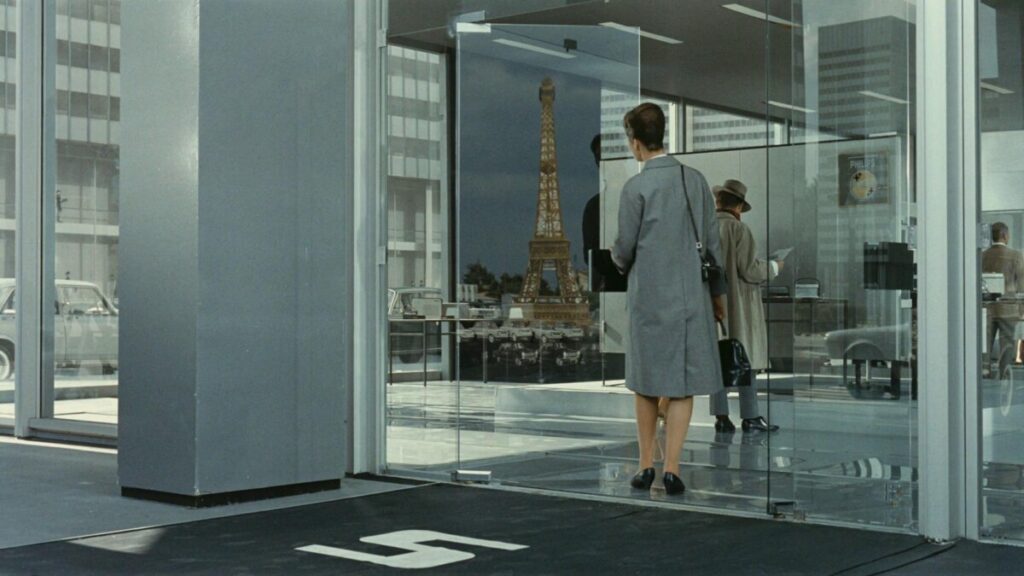
    For a film set in Paris, you’d expect to see the city’s ornate and charming buildings. But in Playtime, those beautiful buildings are overshadowed by drab office buildings, which serve as the setting for the film. There’s even a scene where a character enters an airport, just to see all the classic landmarks on travel posters blocked by office buildings. In both set design and costuming, Tati opts to use muted colors like beige and grey as the main color palette for the film. In fact, most sets are completely bland (in a charming way).

    Character costumes are the same. Hulot, in his grey raincoat, begins to blend in with the sea of ordinary suits and coats. The only way of distinguishing him from the extras in the frame is from the way he moves: The others know their place and move robotically, while Hulot roams and explores the frame, lost. When I watched the movie, I recognized him through the long umbrella he always carried by his side.

    Though Tati doesn’t use any striking and attention-seeking colors, this film is still one of the visually strongest films I’ve seen. Its sets and costumes could also be seen as a critique of urbanization and modernity – a world with too many pointless buildings and gadgets. But in this drab world, there are still signs of life. As Hulot begins to interact with the Parisians and take part in their nightlife and morning routines, the settings he finds himself in become increasingly colorful. It could be as subtle as the pink flowers in a woman’s hair or as eye-catching as a bright red car.

    All in all, both films are absolute gems in showing the power of mise-en-scène. High and Low shows the power of blocking, in both fitting all actors in the frame and also adding narrative significance to their positioning. Playtime employs neutral colors to critique modern styles and also increase our appreciation for color.

    If this blog convinced any of you to watch either of these movies, please let me know in a comment! I’d love to hear what you all think about these movies and the aspects of mise-en-scène they employ.

  • How does Anderson’s filming approach affect the way we understand this film’s theme?

    In the Grand Budapest Hotel, as I searched the background of its creation, the film’s director Wes Anderson was partly inspired by the novels and memoirs of Austrian writer Stefan Zweig, whose work often talks about the disappearance of old European culture. I believe it influences the tone of the film and its focus on the decline of an era. Also, the film style especially emphasize symmetry, and the camera is almost always positioned directly from the front, side or back. Shots taken from an oblique angle is almost not exist, which always create a sense of precision and this strict formalism gives audience the feeling that the film is almost like a painting or a stage.


    Also, another detail I noticed while watching is that Anderson uses three distinct aspect ratios in the film to visually separate the timelines. The first two parts use 1.85:1(1980s), the third part adopts the widescreen format of 2.35:1(1960s), and the most important final part uses the classic industrial standard of old films, 1.37:1(1930s).(https://b23.tv/JTTba6Q, 拉片实验室,2020)

    Screenshot

    In the end, I think one of the most striking scenes for me is the train inspection. In the first inspection, the inspection is conducted by local policemen who still remain some sense of civility, wearing classical uniforms, and Gustave is able to resolve the situation through his personal connections. However, in the second inspection, Zubrowka is no longer an independent state, and the temporary pass that previously was issued by Norton is not working. The policemen are now armed soldiers in identical uniforms. I believe Anderson was using costume, this element of Mise-en-scène to strengthen the contrast. In the end, the film shift to black-and-white imagery which I may consider as a metaphor for Nazi Germany.


    My question is: How does Anderson’s stylized filming approach, which are his symmetry, colors, and changing aspect ratios affect the way we understand this film’s themes-cultural decline?

  • The Grand Budapest Hotel_ Viewer’s Comment

    The use of Mise-en-Scene in The Grand Budapest Hotel


    Hello classmates, it was great to watch this interesting movie with you all this afternoon. I don’t know how you felt about this movie, but personally speaking, I loved it. The plots are so tight, and I got fully immersed in it! Besides the fantastic storytelling, I believe that this movie effectively shows the power of Mise-en-Scene. The smart uses of setting, costume and makeup, lighting, and staging not only help the audience engage better, but also gives us more space to explain the film further and taste it deeper.

    In this post, I’d love to share with you some of my findings while watching and also share initial questions I have, so we can further discuss them.

    Insights:

    1. In the scene of reading Madame D.’s will, Gustave and Zero are standing at the door of the entire room, on the opposite side, wearing purple suits, while almost all of the other people in the same scene were in black. By contrasting standing position and clothes’ color, I think that the director is trying to emphasize the contrast of their personalities: Gustave and Zero embody individuality, elegance, visually marked by their purple uniforms. The others dressed uniformly in black represent conformity, rigidity, and the coldness of aristocratic tradition. (Costume & Makeup + Staging)
    2. Jopling: This ruthless killer is depicted by using a combination of costume and lighting techniques. If I remember correctly, he is always dressed in black throughout the entire movie, often wearing black sunglasses or having shadowed eyes due to the lighting effect. For example, in the snow mountain scene, he chases after Zero and Agatha on a sled after Gustave and Zero escape. The stark white snow, contrasted with Jopling’s dark figure, strengthens his dark side and ruthless personality. (Costume + Llighting)
    3. In the prison escape tunnel, light becomes symbolic: the small window glows brightly while everything else is engulfed in darkness. This stark contrast emphasizes freedom as a distant possibility, a fragile opening amid confinement. (Lighting + Setting)


    Questions:

    1. Why does Anderson begin the film in a cemetery filled with crosses? How does this opening frame set the tone of memory and loss? (Setting)
    2. What’s the implication of the children with weapons in the second scene? Is Anderson suggesting that violence disrupts innocence and order? (Staging + Setting)
    3. How does Anderson’s pastel palette (pink hotel exterior, purple uniforms, candy-colored props) evoke nostalgia? Does it make the story feel like a memory or a fairy tale? (Costume & Makeup + Setting)
    4. What are the symbolic meanings of the painting Boy with Apple? Why did Anderson choose this painting instead of others? (Props/Costume & Makeup)
    5. Why does Anderson often isolate characters in their own shots during dialogue (like Gustave and Zero on the train), instead of framing them together? (Staging)

    Hope we can discuss further in the comment area or in class!

  • The Visual Power of Mise-en-scene

    Even if you have never watched The Lion King (1994), given the image above, one could guess that the character depicted possesses evil qualities simply by analyzing the visual elements in this particular scene. This power lies in the technique of mise-en-scène: the visual orchestration of setting, lighting, costume, and performance (Bordwell 113).

    This week’s reading took a deep dive into exploring the technique of mise-en-scène. Mise-en-scène is introduced as the arrangement of everything that appears in the frame of a film, including elements such as setting, lighting, costume and makeup, and staging and performance. As discussed in Chapter 4, mise-en-scène represents the director’s control over the visual elements of a film and plays an important role in shaping how audiences perceive characters, themes, and tone.

    After reading, I found myself thinking about how mise-en-scène operates. The chapter emphasizes that mise-en-scène offers filmmakers four general areas of creative control: setting, costume and makeup, lighting, and staging/performance. These elements, when combined, allow directors to guide the viewer’s response and understanding of the story. For example, the reading discussed how lighting can influence the way a character is perceived. Casting shadows can create a sense of mystery, while bright lighting may convey warmth. Recently, I rewatched The Lion King (1994) and noticed how mise-en-scène is at play even in animated films. Take, for example, the following scene(s).

    In early scenes of the film, Pride Rock and the surrounding lands under Mufasa’s rule are depicted using a lively, earthy color palette, such as browns and lush greens. This use of color suggests prosperity and balance. However, when Scar takes over, the entire landscape becomes a desaturated monochromatic color design of grays and blacks. This dramatic shift in color and the use of monochromatic color designs is a clear example of how mise-en-scène is used to visually convey messages. Here, the audience is shown, through setting and color, that Scar’s rule is bad.

    In another scene, the filmmakers use the element of lighting to emphasize character transformation. When Mufasa’s spirit appears in the sky to speak to Simba, a beam of top lighting shines down on Simba, creating a “glow” that covers him. This moment uses top lighting to visually mark a turning point in Simba’s journey. Here, Simba begins to reclaim his rightful place as king, and the mise-en-scène enhances the storytelling.

    These examples helped me better understand how filmmakers use mise-en-scène to execute ideas and tones in a film. What I found interesting is how many of these visual elements operate on a subconscious level. Most viewers may not actively notice the shift in lighting during a film, but they still feel the significance of this choice. Personally, I know the first time I watched The Lion King (1194), I did not actively notice the mise-en-scène at play. This raises an important question for me: how much of mise-en-scène do viewers consciously register, and how much simply influences us emotionally in the background? Additionally, I also wonder if societal norms/cultural context affect how these visual elements are interpreted. For example, does the “halo glow effect” of top lighting rely on cultural/societal assumptions that may not be the same universally?

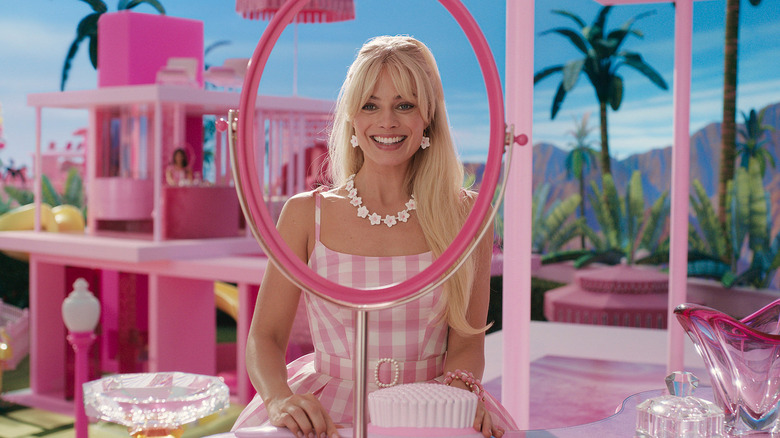
    Using Barbie (2023) as an example, I know that the use of bright, saturated colors was used to convey artificiality. In the Barbie (2023) movie, bright colors were used to give the set a toy-ish wonderland feel. However, viewing it from a different perspective, I wonder if the use of bright, saturated colors could be interpreted as something else, given that bright colors could be the “norm” for settings similar to that of Barbie (2023).

    Given this, I question how someone from a different cultural/societal background would interpret the same lighting and color design I picked up in The Lion King (1994)?

    Sources: Bordwell, David, et al. Film Art: An Introduction. 13th ed., McGraw-Hill, 2024.

  • Mise-en-Suit: Why I can’t stop thinking about Suits

    I’ll start with this: I promise I usually watch “good” media. I like quality television. I also love Suits, a fairly trashy legal drama from the late aughts. Suits is, in my film-student view, terrible. But Suits isn’t always empty collars and ties. The show has some incredible moments of Mise-en-Scene (“what is in a scene”): the combination of it’s lighting, setting, blocking, costume, and action.

    In trying to understand why I love this show, and as application and practice of my understanding of this week’s Film Art reading, I’m going to examine the mise-en-scéne (setting, lighting, costumes, blocking, composition) of the first forty seconds of the pilot of Suits––and maybe, in the process, prove its brilliance.

    Suits opens with a shot of the Manhattan Bridge. Not it’s famous cousin (the almighty Brooklyn Bridge), but it’s functional, steel sister. The lights are bright enough to see the cars, but it’s still dark. Here, Suits has set the aesthetic tone: this is going to be professional, dark. We see cars drive over the bridge, then hard cut to the Chrysler Building. Now we immediately know the setting––no narration or title card required. Even if you don’t recognize the Manhattan Bridge, you know the Chrysler. We’re in New York City, we’re in Manhattan.

    The third shot is the most telling. We cut again to an empty wall, then pan down. We’re looking at a skyscraper (Citigroup Center, for all interested), and somewhere around the fiftieth floor, we see men in suits dancing. They’re centered and bathed in an orange light, a sharp contrast to the blues and blacks of the previous shots. This, the show says, is what you should pay attention to. These people are different.

    So, within literally sixteen seconds, just based on what is physically in the shots, we know where we are (NYC), what type of people we’re going to be watching (Rich People), their status (High), and what we’re going to be watching––not the most beautiful, polished conduct (not the Brooklyn Bridge)––but the functional, real, beautiful-and-terrible lives of these people.

    We cut in to the office floor and see that they aren’t dancing, but arguing. Every character in the titular suits, all chatting excessively––except one. Even in the chaos of this scene, again without a single word, we know who to focus on. The camera settles on the non-arguing man, waiting patiently in the corner. His body language is sharp, he stands tall. He is our focal point, and we know it.

    The frame at 0:36 (above) is, to me, a work of art. Our focal character is the only one lit with low-key contrast; it’s so far from the soft, relaxed light of every other character that we could infer his mixed emotions based only on the lighting. On the scale of importance, he sits at the very top, further highlighted by a silhouette comprising the entire left half of the frame. And, with such a shallow space, our focal man becomes the entire background. The actor’s highly individualized (but not overly-stylized) performance stands out too––he fits in, mostly, but he is clearly different from the rest of his cohort. His hands are laced together. His head is tilted down, almost a slight Kubrick Stare. He’s wearing the costume of everyone else in the room, but he isn’t with them. He’s not like them. We linger on him, confirming with time: he is unique. He’s worth paying attention to.

    Each element of mise-en-scene: setting, costume, lighting, staging, spacing/composition, and time; they are all done perfectly here. We know this man. We know his attitude. We know his world. All this, without a single word––just by what’s in the shot.

    So, in light of all this, is it okay for me to like Suits? Is this an over-read of fairly obvious filmmaking, or a brief glance at a masterclass in mise-en-scene?

  • Color, Light, and Narrative in Amélie

    Mise-en-scène, literally “putting into the scene,” drives the narrative of a film. Through the director’s arrangement of lighting, costume, makeup, and staging, filmmakers construct not just an image but a framework of meaning. This arrangement guides the viewer’s interpretations, often hinting at thematic shifts that words alone cannot. Mise-en-scène serves a dual purpose: it makes the film’s world feel real and familiar, while also shaping it into a visual language that expresses more than everyday reality.

    Jean-Pierre Jeunet’s Amélie (2001) exemplifies this idea. The film’s vivid colors, filled with rich reds and greens, make Paris feel less like a real city and more like a reflection of Amélie’s imagination. While many of the Montmartre street scenes are filmed in real locations rather than constructed sets, the color palette is carefully manipulated: saturated reds, greens, and golds heighten the quirkiness and whimsical tone, turning ordinary streets, cafés, and alleyways into an expressive, almost dreamlike environment.

    Even the photo booth, for example, is used as a strategic prop; the discarded photo strips serving as both narrative clues and visual motifs that reinforce secrecy, playfulness, and the possibility of intimacy. 

    Costume and makeup further enhance this visual storytelling. Amélie’s striking black bob, paired with her pale skin and subtle makeup, emphasizes her whimsical nature. The hairstyle draws attention to her expressions, making her reactions central to the narrative and reinforcing her sense of individuality within the stylized Parisian world.

    By placing such an emphasis on visual style, Jeunet stretches the expressive power of cinema, showing that meaning can emerge as much from images as from words or action. Yet this stylization also comes with complications: does the film’s look tell its own story, separate from the plot and dialogue? When a movie is so carefully constructed visually, do we find ourselves paying more attention to the images than to the characters inhabiting them?

  • Mise-en-scène – Is Lighting Really Everything?

    Mise-en-scène – the art of presenting a scene to the audience.
    There are five components that make up mise-en-scène: lighting, composition, costumes, setting, makeup, and staging. There are hundreds of individual ways to illuminate your stage and therefore evoke certain emotions. It consists of quality, direction, and source, and color also plays a big role when shaping the atmosphere. When reading chapter 4, I was amazed by the focus put on lighting. And as the text states: “No component of mise-en-scène is more important than what Sternberg called ‘the drama and adventure of light’” (p. 132). But is light really the most essential aspect of mise-en-scène? Isn’t every element of great importance? Perhaps sometimes more weight is placed on lighting, in another case on staging, and in yet another on framing.

    As an example of how mise-en-scène can create fear and unease, I want to look at a scene from my favorite movie – Stanley Kubrick’s The Shining.
    In this sequence, we follow Danny riding his bike through the corridors of the Overlook Hotel. After riding for a while, he suddenly stops after turning a corner and sees two girls standing at the other end of the corridor, staring at him.

    For the setting, we have the long and symmetrical hallway. The camera is centered behind Danny, focusing on the motionless twins at the far end of the corridor, who are staring at both Danny and the camera. Furthermore, the emphasis on the girls is enhanced by all the vanishing lines leading to them – our eyes are naturally drawn to this point. This setting evokes an uncomfortable and claustrophobic atmosphere.

    The two girls are both wearing old-fashioned dresses, making them appear ghostly and implying that they belong to another time and should not be in this hotel. Additionally, the light-blue color of their dresses match the darker blue carpet and the white/light-blue walls. This suggests that the girls are, in fact, part of the Overlook Hotel (which they are, if you haven’t seen the movie or read the book) and therefore personify the horrors that have happened in the past. Through the color scheme, they visually merge with the hotel. In contrast to them, Danny is wearing a bright red sweater.

    The top lighting, the source of which is part of the set design, also contributes to making the scene frightening. It comes straight from above, is harsh and cold, and creates an unpleasant feeling.

    I would argue that the composition, setting, and choice of costumes are the most impactful aspects of mise-en-scène that make this scene terrifying. Of course, lighting also supports this feeling, but I can imagine many different lighting arrangements that wouldn’t diminish the sense of unease created here.

    Do you agree with me, or do you think I underestimate the impact of lighting in this scene?

  • How Does Technology Play Into Mise-En-Scène? Does it Limit or Expand?

    Nowadays when we watch a film in a theater, or on Netflix or any other media published for public access, they are likely a finalized, polished version that could not have existed without the efforts of a team of talented filmmakers. We are fully immersed in some actors’ emotional expressions, certainly aware of some of its music, and are constantly being driven by our own expectations towards what will happen next. However, we might not have fully appreciated how the actors’ clothing and makeup aided their expressions, how computer technology adjusted the color scheme of the film, or the dozens of lighting that might have been used for the effects of a single shot. What is all that happened behind the scenes that eventually enabled us such wonderful, enjoyable viewing experience?

    The answer to this question lies in mise-en-scène, which, originated in French, means “putting into the scene.” This includes all the elements that work towards the harmonized end result that aligns with the director’s vision and is powerful enough to resonate the audience. 4 main pillars describe mise-en-scène: setting, costumes & makeup, lighting, and staging.

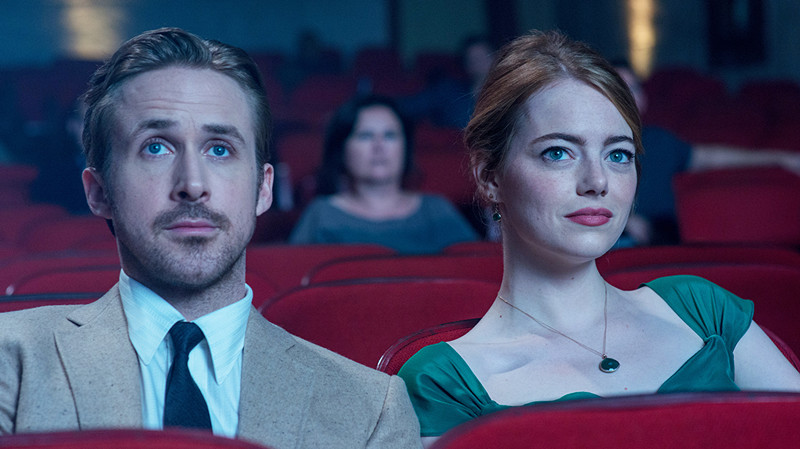
    The 20 Most Romantic Movie Scenes of All Time | Taste Of Cinema - Movie  Reviews and Classic Movie Lists
    La La Land Photo: Dale Robinette

    Do digital technologies in film production encourage bolder mise-en-scène? Or does it risk contradicting with the physical principles of reality? In each fundamental element of mise-en-scène, we seem to find evidence of technology, such as simulated lighting, CGI’s (computer-generated imagery) motion capture, and color grading, etc. Indeed, their usage greatly improved film qualities, but would it happen to be that more and more productions treat raw footages less importantly because “we’ll fix it later on computer”? It potentially could be the case, but for filmmakers treating their works seriously and dedicated to perfection, technologies should not at all be harmful.

    A major part of technology use in mise-en-scène is accounted by lighting, which is also a major aspect of film that a lot of people would under-appreciate, probably because it is so intricate and natural that it becomes a neglected part of an image. However, the truth is that lighting is crucial to every scene we see in a film, contributing to character features, emotional delivery, and contrasts with surrounding objects.

    The most basic arrangement of lighting could be the traditional three-point lighting, which includes at least a key light, a fill light, and a backlight. Key lights are usually placed directly in front of the actor, functioning as the primary light source that enables us to see their features. A fill light, which is an assisting light source that weakens the shadows created by the key light while softening the actor’s features would possibly be placed at a position near the camera, directed diagonally against the actor. Lastly a backlight would come from behind and above the actor, to lighten up the setting and surrounding features.

    For example, in Greta Gerwig’s Barbie (2023), we see the use of three-point lighting in the fictional, idealized Barbie Land. The “sun” functions as the backlight, as evidenced by the glowing edges of Barbie’s hair. Yet, we still see Barbie’s face softly because of the fill light, and eventually bounces off her bedroom and other vibrant set pieces. Such lighting creates an overall bright, cheerful, and shadowless environment, which demonstrates the concept of high-key lighting. High-key lighting uses fill light and back light to create relatively low contrast between brighter and darker areas.

    Apart from lighting, setting, costumes & makeup, and staging are also involved with technology in today’s film production. Softwares are able to add features to characters’ faces. For instance, in Dave Gibbons’s Watchmen (2009), a digital simulation of ink that flows through the superhero Rorschach’s face was imposed during postproduction.

    Dave Gibbons’ Watchmen (2009)

    The existence of such technology expands the possibility of film, and somehow changes the goal from appealing to realism into allowing for fantasy and fictional elements. When the technology strengthens lighting, rehearses blocking, and emphasizes coherent prop motifs, it expands what a filmmaker can stage. However, if it tempts a “we’ll fix it later” mentality, it’s probably getting in the way, despite it is true that a lot of productions were limited on budget and time such that technology becomes a convenient method to reach towards the ideal effects.

  • Lights, Camera, Mise-en-Scene!

    This past week’s reading on Mise-en-Scene was a revealing explanation of the components that are brought together in film. While it may seem common sense that there is thought put into costumes and makeup, setting, lighting, and staging of a scene, it is fascinating to read how they all intertwine to set a tone for the audience. Mise-en-Scene can also be utilized to contribute to the form of a film, such as when a film’s motif is seen through Mise-en Scene. An example of this would be the red coat in Schindler’s List (1993), a film otherwise entirely in black and white. It is up to the viewer’s interpretation of how the Mise-en-Scene can be used to shape the form and meaning of a film, but it still does have a large impact.

    One example of Mise-en-Scene that came to mind when reading was the monochromatic color design of But I’m a Cheerleader (1999). Throughout the film, which takes place at a fictional conversion camp, the set and costumes are obnoxiously pink or blue.

    The perfectly pink world of this conversion camp filled with bright props of common chores of a stereotypical mother in a nuclear family. It looks nothing like a real household, and the design of it contrasts the hair and makeup design of the women living in it. Furthermore, the brightly lit rooms of the camp, likely created by a key light and fill light, are starkly contrasted when the members of the camp leave and go to a bar where they can be their truest selves.

    In this bar scene, the stark change in costuming and lighting is immediately noticeable. The use of low-key lighting highlights how different this setting is from the uncanny conversion camp, and reminds the viewers that this is a safer, quieter space for the characters on screen. There is no pink to be seen, the characters are able to be their truest selves in this scene. Mise-en-Scene is a vital tool throughout But I’m a Cheerleader to satirically comment on the construction of gendered norms in society and call attention to the artificiality of conversion camps.

    Has anyone else who read about Mise-en-Scene thought of a film they had watched in the past that utilized excellent Mise-en-Scene that they may have overlooked beforehand? I also wonder if there is a scene that comes to mind that could have been enhanced with a better concentration on Mise-en-Scene?