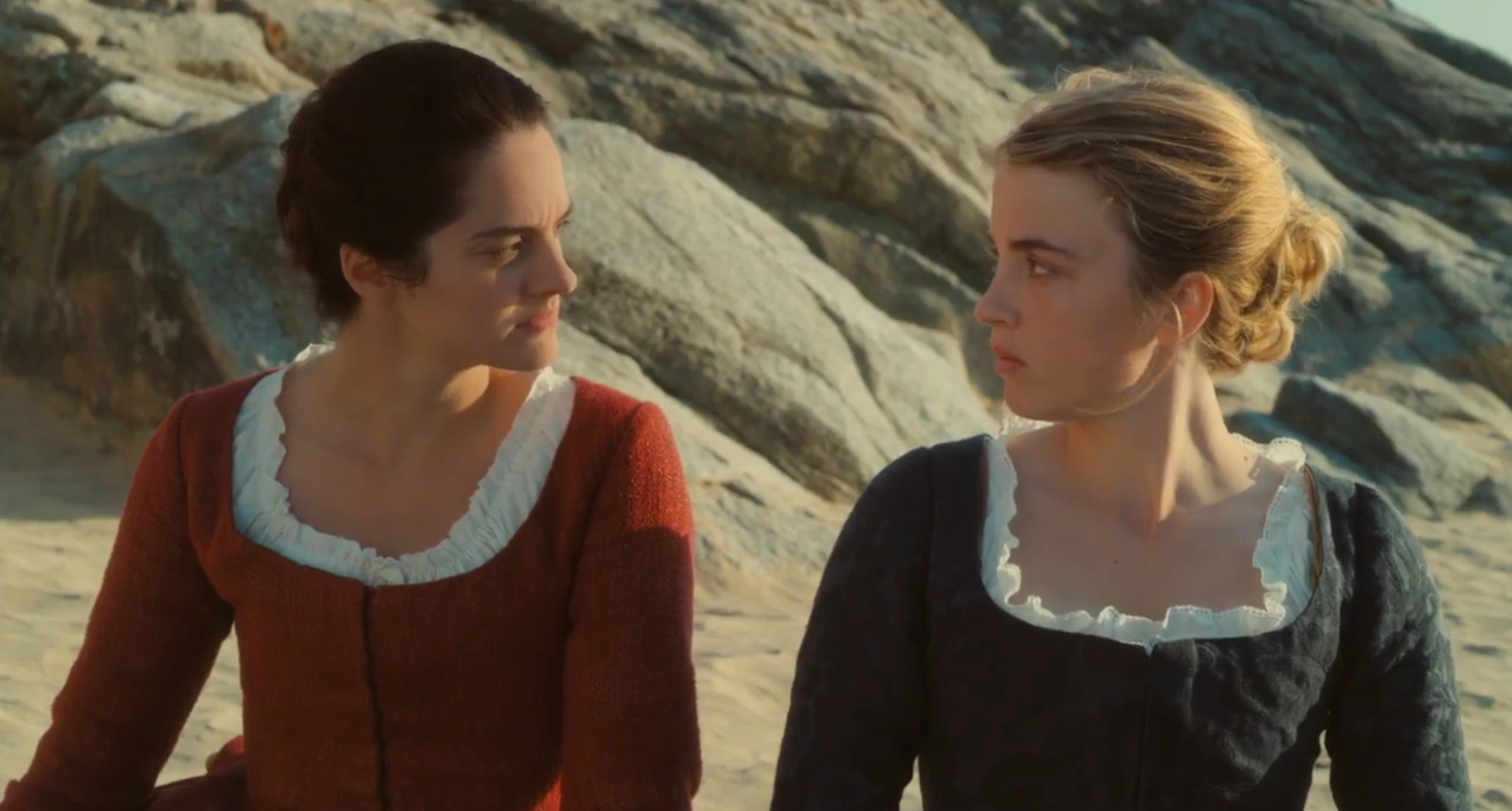
In Portrait of a Lady on Fire, Schiamma uses cinematography to build an emotional world and this becomes very evident in the beach, a place with open framing and stunning landscapes that captures the brief freedom felt by Marianne and Heloise. A place where they can exist outside of the ticking clock that separates their romance and see each other freely.
The beach is more than a backdrop, it’s a constructed space that reflects freedom and intimacy. In contrast with the interior shots (tightly framed and dim lighting), the beach opens up into wider shots with natural lights and horizon lines. This shift in visual style matters as it crafts part of the tone of the narrative. It represents how their relationship is constrained indoors by social norms and surveillance while on the beach the cinematography offers expansiveness, mirroring their sense of freedom.
Additionally, the contrast between lighting can also be read into as one of the key features that build these converging atmospheres of freedom and constraint. On the beach, the light is diffuse, natural and less mediated, with a softness around characters. Compared to the effects of firelight indoors. The natural illumination makes their intimacy feel purer and almost utopian even though we know that this cannot last.
The beach is also a place for mutual observation where the female gaze becomes visible. The camera in these scenes mirror the equality through a centered framing. Staging also tends to be symmetrical and altogether this adds on to the utopian feel of that ambient where the characters can be seen without fear.
In essence, the beach in Portrait of a Lady on Fire is a visual embodiment of freedom, love and memory. Through open framing, natural lights and longer takes Schiamma transforms that landscape into an emotional space. When they return indoors the tone shifts back to restraint and surveillance, reminding us that what happens on the beach is real and temporary. A space of possibility that lives only through memory.
Chapter 5 provided us with a lot of information, as well as a lot of new vocabulary to help us look at film in a new way. My main takeaways fall under the categories Tonality, Perspective, and Framing.
Under tonality, there are a whole bunch of concepts and practices regarding lighting and coloration, but I must closely held onto Contrast and Exposure.
I know this example doesn’t come from a film, but I have known it for a while to be the epitome of contrast in an image. Back in high school theatre, we learned about good poster design and often referenced the poster for Broadway’s Wicked, primarily for the substantial contrast shown. It showcases two characters: Galinda (or Glinda), whose all-white design only touches Elphaba’s black costume. This white-on-black contrast makes the image so much more engaging.
Here’s an example from Who’s Afraid of Virginia Woolf, which showcases rather low exposure. This comes near the end of the film, when the mood, given the previous chaotic events, is much darker than at the beginning.
Continuing on this image example, the perspective shown appears to utilize a middle-focal-length lens. This avoids distortion at either end of the frame, while short-focal-length and long-focal-length lenses tend to distort the ends and obstruct binocular cues respectively. This image also showcases a certain depth of field. We see inside the house just fine, but, past the pole on the outside, the trees and background are blurred–outside of the given depth of field.
I found framing to be the most interesting section of the reading. It deals a lot with how shots are taken through angle, level, height, and distance, among other elements.
In Rabbits, by David Lynch, the framing often stays the same as its long, establishing shot, with slight reframing as characters move to the edges of the set. There are some exceptions to this, as seen in the below image:
Being able to see the full set becomes unsettling after a while, as the viewer never knows what could pop out of any corner at any moment, but shots like these are even more off-putting. The height of the camera tends to be high like a security camera, but then we’re suddenly eye-level with creatures we’ve already labeled as volatile/potentially dangerous. Additionally, the duration of shots is extremely long, which draws out the creepy mood even more. Framing can truly fully frame the viewer’s experience as they peer into the world of the film.
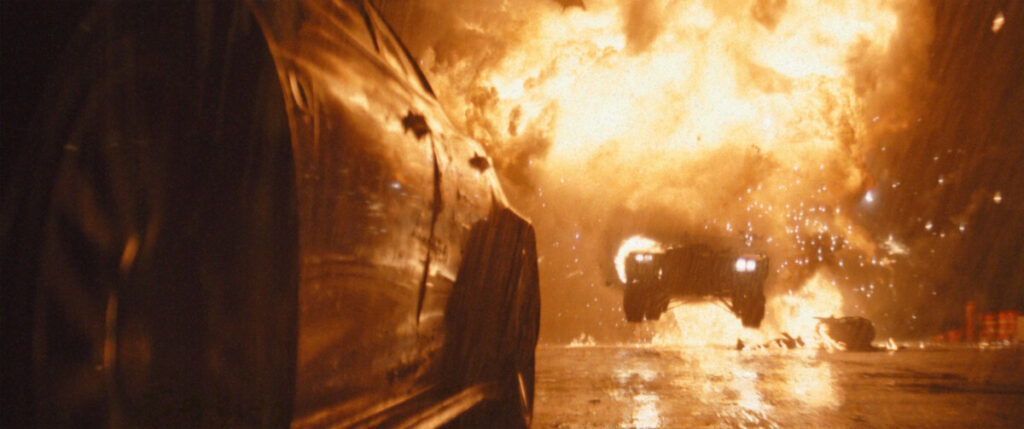
This week’s reading focused on the idea of cinematography not only being a practice of recording an event but also making choices based on light, framing, exposure, or movement, affecting how we see and feel a story. This notion came to mind while I was reading an interview with Greig Fraser, the cinematographer for The Batman (TheWrap). Fraser discusses how he approached the film as an “urban noir” in which darkness is not an absence; it’s an environment that is punctured strategically with small pockets of light. These choices are almost a textual study of tonality and exposure. Batman, for example, often emerges from darkness not because the frame is crudely underlit, but because Fraser provides just enough light on the eyes or the texture of the suit that gives us a presence we can read.
What I find remarkable is how these choices orient our understanding. The reading indicated how framing and lens selection can shift our relation to the space to make you feel more included or excluded. Fraser anchors even the action sequences in point of view, for example the car chase scene, which doesn’t overwhelm with spectacle but places us inside the Penguin’s perspective (which in turn enhances the fear Batman’s character is supposed to embody in this movie). As a result, we are not only spectators of the action, but we are also more connected to the characters.
Some reviewers claimed that the film was “too dark,” which shows the risk of pushing contrast and shadow too far. But Fraser’s work strengthens the principle that cinematography’s role is not decoration but narration. Light, contrast, and framing all become instruments of meaning: Batman as a figure always partially obscured and disclosed, someone we can glimpse but never fully know. The interview reveals how much craft undergirds that sensation, and it offers a good embodiment of what our reading this week refers to as “writing in movement.”
Celine Sciamma’s Portrait of a Lady on Fire (2019) is a wonderfully wistful film, following the painter Marianne as she paints and begins a love affair with the reclusive bride-to-be, Heloise. Through long takes and the almost exclusive usage of diegetic sound, we viewers are transported into this quiet world of longing.
Typically, a utopian film portrays “a setting that is idyllic or a society that strives for perfection” (Hellerman, No Film School – https://nofilmschool.com/utopian-fiction). A good example of a utopia within a film is The Truman Show, where Truman lives in a perfect, scenic neighborhood. Though Portrait of a Woman on Fire doesn’t depict a perfect society –
(sidebar) In fact, Sciamma makes a point of highlighting the imperfections of the society in the film, especially when Marianne discusses her inability to paint male nudes due to her gender.
– The film does take place in the idyllic setting of an isolated island off the coast of France. The color and mise-en-scène of this film reinforce this picturesque setting as well. Sciamma utilizes many softer colors throughout the film, such as the blues, reds, and greens of the women’s dresses, or the offwhite/cream colored walls of the mansion. This muted color scheme is often associated with feelings of gentleness and tranquility. The sound design is the same, with the avoidance of non-diegetic sound. We’re fully immersed in the story and feel as though we’re walking the cliffs with Marienne and Heloise ourselves. This also makes the scenes that utilize non-diegetic sound more meaningful and attention-grabbing, such as the bonfire scene. Lastly, each character’s positioning and blocking is done so intentionally in this film, and makes every frame a painting. These three aspects of the movie make Portrait of a Lady on Fire as utopian as possible.
The utopia is also shown through the film’s material. Left alone on their own island, Marienne and Heloise are given a utopian freedom like never before. As Michael Brzezinski writes for The DePaulia, “she [Sciamma] makes a utopia of femininity for her characters in this world…even though it’s temporary…it’s almost elegiac in that nature”(https://depauliaonline.com/46466/artslife/film-tv/review-portrait-of-a-lady-on-fire-is-utopia-of-femininity/).
An example that stands out to me is the unwanted pregnancy section of the film, where Sophie (the maid) chooses between keeping or aborting her baby. It was very meaningful to see a world in the 1700s where woman could make their own choices regarding their body and sexuality. Ultimately, this utopia is shown as temporary when Marianne leaves her room on her last day on the island and sees a man eating at the dinner table while Sophie serves him.
Ultimately, the two women must leave their feminist utopia and return to the oppressive patriarchal society that they came from, where women lack autonomy and equality.
Portrait of a Lady on Fire provides us with a look into a utopian world, where women are given freedom over their own decisions and health. Sciamma further emphasizes this through using almost unrealistic, picturesque colors in setting, set, and costume to make this world feel perfect and otherworldly.
When I watched Portrait of a Lady on Fire, I felt the film’s intensity, but I didn’t fully understand how Céline Sciamma managed to create so much tension with so “little” happening on the screen. Then I came across this video by lessons from the screenplay that breaks down one of the scenes, and it made me understand how every little detail was used to create this tension. The video essay argues that the power of the scene lies in the deliberate use of camera framing, blocking, pacing, and silence.
Initially, Marianne is framed as the observer, hiding behind her canvas, while Heloise sits exposed.
Sciamma makes a deliberate choice when Heloise challenges the dynamic, having Marianne go to hear in five steps, and in the director’s words, six steps would feel complete, but five steps feel as if there is still a question in the air, so the viewer is left wondering if the next step will be the kiss or not.
As Heloise challenges that dynamic, making Marianne understand that they are in the same place, Marianne flees the frame back to the safety behind her canvas. But now, the camera slowly pushes in on Heloise, enlarging her presence in the frame until she is framed as Marianne was at the start of the scene, and Marianne is reframed from Hélène’s point of view with an even wider frame, with their power dynamics completely reversed.
I appreciate how the video connects these techniques back to the film’s broader themes. The scene is more about than who has the upper hand, but dismantling the idea of power to dominate, instead creating equality between the two.
The only limitation I found is that the video focuses very narrowly on one scene, which does make the analysis for that scene very rich, but it doesn’t cover how the film’s overall painterly look and candlelit lighting contribute to the same themes. However, it further emphasized that Portrait of a Lady on Fire is not just a story of romance, but also of how cinematic choices can convey love, gaze, and equality, even without a score.
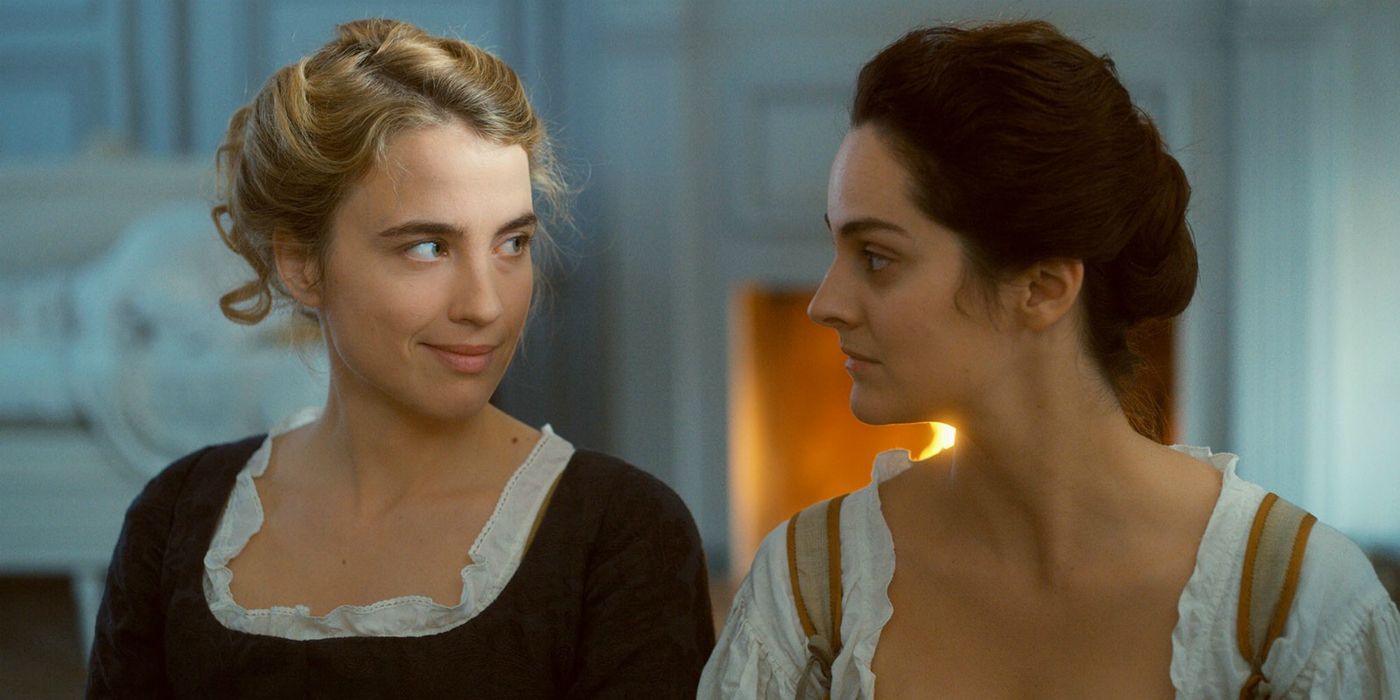
Portrait of a Lady on Fire (2019), directed by Céline Sciamma, is a wonderfully beautiful film, capturing the longing and searching looks shared between the two main characters, Marianne and Héloïse. The film has long takes that give the story room to breathe and establish a quiet, poignant atmosphere. The framing of the shots is usually focused on the two women and their shifts in facial expression and emotion. In the scenes where Marianne and Héloïse are playing the harpsichord and playing a card game, the framing is deliberate, only showing their faces in medium close ups and close ups.
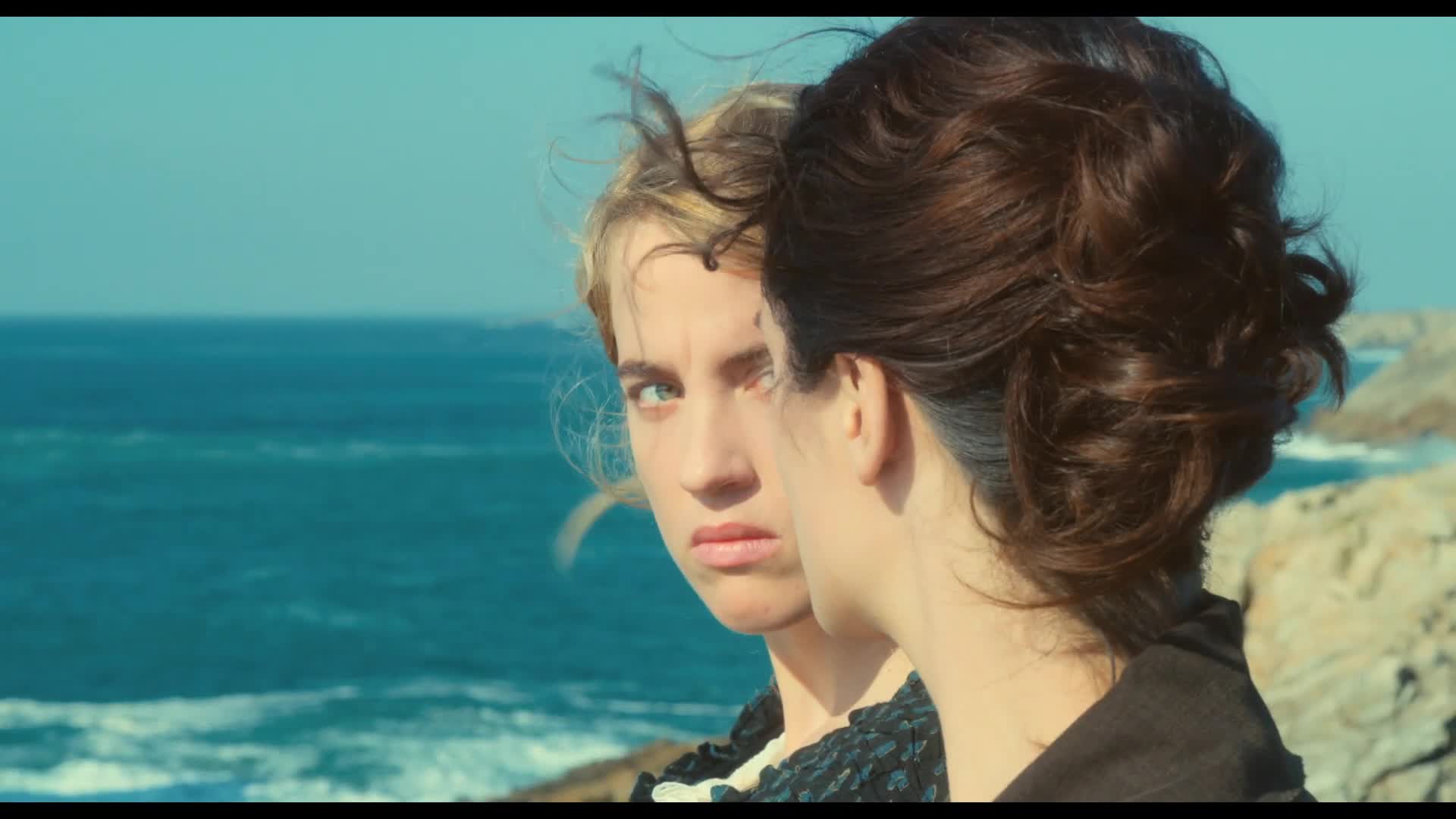
The intentional framing drives the narrative by showing the viewers the emotional journey of the characters. In one scene by the coastline, Marianne and Héloïse are standing side by side. Marianne’s face is covering Héloïse’s face in the frame but reveals Héloïse’s face every time she turns her head to look at her. I thought this was a genius use of framing because it cues the audience in on Marianne’s inner thoughts and her curiosity about Héloïse. We glimpse Héloïse as Marianne does, quick and fleeting.
The long shots throughout Portrait of a Lady on Fire are broken up by a generous helping of close ups, most notably used to emphasize important props. One example is the insert shot on the vase of flowers the maid is using as a subject for her needle work. An earlier shot shows the flowers blooming and flourishing with vibrant colors, but towards the end of the film, the flowers are shown in another shot as dead and withering.
We can take the flowers and extend their physical status to the relationship status of Marianne and Héloïse. Mise-en-scene and cinematography are working in tandem to enforce the mood and themes presented. It’s also worth noting that Marianne is in red throughout the duration of the film, indicating her as the object of desire for Héloïse.
The distinct lack of non-diegetic sound emphasizes the current action and brings the viewer into the fold of the setting. When there is music, however, the emotional effect is greatly increased and has a greater symbolic meaning when taken in the context of the relationship between the two women. The bonfire scene is an emotional moment for both women, and the fire acts as a metaphor for their attraction and desire.
The ending of the film was especially interesting because Marianne and Héloïse were both at the same orchestra concert listening to a piece that held emotional significance during their relationship. Héloïse was lost in the beauty of the orchestra, oblivious to Marianne sitting on the other side of the room. The camera moves in, and we see tears roll down Héloïse’s face.
While talking with several people about this scene, they mentioned being thinking Héloïse would look over and see Marianne or acknowledge the audience in some way. It was an interesting take, especially if you take the story of Orpheus and Eurydice, as told earlier in the film, as a metaphor for the affair.
Was Héloïse truly ignorant to Marianne or was she instead choosing to keep the memory of Marianne that she created? How does the cinematography cater to the feminine gaze? What do you think of how the cinematography impacted the pacing of the film?
“A manifesto about the female gaze”that is how Director Céline Sciamma describes Portrait of a Lady on Fire. This theme was ever present throughout the entire movie and is so important for how we as viewer perceive the entire film and the characters within it. I believe to fully understand the power of having a movie be in the female gaze we first have to contrast it with a direct opposite. I want to contrast this movie for a second with a movie that I believe is “the male gaze” personified. The Wolf of Wall Street, in this movie women are merely props used to show the desires of men. They have no real purpose other than fulfilling fantasies teenage boys would have and it literally fails the Bechdel test, which if you don’t know is the criteria of having two named female characters speak to each other about something other than a man. The women are soulless, lacking depth in their characters as most of the time a woman is shown in this movie, they are either a hooker, stripper, or trophy wife. Of course, this movie was written and directed by 2 white men, that feeling that comes along with watching a movie where you can just feel that a woman had little to no input in the way women were portrayed in the film is overwhelming in this. It is the complete opposite of the beautiful, Portrait of a Lady on Fire.
Portrait of a Lady on Fire, takes us on a journey of gazing. From when Marianne first looked at Héloïse as her hood fell and she turned back to her posing for a portrait, to her being drawn while sleeping, to the very end when Héloïse called out for her to turn around and face her. This movie is all about how the artist views their subject, how a look can mean more than words can allow, and it feels like we are watching a subject, turn into a muse.
I watched this 12 minute breakdown video about “the gaze”within this film and this video creator quoted Jean Paul Sartre, a French philosopher, to help explain that she believes that the gaze always objectifies whatever we are looking at. Sartre said, “…we can not perceive the world and at the same time apprehend a look fastened upon us; it must be either one or the other. This is because to perceive is to look at, and to apprehend a look is not to apprehend a look-as-object in the world; it is the consciousness of being looked at.” In this movie, Marianne begins as just a painter, someone who is used to watching without really being seen herself. As her relationship with Héloïse progresses she strips Marianne of just being “the painter” she humanizes her. We learn about Marianne, we perceive her. One of my favorite scenes in this movie was when Héloïse asked her to come look from her perspective while she was posing, and it cemented our understanding that there is always 2 sides, as we look, we are also being looked at.
However, as we look at each other our predispositions, our stereotypes, our assumptions are being imposed onto whoever our subject is. Even if they are the complete opposite of who we initially think they are, we can’t help but to assume. As a woman, the female gaze in media has always seemed softer, more forgiving, more loving, more honest, more real. I watch movies made by men that have shallow interpretations of female characters, and maybe that’s how they view women. However, when I watch movies directed by women, they never strip the men of their depth and the women always feel more real, like someone you’ve met. I think this theme is ever present in this movie, because the women have life. They fall in love but they are more than just “love interests”, they have hobbies, passions, backstories, monologues, deep thoughts, they are themselves before they are lovers and I often think that movies made in the male gaze portray women as just props for love, sex, and heartbreak, as if all we can do in this life is be loved. Portrait of a Lady on Fire is important because it shows the female gaze so well. It shows the love, the empathy, and the understanding of one woman to another that is unspoken, yet perfectly understood. Along with this, we see women in a time period that is so restrictive, being free.
Our professor for this class said something about this movie that stuck with me throughout the entire screening, “this movie uses lighting in a way that is unique, the light looks like it’s coming from them, not at them.” I believe that is the female gaze in this movie, light coming from them, despite being in a oppressive time period, despite not being able to fully be in a relationship, despite knowing their fates, light comes from them, not at them. These 2 women (like all women) are incredible and resilient, deep and poetic, and fostered love in a circumstance that would normally breed anger and hate. That too, is the female gaze at work and it matters so much in media because women are more than just props for what men are going through. Women are multifaceted and they deserve to be shown on screen as such. This film is brilliant, I hope more directors use the female gaze, it is wonderful to see on screen!
We looked at two examples in class where red was used as a motif of passion, and this film utilized a similar system to convey the characters’ desires. Marianne was always clothed in red, characterizing not only her passion but her defiance and freedom. Unlike Héloïse, she has has the autonomy to pursue her interests and travel the world, as well as choose whether or not to marry. Conversely, Héloïse wears blue, which mirrors the sea. This reflects her desire for freedom from her social constraints, as well as a parallel to her sister and their sadness. However, when she wears the green dress, it reflects her submitting to her social role.
Either way, the two characters wear opposing colors of clothing; Héloïse wears cool colors while Marianne wears warm colors. This suggests their inability to be together due to society’s standards. Additionally, it serves as foreshadowing for their separation at the end of the film.
Sciamma utilizes many long and extreme long shots throughout the film, most of the time with the characters being the center focus of the frame, which emphasizes the film’s nostalgic nature as it is through the memory of Marianne; this is reminiscent of The Grand Budapest Hotel. This film is about observation, which is very prevalent through this framing. As a painter, Marianne is constantly observing, and we are observing with her through her point of view. This is first because she is painting Héloïse and later because she falls in love with her. However, the emptiness of the background in many of the scenes invokes a feeling of solitude and longing as Marianne is melancholy when she looks back at these memories.
Questions:
What is the significance of the low contrast in many scenes between Héloïse and Marianne? What does this say about scenes of high contrast?
What are the functions of the framing in this film, especially when considering we are viewing this story through Marianne’s point of view?
What is the significance of the scene when Marianne literally turns Héloïse’s heart on fire (when she lights the old painting)?
What is the significance of the story of Sophie in relation to the romance plot of the film?
While watching the film, I find out that there are often times two people in the frame.
Before getting into the cinematography of Portrait of a Lady on Fire, we can first see a quote from Claire Mathon, the cinematographer of Portrait of a Lady on Fire. “The THALIA 70mm T2.6 Prime was one of our favorite focal lengths to capture this film about the looks and the proximity of these women.” (https://www.red.com/news/claire-mathon-afc)
We must first know how wide different lens with different focal length capture before analyzing. In actual usage, photographers often use 35mm or less to capture the environment and create a overall livelier mood and add more context. These shots include more background, and characters are more of an element rather than the main component. The 50mm, are close to the view of the human eye, and most commonly used in POV shots.(https://www.youtube.com/watch?v=ImFXpyAA1b8)⬇️
As a result, the persistent use of a 70mm lens by fixing the film at a human-scaled distance from the two women the director is letting us to observe.
The persistent use of 70mm gives us the relaxing compression and at the same time give minimal edge distortion, and make the camera less intruding while giving us all the necessary details. It captures the expressions of Marianne and Heloise, and allow the audience to have their attention on both of them rather than one at a time.
Both their faces are evenly proportioned, paired with the smooth and warm lighting, the 70mm will give the audience enough emphasize on the character while at the same time not so much isolation among the two women.
By locking the film into a 70mm perspective, the director visually compresses characters within their surroundings. This reinforce one of the themes, which is freedom, and the 70mm technique visualize the character’s lack of freedom. As a result, the 70mm lens transform isolation into actual experiences for the viewer, turning form into an extension of theme.
My question is:
Does the director use all these techniques, such as the 70mm, lighting, and all the mise-en-scene elements to frame the love between Marianne and Heloise as a rebellion (maybe the large usage of 70mm is a rebellion against the common used 35mm), that is destined to fade after they are separated and can only be kept in their memories, or a durable, long lasting relationship that persists through history? Which kind of relationship he is trying to present.
While last week’s reading helped us understand mise-en-scene and the artistic components in front of the camera, this week’s reading explains what tools are used behind the camera to shape what we see and how we see it.
I’d like to focus on three aspects of cinematography that were covered in this chapter: depth of field, image duration, and camera angles.
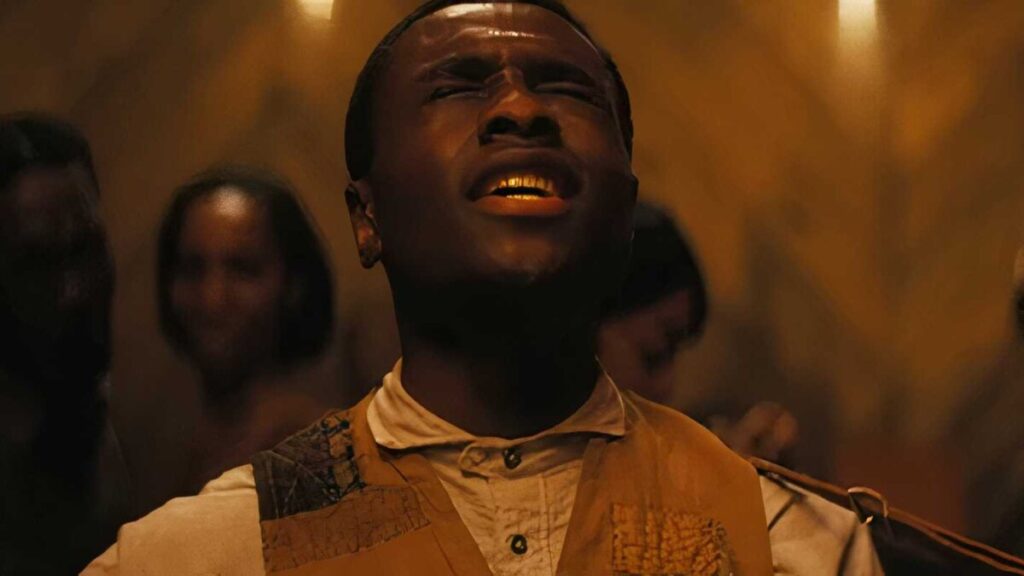
Depth of field describes the “range of distances within which objects can be photographed in sharp focus” (Film Art: An Introduction, 13th Edition). A shallow depth of field, for example, blurs the foreground and the background and keeps the sole subject in focus whereas a deep depth of field allows a larger range of the image to be sharp and in focus. The following scene in Ryan Coogler’s Sinners is a great example of this concept:
Sammie (the guy with the guitar), is in focus in the foreground while everyone else behind him is blurred in the background. This use of shallow depth of field brings all the attention onto Sammie and forces the viewer to focus on him. As the scene progresses, a similar use of depth of field is used to guide the viewer through the crowd of dancers and focus in on specific characters that are meant to represent various eras of music and dance through the years. At minute 3:00, a rockstar-looking man appears in frame (meant to represent afro-futurism) and although a crowd surrounds him, he is the only one in focus while everyone else blurs into the background. The repetitive use of this technique during the scene helps tell the viewer what they should pay attention to.
This scene of Sinners also provides a visual example of image duration. Image duration refers to the length of a single continuous shot. Starting at minute 2:37, a long take begins and in just one continuous progression, the camera immerses us into the crowd, panning to various subjects instead of using cuts. The continuity of the shot underscores the theme in the movie that music transcends time. All the different eras and cultures of music- hip hop, rock, African Zaouli and traditional Chinese dancing- shown with no interruptions emphasizes their unity and interconnectedness, a key point in the film.
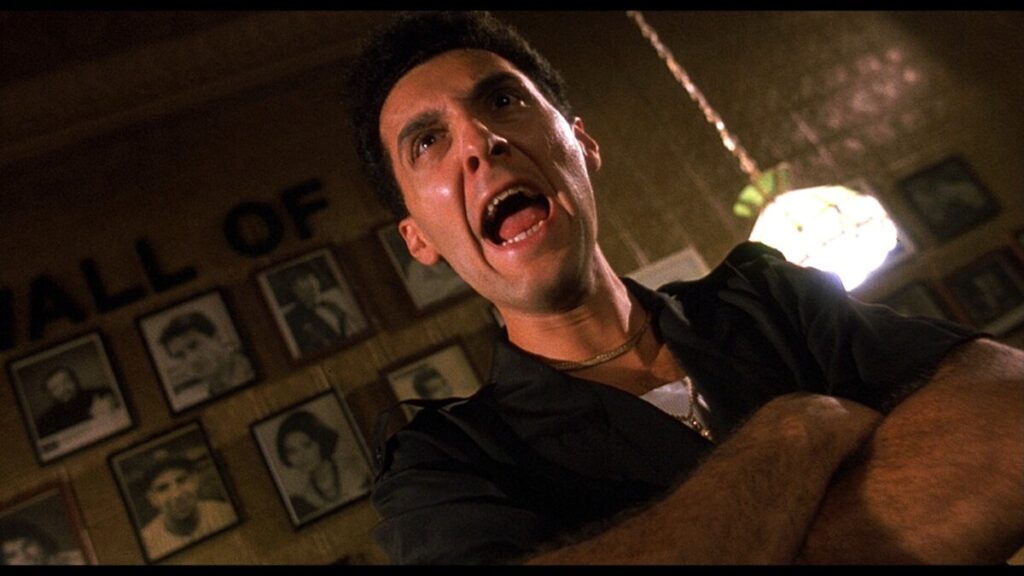
The final technique I’d like to explore is the use of camera angles: the location and/or orientation of the camera relative to the subject. In Spike Lee’s Do The Right Thing, Buggin Out, Radio Raheem, and Smiley barge into Sal’s pizza shop, demanding that Sal put pictures of Black people on his precious “wall of fame” given that most of his clientele is Black. In this scene,Lee uses canted framing (also known as a “Dutch angle”) to disorient the viewer and visually emphasize the tension of the confrontation. Lee also combines these tilted shots with low-angle perspectives to further emphasize the unstable dynamic of the characters.
A key takeaway from this chapter is that cinematography plays a significant role in adding meaning to a shot and serves to enhance the mise-en-scène to form one emotional, stylistic image. I also now better understand that although they overlap, mise-en-scène focuses on what appears within the shot, while cinematography focuses on how the shot is captured.







![Portrait of a Lady on Fire – [FILMGRAB]](https://film-grab.com/wp-content/uploads/photo-gallery/Portrait_of_a_Lady_on_Fire_065.jpg?bwg=1601292400)