Category: Week 8 (10/13+10/15) • Narrative

  • Creativity and its Limits: Citizen Kane

    (73) Orson Welles on Watching Too Many Films – YouTube

    There will always be a debate towards what the “best” movie of all time is. However, there is no debate that Citizen Kane is one of the most culturally and cinematically impactful movies ever created. Orson Welles, with his first ever time directing a film, forever changed the way that cinema was created. New ideas on how to portray lighting, focus, narrative, among many others, were created in Citizen Kane for one key reason: Welles had no idea what he was doing.

    When I say that Orson Welles had no idea what he was doing, of course Welles had a conceptual vision for what he wanted his first direct film to become, but Welles had no preconceptions on what was and wasn’t possible in the process of creating film. That was his greatest strength.

    In an interview with Orson Welles (linked above), he notes that you mustn’t “soak yourself in film.” What he means by this is that you shouldn’t dive too deep into what is and isn’t possible in filmmaking. Welles’ creativity stemmed from the fact that he had no idea on what was possible at the time. Gregg Toland, the working cinematographer on Citizen Kane, brought Welles’ radical-at-the-time ideas to life.
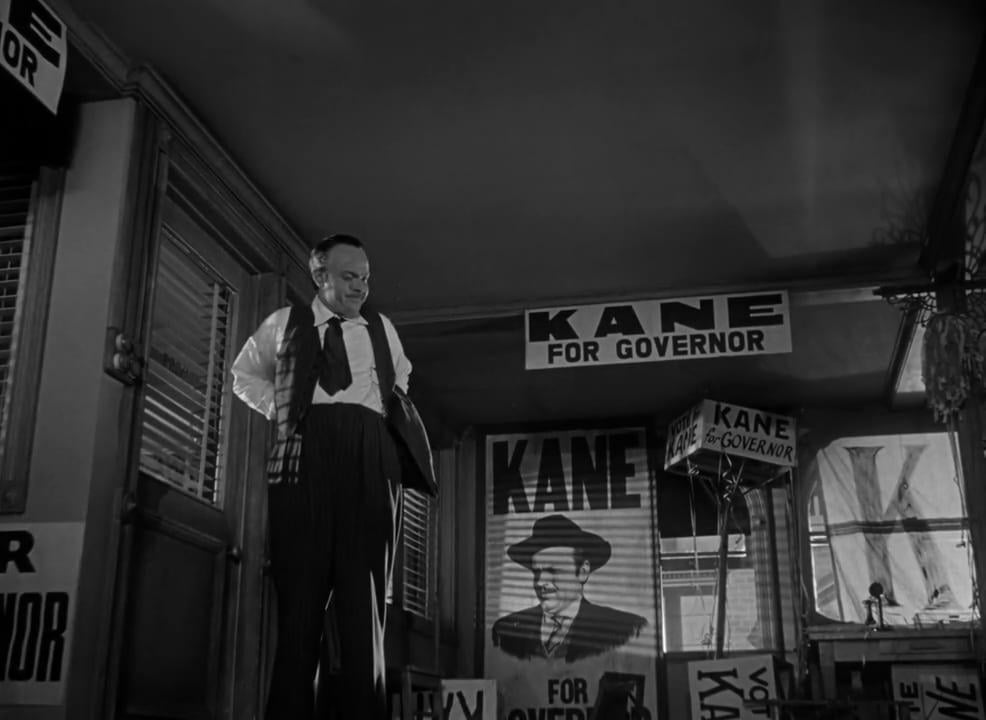
    For example, the low shots in the film were a radical new idea at the time. Cloth ceilings were integrated into the set of Citizen Kane to give more of a realism effect. Cinematographer Gregg Toland adds “The Citizen Kane sets have ceilings because we wanted reality, and we felt that it would be easier to believe a room was a room if its ceilings could be seen in the picture.” The confidence to pull off such a revolutionary idea at the time came from the unbounded creativity of a director who had no idea what the “rules” were.

    Even though Welles’ belief to not “soak yourself in film” sounds good in prospect, it is important to mention the anomaly that is Citizen Kane. Welles mentions it himself in the interview, that most brilliant filmmakers in the next generations will already know the ins and outs of the filmmaking process. It is simply unlikely that a masterpiece will be created just because the creative vision has no prior experience in the creation of a new subject, Orson Welles was simply an anomaly. Overall, even though it is highly unlikely to create genius from nothing like Welles, it is still possible. New filmmakers in the next generation shouldn’t bound their creativity to what is already known, but towards what hasn’t been done. That’s how great films like Citizen Kane are created.

  • The use of mirrors in Citizen Kane

    The famous final sequence, when Kane walks through the corridor of mirrors, is not simply a stylistic and aesthetic choice. Instead, this choice actually resembles one of the primary themes of the films, which is the presence of fractured and fabricated identity. The “many Kanes” that appear because of the mirrored hall shows that there is no true Charles Kane, but instead countless versions of himself that he has portrayed to the general public and been interpreted as. Even Jerry Thompson, who spent weeks studying the life of Kane, could only ever understand him through the fragmented and often unreliable tales told to him by the people closest to Kane.

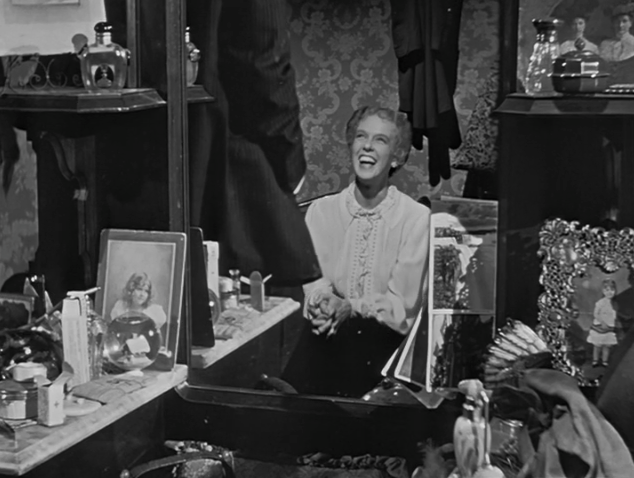
    The mirrors also offer a deep sense of isolation. In Kane’s final days, he spends time not surrounded by loved ones and friends, but by reflections of himself. He has spent years trying to surround himself with people who “love” him, accidentally surrounding himself with people who try and praise him in exchange for power. This isolation can be seen earlier in the film as well, when Susan Alexander sits at her wardrobe, we gaze at her reflection through a mirror. The reflection stands as a confrontation of her loneliness and isolation.

    In totality, mirrors and reflections are used throughout Citizen Kane to establish the distorted nature of life these characters are experiencing. Nothing is genuine, not the people they surround themselves with or the stories they tell. Even the story itself goes through multiple levels of connection (a friend, a manager, etc), leading to a convoluted tale that never truly lets us get a good look at who Charles Kane was. And in his final days, he understands that he doesn’t know either.

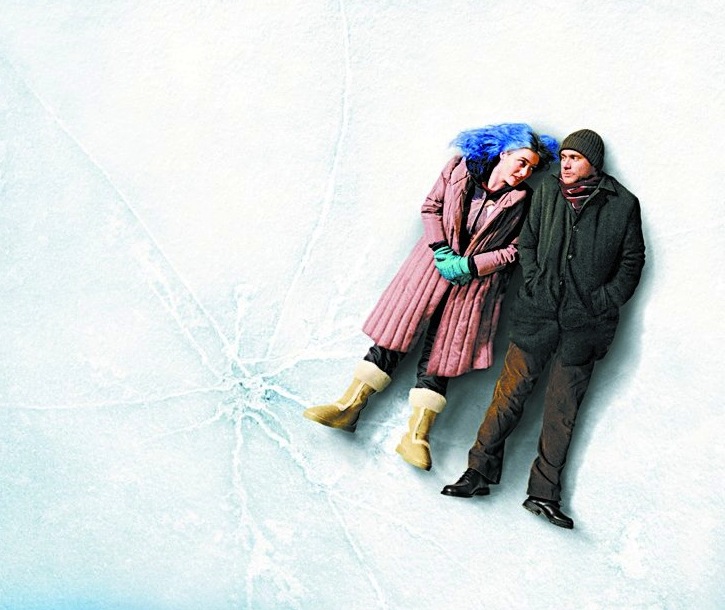
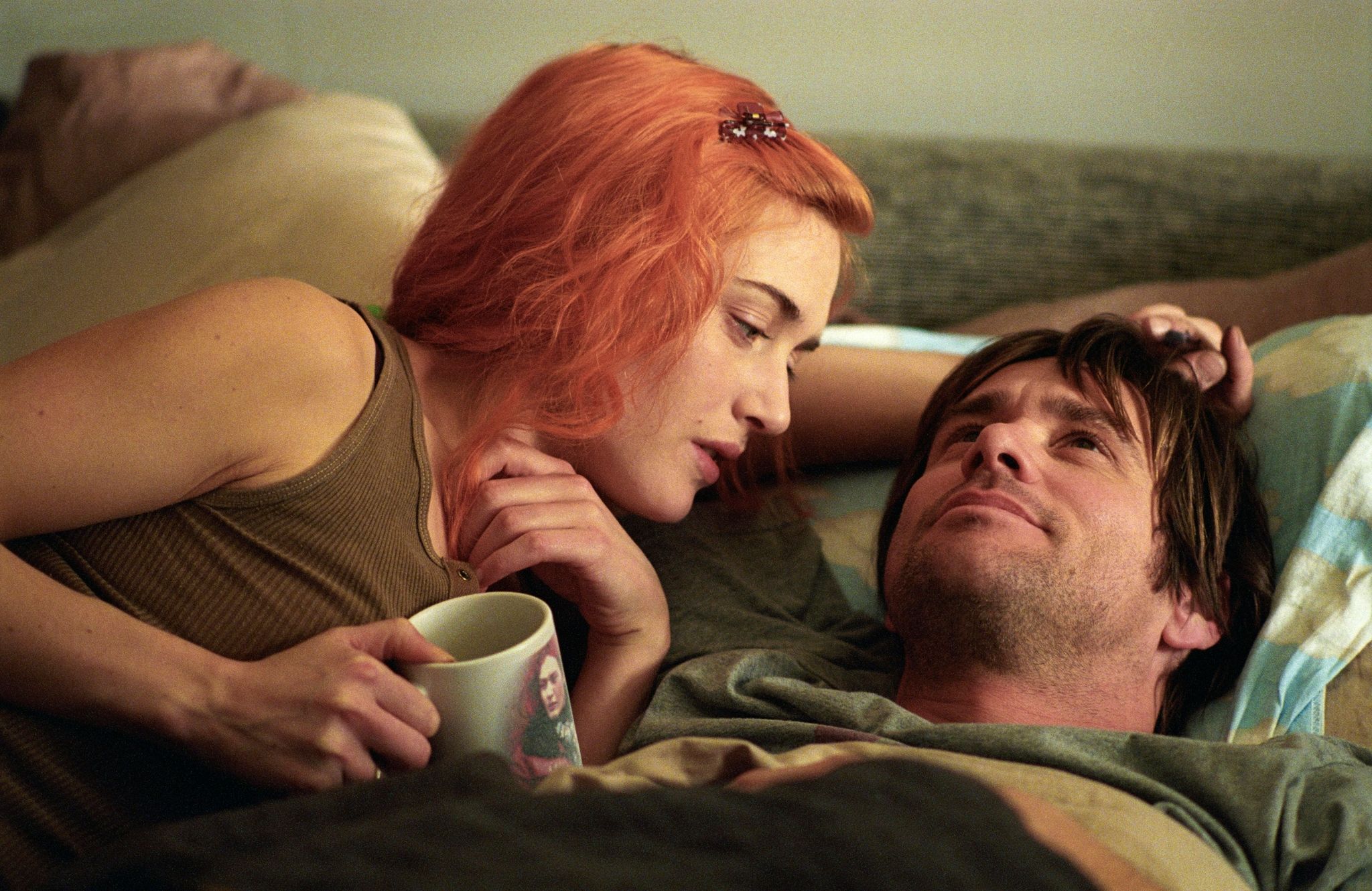
  • The Fragmented Truth of Memory: Narrative Form in Eternal Sunshine of the Spotless Mind

    I am writing this reader’s post after watching Citizen Kane, which gave me a lot of inspiration about how audiences and the movie interact. From Citizen Kane, we see narrative in forms of memory, in fact, in different aspects and versions of memory, such that they seem to piece together a story. Through such nonlinear narratives, why would the audience be able to understand what’s going on? Bordwell, Thompson, and Smith describe narrative as a chain of events linked by cause and effect occurred in time and space.

    However, they also remind us that narration can control what we know and when we know it (which ties back to Citizen Kane, as the story literally is about information control). In Eternal Sunshine of the Spotless Mind (Michel Gondry, 2004), this manipulation of time and information becomes the emotional core of the film.

    The space between who we are and who we think we are movie review (2004) |  Roger Ebert

    The story itself is simple: about two people (Joel and Clementine) meeting and falling in love on a train. Eventually, they experienced a painful breakup due to miscommunication. Both decided to undergo a medical procedure at a company called Lacuna, Inc. to have each other’s memories erased. However, the erasing process forces them to relive their experiences with each other in reverse–so they ended up experiencing their final fight, and moving backward to their first moments of love. As Joel revisits these memories, he realizes that he didn’t actually want his memories of Clementine to be erased.

    Unfortunately, the erasing process was complete, and both of them forgot about each other. Although later by chance they met on a train and fell in love again, just like they first did, ending the movie merrily, what is more important is the narrative structure of this film.

    Dreaming of Lacuna, Inc.. When I first saw Eternal Sunshine of… | by  Christian Montoya | Applaudience | Medium

    The plot is nonlinear and disorienting by design. The film begins after Joel and Clementine’s relationship has already ended and been erased, but neither the audience nor Joel realizes this right away. By employing nonlinear storytelling and restricted narration, we learn Joel’s memories in reverse, mirroring the mind’s gradual erasure. The result is that the audience experiences forgetting alongside the character, and become trapped inside the narrative logic of memory rather than time.

    In this work that narrates time reversely, temporal order and causality are also mixed up. As memories collide into one another, spatial and continuity break down, forcing the audience to think hard piecing these scenes together. In one moment, Joel runs through his own memories to “save” Clementine, blending dream logic with narrative motivation. Bordwell would describe this as a manipulation of time and space that adheres to cause and effect–that the cause (Joel’s resistance to forgetting) to the effect (the reappearance of moments in the past).

    Eternal Sunshine of the Spotless Mind

    But even when the film bends time, the emotional coherence is maintained, which is the unity of meaning. During the final scene, the directors decide to end the film with an open-ended narration: Joel and Clementine listens to tapes of their past relationship. This provides neither a full disclosure nor disunity, but an open-ended interpretation which we do not know what will happen in the future.

    Revisiting this movie after reading through this chapter and watching Citizen Kane, I found a lot more fun in exploring the relationship between how the human mind absorbs information and how narration techniques could best serve the human mind in understanding what filmmakers are trying to tell. The emotional power of Eternal Sunshine of the Spotless Mind does not come from the story itself, but definitely from how it’s told, which is all the power of narrative form.

  • Citizen Kane’s Real Life Drama

    Citizen Kane was not just a drama shown on-screen, it was based on a real life newspaper tycoon William Randolph Hearst and thinly veiled by cinematic flourish. However, Hearst was a powerful man and Orson Welles, an arrogant yet brilliant rising star, had made himself a powerful enemy.

    According to PBS, Orson Welles was an ambitious young man who set out to dethrone Hearst, but Hearst would not take this lying down. He banned any mention of this film in his newspapers and intimidated theatre managers into refusing to show the movie. As such, Citizen Kane was initially a box office flop, failing to recoup its production costs. Despite the boycott, Citizen Kane still managed to get nominated for nine categories at the 14th Academy Awards, but only winning for Best Original Screenplay. Hearst’s influence managed to reach into the Academy voters, with many claiming that Citizen Kane was snubbed due to personal dislike of Welles among voters and Hearst’s supporters. The film was reportedly booed by audience members every time it was named at the Oscars.

    Although Citizen Kane was a less than flattering depiction of Hearst, there is an interesting theory about why Hearst was so adamant to obscure the film. According to the writer Gore Vidal, “Rosebud,” the phrase that the film centers around, was a nickname given by Hearst to his mistress Marion Davies’s clitoris. Marion Davies was an actress who was well liked in Hollywood, and the controversy over Citizen Kane was said to be “a fight over her honor” as her depiction in the movie as Susan Alexander was as Welles claimed himself– “a dirty trick.”

    Out of the three sources I used, only the PBS article seems to be based in fact and backed up by other sources. Although Far Out Magazine titles their article as “Why Citizen Kane was Booed at the 1942 Oscars,” the article clarifies that the booing was only account of Citizen Kane being booed came from Welles himself, who wasn’t even in attendance. Additionally, the Guardian article reads more as celebrity gossip with speculation about Welles and his co-writer Mankiewicz and their hidden motives.

    https://faroutmagazine.co.uk/why-citizen-kane-was-booed-at-the-1942-oscars

    https://www.theguardian.com/unsolvedmysteries/story/0,,1155656,00

    https://www.pbs.org/wgbh/americanexperience/features/kane-william-randolph-hearst-campaign-suppress-citizen-kane

  • Narrative Form in Now You See Me 2

    When reading this week’s Film Art chapter on narrative form, specifically the section about “playing games with story time”, I kept thinking back to the movie Now You See Me 2. This film stood out to me so strongly because of its unique storytelling structure and the way plot twists are revealed.

    I watched this movie, the sequel, before I had ever seen the original movie, so I was probably more confused than the average viewer would have been. But, the film’s narrative is essentially structured as a magic trick in itself, which is fitting for a story centered around magicians.

    The film does an excellent job of building up mystery and suspense while remaining entertaining the entire time. There are quite a few different subplots that run throughout the movie. In terms of narrative form, I’m focusing on timelines and temporal frequency.

    The movie begins in a flashback of the character Dylan’s childhood. It’s a pivotal scene of his father dying while performing a failed magic trick. For viewers who haven’t seen the first film, this scene feels disconnected until the very end, an example of how the film withholds meaning until the right moment, similar to a magician revealing the trick’s secret. However, the scene makes sense from the start if the viewer has already seen the first movie. I was reminded of this scene when reading about the importance of flashbacks, and what part of the movie they are placed in. Putting this at the beginning of the movie keeps viewers intrigued the whole film, as they are waiting to find out what the significance of the scene is.

    Furthermore, the clip I attached is one of the best examples of temporal play in the film. In the beginning, there is a scene where we see the four magicians trying to escape the FBI. They jump down a shoot that they think will bring them to their escape truck, and instead somehow end up in the middle of Japan in a matter of seconds. The audience, sharing the Horsemen’s limited point of view, is completely disoriented. Later on in the movie, the scene is repeated.This time, it is revealed that the entire operation was orchestrated by Walter, the film’s main antagonist. He actually hypnotized and transported them to Japan via private jet during this “instant” transition. By repeating the scene and revealing hidden context, the film “plays games with plot time,” keeping the viewer’s knowledge aligned with that of the main characters.

  • Citizen Kane: Techniques That Changed Hollywood Film

    An article by Gottlieb called “Welles’s Citizen Kane Breaks with Traditional Filmmaking” states that the film Citizen Kane, while groundbreaking and highly influential at the time, was also very controversial. Before the film was released, it faced many problems, and many attempts were made to stop its release. The “Hearst syndicate” tried its best to stop the spread of the film because the main character of the film, Kane, was modeled after William Randolph Hearst (Gottlieb, 2023).

    Welles starts the film with the death of the main character and incorporates flashbacks and interviews with those who knew him. It is a story we must piece together and make meaning of on our own as different characters share their own versions of Charles Foster Kane’s life, and we are trying to figure out his true nature. Welles called this technique “prismatic” (Cheshire, 2002). The story is told out of order to provide mystery and intrigue. 

    Orson Welles’s Citizen Kane (1941) changed Hollywood filmmaking. As an outsider to the Hollywood film industry, Welles brought new, unconventional ideas and techniques to make this film. He expanded the type of stories that could be told in Hollywood films, showing corrupt, powerful people (a more controversial topic than typically depicted in Hollywood) (Gottlieb, 2023). Also, he used some new cinematography techniques. For example, he used low-angle shots that revealed the ceiling and depth of field, which “appeared powerful, modern, hyperarticulate” (Cheshire, 2002).

    An essay from the Library of Congress (Cheshire, 2002) called “Citizen Kane” explains the new techniques used in the film that helped change the film industry forever. 

    The film used wipes (a shot transition in which one image gradually takes the place of another through a horizontal, vertical, or diagonal movement across the screen, while both images remain partially visible), which was innovative at the time.

    One other technique that cinematographer Gregg Toland used was deep focus. This is where everything in the frame is in focus (clearly visible and sharp): the foreground, middleground, and background. In other words, there is a large depth of field. Deep focus and long takes were used to make the scenes feel more realistic and true to nature, which is something that Andre Bazin would appreciate (as he has a deep desire for realism in film).

    Overall, this source is important because it describes how new techniques used in the film changed Hollywood filmmaking – which stories were told and how they were told.

  • Citizen Kane & The Simpsons

    How does a movie like Citizen Kane, made in 1941, stay relevant in the present? Option one would be to make a film that engages the audience with cinematography and elliptical editing so smooth you won’t even notice the swift manipulation of time. Orson Welles and cinematographer Gregg Toland’s use of these techniques creates a rich and layered narrative. Or option two, make it good enough for future writers to joke about it.

    It's Not A Sled Anymore: Remaking A Cinematic Classic : NPR

    Take Keanu Reeves, for example. In 2014, he released an April Fool’s joke about reimagining the movie. The new version, titled Citizen Kane 3-D, was directed by and starred Keanu Reeves, and added a martial-arts subplot to the tale of a wealthy media tycoon who dies friendless, haunted by his childhood.

    Keanu isn’t the only one good at making playful remarks; in fact, The Simpsons created an entire episode dedicated to the parody and reveals the Simpsons character Mr. Burns’ backstory while doing so. This clever homage and original storytelling intertwining shows how Citizen Kane remains part of our cultural fabric. Unable to link the real episode, I have included a video from NowThisNerd to help foster the story. He also details how the Simpsons start their referencing journey, but he does a good job of making clear comparisons for our purposes.

    These playful reinterpretations aren’t just jokes; they’re how classic films stay relevant across generations. They introduce timeless stories to new audiences and keep the conversation going, ensuring that the original works don’t get forgotten.

  • The Film That Reinvented Cinema: Orson Welles’ Citizen Kane

    After watching Orson Welles’ Citizen Kane, I wondered why this film is considered one of the greatest masterpieces of all time. The film left a lingering impression on me – particularly in its portrayal of Kane’s failure to understand others’ desires until his death. Although this film emotionally resonated with me, I still couldn’t understand why it is considered revolutionary. To gain a deeper understanding of why Citizen Kane is regarded as a revolutionary film, I viewed an analytical video about it on YouTube. The video explains that we may not immediately see this movie as revolutionary. In the past, films rarely experimented with visual storytelling or narrative structure to the extent that Citizen Kane did. The video especially highlights how the cinematic techniques that once set Citizen Kane apart are now standard in modern cinema. Although those techniques were not entirely new, Orson Welles and cinematographer Gregg Toland combined them in a new way that reinvented the language of cinema.

    Some interesting innovations include the following:

    1. Deep Focus
      Some of the film’s most notable innovations include the use of deep focus. According to Film Art, deep focus is “a use of the camera lens and lighting that keeps objects in both close and distant planes in sharp focus”. In earlier films, filmmakers typically used different focal lengths to separate the figures from the background. However, in Citizen Kane, the entire scene was kept in focus through the use of a small aperture, which allowed more of the image to remain sharp within a single frame. This allowed viewers to take in the whole frame simultaneously. An example of this technique appears in the scene where young Kane plays in the snow outside the window, while inside, his mother and Mr. Thatcher are making decisions about his future.
    1. Montage Sequence
      Another notable cinematic technique used in Citizen Kane is a montage sequence, which is a film editing technique used to condense time through a series of short shots. In this instance, Welles utilizes this technique to compress sixteen years of marriage into just a few minutes. The audience observes the emotional tone between Kane and his wife evolving throughout their relationship, as multiple breakfast scenes seamlessly dissolve into one another. Even though the exact year or time is never shown, it becomes evident that Kane’s marriage is gradually declining.
    2. Labyrinth of Flashbacks and Different Points of View
      Unlike most films of its time, Citizen Kane does not follow a linear narrative structure. Instead, it followed a radical approach to storytelling. This non-linear narrative structure allows the story to unfold through differing perspectives and recollections. The movie begins with Kane’s death, and the story unfolds as a reporter interviews several people to find out what “Rosebud” means. Each person who was once close to Kane takes the audience back in time, revealing different parts of his life. This kind of narrative technique had never appeared in films before. However, many later films abandoned the strictly linear narrative, adopting techniques such as flashbacks and flash-forwards in ways that reflect Citizen Kane’s influence on modern storytelling.

    After learning about these techniques, I came to understand why Citizen Kane is regarded as revolutionary. The cinematography, shifts in perspective, and narrative structure illustrate the film’s transformative impact on modern cinema. Ultimately, exploring its innovative techniques allowed me to appreciate how Citizen Kane continues to shape the style and storytelling of modern films.

  • When a movie has three narratives (or maybe none?): Diegesis in “Clue”

    Clue (Lynn, 1985) is a classic comedy-mystery film based on the classic whodunnit board game. The movie is absolutely hilarious, but it’s also very unique as far as mystery films go. Clue has three endings. Not narrative jumps, not fake-outs, but three actual solutions to the whodunnit mystery. On theatrical release, each theater was sent a different ending, and on streaming, they are all presented as possible realities. At first, it would seem like this absolutely throws away any sense of a consistent plot or narrative (any proper diegesis)––how can a murder have three different killers, three different distinct sequences of effect?

    Clue is a genius film because it doesn’t have one narrative, one sequence. It cleverly builds up a giant front of nothing, then builds it’s entire narrative in less than five minutes. How? Diegetic narration.

    Clue is a restricted film, in that we never know more than one character. Specifically, we never know more than the murderer knows–-we see the killings as they happen, but we never know who does them. At least one characters always knows more than us. And that character is usually the man above, Wadsworth (Tim Curry). He is the butler of the house, and the story’s effective narrator.

    Throughout most of the film, the characters make absolutely no progress towards finding out who the murderer is. They search the house repeatedly, deal with guests, and discover murder after murder (eventually totaling six), but never get any closer to finding the truth. In this sense, Clue completely disregards the notion that characters are causes of events––the murderer in Clue might as well be a force of nature (faceless, unknown, unfeeling, and unseen), and the plot is otherwise driven by seemingly random occurrences (the motorist’s arrival, the singing telegram, Mr. Boddy not being dead). Clue‘s plot, when pared down, is nearly non-existent: the characters move around the house discovering nothing for an hour as random things happen, until Wadsworth explains the entire thing to them.

    This is not a plot. It’s a sitcom set-up. Which is why Clue‘s comedy takes center-stage. Comedies don’t necessarily need plots, and Clue can sometimes feel more like a Who’s-on-First-esque stand-up bit rather than a film.

    I don’t want to claim that Clue has no elements of narrative story; like all mysteries, it hides it’s causes without hiding it’s effects, while it has no actual flashbacks it does have an extended scene where Wadsworth acts out the beginning of the movie, functioning as a flashback, and it does have a climax (or, more accurately, three––each of the three moments when Wadsworth unmasks the murderer(s)). But it barely has a rising action, if at all. It mostly shuns exposition, giving one detail each per character and nothing else until the very end, and while it theoretically has a goal-oriented plot, nothing happens. The narrative of Clue moves at a speed of zero until the very end, when it suddenly launches through every stage of a plot in five minutes.

    Clue, to me, is a fascinating example of a refusal of narrative. The story of the movie is so completely not-the-point, instead being there only to provide moments of shock and comedic set-ups. I’m curious what others think––is Clue a seminal masterpiece in non-narrative writing? Or just a mystery that leans a little too heavily on humor? Either way, this whodunnit mystery film is a classic for a reason––and that reason isn’t the mystery itself.

  • Narrative Form and Cinema of Attractions in About Time

    In this weeks reading on narrative form, we learn how events in film unfold through causality, time, and space within a coherent diegesis, the film’s world of story action. Temporal relations, such as order and duration, also guide how audiences process the story such as whether events are shown chronologically or through flashbacks and repetitions. This structure provides clarity, creates emotional and thematic unity, and leads viewers toward resolution and meaning.

    In my favorite film, About Time (Curtis, 2013), narrative form is approached in a unique way, because the main character, Tim, is able to time travel to points in his life. The film plays with temporal order by repeating events in new variations, allowing viewers to compare how choices shape meaning. Duration, or how time is represented, varies across the film from quick rewinds to long stretches of lived experience. By the end, when Tim stops time traveling and embraces the present, the pacing slows. The audience feels the emotional weight of time by the end because the narrative stops manipulating it.

    Tim’s narration unifies these shifts in time and space. His reflective voiceover anchors the audience during a nonlinear storyline, shaping understanding of both the story itself and his internal transformation throughout.

    In Tom Gunning’s essay, he looks at an earlier stage of cinema before narrative form became dominant. He defines early film as a “cinema of attractions,” where the emphasis was on showing rather than telling. These films directly addressed the audience, highlighting spectacle, novelty, and surprise rather than character development or plot. Gunning argues that while later narrative cinema wanted to immerse viewers in a continuous story, the cinema of attractions invites awareness of the act of looking. Cinema was about the experience of seeing and being amazed by motion and illusion.

    About Time also contains moments of cinematic attraction in Gunning’s sense. The time-travel sequences momentarily pull viewers out of the story to look at the visual spectacle of time manipulation itself. These instances seem to pause narrative progression for the purpose of emotional spectacle.

    For example, when Tim relives an ordinary childhood day on the beach with his father after learning of his death, the scene functions less as narrative advancement and more as what Gunning would call a “cinema of attractions”: a moment of direct emotional address to the viewer. The slow pacing, golden lighting, and sense of suspended time invite viewers to live in the experience and be in awe of the ocean’s beauty with them, rather than think about the future. It’s an attraction not of shock, as in early cinema, but of sentiment—a spectacle of feeling. The story pauses and time itself seems to hold still. It’s not about narrative logic anymore but about emotion, the beauty of the moment, and the connection between father and son. These scenes remind viewers of film’s power to manipulate and reshape time and shape, creating a sense of wonder that is distinct from the plot’s emotional or overarching “romcom” narrative arc. It reminds viewers that Tim is not on a quest to fall in love with a woman, but rather on a quest to fall in love with life itself.