Category: Week 8 (10/13+10/15) • Narrative

  • Cinematography and Plot Structure in Citizen Kane

    I really get the hype around this movie! Citizen Kane seems to have it all, with a lot of elements that I wouldn’t imagine were typical for other films at the time. This movie is an extremely successful experiment of plot, editing, and cinematography, and features a talented cast of emerging actors–which is such a successful debut to have.

    One of the first technical elements I noticed about Citizen Kane was the transitions. Welles keeps transitions constant between shots–there is a tendency to maintain similar silhouettes of subjects within shots between the transition as one dissolves into the next. He also sometimes takes a more dynamic approach, like when it cuts to a kid holding a newspaper that covers the frame, then properly entering the scene as he puts it down. Either way, every transition was clean and calculated, and made this film a much more enjoyable watch. The music, as well, was very enhancing. In many cases, dramatic and comedic, it was sort of cartoon-ish and had the interesting effect of detracting from the seriousness of a more dramatic plot point, but still maintaining the tone. This cartoon-ish tendency certainly enhanced the comedic points as well, to give into the more borderline slapstick moments. Lastly, in regards to cinematography, I noticed that the camera frame is frequently moving. Whether it’s a zoom (which is very frequent in this film relative to others) or a mobile frame, the cinematography became much more dynamic through this active handling of the camera.

    As for plot structure, the time of the movie seemed very confusing–in a very engaging way. The plot is somewhat structured by each interview with a different person speculating who/what Rosebud is. In many cases, these responses in the interviews only confuse the search for Rosebud. I found this to be reflected in the plot, since there were many points that seemed to divert from this main objective, particularly the opera arc, among others. In doing this, the film throws a lot at you, in a sort of watered-down, super early-on postmodernist way. I thought it was really cool how they played around with so many aspects of this movie, which made it all the more entertaining to watch!

  • Narrative Form in Parasite

    When we watch a movie, we do more than just observe. We actively construct meaning by connecting events, predicting outcomes, and imagining what might exist beyond the frame. This makes storytelling in film an interactive process between the filmmaker and the viewer. This week’s readings on narrative form and narration emphasize that films create meaning not only through what they show but also through how and when information is revealed. Chapter 3 explains that narration is the method through which story and plot are presented to the viewer, shaping how the plot delivers the story moment by moment.


    It is defined that a film’s story represents the full chain of events in chronological order, while the plot is the filmmaker’s intentional arrangement of those events to control what we experience and when. After reading Chapter 3, I began to think about how films guide our understanding by controlling what we know and when we know it. I recently rewatched Bong Joon-ho’s Parasite (2019) and noticed how this dynamic structure is exemplified.


    As the readings explain, the story exists in our minds as a chain of events while the plot shapes how we experience it. Parasite’s story could be told straightforwardly as a poor family infiltrating a wealthy household. However, the plot of the film builds suspense by giving us information slowly through the eyes of the Kim family. Joon-hoo rearranges and reveals information in ways that control how we feel and what we know. Scenes are placed strategically to build curiosity and suspense. For example, at first, the Kim family’s plan seems clever and lighthearted. However, when the hidden basement is revealed, everything we thought we understood about the family’s actions changes. This rearranging of information keeps us engaged, encouraging us to connect causes and effects and to reinterpret what we have already seen.

    Techniques such as restricted narration and point-of-view (POV) shots deepen this process. The readings explain that narration determines whether we know more (unrestricted) or less (restricted) than the characters. Parasite relies mostly on restricted narration, as we often know only what the Kim family knows. The POV shot, as the readings describe, is a tool that allows us to see the world through a character’s eyes. Bong uses both of these to heighten tension and align us with the Kims’ limited perspective. For example, when Ki-taek peers out from hiding beneath the table, the camera mimics his restricted view, forcing us to imagine what lies just outside the frame. These moments emphasize that narration is not neutral, but rather it is constructed through selective framing and sound that guide how we process information.

    Narrative cinema is a collaboration between what the filmmaker shows and what the audience infers. Through its manipulation of story, plot, point-of-view, and other techniques, Parasite exemplifies that film is not something we simply watch, it is something we build meaning from.

  • Following the Trio: A Narrative of Fear and Uncertainty in Harry Potter and the Deathly Hallows (Part 1)

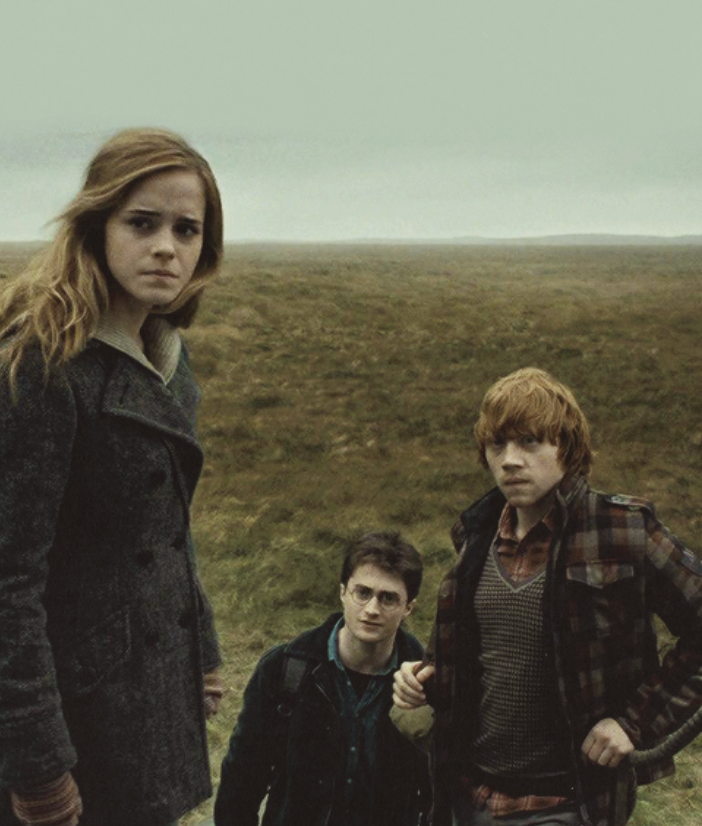
    While reading about narrative form and the cinema of attractions, I kept thinking about Harry Potter and the Deathly Hallows, Part 1 and how its slower pace and moments of spectacle make us feel the story’s uncertainty in a really visual way. Unlike the earlier Harry Potter movies, The Deathly Hallows, Part 1 slows everything down and narrows the focus. The film uses restricted narration, so we only see and know what Harry, Ron, and Hermione do. Because we’re limited to their perspective, we’re able to strongly connect to their confusion and frustration as they struggle to search for the Horcruxes. The long stretches of silence and constant wandering throughout the film make the narrative itself feel tense, almost as if the characters are stuck in time.

    The film also plays with the element of temporal order which further encourages us to put ourselves in the positions of the main characters. For example, the long and quiet forest sequences make the passage of time feel stretched out, and the use of flashbacks and dream sequences momentarily disrupt the flow of events. When Harry sees flashes of Voldemort’s movements through their mental link, we’re pulled out of the present moment and into his mind, which leaves us disoriented and questioning what’s real or imagined. These choices in narrative form force viewers to question what’s real, what’s memory, and what’s imagination, blurring the line between the past and present. It’s less about building toward a single climax and more about showing how time itself feels distorted when the characters are directionless while searching for Horcruxes the whole movie.

    Even with its slower pace, the film still has moments that support Tom Gunning’s idea of the cinema of attractions, which are scenes meant to astonish the viewer rather than just move the story forward. The Tale of the Three Brothers sequence, which is told through shadow animation, is a perfect example. For a few minutes, the film pauses the main narrative to tell a story within the story that’s visually striking and stylistically different from everything else. Considering that we only realize the tale’s significance later in the film, it feels like this pause invites us to watch for the sake of wonder before its deeper meaning clicks into place.

    Through the mixture of restricted narration, disrupted temporal order, and visually striking flashes, Deathly Hallows, Part 1 is a perfect setup for the battle to follow. The decisions in narrative form regarding time, perspective, and spectacle allow viewers to more deeply empathize with the characters and actually feel what it’s like to live inside a wizarding world that’s falling apart.