Blog

  • Narrative Form in Now You See Me 2

    When reading this week’s Film Art chapter on narrative form, specifically the section about “playing games with story time”, I kept thinking back to the movie Now You See Me 2. This film stood out to me so strongly because of its unique storytelling structure and the way plot twists are revealed.

    I watched this movie, the sequel, before I had ever seen the original movie, so I was probably more confused than the average viewer would have been. But, the film’s narrative is essentially structured as a magic trick in itself, which is fitting for a story centered around magicians.

    The film does an excellent job of building up mystery and suspense while remaining entertaining the entire time. There are quite a few different subplots that run throughout the movie. In terms of narrative form, I’m focusing on timelines and temporal frequency.

    The movie begins in a flashback of the character Dylan’s childhood. It’s a pivotal scene of his father dying while performing a failed magic trick. For viewers who haven’t seen the first film, this scene feels disconnected until the very end, an example of how the film withholds meaning until the right moment, similar to a magician revealing the trick’s secret. However, the scene makes sense from the start if the viewer has already seen the first movie. I was reminded of this scene when reading about the importance of flashbacks, and what part of the movie they are placed in. Putting this at the beginning of the movie keeps viewers intrigued the whole film, as they are waiting to find out what the significance of the scene is.

    Furthermore, the clip I attached is one of the best examples of temporal play in the film. In the beginning, there is a scene where we see the four magicians trying to escape the FBI. They jump down a shoot that they think will bring them to their escape truck, and instead somehow end up in the middle of Japan in a matter of seconds. The audience, sharing the Horsemen’s limited point of view, is completely disoriented. Later on in the movie, the scene is repeated.This time, it is revealed that the entire operation was orchestrated by Walter, the film’s main antagonist. He actually hypnotized and transported them to Japan via private jet during this “instant” transition. By repeating the scene and revealing hidden context, the film “plays games with plot time,” keeping the viewer’s knowledge aligned with that of the main characters.

  • Citizen Kane: Techniques That Changed Hollywood Film

    An article by Gottlieb called “Welles’s Citizen Kane Breaks with Traditional Filmmaking” states that the film Citizen Kane, while groundbreaking and highly influential at the time, was also very controversial. Before the film was released, it faced many problems, and many attempts were made to stop its release. The “Hearst syndicate” tried its best to stop the spread of the film because the main character of the film, Kane, was modeled after William Randolph Hearst (Gottlieb, 2023).

    Welles starts the film with the death of the main character and incorporates flashbacks and interviews with those who knew him. It is a story we must piece together and make meaning of on our own as different characters share their own versions of Charles Foster Kane’s life, and we are trying to figure out his true nature. Welles called this technique “prismatic” (Cheshire, 2002). The story is told out of order to provide mystery and intrigue. 

    Orson Welles’s Citizen Kane (1941) changed Hollywood filmmaking. As an outsider to the Hollywood film industry, Welles brought new, unconventional ideas and techniques to make this film. He expanded the type of stories that could be told in Hollywood films, showing corrupt, powerful people (a more controversial topic than typically depicted in Hollywood) (Gottlieb, 2023). Also, he used some new cinematography techniques. For example, he used low-angle shots that revealed the ceiling and depth of field, which “appeared powerful, modern, hyperarticulate” (Cheshire, 2002).

    An essay from the Library of Congress (Cheshire, 2002) called “Citizen Kane” explains the new techniques used in the film that helped change the film industry forever. 

    The film used wipes (a shot transition in which one image gradually takes the place of another through a horizontal, vertical, or diagonal movement across the screen, while both images remain partially visible), which was innovative at the time.

    One other technique that cinematographer Gregg Toland used was deep focus. This is where everything in the frame is in focus (clearly visible and sharp): the foreground, middleground, and background. In other words, there is a large depth of field. Deep focus and long takes were used to make the scenes feel more realistic and true to nature, which is something that Andre Bazin would appreciate (as he has a deep desire for realism in film).

    Overall, this source is important because it describes how new techniques used in the film changed Hollywood filmmaking – which stories were told and how they were told.

  • Citizen Kane & The Simpsons

    How does a movie like Citizen Kane, made in 1941, stay relevant in the present? Option one would be to make a film that engages the audience with cinematography and elliptical editing so smooth you won’t even notice the swift manipulation of time. Orson Welles and cinematographer Gregg Toland’s use of these techniques creates a rich and layered narrative. Or option two, make it good enough for future writers to joke about it.

    It's Not A Sled Anymore: Remaking A Cinematic Classic : NPR

    Take Keanu Reeves, for example. In 2014, he released an April Fool’s joke about reimagining the movie. The new version, titled Citizen Kane 3-D, was directed by and starred Keanu Reeves, and added a martial-arts subplot to the tale of a wealthy media tycoon who dies friendless, haunted by his childhood.

    Keanu isn’t the only one good at making playful remarks; in fact, The Simpsons created an entire episode dedicated to the parody and reveals the Simpsons character Mr. Burns’ backstory while doing so. This clever homage and original storytelling intertwining shows how Citizen Kane remains part of our cultural fabric. Unable to link the real episode, I have included a video from NowThisNerd to help foster the story. He also details how the Simpsons start their referencing journey, but he does a good job of making clear comparisons for our purposes.

    These playful reinterpretations aren’t just jokes; they’re how classic films stay relevant across generations. They introduce timeless stories to new audiences and keep the conversation going, ensuring that the original works don’t get forgotten.

  • The Film That Reinvented Cinema: Orson Welles’ Citizen Kane

    After watching Orson Welles’ Citizen Kane, I wondered why this film is considered one of the greatest masterpieces of all time. The film left a lingering impression on me – particularly in its portrayal of Kane’s failure to understand others’ desires until his death. Although this film emotionally resonated with me, I still couldn’t understand why it is considered revolutionary. To gain a deeper understanding of why Citizen Kane is regarded as a revolutionary film, I viewed an analytical video about it on YouTube. The video explains that we may not immediately see this movie as revolutionary. In the past, films rarely experimented with visual storytelling or narrative structure to the extent that Citizen Kane did. The video especially highlights how the cinematic techniques that once set Citizen Kane apart are now standard in modern cinema. Although those techniques were not entirely new, Orson Welles and cinematographer Gregg Toland combined them in a new way that reinvented the language of cinema.

    Some interesting innovations include the following:

    1. Deep Focus
      Some of the film’s most notable innovations include the use of deep focus. According to Film Art, deep focus is “a use of the camera lens and lighting that keeps objects in both close and distant planes in sharp focus”. In earlier films, filmmakers typically used different focal lengths to separate the figures from the background. However, in Citizen Kane, the entire scene was kept in focus through the use of a small aperture, which allowed more of the image to remain sharp within a single frame. This allowed viewers to take in the whole frame simultaneously. An example of this technique appears in the scene where young Kane plays in the snow outside the window, while inside, his mother and Mr. Thatcher are making decisions about his future.
    1. Montage Sequence
      Another notable cinematic technique used in Citizen Kane is a montage sequence, which is a film editing technique used to condense time through a series of short shots. In this instance, Welles utilizes this technique to compress sixteen years of marriage into just a few minutes. The audience observes the emotional tone between Kane and his wife evolving throughout their relationship, as multiple breakfast scenes seamlessly dissolve into one another. Even though the exact year or time is never shown, it becomes evident that Kane’s marriage is gradually declining.
    2. Labyrinth of Flashbacks and Different Points of View
      Unlike most films of its time, Citizen Kane does not follow a linear narrative structure. Instead, it followed a radical approach to storytelling. This non-linear narrative structure allows the story to unfold through differing perspectives and recollections. The movie begins with Kane’s death, and the story unfolds as a reporter interviews several people to find out what “Rosebud” means. Each person who was once close to Kane takes the audience back in time, revealing different parts of his life. This kind of narrative technique had never appeared in films before. However, many later films abandoned the strictly linear narrative, adopting techniques such as flashbacks and flash-forwards in ways that reflect Citizen Kane’s influence on modern storytelling.

    After learning about these techniques, I came to understand why Citizen Kane is regarded as revolutionary. The cinematography, shifts in perspective, and narrative structure illustrate the film’s transformative impact on modern cinema. Ultimately, exploring its innovative techniques allowed me to appreciate how Citizen Kane continues to shape the style and storytelling of modern films.

  • When a movie has three narratives (or maybe none?): Diegesis in “Clue”

    Clue (Lynn, 1985) is a classic comedy-mystery film based on the classic whodunnit board game. The movie is absolutely hilarious, but it’s also very unique as far as mystery films go. Clue has three endings. Not narrative jumps, not fake-outs, but three actual solutions to the whodunnit mystery. On theatrical release, each theater was sent a different ending, and on streaming, they are all presented as possible realities. At first, it would seem like this absolutely throws away any sense of a consistent plot or narrative (any proper diegesis)––how can a murder have three different killers, three different distinct sequences of effect?

    Clue is a genius film because it doesn’t have one narrative, one sequence. It cleverly builds up a giant front of nothing, then builds it’s entire narrative in less than five minutes. How? Diegetic narration.

    Clue is a restricted film, in that we never know more than one character. Specifically, we never know more than the murderer knows–-we see the killings as they happen, but we never know who does them. At least one characters always knows more than us. And that character is usually the man above, Wadsworth (Tim Curry). He is the butler of the house, and the story’s effective narrator.

    Throughout most of the film, the characters make absolutely no progress towards finding out who the murderer is. They search the house repeatedly, deal with guests, and discover murder after murder (eventually totaling six), but never get any closer to finding the truth. In this sense, Clue completely disregards the notion that characters are causes of events––the murderer in Clue might as well be a force of nature (faceless, unknown, unfeeling, and unseen), and the plot is otherwise driven by seemingly random occurrences (the motorist’s arrival, the singing telegram, Mr. Boddy not being dead). Clue‘s plot, when pared down, is nearly non-existent: the characters move around the house discovering nothing for an hour as random things happen, until Wadsworth explains the entire thing to them.

    This is not a plot. It’s a sitcom set-up. Which is why Clue‘s comedy takes center-stage. Comedies don’t necessarily need plots, and Clue can sometimes feel more like a Who’s-on-First-esque stand-up bit rather than a film.

    I don’t want to claim that Clue has no elements of narrative story; like all mysteries, it hides it’s causes without hiding it’s effects, while it has no actual flashbacks it does have an extended scene where Wadsworth acts out the beginning of the movie, functioning as a flashback, and it does have a climax (or, more accurately, three––each of the three moments when Wadsworth unmasks the murderer(s)). But it barely has a rising action, if at all. It mostly shuns exposition, giving one detail each per character and nothing else until the very end, and while it theoretically has a goal-oriented plot, nothing happens. The narrative of Clue moves at a speed of zero until the very end, when it suddenly launches through every stage of a plot in five minutes.

    Clue, to me, is a fascinating example of a refusal of narrative. The story of the movie is so completely not-the-point, instead being there only to provide moments of shock and comedic set-ups. I’m curious what others think––is Clue a seminal masterpiece in non-narrative writing? Or just a mystery that leans a little too heavily on humor? Either way, this whodunnit mystery film is a classic for a reason––and that reason isn’t the mystery itself.

  • Narrative Form and Cinema of Attractions in About Time

    In this weeks reading on narrative form, we learn how events in film unfold through causality, time, and space within a coherent diegesis, the film’s world of story action. Temporal relations, such as order and duration, also guide how audiences process the story such as whether events are shown chronologically or through flashbacks and repetitions. This structure provides clarity, creates emotional and thematic unity, and leads viewers toward resolution and meaning.

    In my favorite film, About Time (Curtis, 2013), narrative form is approached in a unique way, because the main character, Tim, is able to time travel to points in his life. The film plays with temporal order by repeating events in new variations, allowing viewers to compare how choices shape meaning. Duration, or how time is represented, varies across the film from quick rewinds to long stretches of lived experience. By the end, when Tim stops time traveling and embraces the present, the pacing slows. The audience feels the emotional weight of time by the end because the narrative stops manipulating it.

    Tim’s narration unifies these shifts in time and space. His reflective voiceover anchors the audience during a nonlinear storyline, shaping understanding of both the story itself and his internal transformation throughout.

    In Tom Gunning’s essay, he looks at an earlier stage of cinema before narrative form became dominant. He defines early film as a “cinema of attractions,” where the emphasis was on showing rather than telling. These films directly addressed the audience, highlighting spectacle, novelty, and surprise rather than character development or plot. Gunning argues that while later narrative cinema wanted to immerse viewers in a continuous story, the cinema of attractions invites awareness of the act of looking. Cinema was about the experience of seeing and being amazed by motion and illusion.

    About Time also contains moments of cinematic attraction in Gunning’s sense. The time-travel sequences momentarily pull viewers out of the story to look at the visual spectacle of time manipulation itself. These instances seem to pause narrative progression for the purpose of emotional spectacle.

    For example, when Tim relives an ordinary childhood day on the beach with his father after learning of his death, the scene functions less as narrative advancement and more as what Gunning would call a “cinema of attractions”: a moment of direct emotional address to the viewer. The slow pacing, golden lighting, and sense of suspended time invite viewers to live in the experience and be in awe of the ocean’s beauty with them, rather than think about the future. It’s an attraction not of shock, as in early cinema, but of sentiment—a spectacle of feeling. The story pauses and time itself seems to hold still. It’s not about narrative logic anymore but about emotion, the beauty of the moment, and the connection between father and son. These scenes remind viewers of film’s power to manipulate and reshape time and shape, creating a sense of wonder that is distinct from the plot’s emotional or overarching “romcom” narrative arc. It reminds viewers that Tim is not on a quest to fall in love with a woman, but rather on a quest to fall in love with life itself.

  • Cinematography and Plot Structure in Citizen Kane

    I really get the hype around this movie! Citizen Kane seems to have it all, with a lot of elements that I wouldn’t imagine were typical for other films at the time. This movie is an extremely successful experiment of plot, editing, and cinematography, and features a talented cast of emerging actors–which is such a successful debut to have.

    One of the first technical elements I noticed about Citizen Kane was the transitions. Welles keeps transitions constant between shots–there is a tendency to maintain similar silhouettes of subjects within shots between the transition as one dissolves into the next. He also sometimes takes a more dynamic approach, like when it cuts to a kid holding a newspaper that covers the frame, then properly entering the scene as he puts it down. Either way, every transition was clean and calculated, and made this film a much more enjoyable watch. The music, as well, was very enhancing. In many cases, dramatic and comedic, it was sort of cartoon-ish and had the interesting effect of detracting from the seriousness of a more dramatic plot point, but still maintaining the tone. This cartoon-ish tendency certainly enhanced the comedic points as well, to give into the more borderline slapstick moments. Lastly, in regards to cinematography, I noticed that the camera frame is frequently moving. Whether it’s a zoom (which is very frequent in this film relative to others) or a mobile frame, the cinematography became much more dynamic through this active handling of the camera.

    As for plot structure, the time of the movie seemed very confusing–in a very engaging way. The plot is somewhat structured by each interview with a different person speculating who/what Rosebud is. In many cases, these responses in the interviews only confuse the search for Rosebud. I found this to be reflected in the plot, since there were many points that seemed to divert from this main objective, particularly the opera arc, among others. In doing this, the film throws a lot at you, in a sort of watered-down, super early-on postmodernist way. I thought it was really cool how they played around with so many aspects of this movie, which made it all the more entertaining to watch!

  • Cause and Effect in Fantastic Mr. Fox

    This weekend, I sat down and finally watched Fantastic Mr. Fox (Wes Anderson 2009). This marks the second Wes Anderson film I have ever seen, and I must say, it was a delight to watch. As I sat through the film, it was impossible to ignore the causal role the characters played throughout the film.

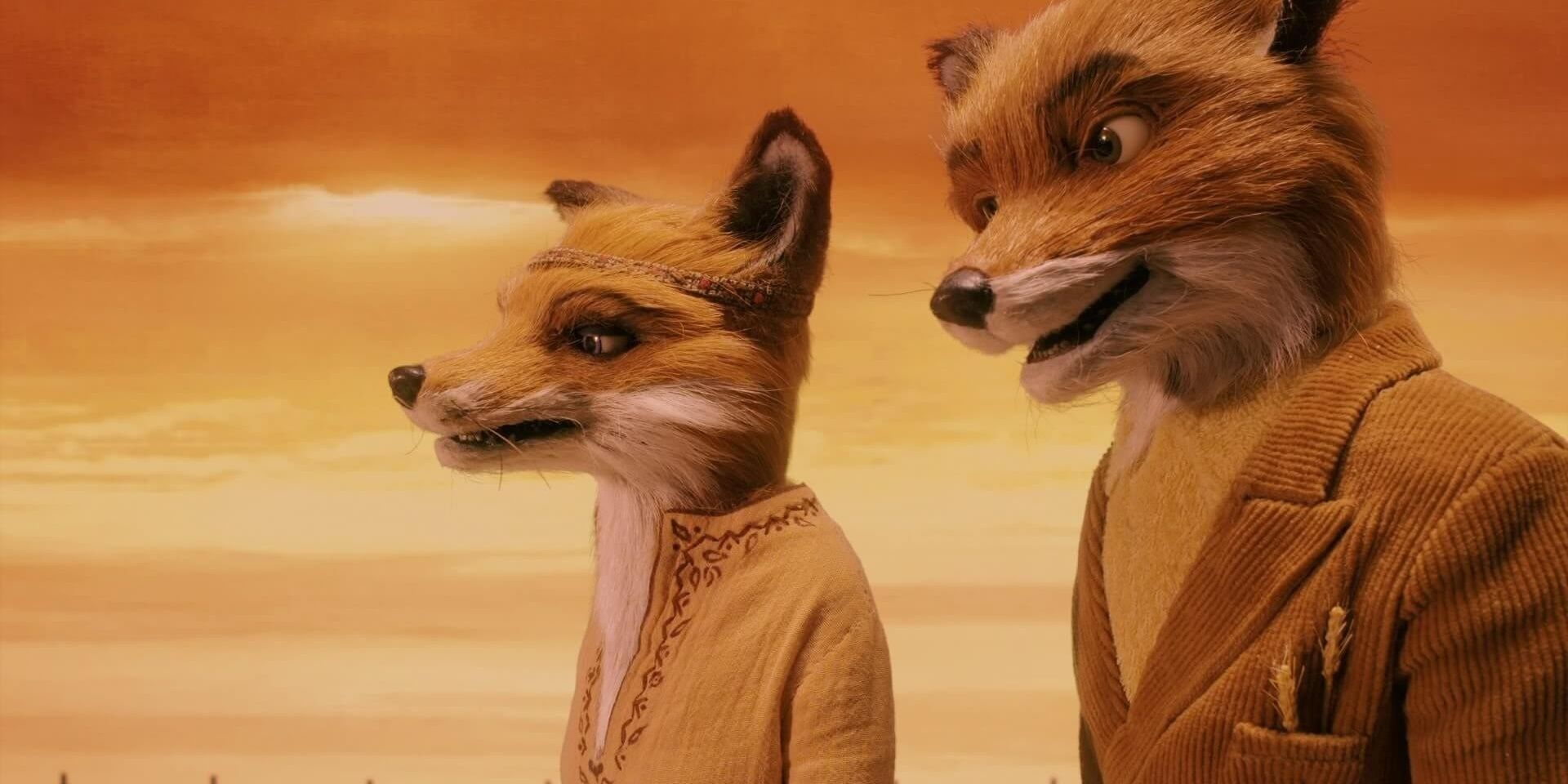
    The plot is centered around Mr. Fox, a charismatic fellow who conspires to steal chickens and cider from the three mean farmers Boggis, Bunce, and Bean. This course of action directly goes against the promise Mr. Fox made to his wife, that he would never steal chickens again and find a new occupation.

    Fantastic Mr. Fox: 10 Behind-The-Scenes Facts About Wes Anderson's Movie
    Colorful Animation Expressions: Fantastic Mr. Fox: The Book (1/5)

    Robbing Boggis, Bunce, and Bean has consequences. In response to Mr. Fox’s thefts, the farmers go to his home and try to kill him, shooting off his tail and blowing up his house. Mr. Fox’s choices backfire on him. His lavish life is short-lived, and his family is forced back underground. Rather than call it quits, however, Mr. Fox decides to escalate the situation and steal everything from the farmers. The rest of the movie is spent dealing with the fallout of Mr. Fox’s thefts.

    wes anderson title cards | Title card, Fantastic mr fox, Wes anderson

    Fantastic Mr. Fox has an interesting way of showing the audience the passage of time. Usually, there will be a title card with text displaying how much time has passed. The way time is counted, however, varies. Sometimes, the time is displayed in normal hours or days, other times, in a special passage of time the movies calls “fox time”. These differences in the way the passage of time is shown convey the animals’ perception of time and contrast with the humans’ perception of time. It’s a gentle reminder that no matter how anthropomorphic the animals seem, they are not human.

    The idea that their true nature is that of a wild animal and that they can’t escape their natures is an overall theme woven into the action. We see this struggle particularly in Mr. Fox. He always wants more out of life, the desire to not live underground, the desire to steal chickens. His internal desires drive the story, and his actions affect his relationships. When his son barely escapes the farmers when trying to steal back his tail, Mr. Fox realizes his child is emulating him to try to gain his approval at the cost of his own safety. In some ways, Fantastic Mr. Fox is about selflessness vs. selfishness, putting the needs of others before yourself or giving into your desires. Mr. Fox’s choices connect the events of the film and create continuity by giving a clear line of cause and effect in the action and the narrative of the story.

  • Narrative Form in Parasite

    When we watch a movie, we do more than just observe. We actively construct meaning by connecting events, predicting outcomes, and imagining what might exist beyond the frame. This makes storytelling in film an interactive process between the filmmaker and the viewer. This week’s readings on narrative form and narration emphasize that films create meaning not only through what they show but also through how and when information is revealed. Chapter 3 explains that narration is the method through which story and plot are presented to the viewer, shaping how the plot delivers the story moment by moment.


    It is defined that a film’s story represents the full chain of events in chronological order, while the plot is the filmmaker’s intentional arrangement of those events to control what we experience and when. After reading Chapter 3, I began to think about how films guide our understanding by controlling what we know and when we know it. I recently rewatched Bong Joon-ho’s Parasite (2019) and noticed how this dynamic structure is exemplified.


    As the readings explain, the story exists in our minds as a chain of events while the plot shapes how we experience it. Parasite’s story could be told straightforwardly as a poor family infiltrating a wealthy household. However, the plot of the film builds suspense by giving us information slowly through the eyes of the Kim family. Joon-hoo rearranges and reveals information in ways that control how we feel and what we know. Scenes are placed strategically to build curiosity and suspense. For example, at first, the Kim family’s plan seems clever and lighthearted. However, when the hidden basement is revealed, everything we thought we understood about the family’s actions changes. This rearranging of information keeps us engaged, encouraging us to connect causes and effects and to reinterpret what we have already seen.

    Techniques such as restricted narration and point-of-view (POV) shots deepen this process. The readings explain that narration determines whether we know more (unrestricted) or less (restricted) than the characters. Parasite relies mostly on restricted narration, as we often know only what the Kim family knows. The POV shot, as the readings describe, is a tool that allows us to see the world through a character’s eyes. Bong uses both of these to heighten tension and align us with the Kims’ limited perspective. For example, when Ki-taek peers out from hiding beneath the table, the camera mimics his restricted view, forcing us to imagine what lies just outside the frame. These moments emphasize that narration is not neutral, but rather it is constructed through selective framing and sound that guide how we process information.

    Narrative cinema is a collaboration between what the filmmaker shows and what the audience infers. Through its manipulation of story, plot, point-of-view, and other techniques, Parasite exemplifies that film is not something we simply watch, it is something we build meaning from.

  • Following the Trio: A Narrative of Fear and Uncertainty in Harry Potter and the Deathly Hallows (Part 1)

    While reading about narrative form and the cinema of attractions, I kept thinking about Harry Potter and the Deathly Hallows, Part 1 and how its slower pace and moments of spectacle make us feel the story’s uncertainty in a really visual way. Unlike the earlier Harry Potter movies, The Deathly Hallows, Part 1 slows everything down and narrows the focus. The film uses restricted narration, so we only see and know what Harry, Ron, and Hermione do. Because we’re limited to their perspective, we’re able to strongly connect to their confusion and frustration as they struggle to search for the Horcruxes. The long stretches of silence and constant wandering throughout the film make the narrative itself feel tense, almost as if the characters are stuck in time.

    The film also plays with the element of temporal order which further encourages us to put ourselves in the positions of the main characters. For example, the long and quiet forest sequences make the passage of time feel stretched out, and the use of flashbacks and dream sequences momentarily disrupt the flow of events. When Harry sees flashes of Voldemort’s movements through their mental link, we’re pulled out of the present moment and into his mind, which leaves us disoriented and questioning what’s real or imagined. These choices in narrative form force viewers to question what’s real, what’s memory, and what’s imagination, blurring the line between the past and present. It’s less about building toward a single climax and more about showing how time itself feels distorted when the characters are directionless while searching for Horcruxes the whole movie.
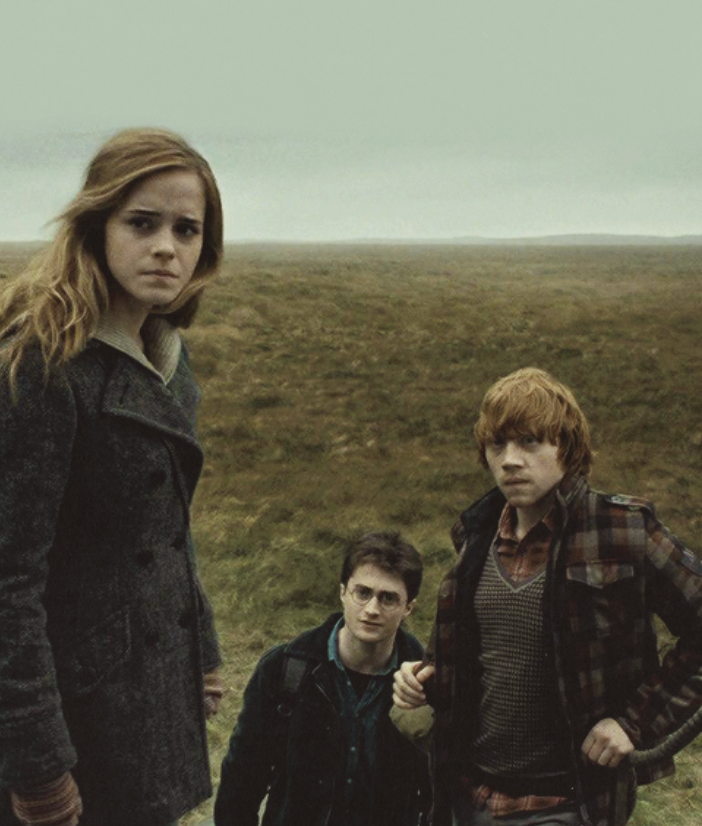
    Even with its slower pace, the film still has moments that support Tom Gunning’s idea of the cinema of attractions, which are scenes meant to astonish the viewer rather than just move the story forward. The Tale of the Three Brothers sequence, which is told through shadow animation, is a perfect example. For a few minutes, the film pauses the main narrative to tell a story within the story that’s visually striking and stylistically different from everything else. Considering that we only realize the tale’s significance later in the film, it feels like this pause invites us to watch for the sake of wonder before its deeper meaning clicks into place.

    Through the mixture of restricted narration, disrupted temporal order, and visually striking flashes, Deathly Hallows, Part 1 is a perfect setup for the battle to follow. The decisions in narrative form regarding time, perspective, and spectacle allow viewers to more deeply empathize with the characters and actually feel what it’s like to live inside a wizarding world that’s falling apart.