Blog

  • The Editing of Memento

    This week, we looked at how editing can change how a film feels through changes in rhythm, space, and time. Film Art refers to them as “relations” (rhythmic relations, spatial relations, etc).

    One particularly good example of a good execution of these techniques is Christopher Nolan’s Memento (2000). Based on Jonathan Nolan’s (Christopher Nolan’s brother) short story “Memento Mori”, Memento follows Leonard, a man with amnesia and short-term memory loss, as he uses polaroids, tattoos, and notes to find the man who assaulted and murdered his wife.

    Spoiler warning.

    The masterful editing is most evident through Dody Dorn’s (the editor) ability to manipulate temporal relations. For a film about amnesia, telling the story from start to end would be, as Jared Devin writes, “nothing interesting and…[lacking of] impact” (https://medium.com/@jdevin413/the-editing-room-memento-in-reverse-bd379b33620). Instead, this film is edited from end to beginning, working backwards through a series of black-and-white flashbacks and color lapses of memory for Leonard.

    Our perception of time and the film’s plot as a whole is altered by the editing because we’re suddenly thrown into Leonard’s situation. We don’t know the full picture, yet we’re barrelling ahead into the unknown. As the film progresses (backward), we learn more and more about the people around him, and how some characters aren’t what they seem. For example, Natalie is seen as a particularly benevolent character who is helping Leonard out of pity, but later on, it’s revealed that she’s taking advantage of his amnesia and manipulating him to do cleanup work for her late drug dealer boyfriend.

    Another way Memento manipulates temporal relations is through switching between color and black-and-white shots. When the color scene initially cuts to a black-and-white shot, we’re left confused as to why it happened. But as the film goes on, we begin to reach an understanding of what the color change is meant to signify – color means the story is going backwards, and black-and-white is going forwards. My favorite part of the entire movie is when the ending sequence begins in black-and-white, and halfway through, it seamlessly transitions into color, and you realize that the stories have converged.

    Another aspect I’d like to point out is how Dorn uses repeating actions (this could also be overlapping editing) in the film to help the viewers familiarize themselves with where they temporally are in the film. For example, one scene opens with Leonard frantically trying to find a pen to write something down. We’re not sure what he’s panicking about, and soon we forget as Natalie walks in. But in the next color scene, it’s revealed that Natalie is manipulating him. That color scene ends with him panicking to find a pen, which Natalie had taken out of the room. As jarring as this sounds, this film is able to transition between the two seamlessly. Dorn uses a variety of dissolves and fades to move between black-and-white and color snippets.

    All in all, this film is a masterpiece in both storytelling and editing. Nolan and Dorn are both so talented at hiding information from the viewer and foreshadowing future events that you will be on the edge of your seat for the entire movie. I wholeheartedly recommend you watch this film if you like psychological and/or thriller movies.

  • Editing and Kubrick’s Dr. Strangelove

    This chapter covers how editors can manipulate time, space, and emotion through choosing which shots to include in a film and how they will be arranged. Film Art discusses four different relations that could happen between two shots: graphic relations, rhythmic relations, special relations, and temporal relations.

    Graphic relations includes using contrasts or similarities between two clips; one example is making a graphic match which links shots by close graphic similarities.

    Rhythmic relations is characterized by using cuts of certain lengths to create a rhythm. Additionally, this technique uses different cuts to evoke different emotions, such as flash-frames; this is often used in action films as it stresses a moment and can elicit suspense.

    Spacial relations uses editing to establish and manipulate space. One example of this is the Kuleshov effect, which we talked about in class. This effect is used to reveal the emotion or intent of a character by showing a person and then the object they are looking at, allowing us to interpret what they may be thinking.

    Temporal relations shapes how the viewer sees time. For instance, a flash forward manipulates the chronological order of information the viewer gets. Additionally, editing can condense or expand the duration that a certain action can take. Elliptical editing can present an action as taking less time than it actually does, while overlapping editing can prolong an action.

    One specific type of editing than manipulates space and time is crosscutting, when the plot alternates shots of one story with shots of another one elsewhere. My favorite movie, Dr. Strangelove or: How I Learned to Stop Worrying and Love the Bomb, utilizes this technique very effectively. There are two simultaneous events happening during the film: the politicians and military deliberating in the war room, and the lieutenants in the B-52.

    The constant crosscutting creates suspense, as the people in the war room cannot communicate with the personnel in the B-52, unable to call them back to abandon their previous order to bomb the Soviet Union. Switching between these two simultaneous events, with each side holding limited information, builds tension for the viewer who can see the whole picture. We understand that if the B-52 successfully manages to bomb the USSR, it will activate the “doomsday bomb”, which will essentially wipe out all life on the planet. However, the people in the plane do not know that. Additionally, we see the B-52 evade getting taken down from Soviet airspace, but feel anticipation when we see that the people in the war room do not realize that until it is too late. Overall, I believe this film perfectly demonstrates how crosscutting can create suspense and highlight the motivations and emotions of two different places at once.

  • How do we make sense of the universe?

    Mark Levinson’s The Universe in a Grain of Sand (2024) stems from one of the most fascinating questions that has been asked throughout human history: how do we make sense of the world we live in? The documentary combines the scientific explanations from IBM researchers, technological historians, computer scientists, and more with the works of artists in all fields ranging from sculptors, experimental filmmakers, and even famous painters such as Van Gogh or Picasso. The small selection of extraordinary individuals in this film represent the expansive amount of human contribution to answering the question of what our place in this world is, and how to understand how journey in this universe. It truly puts the viewer through an existential crisis of sorts, but reminds them of their capacity to learn.

    Levinson takes science and art, two fields notoriously different from one another, and argues for their necessity to collaborate. Without science, we cannot create memory banks to capture human progress, and create tools to better our society and our intrinsic curiosity of the world. Without art, we cannot capture the deeply human emotions that we feel and express that to others, and connect in ways that even the most advanced quantum computers can try. The artists featured in this film would likely never have guessed their work to be shown alongside explanations of complicated physics, but it is quite beautiful to remember that art can never mean one thing, and the meaning of the universe has no one answer. As said in the film, who would have thought that the sands of the deserts thousands of years ago could have brought up to the world we live in today?

  • Usage of background sound in The Universe in a Grain of Sand

    I forgot to take picture of the scene I am describing here, but I think people who went to the screening will get which part I am describing.

    While watching, I noticed that often whenever a new period of description or a demonstration of artworks start, there often accompanied a sequence of background sound. For example, the use of guitar sound when introducing electrons and how they move, and the Jazz music that played along when discussing the modern usage of electrons in precise instruments.

    These sounds often brings my attention back to what the artists or researchers are discussing. Also, that sound that play alonged with interview make me less prone to loss interest when watching the relatively less interesting interview. In addition, it smooth transitions between sections that could otherwise feel discontinuous.

    In week 7, we are going to discuss about sound, and I think I might expand more on the topic after studying more in depth.

  • Universe in a Grain of Sand

    I did not expect to enjoy this film as much as I did. At first, I went in skeptical, but the more I watched, the more I was drawn in. Learning that the director had a background in physics definitely helped in giving me an extra layer of trust in the script, helping me be confident that the film was grounded in real thought.

    What stood out the most was the way that art was used to explore scientific ideas. The artwork wasn’t there for aesthetics but was part of the storytelling, a way to create tension and curiosity. This mix of art and science, and the film, really comes to life and makes me think of experimenting with how to see knowledge.

    Another thing I loved about it was that it took four years to make. That choice paid off because it allowed the story to capture the evolution of quantum computing from abstract ideas to the actual development of these computers in 2024. While the technology isn’t ready for everyday use, the film highlighted something about how creativity and imagination, even through art and nature, can inspire innovation and help us grasp concepts that might be impossible to think of out of the blue.

    In the end, I was pleasantly surprised by how seamlessly the film bridged these worlds. Science doesn’t only advance in labs and equations, but grows through the world around you and human imagination.

  • Why continuity matters?

    In chapter 6 argues that editing is not just a tradition, but it is a viewer-oriented tool. The directors use these tools to shape viewer’s experience by manipulating time, space, and pictural qualities. These techniques can decide how the film is ordered, transitioned, and presented to guide the audience’s understanding of the whole film.

    180 degrees system (axis of action).

    This technique fixes the camera placement to one side of an imaginary line on screen, so that the spatial relationships stay the same. This makes the audience able to understand how the characters are doing within a scene.

    Eyeline match.

    The eyeline match connects the glance into shot A of character A into shot B of character B. Because of the space it created through the 180 degrees system and the space created through the connecting look, we can sense how it builds space for us to see.

    Shot/reverse shot.

    This shot pattern alternates views from two ends of the axis, typically with two people, each shot can represent one person talking or their relationships.

    After reading chapter six, I would like to discuss it along with some shots of a film I watched recently called the Contratiempo, or The Invisible Guest.

    This scene is from the ending of the story, where Adrian and the fake Ms. Goodman are discussing where exactly Adrian sunk the car, and how he should respond to the court to not get caught and be in jail.

    This part starts with a side shot of Adrian’s face, then it went on to have the 180 degrees system in the apartment room.

    Then follows a close shot of Ms. Goodman (fake). At this point their line of view already started to come at one point, where they each star each other into the eye. Ms. Goodman (fake) is acting angry as a lawyer role for her client not cooperating, while Adrian is angry that Ms. Goodman always leads him to say things he hide inside his heart that “will be good for him on court”.

    Then it went to medium, over-shoulder shots that records their conversation. We can also see the shot/reverse shot technique used here

    The last part is a long shot, but still on the 180 degree system, with the two apart, suggesting their fate will not eventually come together, and the “Ms. Goodman” will not win her case on court.

    We see how the director used the 180 degree system to show their final conversation carried on, and how different camera positions on the 180 degree system is used to achieve different effect and feeling for the audience.

    In short, the scene use continuity to stabilize comprehension, and create a clear map of space, time and causality, so performance carries our attention. The filmmaker can modulate intensity of a clip and its meaning through editing, and make the dramatic logic work more fluently.

  • Jaws: An Exploration of the “Great White” Unknown

    When I walked into Emory Cinematheque’s viewing of the 1975 blockbuster Jaws, I braced myself for two hours of bloody waters and jump scares. What I did not realize was that I was about to experience a tale of manhood, pride, and the deep effects that fear can have on not only an individual but a community as a whole. I would preface the rest of this blog post with a spoiler warning, but it seems as though I am one of the last people to have not seen Steven Spielberg’s groundbreaking summer blockbuster, which I learned was a pioneer for the film marketing industry. Even my seven-year-old camper, who spent an entire lunch block describing to me the genius of John Williams, was surprised at the news that I had yet to see Jaws.

    I must admit, however, my reasoning for not having seen this film in the first place is quite ironic now that I have seen it, as it contributes to the greater purpose of Jaws entirely. In its simplicity, the film concentrates on the fear of what is not seen. The most obvious fear is the shark attacking the community of Amity Island, which goes unseen for a large portion of the movie.

    The strategic decision to make the audience see the early attacks from the shark’s point of view builds suspense and leaves the horror of the creature to the imagination of the viewer. The use of framing throughout the film to show the expansiveness of the ocean reminds characters in the film and viewers alike of the isolated nature of boat life, and instills a sense of fear when the shark attacks.

    The fear in Jaws is not exclusive to the terror below the surface. The mayor fears the uncertainty of his town’s success without the summer crowd, leading him to continue allowing Fourth of July operations. Quint was afraid of displaying signs of weakness, destroying a radio that could have potentially given the men help. The confrontations of these men, learning when their pride is hiding their fear, there are moments of vulnerability and progress. Viewers may not be able to resonate with the experience of being attacked by sharks, but they can understand the effects that masculinity has on the confines of society.

    When confronting my own fear, which admittedly is horror movies, I can see the reason movies like Jaws have resonated with millions for 50 years. I was surprised by not only the largely comedic tone of the film but also the depth of the character building. One audience member commented on how horror movies of the present day focus more on the scare factor and less on the world-building, making the deaths of their characters less impactful to the overall film. Quint’s monologue about his experience on the USS Indianapolis, crafted with a shallow depth of field focus, leaves viewers to mourn his death in a way that they may not have had Jaws been made in 2025.

    I must be honest, I likely would have never gotten around to seeing Jaws if not for Emory Cinematheque’s feature. I was luckily reminded that the possibilities of fears, even small ones, can halt us from experiencing iconic pieces of cinematic history. This was an enjoyable night at the cinema, but also a reminder to confront what is under the surface in life, as even great whites can be fought.

  • The Impact of Contrast in Jaws

    Last night, I went to the Cinematheque presentation of Jaws (Spielberg 1975). It was quite the experience, and I’m very fortunate that I was able to view it on the big screen. Jaws is a horror movie directed by Steven Spielberg. The story centers around the Chief of Police, Brody, as he attempts to find and destroy a Great White shark threatening the lives of the people on Amity Island. Throughout the film, lighting, sound, and editing work together to amp up the fear factor by creating deep contrast between scenes.

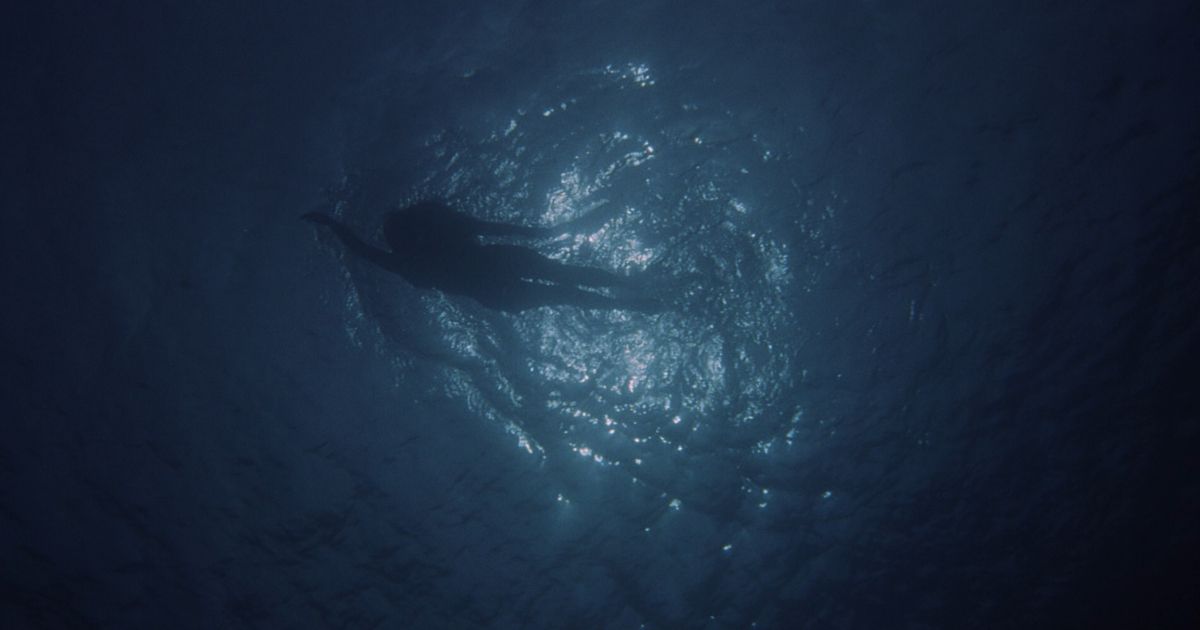
    The shots of the people on the beach use high key lighting, bright colors, and a cacophony of noise. In contrast, the POV shots of the shark moving underneath the water have a noticeable absence of sound, broken only by the “ba dum, ba dum, ba dum’ of John Williams’ score. The beach shots lull the viewer into a false sense of security. They let their guard down and relax. This established mood is what allows shark attack scenes to elicit a high level of fear. All of a sudden, the lighting is low key, the colors are dark blues, and the score grows ominous.

    jaws beach scene - Google Search | Cinematic photography, Beach scenes ...
    10 Thrillers with Incredible Openings Scenes

    This feeling grows stronger as the film goes on. The latter half of Jaws is filled with tension because the viewers can feel the absence of the Amity Island inhabitants. The characters are left alone with the shark out at sea. All sense of safety is gone and there is nowhere to run.

    Jaws (1975): The boat in which the main characters set out to hunt and ...

    Jaws was a hit summer blockbuster and won Oscars for Best Sound, Best Original Score, and Best Film Editing.

    What makes a movie like Jaws hold up so well in the modern day?

    Why do audiences like horror movies so much?

  • Chapter 5: Cinematography and its applications

    Chapter 5 provided us with a lot of information, as well as a lot of new vocabulary to help us look at film in a new way. My main takeaways fall under the categories Tonality, Perspective, and Framing.

    Under tonality, there are a whole bunch of concepts and practices regarding lighting and coloration, but I must closely held onto Contrast and Exposure.

    I know this example doesn’t come from a film, but I have known it for a while to be the epitome of contrast in an image. Back in high school theatre, we learned about good poster design and often referenced the poster for Broadway’s Wicked, primarily for the substantial contrast shown. It showcases two characters: Galinda (or Glinda), whose all-white design only touches Elphaba’s black costume. This white-on-black contrast makes the image so much more engaging.

    Here’s an example from Who’s Afraid of Virginia Woolf, which showcases rather low exposure. This comes near the end of the film, when the mood, given the previous chaotic events, is much darker than at the beginning.

    Continuing on this image example, the perspective shown appears to utilize a middle-focal-length lens. This avoids distortion at either end of the frame, while short-focal-length and long-focal-length lenses tend to distort the ends and obstruct binocular cues respectively. This image also showcases a certain depth of field. We see inside the house just fine, but, past the pole on the outside, the trees and background are blurred–outside of the given depth of field.

    I found framing to be the most interesting section of the reading. It deals a lot with how shots are taken through angle, level, height, and distance, among other elements.

    In Rabbits, by David Lynch, the framing often stays the same as its long, establishing shot, with slight reframing as characters move to the edges of the set. There are some exceptions to this, as seen in the below image:

    Being able to see the full set becomes unsettling after a while, as the viewer never knows what could pop out of any corner at any moment, but shots like these are even more off-putting. The height of the camera tends to be high like a security camera, but then we’re suddenly eye-level with creatures we’ve already labeled as volatile/potentially dangerous. Additionally, the duration of shots is extremely long, which draws out the creepy mood even more. Framing can truly fully frame the viewer’s experience as they peer into the world of the film.

  • The Female Gaze in Film

    In contemplation of Portrait of a Lady on Fire, I thought a comparison to another recent movie which demonstrates the female gaze could be useful: Greta Gerwig’s Barbie

    If the Male Gaze envisions women as sexualized objects of desire, then the Female Gaze sees women as full, real human beings, as complex individuals. In adopting the Female Gaze, a difficulty that arises is how to navigate nudity, sexuality, and desire on screen. Gerwig’s Barbie sidesteps that issue and decides to emphasize that women (and men) are complete individuals who are not defined by their sexual or romantic relationships. Ken, in an obvious reversal of typical gender structures, tells Barbie, “I just don’t know who I am without you” and “I only exist within the warmth of your gaze.” Ken also cited the way others define him as part of a pair, saying, “it’s ‘Barbie and Ken.’” Barbie challenges that construct, saying, “Maybe it’s Barbie and it’s Ken.”

    The happy ending of the movie isn’t the boy and girl getting together, it’s the boy and the girl learning how to stand on their own and be happy independently. When Ruth took Barbie’s hands to show her what it means to be human, none of the images in the montage depicted relationships between men and women. There were children, there was a women laughing, a woman playfully kissing her friend on a couch, a woman playing in a pool, a woman skydiving, bowling, putting on makeup, and there was even a brief shot of a woman in what appeared to be a wedding dress— but there were no men. The implication seemed clear to me: there is more to life for a woman than heterosexual romantic love. The way Barbie talked about becoming a human rather than a doll also sounded a lot like breaking free from the limitations of the male gaze. She said she wanted to make meaning rather than being the thing that’s made. “I want to do the imagining. I don’t want to be the idea,” she continued. With all this in mind, I think Gerwig’s movie is a powerful denunciation of the male gaze.

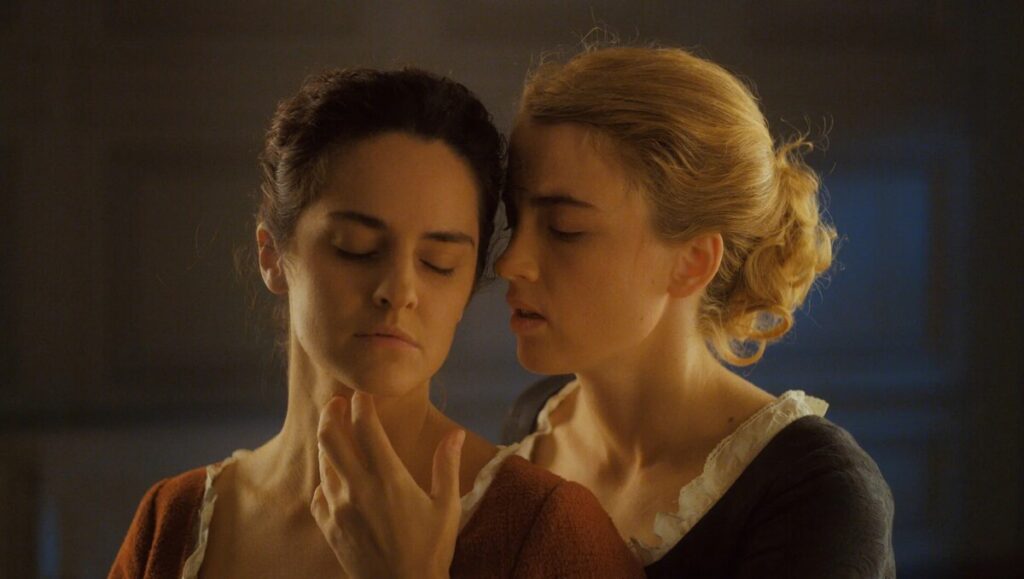
    I found the lack of nudity or sex scenes in Barbie refreshing, given film’s long tradition of stripping and sexualizing women under the male gaze. But Portrait of a Lady on Fire shows that that a film can maintain a feminist point of view and a female gaze while incorporating sexuality and nudity. The scene where Marianne sat naked in front of the fire initially worried me. It seemed unnecessary to have her be fully nude, and I wondered what the purpose was. She just sat by the fire, warming up, smoking a pipe— apparently at ease and comfortable in her own skin. I’m still not entirely clear on the point of this scene, but I suppose I appreciated that it showed her body outside of a sexual context. Putting this confusing take aside, I thought the way the relationship between Marianne and Héloïse was captured catered more to women than to men. The film showed their knowledge of each other and their emotional intimacy, and the more sexual scenes were slow, sensuous, reciprocal, and tender. The movie allowed both women to embody desire without degrading their agency. Actually, their sexual relationship seemed to be a powerful expression of their agency, as they seized upon a brief window of freedom and acted upon their own desires.

    In Barbie, the focus was independent identity and agency, and sexual desire wasn’t really dealt with. In Portrait of a Woman on Fire, a sapphic relationship allowed women to act upon their sexual desires in a way that enhanced their agency. After watching Portrait of a Lady on Fire, I wondered if there was a movie with both the female gaze and heterosexual desire as beautiful and feminist as Portrait of a Lady on Fire. No one movie title immediately sprung to mind. Is it even possible to fully realize the female gaze with a male-female relationship that may at some level always have inequality baked into it? I found this BBC article, “Top 100 films directed by women: What is the ‘female gaze’?,” and maybe there is such a movie listed therein— it bears further investigation! I hope my classmates might also enjoy pursuing this list! https://www.bbc.com/culture/article/20191127-the-100-films-directed-by-women-what-is-the-female-gaze