Mise-en-scène, literally “putting into the scene,” drives the narrative of a film. Through the director’s arrangement of lighting, costume, makeup, and staging, filmmakers construct not just an image but a framework of meaning. This arrangement guides the viewer’s interpretations, often hinting at thematic shifts that words alone cannot. Mise-en-scène serves a dual purpose: it makes the film’s world feel real and familiar, while also shaping it into a visual language that expresses more than everyday reality.
Jean-Pierre Jeunet’s Amélie (2001) exemplifies this idea. The film’s vivid colors, filled with rich reds and greens, make Paris feel less like a real city and more like a reflection of Amélie’s imagination. While many of the Montmartre street scenes are filmed in real locations rather than constructed sets, the color palette is carefully manipulated: saturated reds, greens, and golds heighten the quirkiness and whimsical tone, turning ordinary streets, cafés, and alleyways into an expressive, almost dreamlike environment.
Even the photo booth, for example, is used as a strategic prop; the discarded photo strips serving as both narrative clues and visual motifs that reinforce secrecy, playfulness, and the possibility of intimacy.
Costume and makeup further enhance this visual storytelling. Amélie’s striking black bob, paired with her pale skin and subtle makeup, emphasizes her whimsical nature. The hairstyle draws attention to her expressions, making her reactions central to the narrative and reinforcing her sense of individuality within the stylized Parisian world.
By placing such an emphasis on visual style, Jeunet stretches the expressive power of cinema, showing that meaning can emerge as much from images as from words or action. Yet this stylization also comes with complications: does the film’s look tell its own story, separate from the plot and dialogue? When a movie is so carefully constructed visually, do we find ourselves paying more attention to the images than to the characters inhabiting them?
Mise-en-scène – the art of presenting a scene to the audience. There are five components that make up mise-en-scène: lighting, composition, costumes, setting, makeup, and staging. There are hundreds of individual ways to illuminate your stage and therefore evoke certain emotions. It consists of quality, direction, and source, and color also plays a big role when shaping the atmosphere. When reading chapter 4, I was amazed by the focus put on lighting. And as the text states: “No component of mise-en-scène is more important than what Sternberg called ‘the drama and adventure of light’” (p. 132). But is light really the most essential aspect of mise-en-scène? Isn’t every element of great importance? Perhaps sometimes more weight is placed on lighting, in another case on staging, and in yet another on framing.
As an example of how mise-en-scène can create fear and unease, I want to look at a scene from my favorite movie – Stanley Kubrick’s The Shining. In this sequence, we follow Danny riding his bike through the corridors of the Overlook Hotel. After riding for a while, he suddenly stops after turning a corner and sees two girls standing at the other end of the corridor, staring at him.
For the setting, we have the long and symmetrical hallway. The camera is centered behind Danny, focusing on the motionless twins at the far end of the corridor, who are staring at both Danny and the camera. Furthermore, the emphasis on the girls is enhanced by all the vanishing lines leading to them – our eyes are naturally drawn to this point. This setting evokes an uncomfortable and claustrophobic atmosphere.
The two girls are both wearing old-fashioned dresses, making them appear ghostly and implying that they belong to another time and should not be in this hotel. Additionally, the light-blue color of their dresses match the darker blue carpet and the white/light-blue walls. This suggests that the girls are, in fact, part of the Overlook Hotel (which they are, if you haven’t seen the movie or read the book) and therefore personify the horrors that have happened in the past. Through the color scheme, they visually merge with the hotel. In contrast to them, Danny is wearing a bright red sweater.
The top lighting, the source of which is part of the set design, also contributes to making the scene frightening. It comes straight from above, is harsh and cold, and creates an unpleasant feeling.
I would argue that the composition, setting, and choice of costumes are the most impactful aspects of mise-en-scène that make this scene terrifying. Of course, lighting also supports this feeling, but I can imagine many different lighting arrangements that wouldn’t diminish the sense of unease created here.
Do you agree with me, or do you think I underestimate the impact of lighting in this scene?
Nowadays when we watch a film in a theater, or on Netflix or any other media published for public access, they are likely a finalized, polished version that could not have existed without the efforts of a team of talented filmmakers. We are fully immersed in some actors’ emotional expressions, certainly aware of some of its music, and are constantly being driven by our own expectations towards what will happen next. However, we might not have fully appreciated how the actors’ clothing and makeup aided their expressions, how computer technology adjusted the color scheme of the film, or the dozens of lighting that might have been used for the effects of a single shot. What is all that happened behind the scenes that eventually enabled us such wonderful, enjoyable viewing experience?
The answer to this question lies in mise-en-scène, which, originated in French, means “putting into the scene.” This includes all the elements that work towards the harmonized end result that aligns with the director’s vision and is powerful enough to resonate the audience. 4 main pillars describe mise-en-scène: setting, costumes & makeup, lighting, and staging.
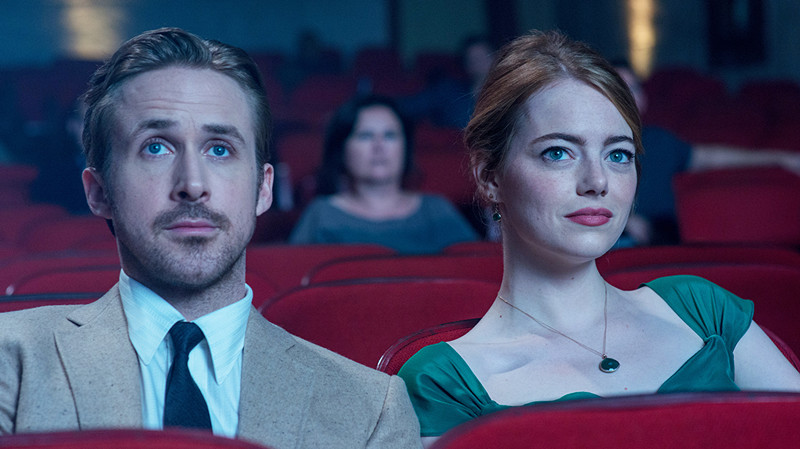
La La Land Photo: Dale Robinette
Do digital technologies in film production encourage bolder mise-en-scène? Or does it risk contradicting with the physical principles of reality? In each fundamental element of mise-en-scène, we seem to find evidence of technology, such as simulated lighting, CGI’s (computer-generated imagery) motion capture, and color grading, etc. Indeed, their usage greatly improved film qualities, but would it happen to be that more and more productions treat raw footages less importantly because “we’ll fix it later on computer”? It potentially could be the case, but for filmmakers treating their works seriously and dedicated to perfection, technologies should not at all be harmful.
A major part of technology use in mise-en-scène is accounted by lighting, which is also a major aspect of film that a lot of people would under-appreciate, probably because it is so intricate and natural that it becomes a neglected part of an image. However, the truth is that lighting is crucial to every scene we see in a film, contributing to character features, emotional delivery, and contrasts with surrounding objects.
The most basic arrangement of lighting could be the traditional three-point lighting, which includes at least a key light, a fill light, and a backlight. Key lights are usually placed directly in front of the actor, functioning as the primary light source that enables us to see their features. A fill light, which is an assisting light source that weakens the shadows created by the key light while softening the actor’s features would possibly be placed at a position near the camera, directed diagonally against the actor. Lastly a backlight would come from behind and above the actor, to lighten up the setting and surrounding features.
Visual by visual education.comWarner Bros.
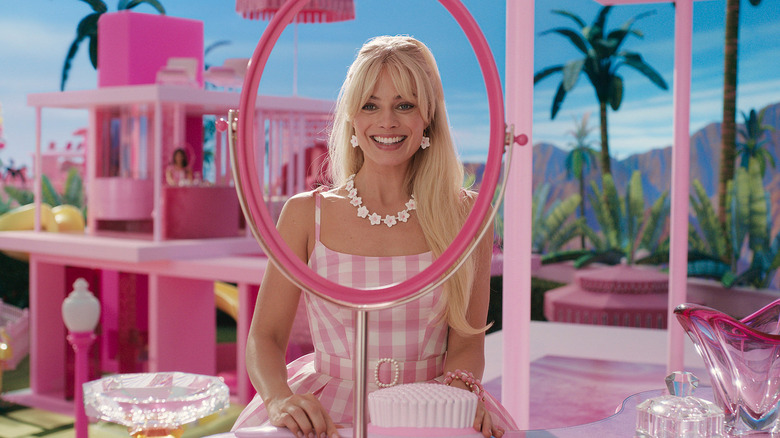
For example, in Greta Gerwig’s Barbie (2023), we see the use of three-point lighting in the fictional, idealized Barbie Land. The “sun” functions as the backlight, as evidenced by the glowing edges of Barbie’s hair. Yet, we still see Barbie’s face softly because of the fill light, and eventually bounces off her bedroom and other vibrant set pieces. Such lighting creates an overall bright, cheerful, and shadowless environment, which demonstrates the concept of high-key lighting. High-key lighting uses fill light and back light to create relatively low contrast between brighter and darker areas.
Apart from lighting, setting, costumes & makeup, and staging are also involved with technology in today’s film production. Softwares are able to add features to characters’ faces. For instance, in Dave Gibbons’s Watchmen (2009), a digital simulation of ink that flows through the superhero Rorschach’s face was imposed during postproduction.
Dave Gibbons’ Watchmen (2009)
The existence of such technology expands the possibility of film, and somehow changes the goal from appealing to realism into allowing for fantasy and fictional elements. When the technology strengthens lighting, rehearses blocking, and emphasizes coherent prop motifs, it expands what a filmmaker can stage. However, if it tempts a “we’ll fix it later” mentality, it’s probably getting in the way, despite it is true that a lot of productions were limited on budget and time such that technology becomes a convenient method to reach towards the ideal effects.
This past week’s reading on Mise-en-Scene was a revealing explanation of the components that are brought together in film. While it may seem common sense that there is thought put into costumes and makeup, setting, lighting, and staging of a scene, it is fascinating to read how they all intertwine to set a tone for the audience. Mise-en-Scene can also be utilized to contribute to the form of a film, such as when a film’s motif is seen through Mise-en Scene. An example of this would be the red coat in Schindler’s List (1993), a film otherwise entirely in black and white. It is up to the viewer’s interpretation of how the Mise-en-Scene can be used to shape the form and meaning of a film, but it still does have a large impact.
One example of Mise-en-Scene that came to mind when reading was the monochromatic color design of But I’m a Cheerleader (1999). Throughout the film, which takes place at a fictional conversion camp, the set and costumes are obnoxiously pink or blue.
The perfectly pink world of this conversion camp filled with bright props of common chores of a stereotypical mother in a nuclear family. It looks nothing like a real household, and the design of it contrasts the hair and makeup design of the women living in it. Furthermore, the brightly lit rooms of the camp, likely created by a key light and fill light, are starkly contrasted when the members of the camp leave and go to a bar where they can be their truest selves.
In this bar scene, the stark change in costuming and lighting is immediately noticeable. The use of low-key lighting highlights how different this setting is from the uncanny conversion camp, and reminds the viewers that this is a safer, quieter space for the characters on screen. There is no pink to be seen, the characters are able to be their truest selves in this scene. Mise-en-Scene is a vital tool throughout But I’m a Cheerleader to satirically comment on the construction of gendered norms in society and call attention to the artificiality of conversion camps.
Has anyone else who read about Mise-en-Scene thought of a film they had watched in the past that utilized excellent Mise-en-Scene that they may have overlooked beforehand? I also wonder if there is a scene that comes to mind that could have been enhanced with a better concentration on Mise-en-Scene?
The cycle of natural decay is both materially enacted and mirrored in the making of Jennifer Reeves’s Landfill 16 (2011), which takes up the idea of recycling, waste management, and the death of film. Reeves buried 16mm outtakes from her double-projection celebration of the natural world, When It Was Blue (2008), in a homemade landfill in Elkhart, Indiana. She then gave the exhumed film new purpose, hand-painting the corroded and soil-stained frames. The resultant imagery scans as densely textured terraforms, like pebbled plastic covered in mold. No photography was required to re-animate this celluloid originally consigned to the literal scrap heap. Images of animals briefly appear—a deer, an eagle, an ominous black widow—all barely recognizable through the garbage-battered frames, and seemingly buried under the decaying and dirty film. With its foreboding score, which mixes bulldozers, nature sounds, factory noise, and a trapped bird tweeting in pain, Reeves addresses not only the ways in which the media of analog moving images is literally and metaphorically being disposed as it approaches its industrial obsolescence, but also the disastrous environmental consequences of modern life.
Brimming with alternatively mottled and lapidary images, Landfill 16 pulses like living thing, a horror film about, to use Jussi Parikka’s phrase, “zombie media”—here, discarded moving images coming back to life, deformed. And while she never conceived the work as a collaboration per se, Reeves acknowledges the way the project represents a conjoining of forces that includes, she says, “the world, her thinking mind, and her spiritual muse….I had a feeling it wasn’t all me…that something else was at work.”
Furthermore, Reeves’ work illuminates a politics of process. It does not merely exhibit political engagement through content, but also describes a mode of deeper philosophical inquiry regarding the role and positioning of humanity vis-a-vis the world through methods of production. Landfill 16 demonstrates that how things are made matters, and that making carries ramifications for how we think about and conduct ourselves in relation to other people, objects, and things. Art therefore provides a useful model for broadening our approach to thinking about the nonhuman, about the limits of authorship, and about attributions of agency. Works like Landfill 16 show that when we decenter the human, that when ego gives way to an “at-oneness with whatever,” we ironically gain a better sense of humanity’s place in the world.
Plants, insects, and people all die, but cinema lives, every time it is played. Is dead/is dying.; a reversal of time, a reversal of nature itself. This is what cinema can do—change time, change the way things look or appear, open us up to new kinds of sight, new kinds of visions.
All photographs carry an indexical relationship to their referents—Roland Barthes notes that he “can never deny that the thing has been there.There is a superimposition here: of reality and of the past” (Camera Lucida, 76. Emphasis in original). Barthes labels this persistent presence of the referent the essence of photography and the “That-has-been.” How does this change when there is not a camera?


![Three-Point Lighting Ideas for Portraits [with Lighting Diagrams] | Visual Education](https://cdn-bjpdk.nitrocdn.com/dyjDRTumiVVFLKEpXMADzKdEUUbypNrL/assets/images/optimized/rev-142a2bb/visualeducation.com/wp-content/uploads/2019/06/Three-Light-High-key-flash.jpg)