While watching stranger things over the break I heard them say that the wiz was a flop. In my childhood it did numbers and I constantly rewatched it on DVD! Diana Ross and Michael Jackson in one movie you would think that it would be a success.
It is said that the expenses of the movie did not out do the ticket sells in the box office. The pacing and the unique style of the movie turned dozens of movie-goers away including the casting of Diana Ross due to her age. Dorthy is famously known to be a young teenaged girl. Which another actress Stephanie Mills had already been playing the role on broadway. She was originally in mind for the role, but was over looked by Diana’s star power and connection to get Michael to join the cast.
I have included a article by Luke macy sharing the critiques made about the movie! It truly is an interesting read of movie critic Robert Ebert having an opposing view to the general public.
Interesting how much the publics view can make or break a movie. Even though it didn’t get as much love in the 80’s, it is now considered a Cult classic and even mentioned in the #1 rated Tv show on Netflix in 2025!
As I went in to watch RRR, I was expecting to see a fun action movie, which it was in some parts, but it was also so much more. It felt bigger, louder, and more emotionally direct than most blockbusters I have seen, completely open about its political purpose. The New Yorker review I read points out that “blatant is better than insidious” when it comes to political filmmaking, and I completely agree after watching this. RRR never hides what it is trying to say. It embraces its message of resistance, unity, and national pride with over-the-top energy, and that makes it more honest and interesting compared to other movies that try to slip politics in quietly. The article also explains that RRR “turns history into legend,” which is exactly how it feels. The story is not meant to be accurate, but instead takes the real history of colonial oppression and brings out the emotions behind it so strongly and obviously that the message can’t be ignored. At first I thought the exaggerated fight scenes and the personality-heavy villains were too unrealistic, but after reading the review, I agree with the idea that the exaggeration is the point. It shows the intensity of the struggle artistically rather than telling a more literal version of it.
What stood out to me most was the way RRR mixes its political intensity with pure, wild entertainment. The feral action sequences, huge dance numbers, and dramatic plot twists keep the movie fun, but they also work to reinforce its message about resistance and perseverance. The review calls the film “giddy, exhilarating hyperbole,” and I think that captures the spirit of it exactly. In the end, RRR works because it refuses to tone anything down. It breaks out of the boxes that other action movies are inclined to stay within. It is emotional, loud, and confidently extravagant. Even though so much of it is unrealistic, the feelings behind it come across as completely genuine. This blend of fantasy and raw emotion is what will ensure that I will never forget the film.
This week, I revisited Baahubali in light of my earlier conversation about RRR and the troubling politics in the work of S. S. Rajamouli. I found a critical essay titled “The Problem With Baahubali’s Casteist, Supremacist Logic” in The Quint that argues the film normalizes hierarchy and caste-based supremacy. The writer claims the film portrays its fair-skinned heroes and heroines as civilized defenders of order, while dark-skinned tribal villains evoke “savage” barbarism. That contrast signals a clear racial and caste gradient embedded in the fantasy world. The article helped me see how spectacle and visual design in Baahubali do more than create fantasy: they reinforce a social order that treats inequality as natural.
The critique points out how the “tribal” Kalakeyas appear as monstrous, dark-skinned, and “other,” while protagonists align with Aryan-supremacist tropes. The film reportedly uses a harsh invented language for the Kalakeyas, modeled after Tamil, to imply primitiveness. Even female characters like the warrior heroine and the queen mother end up having their power defined by caste or by their role in supporting male lineage. Watching Baahubali again with this context made me realize how visuals, casting, and narrative all shape viewers’ sympathies toward “civilized” rulers and away from the “barbaric” outsiders.
The article does not engage much with the economic or production-side politics behind Baahubali, though that would be a valuable angle. Still, as someone from a Telugu background who has admired Rajamouli’s films for years without noticing casteism, I find this critique important. It provides a lens to question what I once accepted as mythic or heroic spectacle. After our class discussion of RRR’s politics, this piece shows that Baahubali too deserves scrutiny: behind its grandeur lies an inherited hierarchy that cinema packages in the name of myth and entertainment.
Hope that got your attention! Have you ever noticed someone on campus for the first time and then, suddenly, you keep seeing them everywhere? Or maybe you’ve noticed a specific number once, and afterward it seems to appear constantly. If so, you’ve experienced the Baader–Meinhof phenomenon, also known as the frequency illusion, which Psychology Today describes as a “cognitive bias in which someone learns a novel word or concept—and then ‘suddenly’ encounters it everywhere.” That phenomenon is essentially what I’m experiencing, but with every piece of media I consume.
Film and media have always been interests of mine since childhood. I used to beg my parents to take me to the movies, even though I wasn’t allowed to go out on school nights, and I would stay up late watching the behind-the-scenes features of almost every Disney Channel show released between 2002 and 2013. Without doing much analytical research on filmmaking, I assumed all that behind-the-scenes content I consumed would somehow turn me into a great movie critic. Combined with my growing passion for cinematography, cameras, and the evolving world of content creation, I truly thought I knew everything there was to know, not just about watching movies, but about eventually creating one of my own.
That belief remained strong until I took this class. Taking the time to read Film Art every week and diving deep into various genres has made me view all upcoming blockbusters in a completely different light. Movies I’ve watched in the past now feel changed when I revisit them with this new perspective on viewership. Even the slightest bit of cinematography I see in a TikTok or instagram post has me questioning the mise-en-scene of it all.
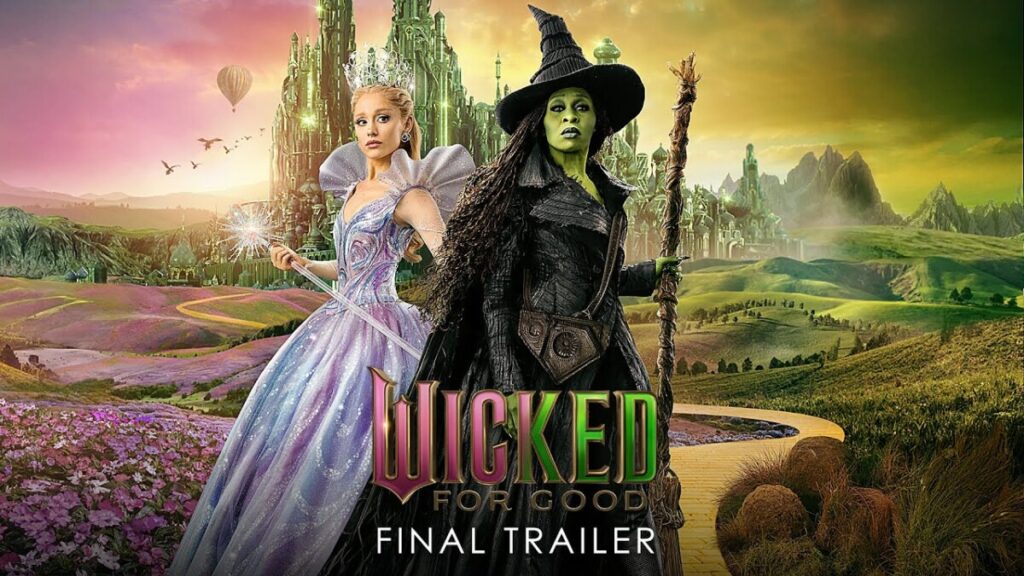
An experience that I had recently that reinforced this phenomenon was my when I watched the movie Wicked: For Good. Having studied the elements of a musical along with the mise-en-scene from Dancing In The Rain, I spent a good chunk of the movie hyper focusing on the costume choice, dialogue, and various whip pan transitions of Elphaba screamign about Fiyero while flying around Oz on her broomstick. In that moment, I realized how much this class really reshaped how I engage with storytelling. Every film, every scene, every quick-cut TikTok suddenly feels layered with intention, style, and technique that I never would have noticed before. The frequency illusion has ultimately enriched the way I see things, and while a part of me misses having the ability to watch things “just for fun” I’m grateful that I’m now able to analyze the craft I’ve had a passion for. The lessons taught within this course have shown me the artistry and patience woven into every frame, upholding the child in me.
To be honest, I didn’t love this movie as much as I thought I was going to. With 96% on rotten tomatoes, and over a 4 on Letterboxd, I thought that I would walk out of this movie thinking it was one of the best films I’d ever seen but instead I left with the ultimate consensus that I do not like action movies and some questions. After reading this article, I began to wonder how the writers thought including a love story subplot between the woman holding Malli captive and the man trying to get her back was a good idea. This film constantly is pushing this anti colonial message with both main characters fighting against the oppressive system they are in in their own ways, however during Rams revolutionary fight, he catches feelings for the woman holding Malli hostage. What made it harder to watch was the fact that they didn’t even speak the same language and there were countless scenes of her just talking..at him. He would frequently respond that he couldn’t understand her at all but she would keep talking, it was honestly sad. It felt like she caught those feelings because people don’t really listen to her so she enjoyed having someone who was “listening” to her. This article explores the dangers of watching this movie with a close eye because of the political issues within it that someone with no context would totally miss. It brought to my attention how violence is used in this movie, it makes note of the fact that when British characters are hit it is cartoonish and doesn’t have nearly as much realism as the violence against Indians, while also noting the hints of Hindu nationalism within the film. Overall, this article begs watchers to pay attention to the history and politics in India and pay attention to the messages being shown throughout the movie instead of just simply watching it.
While watching the film, viewers are taken on a rollercoaster of emotions. The two protagonists’ relationship keeps us in suspense. They start as friends, but we know that conflict is looming between them because of their opposing views. Indeed, they become enemies, but in a shocking reversal, they put aside their differences and become friends again. The movie definitely pulled on my heartstrings.
An article about the ethics of the film by Alex Woodson talks about how different people view the movie from different perspectives. Symbolism is lost for those who do not know much about Indian history/culture. Alex Woodson argues that clothing, flags, names, and locations are “all packed with symbolism” that can be interpreted as suggesting Hindu nationalism. The author of the article mentions that it is hard to understand the details about the inner struggles that were going on during the time. People in the U.S. may not fully comprehend the conflict between the two religious groups, Hindu and Muslim. The director of the film addressed the political topic while bringing entertainment through comedic stunts and supernatural action scenes.
Woodson’s article questions the selection of leaders who were shown at the end of the film. This list of figures did not include any Muslims, which could be interpreted as a political minimization of the role of Muslims in the Indian political struggle for independence from the British Empire.
Woodson points out the use of violence and blood in the film. He mentions the scene where blood splashes on a map with the words, “The sun never sets on the British Empire.” This scene is very symbolic, seemingly going against a non-violent stand that Mahatma Gandhi (who was not depicted in the movie) had on the struggle for independence in India.
In a New Yorker interview, the director (Rajamouli) states, “Entertainment is what I provide.” Rajamouli claims that he is averse to any extremist position, while at the same time stating that he “hates” extremism, suggesting that he is more extremist than he wants to portray himself as.
Throughout the interview, Rajamouli tries to defend the political implications that critics state the movie implies. He says that he did not think that the movie would be interpreted as a “Hindu nationalist fantasy.” He states that he just drew on his subjective views, mentioning the historical figures he admired when he was little. He keeps reiterating that the movie’s purpose was entertainment, not a political statement. The issue is that the movie has reached millions of people and is highly influential, affecting the beliefs of people, so the director has a responsibility for more equal inclusion and representation.
Rajamouli states, “American audiences are looking with fresh eyes.” They may not have seen his previous movies as Indian audiences have, so they were probably less expectant of big action scenes. This seems to be a contributing factor to why the movie was such a big hit globally.
I was amazed by the visual effects in many of RRR‘s scenes. There was a particular feeling of grandeur that almost reminded me of a CG Lawrence of Arabia, and I was curious as to how Rajamouli’s team achieved this look. I found both a video going through the visual process and an article discussing it.
Animatrix, a visual effects company, helped with camera tracking in the film. Motion capture supervisor Ben Murray emphasizes that “it always ends up looking better when you combine real action with CGI, rather than relying entirely on the computer generated side.” You can see this blend clearly in the video with a mixture of sets, props, and green screens which are overlayed with CGI. The computer imagery is largely used for the animals, objects in a path of destruction/objects that are destroyed, and backgrounds to achieve a look of grandeur.
This is not from my imbedded video but I thought it was funny
Murray also talks about how Animatrix used NCAM which makes it possible to see CGI while filming, leaving less chance up to post-op. This is used in large Western blockbuster films such as Warner Bros films as well as for sports games like Fox Sports. It makes sense that this production, with its level of CGI, required this kind of technology.
NCAM
“Our aim is to revolutionise augmented reality and real-time visual effects. This is why our technology is so unique. Our patented camera tracking is able to continuously stream data to industry standard graphic engines, resulting in the photorealistic and immersive integration of virtual assets. The versatility of our design means you can use Ncam across multiple applications and interchangeable configurations.” -Nic Hatch, CEO of NCAM
When I watched RRR, I didn’t realize that the film reproduced an upper-caste Hindu nationalist fantasy aligned with contemporary Hindutva ideology. By reading the Vox article, I noticed that both protagonists, Raju and Bheem, are portrayed in ways that make Raju seem the educated, visionary savior and Bheem shown as emotionally driven and illiterate “noble savage.” I learned that many popular films are made by upper-caste directors and actors, not confronting the caste system issues in society. I wanted to search if any films actually criticize this nature of Indian films relying on upper-caste “savior” narratives.
This article from Hindus for Human Rights examines how the Indian caste system continues to shape popular cinema. It first explains that caste is not just a historical phenomenon but a living structure that still affects education, economic opportunity, policing, and social mobility. The article highlights how Indian films have historically avoided directly confronting caste or have softened it through romance and nationalism to avoid criticism.
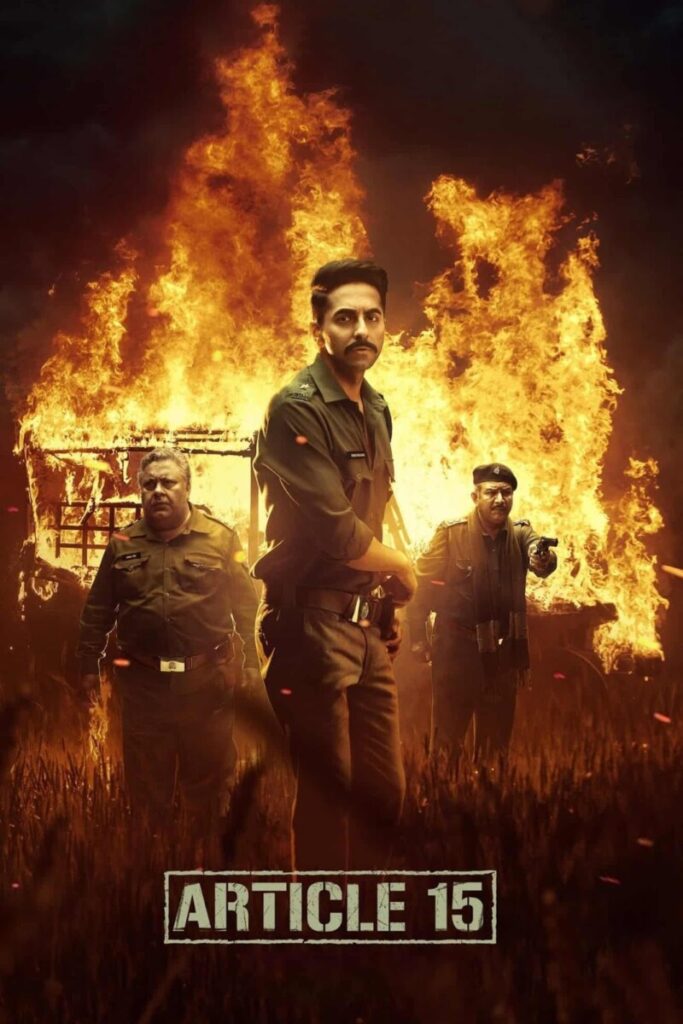
It then contrasts older films with more recent works like Jai Bhim (2021), which directly depicts caste-based police violence against an Adivasi family, and Article 15 (2019), which addresses caste discrimination but has been criticized for relying on an upper-caste “savior” protagonist. Through these examples, the article argues that cinema can either reinforce or challenge caste hierarchies by centering the voices of marginalized communities.
This source is worthwhile because it provides a clear framework for analyzing how caste operates in the film industry. I think this is useful for our discussion of RRR tomorrow because it helps identify whether a movie truly centers marginalized voices or instead reproduces an elite-savior narrative. Since the article is written by a human rights organization, its perspective is strongly activist and critical, but that also makes it effective at questioning films that appear progressive on the surface while remaining politically limited beneath the surface.
It is an unfortunate fact that we as a society have stopped going to the movie theaters as much. With the introduction of large-scale media streaming on platforms such as Netflix, Disney+, HBO Max, etc., there is simply less incentive to go to a movie theater when there are plenty of accessible options at home. These companies, now with their dominant influence in this revolutionized industry, have begun to produce their own movies that will go straight to streaming rather than traditional cinematic screenings. Now, as Professor Zinman brought up on Monday, it is important to acknowledge that these companies like Netflix are NOT filmmaking companies, they are tech companies. When a big business like Apple or Amazon takes over the production of a movie, it begins to feel like an advertisement instead of a creative work. When the discussion of this tech-takeover was taking place on Monday, I could not get the recent Amazon Prime exclusive, War of the Worlds, out of my head.
Check out this clip:
This is a real scene in this movie. The product placement is absolutely ridiculous in War of the Worlds. A man risks his entire life for a 1000$ Amazon gift card, there is a scene of the main character ordering a USB drive on the Amazon website, and Devon Bostick’s character is literally just an Amazon delivery driver. In the broader narrative of this movie, the Amazon company essentially saves the entire world. This movie just feels like an hour and a half long ad. What’s funnier is that the producer of War of the Worlds, Patrick Aiello, denies any sort of Amazon product placement in this movie. (https://www.msn.com/en-us/entertainment/news/war-of-the-worlds-producer-insists-there-isnt-any-product-placement-in-the-widely-panned-reboot-we-never-intended-for-amazon-to-release-the-movie/ar-AA1LrATe)
Overall, it is very important to recognize and appreciate the artistic value that comes from an authentic movie producer like Warner Bros or 20th Century Studios. As previously mentioned, movies coming from large tech companies often do not receive theatrical release and go straight to streaming. This practice is a large factor in the modern decline of theater-going. To keep the love of movie-going alive, keep this message in mind.
While looking into the history of RRR, I came across a Reddit post that caught my attention and intrigued me:
The user, Fragrant-Strength482, discussed how the “over-the-top action, melodrama, and larger-than-life storytelling” is a norm in Indian cinema. From his point of view, he didn’t get why this film became the one everyone in the West suddenly cared about, especially when he thought there were other Indian films that were better. That got me thinking: why did RRR click with Western audiences?
To me, RRR feels like a three-in-one package. It is part action film, part musical, and part bromance. I enjoyed the film because it never felt too serious. Even though it deals with a serious topic like colonialism, it still manages to have fun with itself. The film is loud, colorful, emotional, and dramatic, and somehow all of that works to deliver a message.
New Lines Magazine dove deeper into understanding why the film resonates with American audiences. The article quoted Telugu film critic Hemanth Kumar C.R. who explained that, unlike many Marvel and DC heroes, who often seem tired or cynical, the characters in RRR are full of life and excitement. Their friendship is the heart of the movie, and the story jumps from action to romance to drama at a speed that surprises people who are not used to Indian filmmaking. That mix felt fresh and exciting for Western audiences who do not usually see movies done this way.
Additionally, there were also outside factors. People Magazine discussed how, after the pandemic, viewers wanted movies that were fun and thrilling. RRR delivered exactly that. The movie was also easy to access on streaming platforms such as Netflix, which helped it spread quickly. This caused the film to gain popularity, given that someone would watch it, get hooked by one of the wild scenes, and immediately tell other people to check it out.
Ultimately, RRR did not just stand out because it was different. It became popular because it reminded audiences that movies can be huge and energetic while still being emotional and enjoyable to watch.