Blog

  • Is this the right thing to do?

    Do the Right Thing is a film about idols. In this case, especially those who share the same skin color as the person looking up to them. Sal clearly reveres Italian Americans like Sinatra, Al Pacino, and De Niro. Smiley looks up to Malcolm X and MLK. Mookie seemingly is a fan of Brooklyn Dodgers player Jackie Robinson and the white byciclist who bumps into Buggin’ Out doesn’t mind Larry Bird. This is actually something beautiful. Having a role model or someone to look up to is a good thing. However, here it becomes the trigger for the catastrophe.

    Buggin’ Out wants Sal to put up a picture of a successful black person in his restaurant, because he is bothered that only white people are represented. I then asked myself: Does he do the right thing to demand this?

    This question can be posed to almost all the characters in this film. Did Sal do the right thing destroying the boombox? Did Radio Raheem do the right thing storming into Sal’s restaurant playing loud music? Did Mookie do the right thing smashing the restaurant window, or or by being an unreliable partner and father? And what actually is the right thing to do?

    In my opinion, most of the characters do not do the right thing. They fuel prejudice, hatred, and violence against one another. And yet, the film powerfully allows the viewer to understand the emotions and intentions behind their actions. Concerning the black community largely because of the visible frustration built up by systemic racism. The film shows that throughout the neighborhood, white people own businesses and drive cars while the black community must work for them just to get by. The oppressive atmosphere is further highlighted by the police officers, who are shown looking at the three men against the red wall from their car as if they were about to commit a crime at any moment. Ultimately, the racially motivated murder of Radio Raheem brings everything to a head: Sal and his restaurant become the target of the retaliation.

    All of this violence and hatred, coming from all of the groups, makes communal coexistence increasingly difficult.

  • The “Heat” that never cools

    Racial discrimination in the United States didn’t end with the civil rights movement. By the 1980s, black communities in New York were still confronting systems shaped by earlier eras of racial segregation. Just as significant was the relationship with the police, unequal treatment happen everyday. Life carried a sense of vulnerability, where dignity and safety were never guaranteed.

    Spike Lee’s Do the Right Thing isn’t just a film, but rather it is a whole environment that you step into, the African American neighborhood. Also, it is a movie based on real violence. In 1986, Howard Beach, Queens, NYC, a group of white man chased three Black man onto a highway, and one of the Black men, Michael Griffith, was hit by a car and killed. This incident, plus the many many police violence happening in New York, pushed Spike Lee to create this film about what happens when racism, heat, and everyday disrespect happens to people just living across the street.

    Me knowing the social context afterwards does not change how this film give me feelings. It is not an abstract racial tension being filmed in the studio, but rather a compression of the actual thing happening everyday in Brooklyn. The heat is the pressure that made everything cook up and explode in the community. A small argument about the wall of fame arises into a violence fight and people dying in the conflict. None of the things actually seem matters, but Lee shows how they absolutely do when the happen on top of years of ignorance and violence.

    Lee doesn’t let anyone off the hook, including the audience. So this is why Lee put the two quotes at the end, one of MLK Jr. and the other one of Malcolm X.

    “Violence ends by destroying itself. “Violence as a way of achieving racial justice is both impractical and immoral. It is impractical because it is a descending spiral ending in destruction for all. The old law of an eye for an eye leaves everybody blind. It is immoral because it seeks to humiliate the opponent rather than win his understanding; it seeks to annihilate rather than to convert. Violence is immoral because it thrives on hatred rather than love. It destroys community and makes brotherhood impossible. It leaves society in monologue rather than dialogue. Violence ends by destroying itself. It creates bitterness in the survivors and brutality in the destroyers.”

    AND

    “I think there are plenty of good people in America, but there are also plenty of bad people in America and the bad ones are the ones who seem to have all the power and be in these positions to block things that you and I need. Because this is the situation, you and I have to preserve the right to do what is necessary to bring an end to that situation, and it doesn’t mean that I advocate violence, but at the same time I am not against using violence in self-defense. I don’t even call it violence when it’s self-defense, I call it intelligence.”

    That’s why those two quotes appear at the end—Martin Luther King Jr. arguing for nonviolence, Malcolm X defending self-defense. They’re not an answer, but rather they’re a contradiction the film refuses to resolve for you.

  • Do The Right Thing

    Ive only ever had one exposure to Spike Lee, and it was from my dad who worked on set with him and said he was horrible to him- so of course ive never watched any of his stuff and have to mention that whenever someone bring him up now. I have thought about watching Do the Right Thing for the same reason as everyone else, it has 4.4 stars on letterboxed. However, based on the reading this week I feel like I already have seen the whole film. They broke down the scenes and talked about the unique style of the film that helps make it so popular today. Specifically the notion that, “Lee weaves his many stories into a whole.” This seems to be a key definer of this movie, whether on letterboxed or the reading – people are praising how Lee was able to put so many ideas together into one and make it work. Along with this the reading goes on to praise the community within the film, and says that despite there being so many characters to focus on – Lee did a great job of using a formal narrative structure on each one. This reading is a praise of how Spike Lee was able to balance multiple characters and their stories and weave them all into one to create a fluid story about community and life within their neighborhood while also battling conflicts. It goes on to compliment Spikes ability to stay on the 180 degree line and utilize continuity editing despite the switch in focuses. The film is seemingly revered very highly as the reading talks about the flow in and out of traditional narrative structure by mentioning how Spike, despite having 8 main characters, was able to give each a conflict and goal as if it was just 1 character. Then talks about how Spike fades out of narrative structure by not giving all 8 of the main characters “clear cut” goals that bring them to a conflict. I believe based off this reading that the because Spike deviates from the norm, the film is what it is and is so well received, he has created something that people were not used to seeing, it was unique. By doing that, this movie has remained something that people all these years later still are shocked if you have not seen it because of its lasting relevance. Spike Lee, despite being rude to my dad, seemed to have a vision and it is one I can appreciate as he utilizes these aspects of film making to produce a movie that navigates complex themes while using complex film and narrative structures, which is (unfortunately, always got to side with my dad) very very impressive.

  • How Style Shapes Tension

    This week’s reading on Do the Right Thing made me think a lot about how filmmakers use form to create meaning, especially when the story contains dozens of characters and a constantly shifting flow of small moments. Spike Lee builds a film that looks loose on the surface, but the chapter shows how carefully he organizes it through restricted narration, recurring visual and sonic motifs, and a flexible continuity system that still keeps us oriented. Those ideas helped me see the film less as chaotic and more as deliberately unified.

    I found the discussion of restricted narration especially interesting. Even though the movie jumps between characters, Lee often limits what we know in a given moment, which builds tension inside the neighborhood. We may understand the community, but we don’t always know where the next spark will come from. That gap mirrors the instability inside the block itself—one heated moment away from exploding.

    The reading also highlights how motifs pull everything together. Mister Señor Love Daddy’s radio presence becomes the neighborhood’s heartbeat, stitching scenes together through sound. Even Mookie repeatedly stepping over the girl’s chalk drawing becomes a small but sharp reminder of how disconnected he feels from the community he lives in.

    To connect this to something I’ve watched recently, I kept thinking about La La Land. It is totally different tonally, but it uses motifs in a similar way—like the recurring musical theme that reappears each time Mia and Sebastian confront a new stage in their relationship. It also blends classical continuity with more stylized moments, just as Lee does. In both films, those choices subtly control how we experience character conflict.

    Overall, this week’s reading pushed me to look past plot and pay more attention to the craft that shapes how stories hit us emotionally.

  • Do the Right Analysis

    This week’s reading from Film Art focused on film criticism and walked us through a sample analysis of a film directed by Spike Lee, Do the Right Thing. What stood out to me during the readings was the mention of the film’s plot disconnecting from traditional storytelling and classical usage. Instead of having clear, cause-and-effect action or movement that pushes the plot forward in a traditional way, the film steps outside of that structure. At the same time, it still taps into certain elements of American cinema, just in its own style and on its own terms. This approach allows the film to feel both familiar and completely original, creating space for the social and emotional weight of the story to take priority over a strict narrative.

    Do the Right Thing' Review: Movie (1989)

    Throughout the film, Lee makes an effort to incorporate and seamlessly show the connections among several sequences that hold their own stories and lead back to the central theme of respecting the community. In the beginning of the film, there is a brief introduction of the man on the radio, which establishes the setting of the town and ultimately binds together the relationships presented. Lee’s ability to utilize setting helps hold the characters and their actions together. With the radio man speaking about the heat wave currently affecting the residents of the neighborhood, there is space for the feeling of irritability and tension that leads to the climax later in the film. Lee is also able to detach slightly from traditional filmmaking and touch on elements of experimental film in the way he stitches these scenes together. This creates a rhythm that mirrors real life, where smaller moments slowly build toward larger conflicts, making the film feel grounded, intentional, and socially aware.

    In addition, the reading also discusses Lee’s choice to incorporate various camera positions to evoke emotion throughout different scenes. For example, it highlights his use of high angles and the shot of a man walking over a child’s drawing, which helps convey a sense of self-absorption within the narrative. This further underscores his reliance on classical usage.

  • Holy Motors and Un Chien Andalou

    Last year in my high school French class, I watched Un Chien Andalou for the first time. What I remember most is the shocking scene where a razor slices through a woman’s eye. At the time, I saw it mainly as a bizarre product of avant-garde filmmaking. After our class discussion on Monday, however, I decided to rewatch it and look for deeper meaning in the film as a whole. Seeing it again after Holy Motors made me realize that both films use unsettling and absurd imagery not just to shock the audience, but to challenge how we watch and interpret what’s on screen.

    The eye scene in Un Chien Andalou feels like a direct attack on the viewer’s sense of sight. It is disturbing but also symbolic, as if the film is forcing us to open our eyes to new ways of seeing. Holy Motors captures that same kind of shock with its random bursts of violence, like when Oscar kills a man who turns out to be himself. These scenes might feel random and unnecessary, but that is what makes them effective. They remind us that cinema can still surprise us and that meaning does not always have to come from logic.

    Another parallel that stood out to me is the scene in Un Chien Andalou where a woman is hit by a car. The suspense builds as several cars narrowly miss her before one finally makes contact, and even then, the moment feels completely unprovoked. It reminded me of the quick, jarring deaths in Holy Motors that appear suddenly and are never explained. Both scenes deny viewers any sense of closure or reasoning. Instead, they reveal how unpredictable and empty violence can feel when it is removed from a clear narrative or purpose. Rewatching Un Chien Andalou helped me understand Holy Motors in a new way. Both films go against traditional storytelling, but that confusion is what makes them so captivating. They challenge us to keep watching even when we want to look away or are unsure of what we are supposed to feel.

  • A Review of Eternity

    ‘Eternity’ Trailer: Elizabeth Olsen, Mile Teller & Callum Turner ...

    Tonight, I went to an advance screening of Eternity (David Freyne, 2025) at Regal Cinemas. I want to thank Kate for giving me the opportunity to experience this movie in theaters before its official release on November 26th.

    Eternity follows a woman named Joan who dies and must decide who to spend her afterlife with, her first husband, Luke, or her second husband, Larry. The movie balances comedy with a touching emotional center, and the set design of the afterlife world is well done. While the film struggles to settle on a clear distinct message, the plot is still better than many of the other A24 films I’ve seen this year. This is one of those movies you feel because if you start to think about it logically, it kind of falls apart. The acting is well done, and both Elizabeth Olsen and Miles Teller play their parts beautifully.

    Eternity (2025) | Release Date South Africa | Movie Showtimes

    I definitely recommend this movie to anyone interested in romcoms or dramas. It’s a fun, whimsical time that will have you feeling the feels!

  • The Writing Process of Holy Motors

    This interview, linked here is a discussion with Leos Carax about his own process developing the twisted ideas behind Holy Motors. Leos Carax described his emotional state when entering the writing process of Holy Motors as “rage”. Having been unable to develop, fund, or shoot a film in years, Carax found himself questioning filming location, language, and methods of funding for future films. That is why, when beginning to write Holy Motors, he found himself writing unconsciously, which I think is very clear in the viewing of the film. As the movie progresses, the viewer gets the feeling that there is an accumulation of something, although its hard to figure out what. Each different “appointment” is separated, yet we feel like each is somehow building on eachother to reach some sort of accumulation. He described writing it as “you don’t react to what you’re doing, you just do it”. For example, he talks about how he initially wanted to play the part of the man with the birthmark in the car, as he was the “director”. However, as the film came together, Carax realized that that character was in fact not the director, but some looming professional, dictating the flow of art, therefore being closer to a producer. Therefore, he replaced himself as the actor with Michel Piccoli. This is a good example of Carax reacting to the film as he creates it, just as he does with most of his films, starting them with combinations of images and seeing what feelings those images invoke.

    Carax goes on to say that Holy Motors stands alone in his filmography, meaning it was not inspired by any of his other films. He views the film as a representation of reality and what it means to be alive, and therefore didn’t want it to have any aspects of a replication of something else. This is a concept I think is extremely interesting, since most directors at least develop some strand of style that stays consistent throughout their films. He goes on to further examine the films themes of performance for performance’s sake and the disappearance of physical film in cinema history, but I interpreted the interview as Carax saying that Holy Motors is about life and how we choose to live it and how difficult it is to be authentic in a digital age.

  • Holy Motors: Merely Players?

    “All the world’s a stage,/ And all the men and women merely players;/ They have their exits and their entrances;/ And one man in his time plays many parts” (Shakespeare, As You Like It).

    I think the world is a stage in Holy Motors. The limo is like backstage, with the Hollywood vanity mirror, costumes, and makeup. We even hear Oscar practicing a line that he later says in the hilarious death scene with “Léa” (Élise). Maybe hilarious isn’t the right word, but I enjoyed a hearty snigger at the obvious theatricality and melodrama of the interaction. Once I got into it, I liked this movie a lot. I could start to predict things— of course Oscar was going to get up and go on after being shot multiple times in the torso! After all, he had just come back from being stabbed in the neck. I saw echoes— while the connecting door in the hotel wasn’t technically a hidden door, it had a similar feel. Add a man, in bed, with a dog? It reminded me of the opening sequence. I felt like I was playing a video game where I was finally starting to make sense of the world, the rules, and the themes. For me, watching this film was a weird and wonderful experience. 


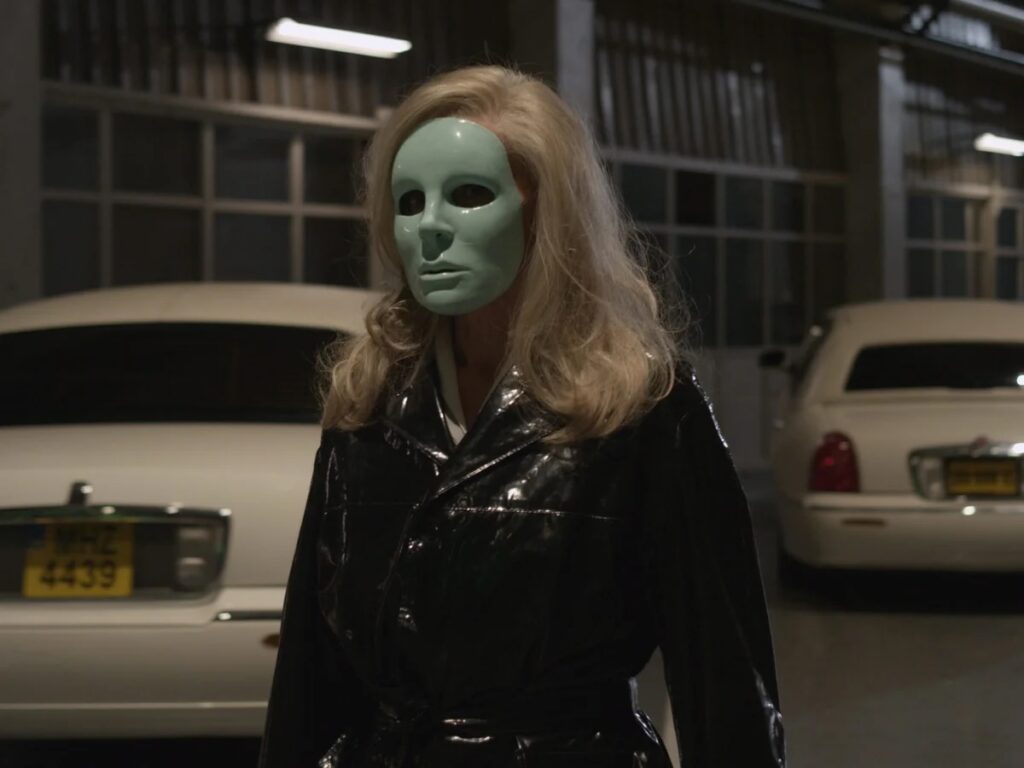
    A scene that stood out to me was when Oscar and the concerned guy from the agency talked in the limo. According to my notes, they discussed how small and imperceptible cameras have become, Oscar’s believability to his watchers, and the idea that beauty is in the eye of the beholder. I started to watch this movie as if every time Oscar stepped out of the limo, out of the liminal, interior space where he could be honest and authentic, he was participating in a piece of performance art— perhaps even acting for a camera we can’t see. We as watchers had a choice to believe or not to believe what we were seeing. And while I think I constructed a somewhat plausible explanation for what was literally happening in the movie— a professional actor going from gig to gig to film short scenes— that was just a way to force the film into a narrative I could wrap my head around. But the “literally,” the what’s-really-happening, my made-up, interpretive narrative isn’t what matters. I think the limo driver putting on a mask before stepping out asks us to recognize that all humans grapple with the actor’s struggle: we all struggle to define ourselves, to disentangle and distinguish ourselves from the many roles we play. 

  • Holy Motors and the Disappearing Reality

    Holy Motors feels like a film about film itself, or maybe about what’s left of it. Léos Carax immerses us in a world where the boundaries between performance and reality are blurred. Mr. Oscar (played by Denis Lavant) moves from one “appointment” to another, assuming new identities in each, yet there’s no visible audience or camera to justify his transformations. That absence makes the performances feel strangely hollow, as if he’s acting purely because he has to – a slave to the “invisible machines” Carax mentions in his interview.

    Carax’s distrust of digital technology seems to haunt every scene. The old “visible machines” of cinema (cameras, projectors, cars) are fading, replaced by something more virtual, impersonal. Even the limo, which carries Oscar between his appointments, becomes a symbol of this transition: a kind of impossible, in-between space where he prepares to become someone else. It’s home, but not in the comforting sense. It’s more like a place of regression or exhaustion after too many lives lived.

    As an experimental film, Holy Motors rejects conventional storytelling. It doesn’t explain itself. Instead, it drifts through moods and genres (e.g., tragedy, absurdity, musical, horror) like flipping through channels on TV. The accordion interlude midway through feels like the only true burst of life. It’s spontaneous and rhythmic, feels almost rebellious against the film’s growing artificiality.

    Is Mr. Oscar an actor, or just a person conditioned by an over-mediated world? How does the film comment on our relationship to technology and authenticity? If the limo is “home,” what does that say about the way we live between screens, constantly switching roles?