Last night, I went to the Cinematheque presentation of Jaws (Spielberg 1975). It was quite the experience, and I’m very fortunate that I was able to view it on the big screen. Jaws is a horror movie directed by Steven Spielberg. The story centers around the Chief of Police, Brody, as he attempts to find and destroy a Great White shark threatening the lives of the people on Amity Island. Throughout the film, lighting, sound, and editing work together to amp up the fear factor by creating deep contrast between scenes.
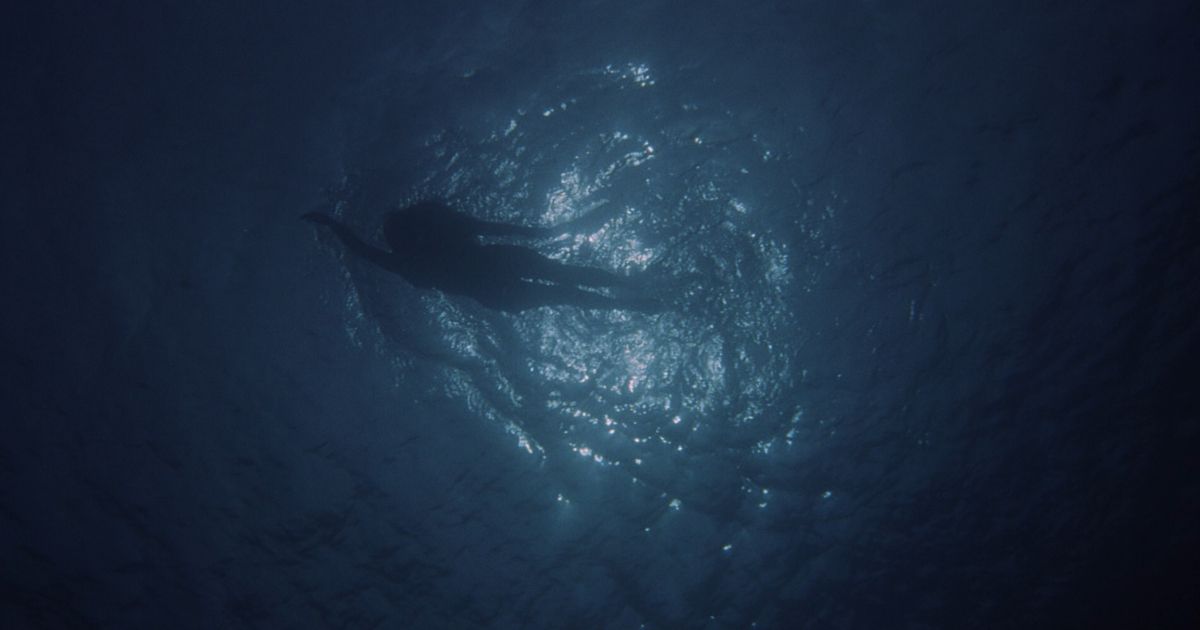
The shots of the people on the beach use high key lighting, bright colors, and a cacophony of noise. In contrast, the POV shots of the shark moving underneath the water have a noticeable absence of sound, broken only by the “ba dum, ba dum, ba dum’ of John Williams’ score. The beach shots lull the viewer into a false sense of security. They let their guard down and relax. This established mood is what allows shark attack scenes to elicit a high level of fear. All of a sudden, the lighting is low key, the colors are dark blues, and the score grows ominous.
This feeling grows stronger as the film goes on. The latter half of Jaws is filled with tension because the viewers can feel the absence of the Amity Island inhabitants. The characters are left alone with the shark out at sea. All sense of safety is gone and there is nowhere to run.
Jaws was a hit summer blockbuster and won Oscars for Best Sound, Best Original Score, and Best Film Editing.
What makes a movie like Jaws hold up so well in the modern day?
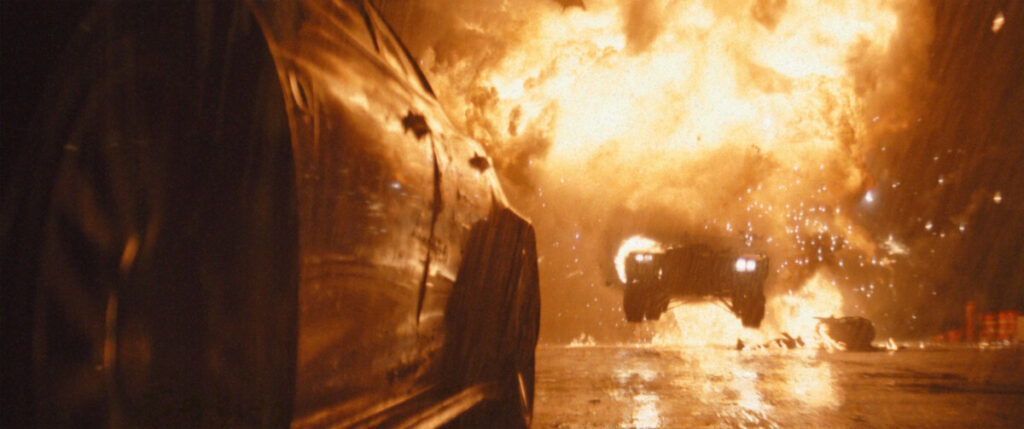
This week’s reading focused on the idea of cinematography not only being a practice of recording an event but also making choices based on light, framing, exposure, or movement, affecting how we see and feel a story. This notion came to mind while I was reading an interview with Greig Fraser, the cinematographer for The Batman (TheWrap). Fraser discusses how he approached the film as an “urban noir” in which darkness is not an absence; it’s an environment that is punctured strategically with small pockets of light. These choices are almost a textual study of tonality and exposure. Batman, for example, often emerges from darkness not because the frame is crudely underlit, but because Fraser provides just enough light on the eyes or the texture of the suit that gives us a presence we can read.
What I find remarkable is how these choices orient our understanding. The reading indicated how framing and lens selection can shift our relation to the space to make you feel more included or excluded. Fraser anchors even the action sequences in point of view, for example the car chase scene, which doesn’t overwhelm with spectacle but places us inside the Penguin’s perspective (which in turn enhances the fear Batman’s character is supposed to embody in this movie). As a result, we are not only spectators of the action, but we are also more connected to the characters.
Some reviewers claimed that the film was “too dark,” which shows the risk of pushing contrast and shadow too far. But Fraser’s work strengthens the principle that cinematography’s role is not decoration but narration. Light, contrast, and framing all become instruments of meaning: Batman as a figure always partially obscured and disclosed, someone we can glimpse but never fully know. The interview reveals how much craft undergirds that sensation, and it offers a good embodiment of what our reading this week refers to as “writing in movement.”
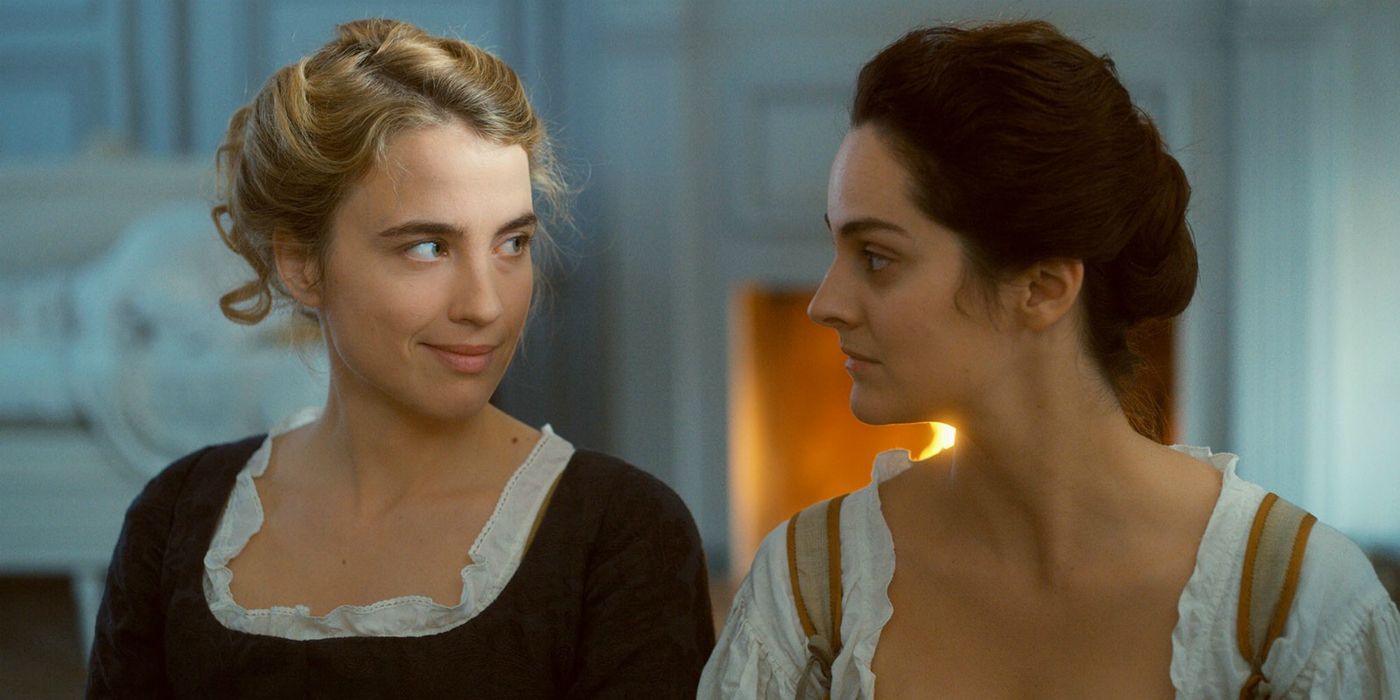
Portrait of a Lady on Fire (2019), directed by Céline Sciamma, is a wonderfully beautiful film, capturing the longing and searching looks shared between the two main characters, Marianne and Héloïse. The film has long takes that give the story room to breathe and establish a quiet, poignant atmosphere. The framing of the shots is usually focused on the two women and their shifts in facial expression and emotion. In the scenes where Marianne and Héloïse are playing the harpsichord and playing a card game, the framing is deliberate, only showing their faces in medium close ups and close ups.
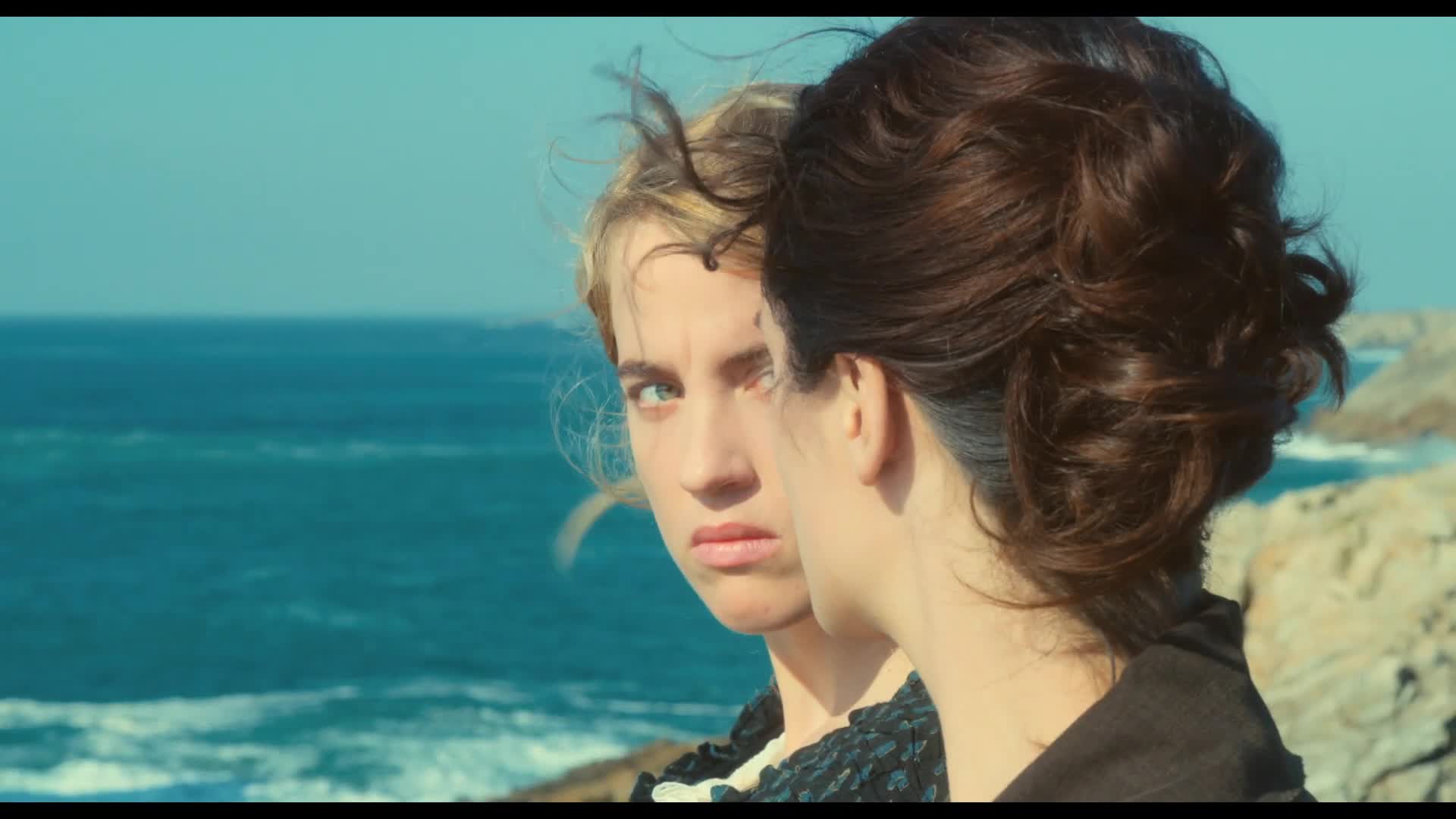
The intentional framing drives the narrative by showing the viewers the emotional journey of the characters. In one scene by the coastline, Marianne and Héloïse are standing side by side. Marianne’s face is covering Héloïse’s face in the frame but reveals Héloïse’s face every time she turns her head to look at her. I thought this was a genius use of framing because it cues the audience in on Marianne’s inner thoughts and her curiosity about Héloïse. We glimpse Héloïse as Marianne does, quick and fleeting.
The long shots throughout Portrait of a Lady on Fire are broken up by a generous helping of close ups, most notably used to emphasize important props. One example is the insert shot on the vase of flowers the maid is using as a subject for her needle work. An earlier shot shows the flowers blooming and flourishing with vibrant colors, but towards the end of the film, the flowers are shown in another shot as dead and withering.
We can take the flowers and extend their physical status to the relationship status of Marianne and Héloïse. Mise-en-scene and cinematography are working in tandem to enforce the mood and themes presented. It’s also worth noting that Marianne is in red throughout the duration of the film, indicating her as the object of desire for Héloïse.
The distinct lack of non-diegetic sound emphasizes the current action and brings the viewer into the fold of the setting. When there is music, however, the emotional effect is greatly increased and has a greater symbolic meaning when taken in the context of the relationship between the two women. The bonfire scene is an emotional moment for both women, and the fire acts as a metaphor for their attraction and desire.
The ending of the film was especially interesting because Marianne and Héloïse were both at the same orchestra concert listening to a piece that held emotional significance during their relationship. Héloïse was lost in the beauty of the orchestra, oblivious to Marianne sitting on the other side of the room. The camera moves in, and we see tears roll down Héloïse’s face.
While talking with several people about this scene, they mentioned being thinking Héloïse would look over and see Marianne or acknowledge the audience in some way. It was an interesting take, especially if you take the story of Orpheus and Eurydice, as told earlier in the film, as a metaphor for the affair.
Was Héloïse truly ignorant to Marianne or was she instead choosing to keep the memory of Marianne that she created? How does the cinematography cater to the feminine gaze? What do you think of how the cinematography impacted the pacing of the film?
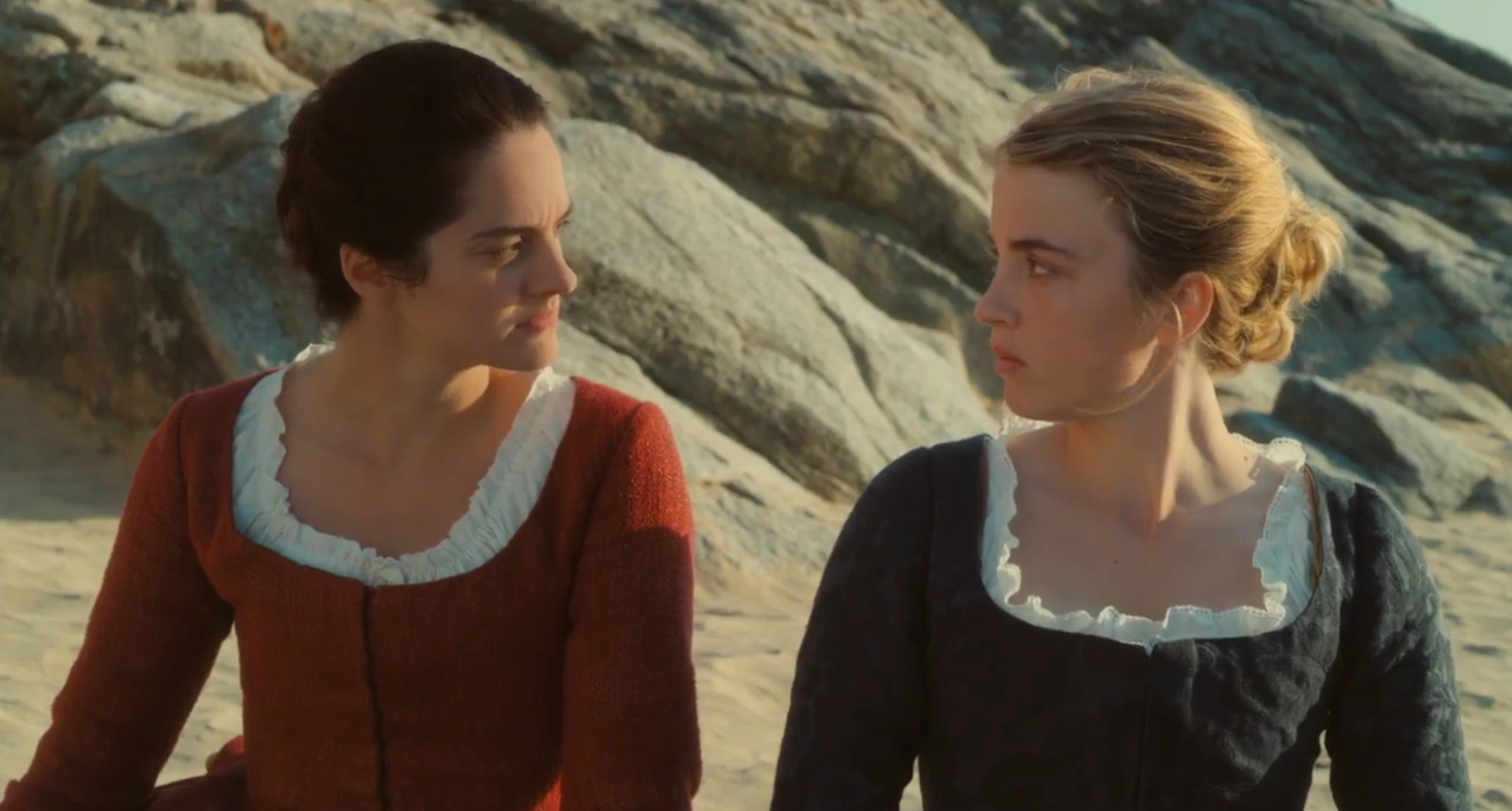
While watching the film, I find out that there are often times two people in the frame.
Before getting into the cinematography of Portrait of a Lady on Fire, we can first see a quote from Claire Mathon, the cinematographer of Portrait of a Lady on Fire. “The THALIA 70mm T2.6 Prime was one of our favorite focal lengths to capture this film about the looks and the proximity of these women.” (https://www.red.com/news/claire-mathon-afc)
We must first know how wide different lens with different focal length capture before analyzing. In actual usage, photographers often use 35mm or less to capture the environment and create a overall livelier mood and add more context. These shots include more background, and characters are more of an element rather than the main component. The 50mm, are close to the view of the human eye, and most commonly used in POV shots.(https://www.youtube.com/watch?v=ImFXpyAA1b8)⬇️
As a result, the persistent use of a 70mm lens by fixing the film at a human-scaled distance from the two women the director is letting us to observe.
The persistent use of 70mm gives us the relaxing compression and at the same time give minimal edge distortion, and make the camera less intruding while giving us all the necessary details. It captures the expressions of Marianne and Heloise, and allow the audience to have their attention on both of them rather than one at a time.
Both their faces are evenly proportioned, paired with the smooth and warm lighting, the 70mm will give the audience enough emphasize on the character while at the same time not so much isolation among the two women.
By locking the film into a 70mm perspective, the director visually compresses characters within their surroundings. This reinforce one of the themes, which is freedom, and the 70mm technique visualize the character’s lack of freedom. As a result, the 70mm lens transform isolation into actual experiences for the viewer, turning form into an extension of theme.
My question is:
Does the director use all these techniques, such as the 70mm, lighting, and all the mise-en-scene elements to frame the love between Marianne and Heloise as a rebellion (maybe the large usage of 70mm is a rebellion against the common used 35mm), that is destined to fade after they are separated and can only be kept in their memories, or a durable, long lasting relationship that persists through history? Which kind of relationship he is trying to present.
While last week’s reading helped us understand mise-en-scene and the artistic components in front of the camera, this week’s reading explains what tools are used behind the camera to shape what we see and how we see it.
I’d like to focus on three aspects of cinematography that were covered in this chapter: depth of field, image duration, and camera angles.
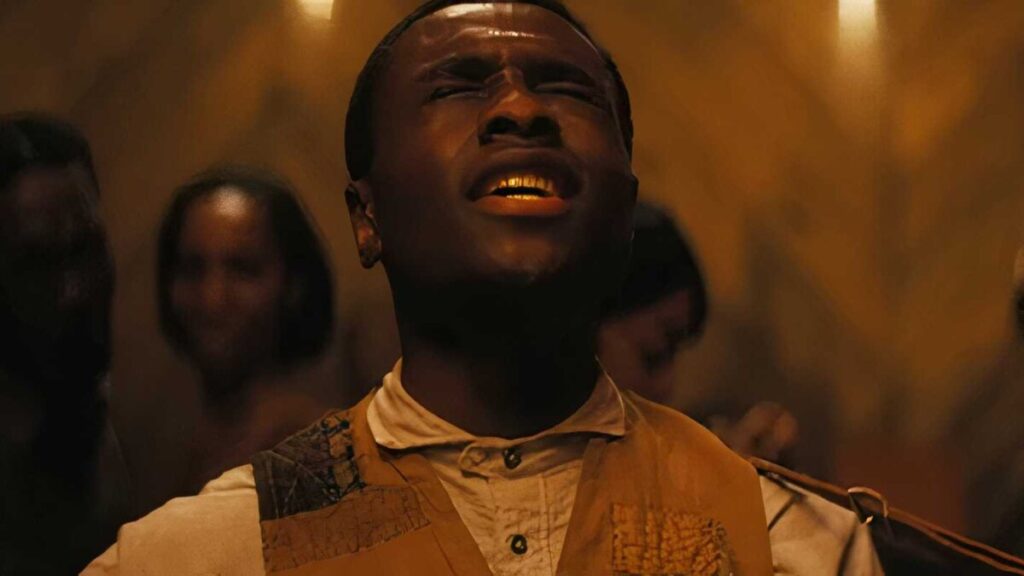
Depth of field describes the “range of distances within which objects can be photographed in sharp focus” (Film Art: An Introduction, 13th Edition). A shallow depth of field, for example, blurs the foreground and the background and keeps the sole subject in focus whereas a deep depth of field allows a larger range of the image to be sharp and in focus. The following scene in Ryan Coogler’s Sinners is a great example of this concept:
Sammie (the guy with the guitar), is in focus in the foreground while everyone else behind him is blurred in the background. This use of shallow depth of field brings all the attention onto Sammie and forces the viewer to focus on him. As the scene progresses, a similar use of depth of field is used to guide the viewer through the crowd of dancers and focus in on specific characters that are meant to represent various eras of music and dance through the years. At minute 3:00, a rockstar-looking man appears in frame (meant to represent afro-futurism) and although a crowd surrounds him, he is the only one in focus while everyone else blurs into the background. The repetitive use of this technique during the scene helps tell the viewer what they should pay attention to.
This scene of Sinners also provides a visual example of image duration. Image duration refers to the length of a single continuous shot. Starting at minute 2:37, a long take begins and in just one continuous progression, the camera immerses us into the crowd, panning to various subjects instead of using cuts. The continuity of the shot underscores the theme in the movie that music transcends time. All the different eras and cultures of music- hip hop, rock, African Zaouli and traditional Chinese dancing- shown with no interruptions emphasizes their unity and interconnectedness, a key point in the film.
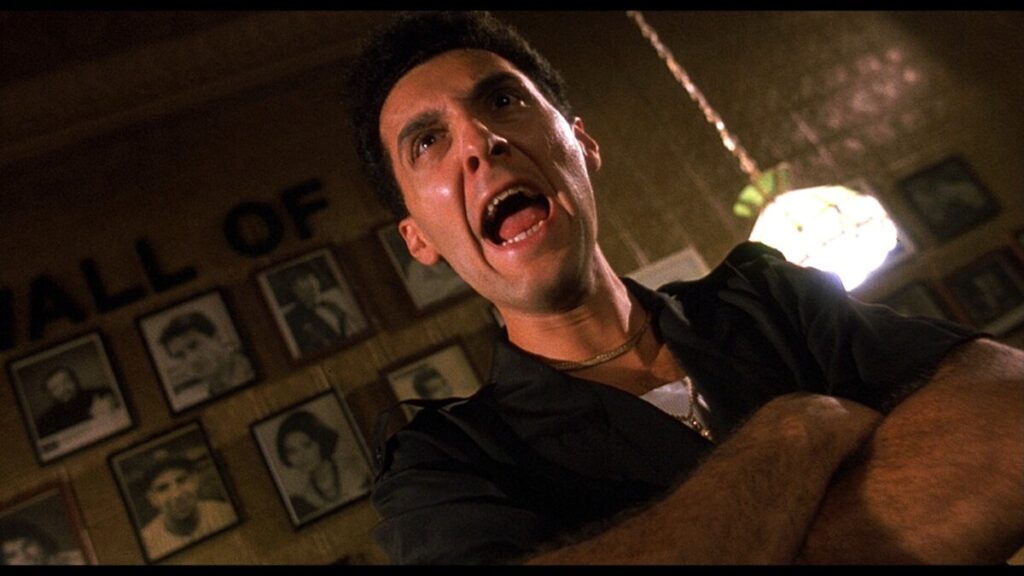
The final technique I’d like to explore is the use of camera angles: the location and/or orientation of the camera relative to the subject. In Spike Lee’s Do The Right Thing, Buggin Out, Radio Raheem, and Smiley barge into Sal’s pizza shop, demanding that Sal put pictures of Black people on his precious “wall of fame” given that most of his clientele is Black. In this scene,Lee uses canted framing (also known as a “Dutch angle”) to disorient the viewer and visually emphasize the tension of the confrontation. Lee also combines these tilted shots with low-angle perspectives to further emphasize the unstable dynamic of the characters.
A key takeaway from this chapter is that cinematography plays a significant role in adding meaning to a shot and serves to enhance the mise-en-scène to form one emotional, stylistic image. I also now better understand that although they overlap, mise-en-scène focuses on what appears within the shot, while cinematography focuses on how the shot is captured.







![Portrait of a Lady on Fire – [FILMGRAB]](https://film-grab.com/wp-content/uploads/photo-gallery/Portrait_of_a_Lady_on_Fire_065.jpg?bwg=1601292400)