Tag: experimental film

  • Holy Motors and the Disappearing Reality

    Holy Motors feels like a film about film itself, or maybe about what’s left of it. Léos Carax immerses us in a world where the boundaries between performance and reality are blurred. Mr. Oscar (played by Denis Lavant) moves from one “appointment” to another, assuming new identities in each, yet there’s no visible audience or camera to justify his transformations. That absence makes the performances feel strangely hollow, as if he’s acting purely because he has to – a slave to the “invisible machines” Carax mentions in his interview.

    Carax’s distrust of digital technology seems to haunt every scene. The old “visible machines” of cinema (cameras, projectors, cars) are fading, replaced by something more virtual, impersonal. Even the limo, which carries Oscar between his appointments, becomes a symbol of this transition: a kind of impossible, in-between space where he prepares to become someone else. It’s home, but not in the comforting sense. It’s more like a place of regression or exhaustion after too many lives lived.

    As an experimental film, Holy Motors rejects conventional storytelling. It doesn’t explain itself. Instead, it drifts through moods and genres (e.g., tragedy, absurdity, musical, horror) like flipping through channels on TV. The accordion interlude midway through feels like the only true burst of life. It’s spontaneous and rhythmic, feels almost rebellious against the film’s growing artificiality.

    Is Mr. Oscar an actor, or just a person conditioned by an over-mediated world? How does the film comment on our relationship to technology and authenticity? If the limo is “home,” what does that say about the way we live between screens, constantly switching roles?

  • Experimental Film in 2001: A Space Odyssey

    Experimental Film in 2001: A Space Odyssey

    This week, we’re discussing three distinct genres of film: documentary, experimental, and animated. Although I haven’t delved into the first two genres extensively, 2001: A Space Odyssey by Stanley Kubrick stood out to me immediately as an experimental film I’ve actually seen (so many films that are considered experimental have been on my watchlist for a LONG time, such as House and Stalker).

    Though not all of the film is considered “experimental”, the “Stargate” sequence definitely should be.

    At the beginning of the sequence, Bowman, our main character, is in space investigating one of the monoliths when he is pulled into a gateway of colorful lights.

    Throughout the rest of the sequence, we see tunnel-like flashes of light (shown above), with shots of Bowman in distress interspersed between. It’s worth noting that as the sequence continues, the shots of Bowman become motionless, his face frozen in horror and distress. As the sequence continues, we begin to see shots of blinking eyes (presumably Bowman’s?) with different color schemes, space phenomena, and landscapes of strange colors.

    This sequence is a version of what Film Art calls “associational form”. Using these images, Kubrick suggests ideas and emotions to the viewer, despite the images seemingly having no logical connection.

    Through the tunnel-esque design of the colors, we infer that Bowman is traveling somewhere. Then, using the short, shaky shots of Bowman in distress, along with the freeze-frames, we know that whatever journey Bowman is on is nowhere near pleasant. But on the other hand, some parts of this sequence are also abstract (the second form). The images aren’t necessarily used to convey a meaning; it’s up to the viewers themselves to find meaning within them. A good example of this in the sequence is the eyes or the space phenomena. Is Kubrick trying to show what Bowman is seeing as he travels?

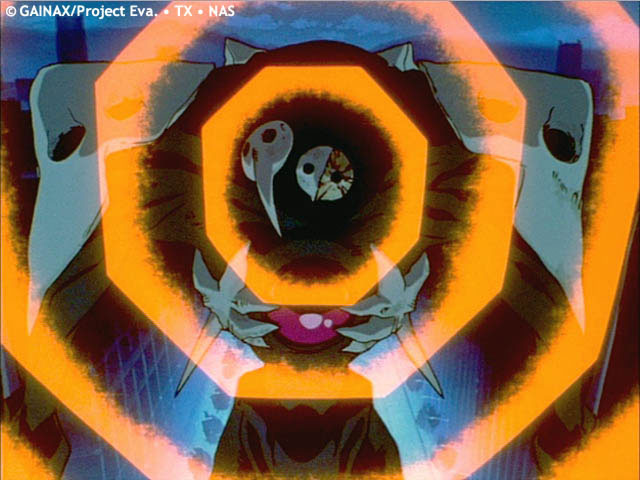
    On the topic of 2001, it’s also fun to see references to such an influential movie in other media. There were two pieces of media that came to mind immediately, which are the anime Neon Genesis Evangelion and one of my favorite video games of all time, Signalis.