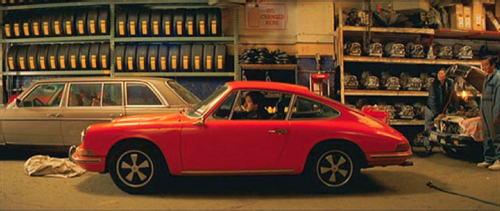
Tag: # Mise-en-scene

  • Animals, Mirrors, and Staircase Symbolisms: The Mise-En-Scène of a Melodrama

    Picture from mubi.com

    Douglas Sirk’s All That Heaven Allows is surely a classical demonstration of continuity editing, using lots of dissolves, fade-ins, and match-on-action, etc. The techniques of shooting/editing is also our main topic for this week.

    However, when I was watching the film, I cannot help myself from thinking about the mise-en-scène, particularly the symbolisms of each prop/object. There were lots of occasions when we see one’s facial features clearly but not the other one (due to lighting), when the two of them were having a conversation. Why is that? There were also different animals that appeared, including pigeon and dears. Why these animals? Mirrors also seem to be symbolic. Why did the production team make these choices?

    Hence, I searched up an analysis of the mise-en-scène in All That Heaven Allows and found a really interesting article: All That Mise En Scène Allows: Douglas Sirk’s Expressive Use of Gesture.

    Screenshot from the film at time 00:21:31.

    The Sirkian Staircase

    The article talked about the scene when Cary visits Ron’s mill for the first time. As she tries to ascend the stairs, a pigeon flies out, causing her to lose balance and fall into Ron’s arms. The article claims the half-climbed steps as a common device used by Sirk. Although Cary has made the decision to walk on a path that would deviate her from her previous Bourgeois lifestyle, she is only capable of proceeding halfway into Ron’s Bohemian lifestyle. This foreshadows how she had to give up marrying Ron for consideration of her children and her community’s comments.

    Ultimately though, she did fall back into Ron’s arms, in this mill which would later turn into a bedroom.

    Animals

    Speaking of pigeons, I was also confused of its possible symbolic meaning, as well as the deer that appeared multiple times. The article provides an insightful explanation.

    On Ron’s car, there is a scene when Cary hesitates her marriage with Ron. When Ron speaks how a man has to make his own decisions, Cary responds that “And you want me to be a man”. The article claims that what might be truer to say is that Cary wants Ron to be a woman. The movie ended with a shot of Ron laying on the bed then pivoting to a deer outside the window(an animal that is associated with Ron). If the pigeon represents Ron’s challenging sexuality, then the deer implies that the male has become a “meekly submissive creature, signaling Cary’s transition from passive object to dominant subject.”

    Mirror

    Screenshot from the film at time 00:06:22.

    In a review of All That Heaven Allows by criterion.com, All That Heaven Allows: An Articulate Screen, a specific occasion where mirror appears is discussed. This is when the audience first get introduced to the children. On the very right stands a vase containing the branches Ron cut for her earlier, where on the left we see Cary. However, between the branch and Cary intrudes the 2 children. This also acts as a foreshadow of how later in the film Kay and Ned would stand against the marriage between Cary and Ron.

    Screenshot from the film at time 01:15:36.

    Later when Cary and her children celebrates Christmas, Ned bought a television for Cary, with the deliveryman saying “Life’s parade at your fingertips,” but ultimately serves as the “last refuge for lonely women.”

    Library of Congress Film Essay, An academic paper published by the University of Kent, commented this scene by how accurately the deliveryman’s last line captured Cary’s state of emotion as she gazes emptily at the screen. “Yet to be turned on, the machine simply mirrors her own image: a woman lost, lonely and bereft, and something beyond a technological fix.”

    In conclusion, I think that the mirrors function as a reflection of the bourgeois culture. For the first mirror that got us to know Kay and Ned, the fact that Ron’s branches stood outside of the mirror’s frame tells that he is not part of the clubbing, partying culture. Having Cary emptily staring into the television screen, the film might also try to criticize the loneliness and solidarity beneath the bourgeoisie’s fancy socialization.

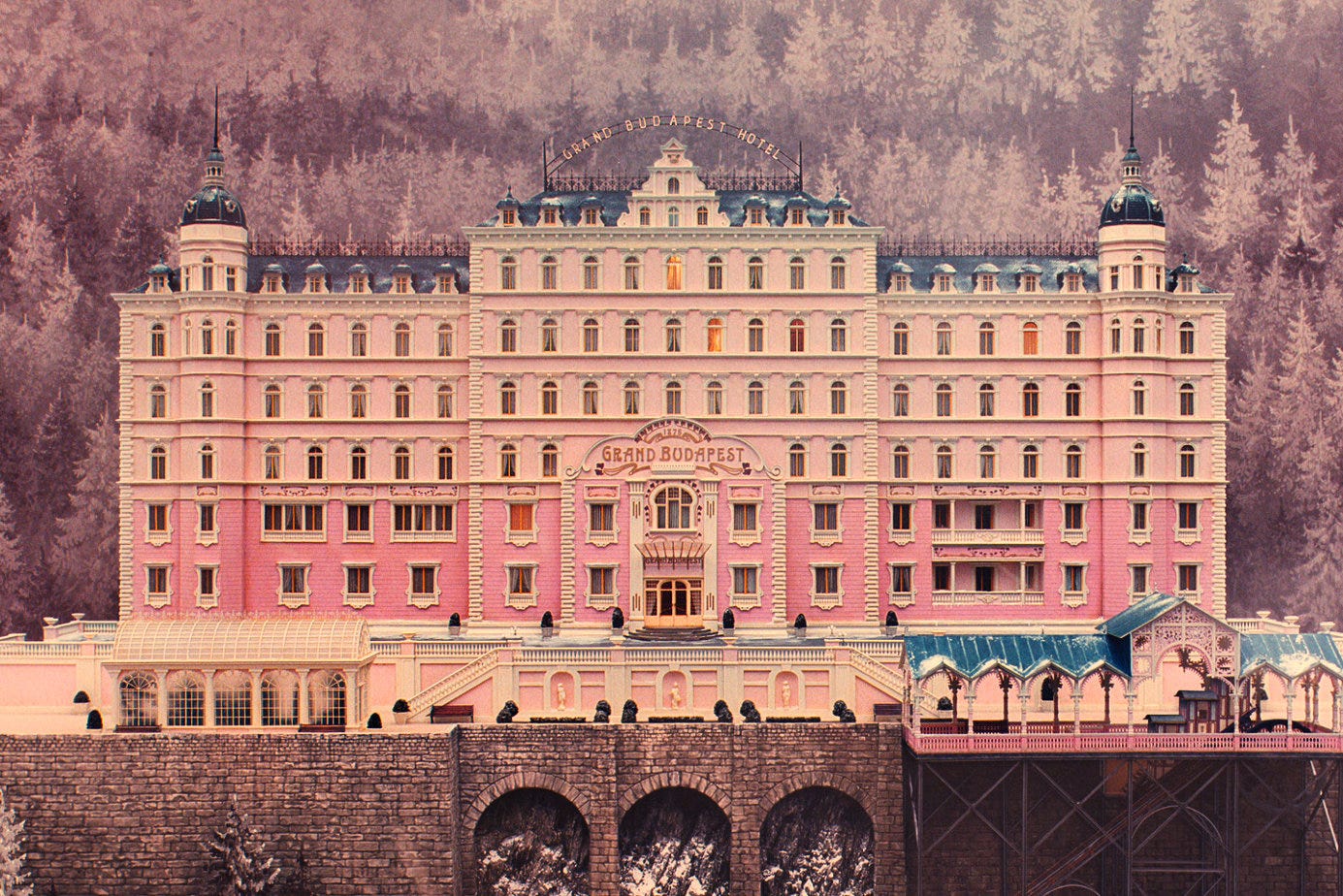
  • The Grand Budapest Hotel: Creating a Fictional World Through Sound

    During my further research into The Grand Budapest Hotel, I was most interested in a video analysis of the creation of the movie’s score. The video, posted by “Inside the Score” on YouTube, highlights the apparent challenge in creating music from an imaginary country. The soundtrack was constructed by Alexandre Desplat, a talented French composer who also collaborated on other Wes Anderson films, including Fantastic Mr. Fox, Isle of Dogs, French Dispatch, and Moonrise Kingdom. Desplat and Anderson situate the fictional country of Zubrowka on the easternmost border of the European continent. Desplat identifies the broader geographical area as “Mittleuropa”, or Middle Europe, stretching from Switzerland to Turkey.

    In order to strengthen the authenticity of the fictional Zubrowka, Desplat utilizes traditional instruments from neighboring regions. For example, in the main theme music, he uses a cimbalom, a stringed instrument popular in Hungary and the alpine regions, thus giving the music a nostalgic and distinctly Central European tone. During winter scenes, he incorporates tubular bells, sleigh bells, and glockenspiel, creating a whimsical sound reminiscent of the Russian composer Tchaikovsky’s Nutcracker. In contrast, for dramatic scenes, the movie uses brass instruments that often mirror marching percussion, signaling the arrival of the fascist groups.

  • Wes Anderson’s Wretched Whimsical World

    We can all admit that this Wes Anderson’s “The Grand Budapest Hotel” is a visually eye-catching film, almost to the point where you begin to question the intentions of the color scheme compared to the topic of the movie.

    This video, made by StudioBinder on YouTube, does a great job of explaining why the movie’s choice of color is so peculiar while considering the circumstances of the movie, or more specifically, the characters’ stories.

    The Grand Budapest Hotel - by Gina Wurtz
    The Grand Budapest Hotel – film review

    Wes uses primary colors, high saturation, and brightness to portray a childlike perspective and maintain the whimsical feeling, though reality reflects the opposite. Specifically, he repeatedly reintroduces the color red into the film to reflect the childhood trauma they still carry into adolescence.

    Film Clip: 'The Grand Budapest Hotel'
    Grand Budapest Hotel | Mick Ricereto Interior + Product Design

    So why does he continue to use this color theory? StudioBinder says that it is an expression of dark humor and a play on the theme’s bipolar tones versus the visuals. I guess you simply cannot believe the emotion to be everything you see. It forces the audience to be engaged in the world and face the dark topics.

    The Grand Budapest Hotel Color Palette Analysis | Wes Anderson - Pixflow  Blog

    When the switch is made in the second train scene, it is apparent that the bipolar color vs. dialogue theory still reigns. Wes’s use of color becomes very telling when the colors become black and white at the time of tragedy. Zero says, “There are still faint glimmers of civilization in this barbaric slaughterhouse that was once known as humanity. He was one of them. What more is there to say?” In my opinion, it shows how quickly reality is turned back on, and hope in humanity was stolen when they killed Mr. Gustave, almost as if the color died with him.

    If you are interested, I highly suggest watching and seeing if you also caught on to the same patterns!

  • The Grand Budapest Hotel_ Viewer’s Comment

    The use of Mise-en-Scene in The Grand Budapest Hotel


    Hello classmates, it was great to watch this interesting movie with you all this afternoon. I don’t know how you felt about this movie, but personally speaking, I loved it. The plots are so tight, and I got fully immersed in it! Besides the fantastic storytelling, I believe that this movie effectively shows the power of Mise-en-Scene. The smart uses of setting, costume and makeup, lighting, and staging not only help the audience engage better, but also gives us more space to explain the film further and taste it deeper.

    In this post, I’d love to share with you some of my findings while watching and also share initial questions I have, so we can further discuss them.

    Insights:

    1. In the scene of reading Madame D.’s will, Gustave and Zero are standing at the door of the entire room, on the opposite side, wearing purple suits, while almost all of the other people in the same scene were in black. By contrasting standing position and clothes’ color, I think that the director is trying to emphasize the contrast of their personalities: Gustave and Zero embody individuality, elegance, visually marked by their purple uniforms. The others dressed uniformly in black represent conformity, rigidity, and the coldness of aristocratic tradition. (Costume & Makeup + Staging)
    2. Jopling: This ruthless killer is depicted by using a combination of costume and lighting techniques. If I remember correctly, he is always dressed in black throughout the entire movie, often wearing black sunglasses or having shadowed eyes due to the lighting effect. For example, in the snow mountain scene, he chases after Zero and Agatha on a sled after Gustave and Zero escape. The stark white snow, contrasted with Jopling’s dark figure, strengthens his dark side and ruthless personality. (Costume + Llighting)
    3. In the prison escape tunnel, light becomes symbolic: the small window glows brightly while everything else is engulfed in darkness. This stark contrast emphasizes freedom as a distant possibility, a fragile opening amid confinement. (Lighting + Setting)


    Questions:

    1. Why does Anderson begin the film in a cemetery filled with crosses? How does this opening frame set the tone of memory and loss? (Setting)
    2. What’s the implication of the children with weapons in the second scene? Is Anderson suggesting that violence disrupts innocence and order? (Staging + Setting)
    3. How does Anderson’s pastel palette (pink hotel exterior, purple uniforms, candy-colored props) evoke nostalgia? Does it make the story feel like a memory or a fairy tale? (Costume & Makeup + Setting)
    4. What are the symbolic meanings of the painting Boy with Apple? Why did Anderson choose this painting instead of others? (Props/Costume & Makeup)
    5. Why does Anderson often isolate characters in their own shots during dialogue (like Gustave and Zero on the train), instead of framing them together? (Staging)

    Hope we can discuss further in the comment area or in class!