In researching RRR and other Tollywood movies this week, I kept thinking about the ending section of the movie, in which Raju Rama is shown to be an incarnation of the actual Hindu God Rama. In a Western cultural context, this seemed absurd––if a character in an action movie turned out to secretly have been Jesus or Moses the entire time, it would undoubtedly be met with eye rolls and and bad reviews from the audience (if played straight).
In RRR, Raju Rama being Lord Rama just happens as part of the movie. Why? What? I needed to know.
There is no prohibition or social taboo against presenting Gods on screen in South India, and there is a concern that younger people do not relate to Hinduism or it’s Gods. Therefore, to get them back in the fold, and to present broadly-known cultural agendas on screen, there are Gods. A lot of Gods.
I encountered an interesting video on YouTube of a more recent interview of Debbie Reynolds. She talks about how, surprisingly, she had no formal dancing experience when she was cast as Kathy. Thus, she had to undergo rigorous rehearsals, eight hours a day for two months, before shooting began.
I found this surprising because she plays such a convincing performance in the film, with her dancing being extremely technical and well-done. In the interview, she talks about her determination to keep up with her co-stars who had much more experience than her. I find this fascinating as it mirrors her character in the film; both are talented performers but had to work extra hard to prove themselves in an industry of veterans. Overall, knowing this detail now almost adds another layer of authenticity to the film.
screenshot from video
I also found it interesting in the video that they address there being two directors and how that worked in the making of the film. Reynolds talks about how Gene Kelly directed the actors while Stanley Donen mostly worked behind the scenes with the crew and cameras. Given the technicality both in the cinematography and the mise en scene, it is not surprising that they would divide and conquer.
screenshot from video
Ultimately, this video highlights the tedious work put into the making of such a grand film, reminding us how it has become such an acclaimed production.
As we began to overview sound it is interesting to understand the extent to which it is naturally occurring or if its being artificially fabricated. The mini documentary “The unsung art of Foley” https://www.youtube.com/watch?v=UO3N_PRIgX0 exposes how foley artists replicate noises in such a realistic manner. The mixer Mary Jo Lang refers to this process as a dance which made me think of how sound is not purely recorded, rather, it is performed. The so-called “natural” sounds we hear in a movie are just a combination of layers meticulously thought of.
This idea directly resonates with the week’s feature Singin in the rain that exposes Hollywood’s obsession with synchronization and illusion. Additionally the sound in the movie is hyperbolized in every sense and there would be no way to grasp that solely from recording the movie. for example: even though the iconic song was recorded on a real water flooded set, the audio was recorded separately. Foley artists lend authenticity to images that would otherwise feel empty or flat — just like Kathy Selden “ghost-voices” Lina Lamont.
In the documentary, Alyson Moore says: “People take sound for granted, but you would miss it if it wasn’t there”. This emphasizes how if well done, sound is meant to be unnoticed. The layering process is an effort towards achieving the most natural noise possible, and in musicals, layering parallels harmony as multiple elements bled together in a single experience. In musicals layering is exaggerated through dialogue, song, dance, ambient sound, rhythm and more.
In essence, both dancers and foley artists rely on rhythm, timing and a combination of movements to succeed. Foley artists dance behind the scenes mirroring the dances on the screen (as exposed on the documentary). By recognizing sound as a choreography we begin to understand that what feels natural in films is sometimes the most artificially constructed elements.
While watching All that Heaven Allows (1955), I kept thinking about how it was supposed to be a “bad movie”. It is a “weepie”, it is unserious, it is “trash” (as director Sirk would positively call it later). I was so interested in the Sirk quote we looked at together—about crazy trash being much closer to high art than we’d like to think—that I went looking for more of his interviews.
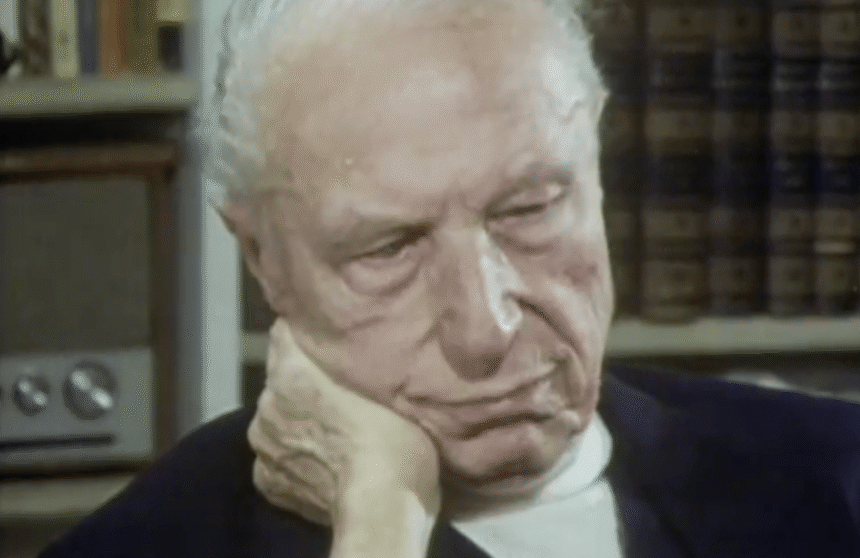
This interview, while not directly concerning All that Heaven Allows, is very much a commentary on it, and Sirk’s other “bad films”. He rebukes this “bad” claim, offering his own set of criteria as to what makes a film good or bad: it must have imagination, must be interesting, must have a theme, must be consistent, and must trust the audience just enough (which is to say, not at all).
What I like the most about this clip, and his criteria, are how they end. Sirk moves from talking about imagination—that every film must have one, that a film without one is a waste, or not even a true film (piece of art) at all—to talking about why he makes “bad movies”. According to him, he makes “preaching” movies: the antithesis of bad.
”The moment you stop preaching in a film, the moment you want to teach your audience, you’re making a bad film.”
Sirk seems, here, to be eschewing the concept of subtlety in film, and based on All that Heaven Allows, it seems that he followed that command. Whether it is the treacherousness and turn-facedness of the children, the incessant nature of the friends, or the unending charm of Mr. Kirby, nothing in AtHA is subtle. Every emotion and character is a metaphorical brick to the face of whatever emotion Sirk wants you to feel. It calls back to something else he said in the interview
“[A movie] should have its own kind of finish, its own kind of theme”.
All that Heaven Allows has finish. It has a theme. And it’s certainly enjoyable to watch. In the wake of AtHA, can we really deny Sirk’s definition of good and bad? And if we enjoy AtHA, why would we?