
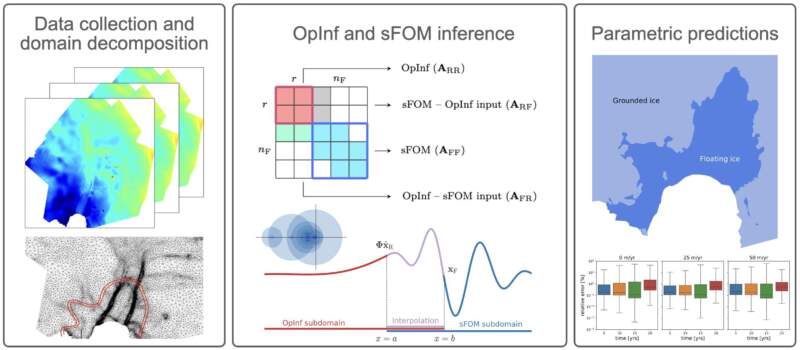
The recent SIAM News article “Using Surrogate Models to Boost Ice Sheet Simulations Under Uncertainty” co-authored by Marco Tezzele highlights an exciting development at the intersection of applied mathematics, scientific computing, and climate science.
The piece shows how to leverage physics-informed reduced order models (ROMs) for fast and accurate parametric predictions of glacier dynamics at a significantly reduced computational cost. When applied to a model of Antarctica’s Pine Island Glacier with varying melting parameters at the ice-ocean interface, the ROM accurately predicted the grounding line’s retreat with an 8x computational speed-up.
These methods demonstrate how modern mathematical tools can make previously intractable simulations tractable, supporting more robust predictions of future ice sheet behavior and sea-level rise, which are key for climate research and policy planning.
This is the result of a collaboration with the Oden Institute for Computational Engineering and Sciences, the Max Planck Institute for Dynamics of Complex Technical Systems, and the Otto von Guericke University Magdeburg.
Read the full SIAM News article here: https://www.siam.org/publications/siam-news/articles/using-surrogate-models-to-boost-ice-sheet-simulations-under-uncertainty/