Tag: Theological Education

The Rise of AI, Judgment Day? Exploring Artificial Intelligence in Theological Education

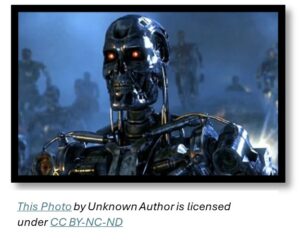
As conversations about Artificial Intelligence (AI) became ubiquitous with the launch of ChatGPT in November 2022, my mind immediately recalled the film franchise, Terminator. The movies are centered on a dystopian future where machines, in becoming self-aware, formulate a plan to wipe out humanity. As this recall suggests, my immediate reaction to ChatGPT was one …
Continue reading

An Online Education in Belonging

In After Whiteness: An Education in Belonging, Willie James Jennings explores the implications of white supremacy and racial identity on American Christianity and education. He argues that white supremacy has profoundly impacted American society and religion and created a culture of segregation and exclusion. For Jennings, American Christianity must embrace a new theology of belonging …

Continue reading

Mapping Out Our Assessment Ecologies as a Theological Practice

By: Ryan Runager and Dr. Sarah Bogue Often, for many classes, getting a particular grade or simply completing the assignment is more important than the learning of class material.  Asao B. Inoue, Professor of Rhetoric and Composition at Arizona State University, writes: Classroom writing assessment is more important than pedagogy because it always trumps what …

Continue reading

Using Design Thinking in the Theological Classroom

What does a business concept have to do with teaching theology? Tom Kelly writes that a “Hands-on, user-centric approach to problem solving can lead to innovation, and innovation can lead to differentiation and competitive advantage.” As theological educators, our work is not inclined toward competitive advantage. Our work is to be present, embodied, and full …

Continue reading

6 Benefits to Peer Review in Theological Education

Simply put, peer review assignments enable students to provide feedback to each other. They are another tool to put in your pedagogical tool belt. There is a lot of research on peer review in the classroom. We will cover some best practices later in this article. The following Benefits to Peer Review we present here …

Continue reading

Twitter for Academics: An Invitation to Public Theology

I recently spoke with a colleague who was curious about academic twitter (#AcademicTwitter). She mentioned how it has become a repository of resources. Everything from book launches to news articles – it’s so valuable. Our conversation shifted, however, once we began talking about Twitter best practices and how to use it.  For many academics, Twitter …

Continue reading

Contemporary Cultural Item with Jesus and John Wayne

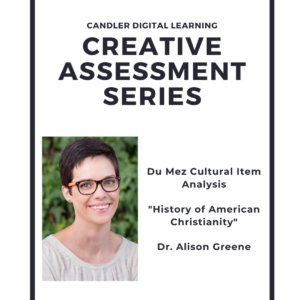
Associate Professor of American Religious History, Alison Greene, teaches a course called “History of Christianity in America.” In her course, she assigns a cultural analysis project through the lens of Jesus and John Wayne: How White Evangelicals Corrupted a Faith and Fractured a Nation by Kristen Kobes Du Mez. In this text, Du Mez provides …

Continue reading

Practical Papers for Practical Theology

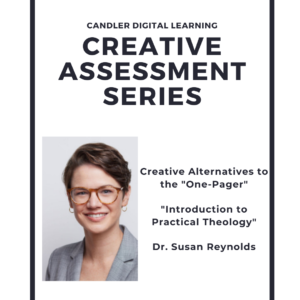
In her course, “Introduction to Practical Theology,” Susan Reynolds invites her students to explore what it means to “do theology in context.” She says, “As they negotiate the fluid, shifting boundary between theology and practice, they encounter a wide and interdisciplinary variety of texts.” In place of the weekly “one-pager” response or reflection of the …

Continue reading

Skill Building for Social Change

Are you interested in political organizing? How do your studies at Candler prepare you for a life of activism and public engagement? These are main objectives of Kyle Lambelet’s “Political Theology and Community Organizing” course: to develop a working theological vocabulary in the realms of political and justice organizing and to utilize this language as …

Continue reading

Digital Tools in Vocation

What is your theology of social media and digital usage? It may not be a bad idea to start thinking about it! Creating values and boundaries with yourself and your digital and online usage serves as a continuous mantra, or reminder, as you spend time on your phone or computer. By checking in with how …

Continue reading