Close your eyes and think back to home.Is home in Georgia? Is it far away from Georgia? Is it on the West Coast or East Coast? Is it in the MidWest? Is it out of the country? Now imagine a law has passed stating that you can never live anywhere outside of your home state. How would that affect your enrollment at Emory? In what ways would you be limited? As horrible as this sounds, this scenario was reality for many Jews between the years 1791 to 1917, during which the Pale of Settlement was established.

The Pale of Settlement was an area apart of Russian territory that allowed Jews permanent residency, but forbade them from taking up residency anywhere else, which crushed the dreams of many young people who wanted to pursue a higher education outside the borders of the Pale of Settlement. However a loophole was found with the issuing of yellow tickets: a nickname for the identification cards that were given to Russian prostitutes that allowed them to live outside the borders. Many Jewish women took on the titles of prostitutes in order to expand their rights and live or go to school wherever they wanted, and The Yellow Ticket is a 1918 film that depicts such a scenario.

When one of our group members, Rachel, first rushed in, trying to find where the movie was located with only two minutes left before it started, a girl walking behind her stated that one of her friends told her the movie was filled with prostitution, which immediately had Rachel questioning Emory University’s taste in film. But we were pleased to find The Yellow Ticket was an engaging film about the struggles of a young woman who loses everything and must take on a double life as a prostitute and university student in order to have a chance at a better life.

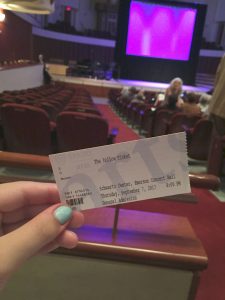
Leaning back in our seats in the Emerson Concert Hall at Schwartz Performing Arts Center, we had no idea what to expect. We had just bought tickets to see the silent film The Yellow Ticket accompanied by a live score. Having never attended an event like this before, we had no idea what to expect.
The lights went dim, and the three performers were introduced: composer Alicia Svigals, pianist Marilyn Lerner, and clarinetist Laura DeLuca. It was easy to tell who was the star of the show: Alicia’s long red dress immediately captured the spotlight.
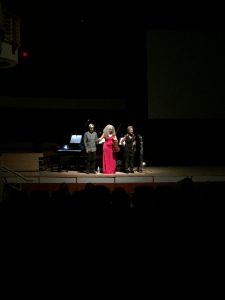
Svigals, the world’s leading klezmer fiddler, founded the Grammy-winning Klezmatics and has collaborated with many renowned musical artists. She has also made appearances on shows such as David Letterman, MTV, and more. She is the recipient of the Foundation for Jewish Culture’s 2013 New Jewish Music Network Commission for her score of the Yellow Ticket.

Lerner’s musical style is seasoned with multiple different cultures, performing internationally from Montreal to Havana to Jerusalem. She is a recording artist, and has also toured with other groups of performers.

DeLuca started playing in the Seattle symphony in 1986 and is one of the founders of Seattle Chamber Players. Aside from performing in concert halls all around the world, she has been featured in more than one hundred recordings and has collaborated with distinguished composers and performers.

Beautiful music filled the concert hall the very second the film began, and the tone perfectly matched the mood of each scene. Alicia’s singing voice perfectly complimented the strings she played, matching with her partners beside her. We watched as the music got louder and darker during the dramatic scenes and soft during the comedic ones. The audience, consisting mostly of older adults and a few college students here and there, was captivated by the abilities of the performers and the emotions they evoked from the film.
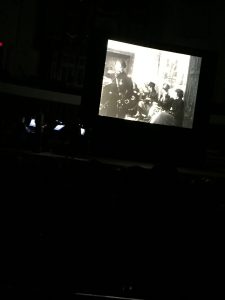
One student in our group, Michael, was able to meet Alicia Svigals as she came to speak to his Music in Film class. Svigals stressed the effort and thought she put into every second of the film as she essentially lived in her studio for two whole months. With The Yellow Ticket being a silent film, Svigals said that she wanted to “make the narrative more clear and bring out the emotion” of the film. Though looking back at it, Svigals said that scoring the film from second to second was a “rookie move”, she is constantly fascinated with how such precision in the score makes each performance slightly different and unique. She explained that playing in complete unison with the score and film was essentially impossible with the amount of detail she put into every scene. Though at first this seemed like a detriment to her work, Svigals came to realize that each performance acted as a snowflake, patterned differently and completely unique from the others.  

Svigals also stressed how the film is filled with unknowns. From the very beginning, the director gives little background information or hints about the setting or main character, Sofia. Instead of trying to make sense of these unknowns, Svigals took advantage of this and layered the score with music from multiple cultures. This melting pot of different sounds emphasized this unknown as Sofia takes us on her journey to St. Petersburg. When viewing the film with Svigals’ score, one might notice that some melodies repeat themselves throughout the movie. Svigals created these specific melodies to represent different emotions and gestures. As Sofia makes the final decision to become a prostitute Svigals plays a melody of shame with a diminished harmony and a strong sense of darkness. This melody appears every time Sofia is seen working her night job in her alternate life. Along with shame, Svigals composed a waltz melody to symbolize romance as Sofia’s classmate quickly fall in love with her. The melody is layered with the three instruments and composed perfectly to bring out the growing feeling of love that falls within Sofia’s story.

Following the performance was a twenty minute Q&A with the artists. Audience members asked about the creation of the score, how they keep up with timing and precision, and the personal lives of the artists in general.
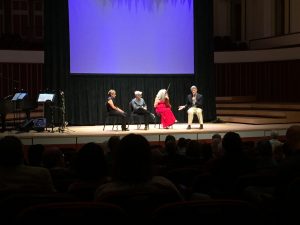
This performance of The Yellow Ticket was a very interesting and unique experience. We enjoyed observing the passion and excitement of the performers which was shared by the audience. The show brought to our attention the effects that music has on the emotions that a film portrays. We left the concert hall impressed, enlightened, and inspired.


By Rachel McNeil, Kate Monger, and Michael Malenfant

Green, David B. “1791: Catherine the Great tells Jews where they can live.” Haaretz.com, 26 Dec. 2016, www.haaretz.com/jewish/features/.premium-1.564905. Accessed 11 Sept. 2017.

“JewishEncyclopedia.com.” PALE OF SETTLEMENT – JewishEncyclopedia.Com, www.jewishencyclopedia.com/articles/11862-pale-of-settlement. Accessed 11 Sept. 2017

“Pale of Settlement.” Wikipedia, Wikimedia Foundation, 27 Aug. 2017, en.wikipedia.org/wiki/Pale_of_Settlement#Jewish_life_in_the_Pale. Accessed 11 Sept. 2017.

“Yellow ticket.” Wikipedia, Wikimedia Foundation, 30 July 2017, en.wikipedia.org/wiki/Yellow_ticket. Accessed 11 Sept. 2017.
The Power of Positivity, Happiness, and Friendship in Emory Women’s Volleyball


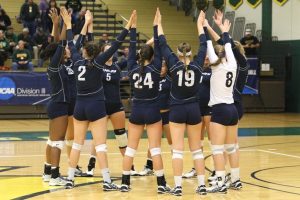
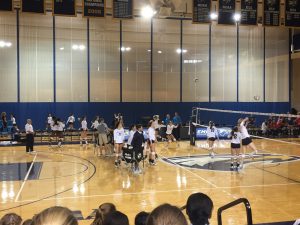
The team practicing before the game.

Skipping, chanting, and smiles never left the gym on Saturday, September the 9th at the Emory women’s volleyball game. The joyful spirit of the girls lasted for the entirety of the match that they won three sets to zero. Although the athletes’ performance impressed us, their sportsmanship fascinated us more. Not every sports group has members that support each other unconditionally. The girls’ ability to remain positive and show support for one another during their game helped lead them to victory.

When we arrived at the match against DeSales University, there was a concession stand set up next to the gym entrance. The snacks were all overpriced, and probably unnecessary considering the match did not last for very long. As we rounded the corner, there was a small bleacher set up on the gym floor, since the actual court was only in the very center of the west half of the gym. The crowd, neither extremely large or small, consisted of a few interested students and mostly parents who came to watch their daughters play. The crowd remained calm throughout the match, however, not much excitement was needed; the girls produced enough pep to last them through every set. Surprisingly the girls never seemed to have a shortage of energy and did not need to use timeouts like the other team. Smiles remained planted on both the players and coaches faces. Typically athletes remain straight-faced and look serious while they play. Even the girls on the other team looked this way and rarely smiled.

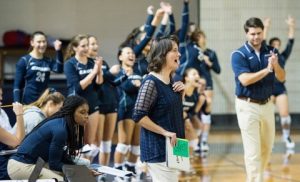
Volleyball Coach

warm smiles on the players and coaches faces let us know that they actually enjoyed playing the game. Clearly, the girls found the game fun and they still appeared to have a passion for the sport. While winning obviously remained their objective, they made sure to enjoy the entire process. This happiness and pure love of the game allowed them to stay positive and cheer each other on that afternoon.

After the first set, the teams switched sides. This almost seemed to have an effect on the girls’ performance because they started to fall behind. Even while the girls were losing, the coach was placid and the girls were smiling. Their attitude is undoubtedly why they were able to easily rally and win the second set. Again, at the start of the third set, Emory dropped some points, but the team found its footing and pulled off the three to zero sweep. No setback ever seemed to faze them. They remained cheerful and positive until they eventually lead the game like they knew they would.

Every team has some form of bond between players that affects the way they interact and play together. On Emory’s team, the girls have a noticeably strong bond. No matter what happened, the girls always appeared to have a united front. Instead of cheering for certain players, the whole group on the court received recognition. Unlike the players from the other team, even when a girl made a serve that did not make it over the net or hit the ball out of bounds, the girls remained supportive of one another.

Doing a team exercise

The girls frequently had group hugs and shared reassuring smiles to comfort each other throughout the game. We could tell that the team members had a very close relationship just by the way they interacted on the court. Even off the court, the girls typically do things together probably as a result of all the time they spend practicing and bonding. This relationship allows them to communicate and play collectively. The girls display trust for each other and belief in the abilities of the team. Studies show that the level of trust and time spent together have a significant impact on team performance. Team members that trust each other perform better because they can work more effectively together (Elsass 137).  When the other team successfully scored, the girls still smiled and cheered each other on because they knew that they had the ability to move past the setback and win the game. Although several girls did stand out as star players, the game did not revolve around them. Each girl playing was given an opportunity to contribute to the success of the team. Emory’s team honestly looks like a huge group of best friends. Friendship and their great spirit lead them to victory.

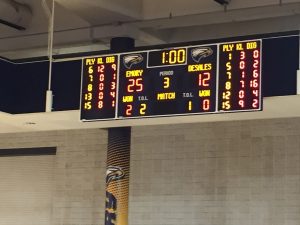
At the end of the tournament, the girls walked away undefeated. Emory won every game three sets to zero in the tournament.

The end of the final set.

It is worth noting that while all these three aspects of the team led them to victory, the skill set of the girls played arguably the most significant part in leading them to victory. Currently, the team is ranked fifth overall in the NCAA Division III category, previously being ranked second. They have made it to the final four five times, they won the national tournament in 2008, and they have seven UAA championships. In fact, the girls have only lost one game this season. We wanted to look beyond their skills to determine what makes them so successful. Virtually every team has amazing players, but some teams have unique qualities that set them apart from the rest of the crowd. What sets Emory apart and gives them a competitive edge are these three qualities that allow them to work harder and to work more efficient collectively.

Tatiana was able to get in touch with freshman Murphy Powell to ask her about her experiences with the game and with her team:

Tatiana: How would you describe the crowd’s energy level at the DeSales match? How did their energy level affect (or not affect) your playing?

Murphy: The crowd’s energy level during the match vs DeSales this past Saturday was pretty good because I’ve been told the bleachers haven’t been that full in a long time. The crowd’s cheering was a motivation bonus added to our own cheering so it affected our play positively. 

The girls high-fiving

Tatiana: Was there a specific goal you had set for the DeSales match?

Murphy: We wanted to keep them from scoring more than 15 points per set (which we were able to do for the 25-12 set but not for the 25-16 and 25-19 sets) and always have more energy than they did, in which I think we did a good job of.

Tatiana: How well did your team play again DeSales University? Do you consider it a good/bad/average game for your team?

Murphy: It was an average game for our team because we beat them by a hefty amount, had an awesome passing game, but also missed a lot of serves and hit a lot of balls out when attacking.

Tatiana: What is the dynamic between you and your teammates during a game?

Murphy: We all keep each other hype no matter what the score is and we all have positive attitudes throughout warmups and in games.

Tatiana: Are you and your teammates close? And how does this affect your playing?

Murphy: My teammates and I are very close – it’s like a family. This affects our playing because we play harder when we want to play well and win for our “family”.

Tatiana: What is your goal for the season?

Murphy: Our goal for the season is to be national champions!

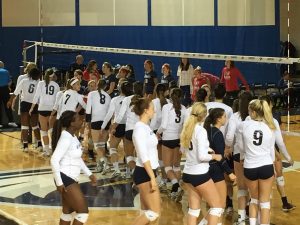
Watching the Emory Women’s Volleyball Team play was very entertaining. While it is always fun to cheer for the winning team, it is clear that our squad has something special. Their non-stop energy made the game enjoyable for themselves, the fans, and even the other team to an extent. It is very easy to see Emory Women’s Volleyball going to the national finals, and we think they will win this year.

The end of the game.

Priscilla Elsass. “Trust and Team Performance in NCAA Basketball.” The Academy of Management Executive (1993-2005), vol. 15, no. 3, 2001, pp. 137–138. JSTOR, JSTOR, www.jstor.org/stable/4165768.

[Emory Volleyball Girls High-Fiving]. [image]. (n.d). [Photograph]. Retrieved from http://www.evbcvolleyball.com/Default.aspx?tabid=25272

[Emory Volleyball Girls Holding Hands in Air]. [image] (n.d.). [Photograph]. Retrieved from http://www.evbcvolleyball.com/Default.aspx?tabid=25274

[Emory Volleyball Coach]. [image]. (n.d). [Photograpgh]. Retrieved from http://www.emoryathletics.com/sports/wvball/index

By: Faith Muyoyo, Josh Maisel, and Tatiana Bennett

17 Over Grilled Chicken days later.

Cox Hall from the outside

Considering everyone in this class is a first-year student, it’s safe to say that the newly established DUC-ling is a go-to place for everyone trying to get breakfast, lunch, and dinner on a day-to-day basis. However, what happens after a while of eating the same over-grilled chicken?  Hopefully, a change in menu. Of course, you might think of going to White Hall for a quick lunch bag, or even to the WoodPec for some chicken tenders. But in all honesty, the first place you think of, and rightfully so, is Cox Hall.

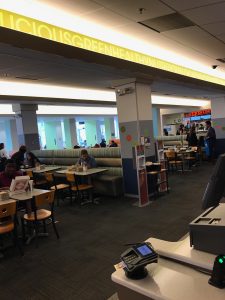
Cox Hall cashiers desk as well as the tables and sit down facilities

Located right by Asbury Circle (only 10-20 feet from the DUC-ling) Cox Hall is one of the most prominent dining facilities on campus. Operating from 11:00 AM to 7:00 PM, it is a food court holding up to 8 different dining options, with overall prices averaging from $8 to $10. By now you must be interested in what a Cox Hall experience is really like: Well,  let me be your guide for today.


Restaurant Twisted Taco
Sample of food from Twisted Taco

Let’s start off with the first restaurant you’d see when entering Cox, a traditionally Mexican joint that serves everything from burritos to tacos filled with your choice of chicken, beef, seafood or veggies along with different sauces, rice, and greens. Suffice it to say, for all you weird vegetarian folk, all tacos can be filled with seasoned tofu as a substitute for meat. Items on the menu average $4. With a menu featuring 16 different kinds of tacos and burritos, it really is hard to go wrong at this place. My personal favorite item on the menu is Buffalo Bill, which is a taco composed of crispy fried chicken strips in buffalo sauce along with tomatoes, lettuce and ranch dressing. In my little private personal ranking, I’d give twisted taco 2nd place on the personal Cox food leaderboards. To personally check out the menu as well as the prices, click on the following link: http://twistedtaco.com/wp-content/uploads/Emory-Menu.pdf

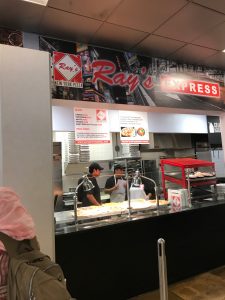
Ray’s Express pizza place
Sample of cheese pizza from Ray’s Express

All the pizza boxes you see throughout the day that isn’t Dominos or Papa Johns belong to Ray’s Express New York pizza place. Located right next to Twisted Taco, it’s as the name suggests: a New York-style pizza joint.  Giving you the choice of pizza or pasta, averaging around $6, it is the perfect place for anyone craving a good satisfying meal. The most popular menu items, which also happen to be my personal favorites, are “Momma’s beef lasagna” and a  few slices of their cheese pizza. In terms of personal ranking and rating, I’d give this restaurant 5th place overall. Attached you will find a menu in case you haven’t started drooling yet: https://www.raysnewyorkpizza.com/copy-of-georgia-state

Restaurant Char’D House
Food on display at Char’D house

Following that row half way down is a traditional American restaurant called Char’d House. There you’d be able to find menu items starting from burgers and fried chicken to sweet potato fries and salad bowls, all averaging a price of around $8 for a fulfilling meal. The most popular menu item is the chicken strips with a side of french fries, getting that first bite really brings you back to the first time you had chick fil a, which in my case was pretty amazing. Placing number 4 on my personal leaderboards, it offers a very\ fulfilling quality meal at a fair price.

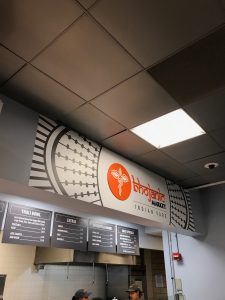
Restaurant Bhojanic
Indian food on display at the Bhojanic

Next, comes the traditional Indian joint, the Bhojanic Market. With a menu featuring everything from Thalis to different types of curry and salads, as well as up to 8 different types of bread, this restaurant is another place where it would be really hard to go wrong. This is a more pricey restaurant within Cox hall, with food items averaging around $15. Being a huge fan of spicy food in general, my personal favorite menu item is the Chicken curry. Consisting of boneless chicken with all kind of spices, garlic and some sort of onion based sauce, it really makes it worth your money, just like every other menu item at the Bhojanic. In my personal leaderboards, I’d give Bhojanik 3rd place overall due to my biased, spice loving self.  If this has you interested for more, please click the following link to access the Bhojanin menu:  http://www.bhojanic.com/restaurantmenu/

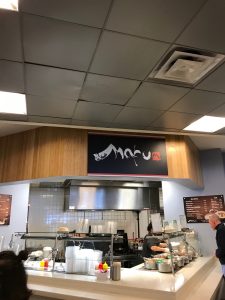
Restaurant Maru
3 samples of various kinds of food available to order at Maru


Right in the corner of Cox Hall, you will find Maru, a traditional East Asian restaurant. Featuring everything from Rice bowls with chicken to noodle soups with beef, as well as a wide variety of vegetarian salad bowls, all averaging $8 in price, Maru provides excellent quality food at a very reasonable price.  My personal favorite item on the Menu is a rice bowl with Ginger chicken and vegetables with hot sauce, it provides an exquisite balance of spicy and sweet,  and to top it off the blend of the soft aromatic chicken pieces with white rice is excellent. Having been in love with Asian food since I was little, it is my go-to place every time I am inconvenienced by the DUC-ling and therefore ranks number 1 on my leaderboards. Maru provides an excellent mix of quality food at a very reasonable price.

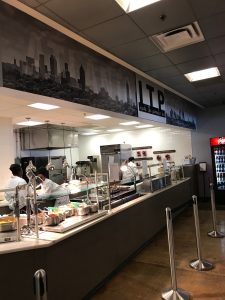
Restaurant ITP
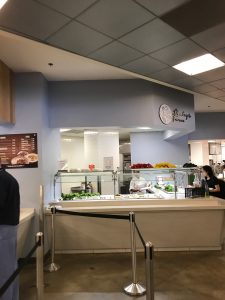
Restaurant Dooley’s Farm and the salad bar displayed

Next in line are ITP and Dooleys farm. ITP is a classic Italian pizza and deli place, averaging prices of around $7, it provides a perfect alternative to Ray’s Express. With thin crust pizzas and finely made deli sandwiches, ITP provides a little fake back-to-home experience for all the Italian students. Dooleys farm is just what it sounds like, averaging prices of about $9, it’s a less popular all salad place in the food court always offering refreshing, yet fulfilling bowls at fair prices. Both joints together place at number 6 in my overall personal ranking.

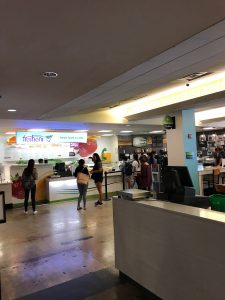
A smoothie as well as a coffee place. Freshens and Beans Coffe respectively.

Finally, last but not least are Freshens and Beans Kaldis coffee shop providing smoothies and coffees as well as healthy salads and little dessert food items for all the passer byes, both joint prices averaging around $6. These two places are pretty much in a different category because of the type of items available, which are mostly different varieties of healthy or energizing smoothies and beverages.


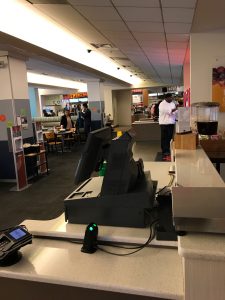
Cashier place

After you’ve picked out food from any of the food places available, you either go pay with Dooley dollars or a credit card, indicate whether or not you want a drink with your food (which would add somewhere around $3 to your overall charge ), sit down and enjoy your meal with your friends or alone if you’re into that. I do have to mention to the first-years in the class that having $150 Dooley dollars automatically on our Emory cards, it’s best to pay with those, keeping in mind that we’ll all be getting another $150 starting from next semester.

Inner store corner within Cox

And hey, if after all of this you still can’t find something to eat, just go to the local store and get some chips, candy or a granola bar with juice/ soda, and go on back to your dorm room to eat there.

In conclusion, if you’re hungry and looking for some place to eat that’s not the DUC-ling, Cox hall is a place for you. Offering a wide variety of meals as well as its own little store, there’s something for all of us.


The BeltLine Was Lit (well, kinda)

Initially, the two of us were planning to cover separate events for this week’s blog posts. However, through a series of unanticipated events, what started as two posts became one. Here is our story.

Jared:

Though this may come as a shock, I have never seen Star Wars. Sure, I know that the little green creature called Yoda talks weirdly, and I know that someone is Luke’s father; I’ve just never understood the hype behind some odd space phenomenon. Nonetheless, this past Saturday, September 9, I ventured to Candler Park to see Star Wars: The Force Awakens, and even did some research about the previous films to have some prior knowledge. Upon arrival, I  found the park deserted. However, there was an older gentleman taking down a nearby stage. I asked him if he knew where Star Wars was being played, but he angrily replied that he had no idea what I was talking about. Alarmed, after digging through the park’s website, Facebook page, and recently uploaded newsletter, I discovered that the film was postponed until next weekend. I couldn’t believe it. Frustrated but eager to find a new topic for my blog post, I remembered that there was a lantern festival starting at Ponce City Market very shortly. I knew that Hannah was covering the event, so I called her frantically and explained my situation. Before I knew it, I was ordering a Lyft to the parade.

Jared with misleading sign advertising the night’s alleged Star Wars showing.

Hannah:

When I found a magnet listing unique Atlanta events plastered on the entrance to my dorm room, I noticed one that peaked my interest: the Atlanta BeltLine Lantern Parade. Upon research, I learned that this was an annual, community-wide tradition that kicks off a series of art exhibitions on the BeltLine. After looking through a series of beautiful photos of the event, I enthusiastically gathered a group of friends to attend it with me.

On Saturday, we met at Woodruff Circle to catch the free Emory Experience Shuttle, but to our surprise, we were not the only ones eager to leave campus and capitalize on this free opportunity. As 6:15 p.m. approached, students around the circle started congregating at the shuttle stop. My friends and I assertively forced our way onto the shuttle, refusing to wait for the next one.

Twenty minutes later, we arrived at Ponce City Market. I immediately felt a sense of relief. It was a pleasant day, and was freeing to briefly escape the sometimes confining “Emory bubble.” We walked around the market, which had a very clean and rustic aesthetic. Almost simultaneously, we all commented on how refreshing it was to see families with younger kids and dogs. Our company was not just restricted to students between the ages of 18 and 22.

The restaurant area was crowded, but gave off a positive energy. After exploring a number of dining options, from fresh to-go food to acai bowls to pizza to southern barbeque, we settled on a Chinese restaurant that certainly outshined the quality of the food at the DUCling. In the middle of my meal, I received a call from Jared, anxiously asking if he could join us at the parade. Minutes later, we met him at the top of the BeltLine.

Hannah making her way to the BeltLine’s festivities.

Together at the Parade:

We made our way down the BeltLine, passing crowds of people sitting on folding chairs and blankets, others watching from the windows of their high-rise apartments. Without something comfortable to sit on, we begrudgingly settled for an empty space on the cement floor and dug into Jared’s unopened movie snacks. People were walking down the BeltLine holding their lanterns, and we joked that this was the actual parade, since we had no idea when it would start.

A small marching band wearing “Krew of Grateful Gluttons” shirts began walking, finally signaling the official start of the parade. We later discovered that this group, under the leadership of a woman named Chantelle Rytter, founded the Lantern Parade to bring people together and celebrate an otherwise ordinary landmark. The event fulfilled this objective.  

The band was followed by a parade of individuals, families, couples and groups of friends. Members varied in age, from kids fighting sleep in their strollers to rowdier adults with beer breath. Anyone was welcomed in the parade, as long as they carried their own lantern. The designs ranged from Harry Potter to life-size dragons to a whole group of coordinated emoji lanterns. No matter the theme, the bright lights and creativity never failed to catch our eyes.

When it was time to catch the shuttle back, we approached the exit, fighting the huge influx of people who were simultaneously entering and leaving the parade. The crowds were highly unpleasant, as people were shoving their way through the lines and yelling at each other in frustration. We both fell, victims to the merciless crowd.

After finally breaking free and reaching the shuttle, we found that it was at its full capacity. We, along with half of the student population, waited impatiently for the next ride. As the shuttle came to a stop, the driver shielded her eyes from the students flooding the seats, aisle, and everything in between. She even generously let a few desperate stragglers sit on the bare floor.

On the unpleasant ride back to campus, we each reflected on our eventful nights. Though our initiation into the greater Atlanta community on the scenic BeltLine was certainly worthwhile, we both agreed that this was a one time feat.

Check out our highlights from the Lantern Parade below:

http://youtube.com/watch?v=CwlBE3zp6Rs&feature=youtu.be

Sources:

Cox, Caroline. “Lighting the BeltLine: How a Motley Krewe Created an Atlanta Tradition.”Choose ATL, www.chooseatl.com/features/beltline-lantern-parade.

Parade, Lantern. “Help Illuminate One of Atlanta’s Great New Traditions!” The Atlanta BeltLine, 2017, art.beltline.org/lantern-parade/.

Kellee Maize. “Crown.” CROWN, J. Glaze, 2017.
Wellness Wednesdays

As school work and studying have begun to pile up as we near mid-semester, a bit of stress is normal within every college student. However, becoming proactive in managing that stress is vital in achieving a healthier mind and soul. To help manage some of my tension, this past Wednesday I decided to delve into the world of attending, Yoga in the Park.
I, in fact, happen to love yoga, yet my only prior experience had been in a 95 degree room, with rivulets of sweat dripping off my nose, that is; I was enthusiastic to try this new outdoor adventure. For many, yoga can offer a multitude of benefits for the body, soul, and spirit. As a victim of JRA (Juvenile Rheumatoid Arthritis), I aim towards achieving a healthy mind within a healthy body. This past week, I decided to venture into the realm of peace and solitude for one hour in the park of Atlantic Station. Through my practice of breathing techniques and meditation, I will share with you what I recognized in these 60 minutes of tranquility.

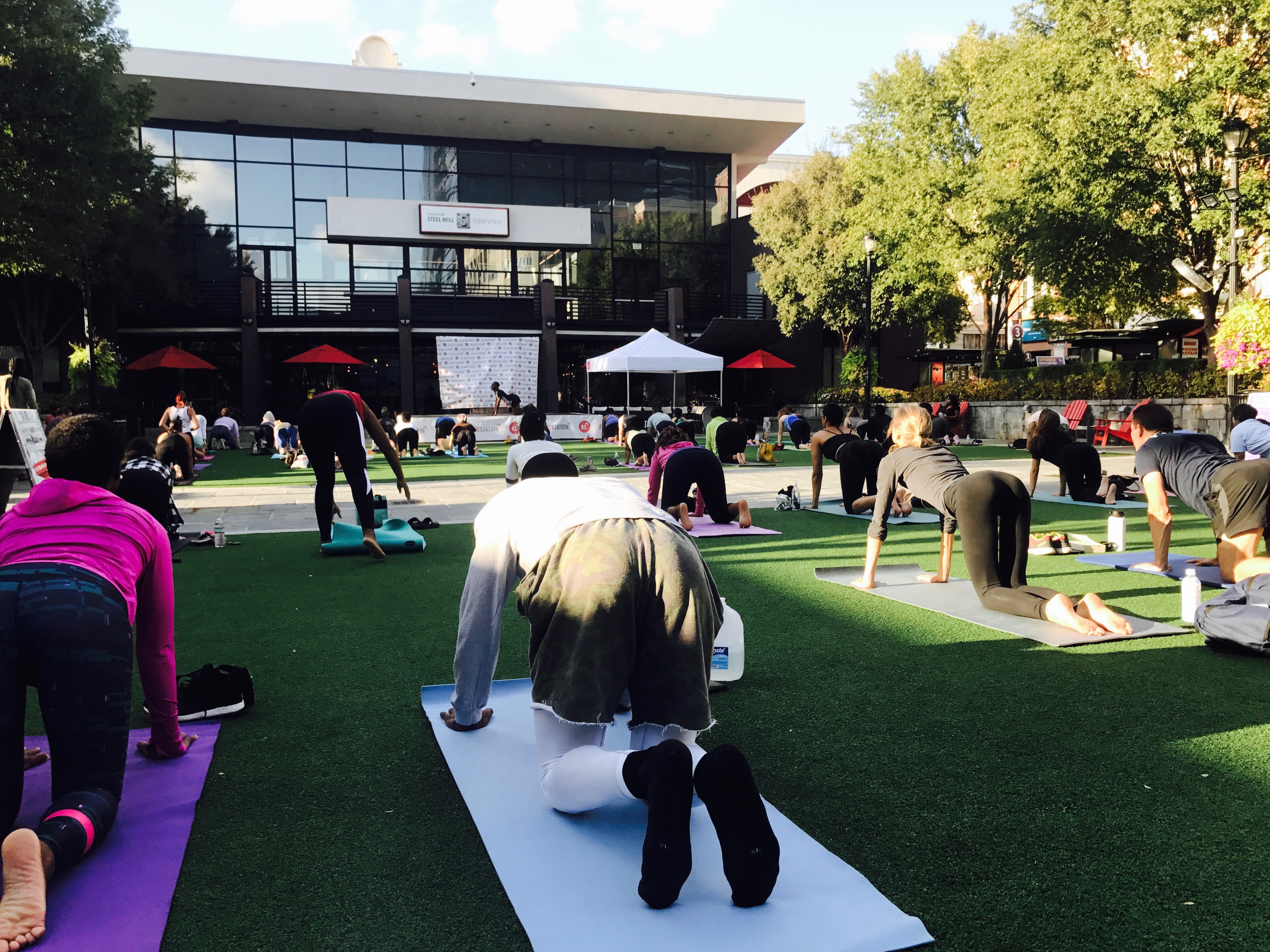
Tabletop Position

Prior to my departure, I slipped on my lycra leggings and tank top, tied up my Nikes, grabbed my yoga mat and headed out on the town. The ride from Emory was about 30 minutes, and I could feel butterflies fluttering in my stomach on the drive there; My excitement was pulsing. As I stepped out of the car, a gust of warm air swept across my face while blowing my hair in various directions. I then scoped out the area and felt a certain ~East Village, New York City~ vibe. While taking in a deep, elongated breath – I smiled – immediately feeling a sense of joy in the air. The sun was just beginning to set, and a positive energy set in, enclosing itself around me.

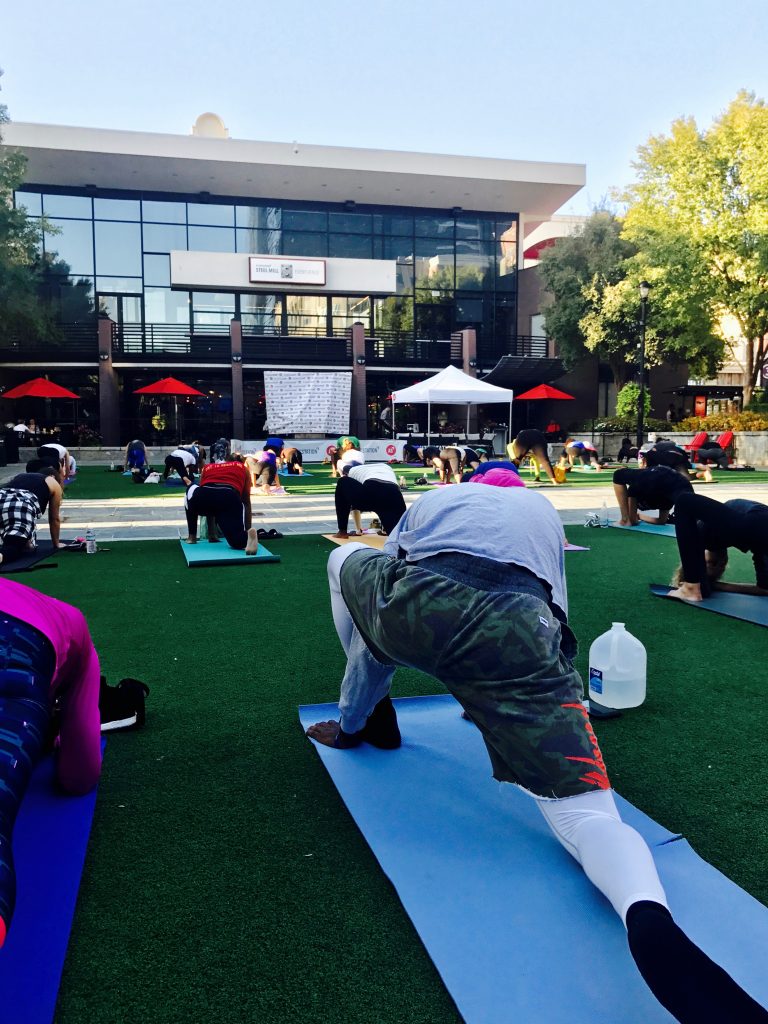
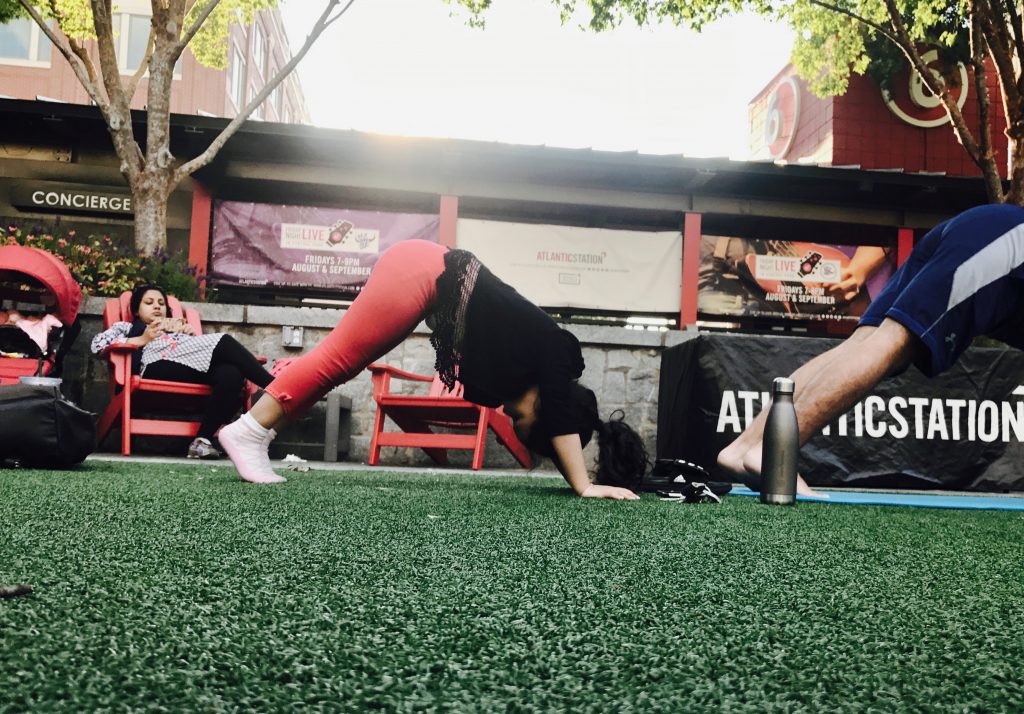
As dusk approached the class commenced, just around 6:30pm. Having arrived five minutes past, I laid out my yoga mat and caught up with the class in the Downward Dog stretch. The class was held on a smooth tarp rectangular field, with observers from nearby restaurants surrounding the outer edges to watch, as we transformed from one pose to the next.

Lunges

I immediately acknowledged the diversity between each and every participant of the class. In this open environment, Mothers were able to bring their children, lovers came with significant others, and even a variety of people brought along their canine companions to take part in this journey. Since this was an hour of free admission, a number of people joined in halfway through simply because of each participant’s dedication.

I then turned to my left, and caught a glimpse of a little girl attempting to remain in her Downward Dog pose, trying her very best to keep up with the rest of us. I smiled to myself, and looked around a bit more. I noticed her gaze varied from down towards the ground, then back up to her mother, a well trained Yogi with sculpted back muscles and a toned body. The girl was mimicking her every action, as her mother kept turning to check and see if she was alright. I then thought of myself in that very moment, as we all shared something in common that day: a maintenance of the same intrinsic value of Yoga, and its abundant benefits.

Downward Dog

While floating from one pose to the next, I did not feel the atmosphere to be intimidating whatsoever, rather it was quite peaceful. It seemed to me that Wellness Wednesdays are the type of activity which recognizes and values diversity in all of their participants. The location, directly centered within Atlantic Station, offers people not only the opportunity to stop their busy day and take an hour to destress, but a chance to become a part of something much larger than themselves. The instructor, Raji, was incredibly assistive; He guided everyone through the correct positioning and stretch while understanding each person’s own limitations.

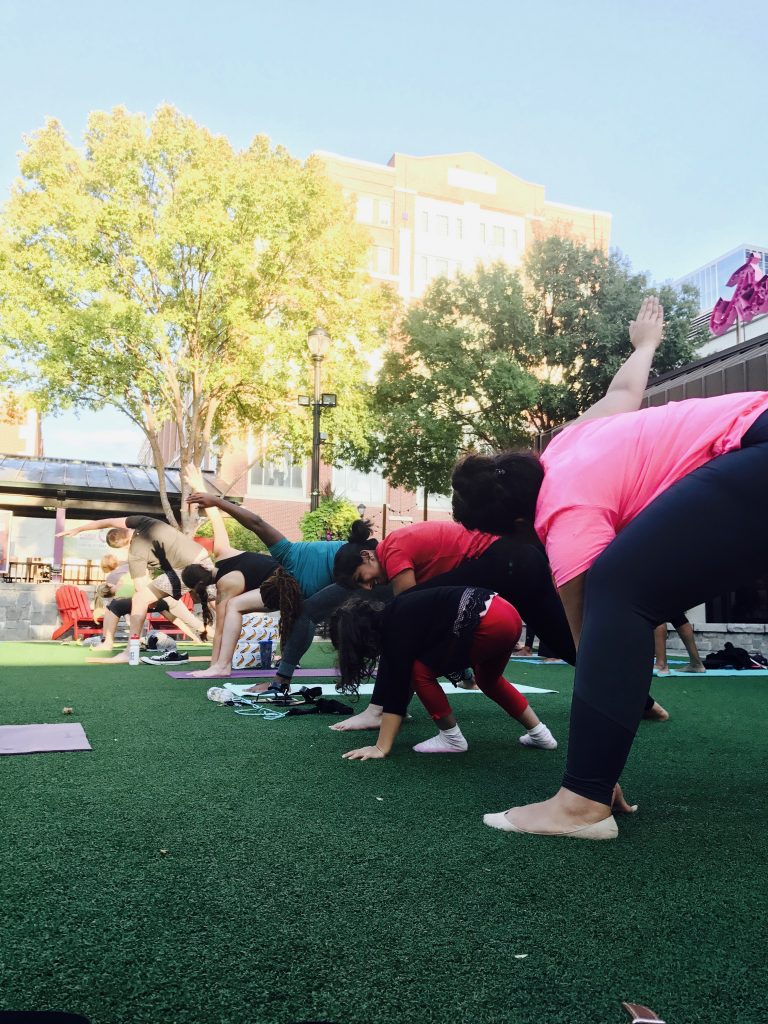
“It’s cool,” he announced as we transformed through our warrior one into warrior two, “We’re all in the same pose, just different positions; That’s like life.”

Inspired by his words, I introduced myself to Raji at the conclusion of our class, telling him of my purposeful journey into Wellness Wednesday.

I began to ask him his favorite aspect of teaching here: “This is my second year teaching the outdoor Wednesday class, and I truly love it.” he started. “The community aspect, having everyone get together for an hour of relaxation and clearing of the mind – that is special. It’s awesome how people can bring their kids, families, dogs, whoever you want really, and still have a great time.”

Raji’s words resonated with me, as I realized that Yoga encourages a sense of diverse community, while congruently forming individuals into a stronger, more vibrant people. To still the mind and be able to simply let go – that is vital in order to maintain a healthy level of stability and security. This was not an environment ridden with intimidation, rather a place to feel empowered within our hearts and minds, at any age or strength. When I began to walk away from the class, I felt increasingly aware and connected to my body, while sensitive to all my surroundings as a feeling of relaxation and calmness washed over me. I highly recommend attending Yoga in the Park, for Wellness Wednesdays are now my favorite day of the week!

Half-star pose

Elm Street Eatery: NOLA Style

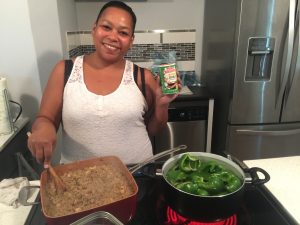
I pulled up to the cutest little house on Elm Street in an Uber and called my mom to tell her I was outside, she said she tracked my phone and already knew so the door was unlocked. She tracked my phone as long as I remembered because my mom is the definition of over protective. When I walked in, the kitchen was filled with savory aromas; if only I could share that smell with a picture. She had Camellia red beans simmering in a pot, crawfish étouffée in a bowl, and had just began preparations for stuffed bell peppers.


I said “Wow, ma. You really transformed this AirBNB into the ‘Elm Street Eatery’ with all this cooking.” She recanted in that New Orleans accent that I had missed so much, “Girllllll, when you told me that you ain’t had no red beans in three whole weeks, I had to come see ya. That should be illegal.” She poured me a glass of wine and told me to let her know how the étouffée was, even though she had cooked it over a hundred times since I was born.


She had flown with so many pots, pans, and bags of seafood stuffed in her checked luggage that TSA broke the locks on her bags.


She saw me taking pictures of everything and said “You and that damn snapchat, always taking pictures. Just live!” I explained to her that it was for a school assignment and that I was posting on a blog. Upon hearing that, she said “oh, well take a better picture of me!” I ended up bargaining with her, I would only take a better picture of her if she fixed me a bowl of red beans.


She finally finished cooking everything she planned to, and sat down and talked with me about what was happening back home, how my classes were, and the cases of water she wanted to get me in preparation for the hurricane heading toward Georgia.  After eating my favorite meal ever, stuffed bell peppers and baked macaroni and cheese; she suggested we end my blog with a “cute selfie.”

Rollins School of Public Health: For the Prospective Student

rsphweb. (2014, December 23). The Rollins Experience [Video file]. Retrieved from https://www.youtube.com/watch?v=JpvX-iymomw


Rollins School of Public Health: By the Numbers. Created using canva.com

If you’re a student in search of a school that will launch you towards your dreams of working in public health, look no further. Emory’s Rollins School of Public Health, ranked seventh in the nation, consists of six departments, all of which study and work towards improving the world’s most prevailing public health issues: behavioral sciences and health education, biostatistics, environmental health, epidemiology, health policy and management, and global health. All departments are taught by doctoral level faculty who are also involved in research. Rollins collaborates with some of the world’s biggest health organizations and agencies such as the American Cancer Society and the Centers for Disease Control and Prevention (CDC). With Atlanta known as the “Public Health Capital of the World”, Emory’s Rollins school attracts students from all over the world.  

Rollins encourages a tight-knit and inclusive community between the students, staff, and faculty. The school’s education is enforced through an engaging cultural aspect with respect to all types of diversity, and it doesn’t stop in the classroom. Rollins’s dedication to inclusion sticks as the school reaches out into all communities in effort to eliminate health discrepancies. As a core part of the curriculum, partnership with diverse communities in public health work remains an integral part of a Rollins education. Diversity is evident in the student body itself. Students come from 46 states and 40 countries, with an international student percentage of 15%. Over 70 languages are spoken at Rollins, and the school understands the importance of communication–building university resources with a diverse faculty and staff.

Kate and Michael interviewed Chris Moye, a first year student at Emory who is thinking about studying public health.

Coming from the Atlanta area describe the health disparities regarding different communities. What do you think the underlying issue is?

I think that the underlying issue in the disparities that are experienced by different communities in Atlanta is strictly a result of economics. People who have a lower socioeconomic status are not able to access to the same health care options as middle-class families, and this can be the difference between life and death.  


The Robin’s school of Public health emphasizes an environment of inclusion. The school is extremely diverse. How has this impacted your decision when thinking to apply?

The diverse background of students at the Robin’s school is one of the most important things to me as a minority. Being educated with other minorities is important to me because it will help to approach the field of medicine from different perspectives. This will help me to become a better physician in the future, while also helping me to figure out how to solve complex healthcare problems in my own community and beyond.


Coming from Atlanta, Chris has seen poverty-stricken neighborhoods that simply cannot afford the same health care options as wealthier communities. Based on the mission of the Rollin’s School, it is clear that these students are striving to not only learn more about public health, but also give back to the community in different ways. The diversity of the school, as Chris mentioned, provides the healthcare community with multiple perspectives and backgrounds. Giving back to the community is an important aspect of life that often goes unnoticed. Much like the free-riding theory of economics, people often wait for others to give back instead of putting themselves out there and making an actual difference. Emory’s Rollins School seems to be that catalyst for action as its students are eager to create solutions to the multitude of problems in the healthcare industry.

If interested in the Rollins school of Public Health, one should start to explore the many steps to apply. Whether its collaboration with experienced CDC researchers, or having tight-knit relations with the Winship Cancer Institute, Rollins is the perfect fit for incoming students in the public health community.

Fall 2018 application:

  • Due August 2, 2018.
  • Average GPA for MPH/MSPH applicants is 3.5 or higher.
  • Transcripts.
  • Two evaluations from academic advisors or faculty.
  • Written piece regarding experience in research.
  • GRE test scores.

Four types of degrees may be earned at Rollins:

  1. Master of science in public health (MSPH)
  2. Dual and doctoral degrees
  3. Master of Public Health (MPH)
  4. and Executive MPH Program.


Apply to Rollins for endless opportunities to experience and learn about the world of public health!

Rollins even holds two-hour information sessions on campus from 10:30am – 12:30 pm.


https://www.youtube.com/watch?v=JpvX-iymomw

rsphweb. (2014, December 23). The Rollins Experience [Video file]. Retrieved from https://www.youtube.com/watch?v=JpvX-iymomw

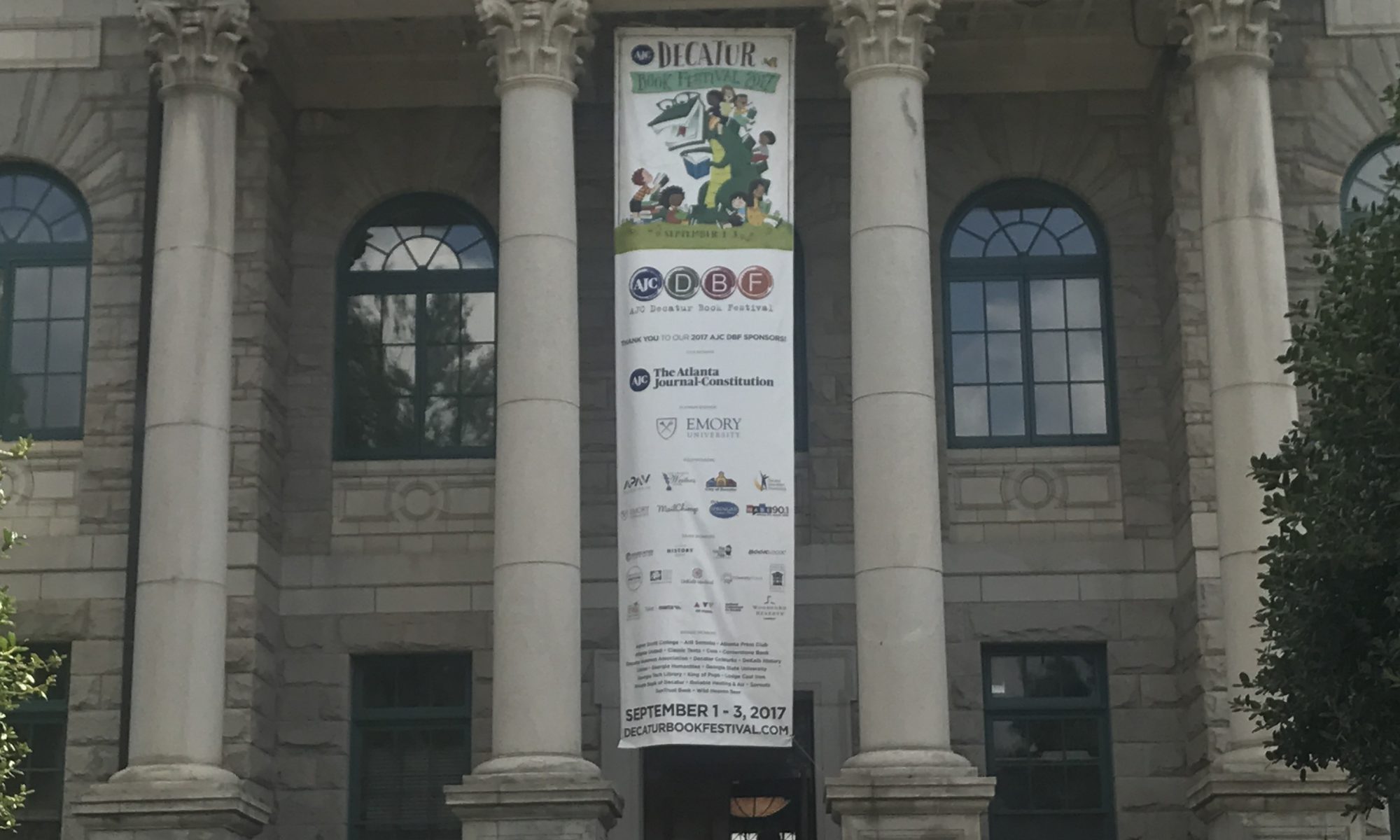
Decatur Book Festival


Pictures above: Canopies of vendors’ booths

Bright colored canopies graced the streets of downtown Decatur, attracting a massive sea of people eager to participate in the festivities. If anyone in Decatur or its surrounding areas needs an amusing way to spend their weekend with their family, friends and pets, they must check out the Decatur book festival when it returns next year. Filled with food, performances, lectures, and of course, books, the event brings together the community with attractions for people of all ages and with different interests. Continue reading “Decatur Book Festival”

The Black Male Initiative @ Emory University

With the dawn of a new school year, comes the dawn of new changes for Emory University. While some, such as the demolition of the Dobbs University Center, are extremely obvious, there are others that aren’t known to the general public. The Black Male Initiative (BMI) is a pilot program targeted at first-year black males at the University. The purpose of the program is to counteract the disproportionately high dropout rate experienced by black males in comparison to their other peers. To do this, the program is designed to give black, male, first-year students both academic and professional resources as well as develop leadership and comradery between each other through events, workshops, and outing in Atlanta. It great to know the purpose of the program, but it’s much more important to see the impact and effectiveness of said program. How do current students feel about the program? Why or why not students applied to BMI? How well known is the program in the Emory community? To answer these questions, we decided to interview three students, Aaron Campbell, Christopher Benedict, and Alex Koo, in order to provide more perspective.

Harris Hall is a traditionally second-year resident hall where some freshman and the BMI reside.

When speaking with Aaron Campbell, a member of the pilot program we learned more about what the program means to him, the Emory community, and the greater black community. The desire to be surrounded by “an environment where black people did well… were successful… [and] were educated” drove Campbell to initially apply for the program. It was clear that Campbell felt as though this program was important and he wanted to be a part of it, due to its recognition of such a prevalent issue. Regarding the BMI’s relationship with other first-years in Harris Hall, Campbell expressed a generally positive relationship between the two groups but voiced concern that “more awareness” could be drawn to the purpose of the initiative itself.

We found the remarks made by Aaron regarding the BMI to be quite interesting, but we wanted to know how others who were not part of the program saw it; more specifically, a black male who did not participate in it and one of Campbell’s fellow hall mates. Christopher Benedict is another first-year black male at the University, who unlike Aaron, decided not to be part of the BMI. Benedict argued that while the idea of a program such as the BMI was good, he wanted a more “immersive” first-year experience. Another first-year named Alex Koo is a current resident of Harris Hall as well. When asked about the BMI she did not initially know what it was, however, after we explained to Koo the premises behind it, she had a better understanding. Koo described being put in a sophomore dorm as “shocking,” however, much like Campbell, she described the atmosphere as a “friendly community.” Koo recognized Emory University’s proactiveness to take the initiative to set up the program, but she did voice concern that more information regarding its purpose should be advertised to other members of the University.

Overall, it seems like the Black Male Initiative here at Emory is just the first step to a longer process. Being that this is the pilot year and the year just got started, it’s hard to judge whether the program is effective in meeting its goals. However, it can be concluded from speaking to Campbell and Koo that the BMI creates a close community for participants surrounded with like-minded individuals. Moreover, the program is being proactive in trying to solve such a pressing issue, therefore we can see the strides being taken and a possible bright future for the BMI and university.

By Zion Kidd and Daquon Wilson