I found The Zone of Interest upsetting, not for what we see, but for what it doesn’t show us. Although Holocaust movies generally face us with horror, Jonathan Glazer’s film creates much of its tension through absence or omission. The mise-en-scène is dominated by the family garden that has neat flower beds, a swimming pool, and bright summer light. It appears bucolic, almost rural advertisements for a country retreat. However, just beyond the wall of the garden, and out of view but heard, the machinery of Auschwitz operates. Perhaps the wall is the single most important “prop” in the film. It turns the setting into a “space of denial”: everything inside of it becomes a performance of normality, and everything outside of it becomes an unasked truth. It invites the viewer to divide attention between what is seen and what is only imagined.
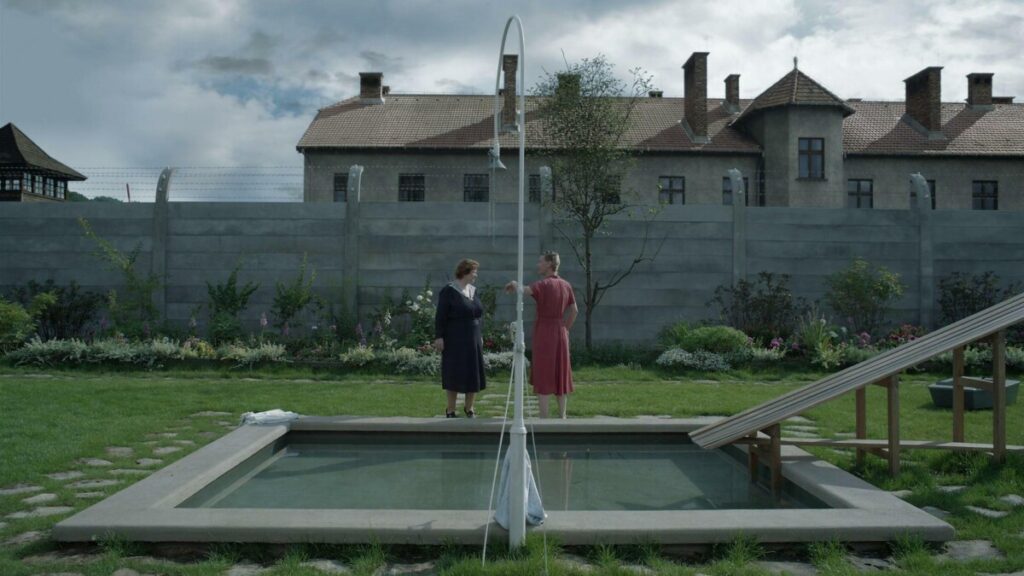
The cinematography really elevates this experience. The camera usually remains distant, presenting the Höss family in wide, static compositions. These extended, sweeping shots allow us to take in the entire composition, unlike the quick edits that usually direct or engage our focus, with our gaze wandering between, for example, the children and then the barely-there smoke in the back. The smoke stays in the distance, but we can’t escape its presence.

The editing, or the lack of it, is just as remarkable. Several scenes play out in long takes, which invites a much heavier sensibility to time than we might expect from typical Hollywood filmmakers, who usually give us some rhythmic ‘relief’ by cutting scenes. When we do come to the cuts, they feel, and are, really jarring. For instance, consider the nighttime sey-gogging sequences, captured in infrared. The tonal shift creates a ghostly, documentary feel. These interruptions make us hyperaware of the film’s structure, like the director is forcing us to question how we are watching. Are we complicit, sitting comfortably on the inside of that wall?

What struck me most in this movie was how ordinary the scenes inside the house felt. A mother selecting wallpaper, children splashing in a pool, a father leaving for work. The horror is how effortlessly those images are drawn into “normal” living, and how those same images coexist with mass murder. That is the film’s success: it doesn’t visually allow us to “see” the atrocity, but returns us to consider the comforts that enable it to happen.


Leave a Reply to Jamie Schechner Cancel reply