“Nope”: How Its Cliches Make the Movie

Nope(Jordan Peele, 2022) is a movie that has been on my watchlist since it came out. Many people have told me it’s one of their favorite movies, and I get it now. This is a film that is very good as creating feelings of tension with genuinely good jump scares, truly spine-chilling suspense, and beautifully disturbing imagery.

In Nope, there are so many of the tropes we’ve come to know from horror. Danger at a house, a fake out scene, the final girl, and jump scares are just some examples of such cliches. The conventions drive our expectations as viewers and present some familiarity to grasp onto. It’s the subject content of the horror, however, that really draws out those feelings of dread. Peele doesn’t rely on cheap scares; he draws out the suspense and lets the audience stew in the disturbing events onscreen. The scene of Gordy’s Birthday Massacre and the Raining Blood scene leave particularly strong impressions, mainly due to the copious amount of onscreen blood. This contrasts with the rest of the film, which has almost no gore at all.
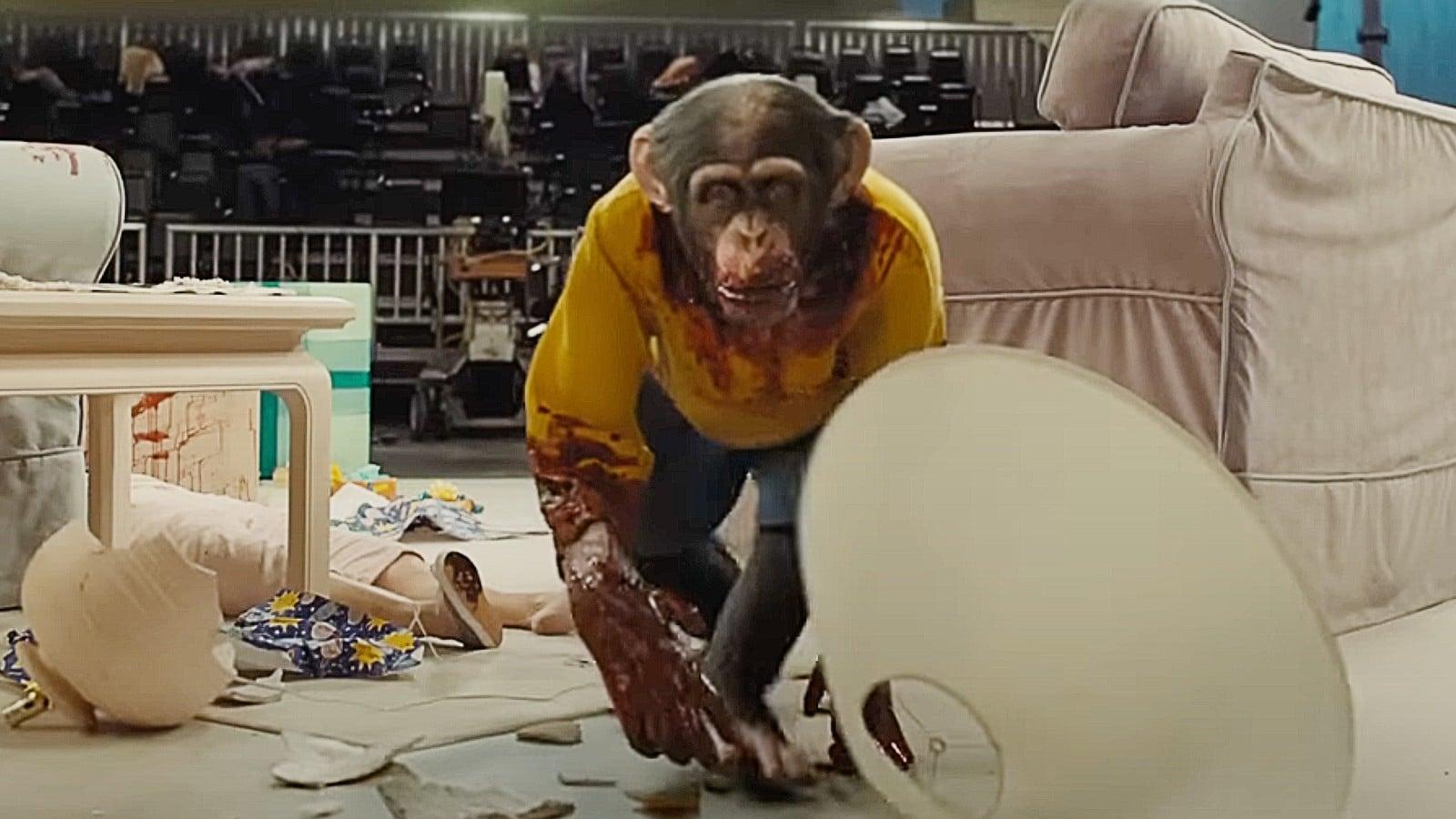
Jordan Peele explains meaning of Gordy chimp sequence in Nope - Dexerto

The relatively slow cutting allows the audience to slowly take in the scene, as the realization of what is actually happening hits. Furthermore, the long takes and sound design work together to keep the audience in a suspended state of tension. During Gordy’s Birthday Massacre, it was truly terrifying to watch the ape, blood on its face and hands, kill the people on set in such an animalistic way. No emotion, no remorse. Just violence. The fact that we saw the slaughter through the eyes of a young Ricky Park just added to the fear factor. To top it off, the gunshot at the end of the scene was so jarring it actually jolted me out of my seat. I’ll mark the experience down as another success of the horror genre.

I can’t just lump it in with all of the other horror movies I’ve seen though. While Nope hits all of the beats of the horror genre, it also shows elements of westerns and sci fi. The warm color tones and California ranch setting are reminiscent of the western genre, and the conspiracy theories and extraterrestrial presence bring the monstrous energy of something otherworldly to the film. Rather than a scary climax, the final confrontation with the alien gives the invokes the essence of the classic western showdown. Tense, yes, but not horrific. There’s a commentary about the lengths people will go to create a spectacle and the dangers of tampering with the unknown.

WATCH: NOPE — VFX & Cinematography Breakdown (2023)

I wonder if the context in which Nope was made gives it a deeper or different meaning? What is the significance of seeing Gordy’s story?

Comments

4 responses to ““Nope”: How Its Cliches Make the Movie”

  1. Alina Avatar
    Alina

    Hello,
    I agree that Nope has a deeper meaning that distinguishes it from traditional horror films (although it includes cliches), giving viewers a lot to contemplate, asking, “why are we being shown this?” Knowing that the film is supposed to reflect the story of Black people in the American West and in Hollywood, a lot of scenes can be interpreted in a new, more symbolic light.

    The Gordy’s Birthday Massacre scene was indeed shocking, especially since the film had not shown such horrific scenes before. The cheerful birthday setting strongly contrasts with the sudden violence, making the scene all the more horrific and making viewers realize the unpredictability (and cruelty) that exists behind the scenes of the entertainment industry.

    I like your point about spectacle. Peele seems to be showing how wrong it is for audiences and the media to consume someone’s pain and trauma for entertainment. In Hollywood, spectacle and profit are encouraged, often at the expense of the people involved. Ricky tries to commercialize his own childhood trauma, turning it into a theme park attraction. This shows how exploitation can become internalized. His calm detachment from what happened when he was a kid feels like the result of years of avoiding and laughing off his trauma for public consumption. I believe that it goes to show how the industry is not some picture-perfect comedy show with a laugh track. There is actually a lot of exploitation occurring behind the scenes. This becomes evident when the depiction of a “perfect” family is killed, and the boy’s trauma is exposed. Victims of spectacle can internalize pain and false beliefs.

    Peele does not just use horror conventions to scare; he uses them to make viewers question their own participation in the spectacle. The film makes us reflect on why we are fascinated with watching the tragedy of others.

  2. Monique Thompson Avatar
    Monique Thompson

    I also considered the significance of Gordy’s story. We have touched on the cohesiveness of subliminals and the dots connecting later in previous screenings, such as The Portrait of a Lady on Fire. I believe that the subliminal here may be linked to how society turns trauma into something comical or glorifies it for entertainment purposes. Peele may be trying to get at the idea of society being desensitized to their traumas. The choice of Ricky having the elements of the show in his office in a secret vault, which he prizes and reminisces on as a good experience, seems to me like it was a deliberate intention to emphasize the idea that you never really know what the motives behind someone’s entertainment purposes are.

    In the context of the movie, though, Peele is using this to show the exploitation of people and animals. Gordy’s story visualizes what happens when that concept of overusing the industry’s power crumbles. We see this in the cinematography of the story through Jupe’s pov. We are viewers who never see the violence that occurs, which is against what I think is one of the movie’s themes, of getting that “impossible shot”, showing what is being hidden under the rug, the violence, the danger, the unwarranted.

  3. Yuen Lin Avatar
    Yuen Lin

    Although I agree with your point on how the gore contrasted with the rest of the film, I would argue that the Gordy scene and the scenes of Jean Jacket killing the humans were not gorey in the typical sense. In the Gordy scene, the majority of the violence was conveniently hidden behind furniture and a closed door, with Jude’s POV view being obscured by the table cloth he is hiding behind. Additionally, I wouldn’t describe the scenes of Jean Jacket sucking up the humans as conventionally gorey either. However, I think that these details of obscuring the gore and violence in a subtle way added to the overall horror and dread during these scenes. Even though we are not explicitly seeing Gordy maul the actors, we know exactly what is happening behind that couch and closed door through the gruesome sound effects and actions. Additionally, the scenes of Jean Jacket ingesting the humans gave me a claustrophobic dread, and the sound effects of them screaming and gasping made my stomach turn, even if there wasn’t any blood and guts on screen. I think that Peele’s way of creating horror without going too over the top made the film scarier, as often times too much gore can create an opposite effect where it becomes tiring or even comedic.

  4. Jooeun Choi Avatar
    Jooeun Choi

    Hello,
    While watching the movie, I kept wondering why the director decided to include Gordy’s birthday party scene. In that scene, Gordy becomes irritated by the sound of a balloon popping and begins attacking people. Eventually, I realized that both the show’s director and Jupe believed they could control Gordy and Jean Jacket—yet both were proven wrong. To me, that moment carried a sense of fear about what might happen to us if we keep turning things that don’t want to be spectacles into spectacles.
    Also, Jean Jacket being defeated by the balloon shaped like the little sheriff was something I never expected. In most movies, it’s usually a hero or a strong character who destroys the monster, not a balloon. I wondered why. Why did the director choose to use the balloon, especially the one modeled after the little sheriff character that Jupe used to play as a child actor?
    When Emerald released the balloon’s string, I felt it symbolized Jupe being freed from his obsession with the fame he had as a child. The monster disappeared the moment Jupe’s desire to watch and to be watched vanished. In the end, I think this film warns us to free ourselves from the desire to witness “bad miracles” and from the urge to be watched by others for fame or money.

Leave a Reply to Monique Thompson Cancel reply

Your email address will not be published. Required fields are marked *