By Timothy D. Harfield
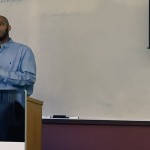
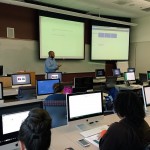
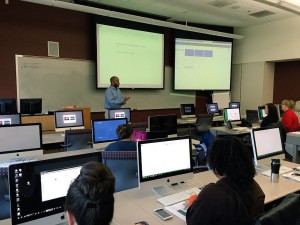 Patrick Leblanc (Microsoft Education) facilitated an engaging and informative lab at Emory University
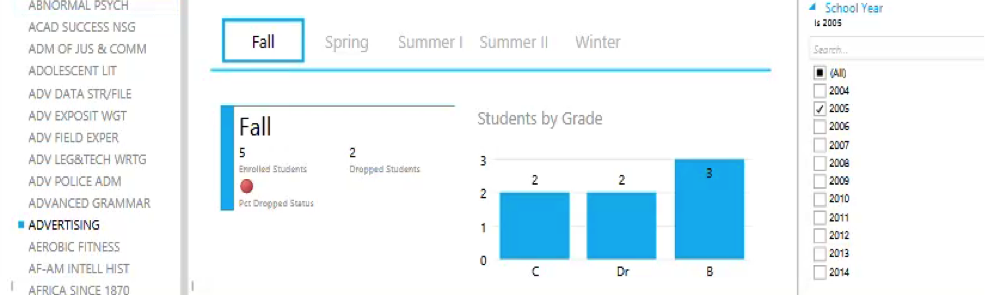
On Wednesday, February 11, 2015 Patrick LeBlanc (Microsoft Education) delivered a half-day workshop on using Excel for extracting, cleaning, modeling, and visualizing educational data. The benefit of using Excel for Windows (Unfortunately, MS Excel for Mac is not yet as fully featured) in conjunction with Power Query, Power View, and Power Pivot is that it allows users to do complex modeling using an environment that is familiar and that we already license. For users lacking experience with statistical/machine learning packages, the visual environment and extensive library of built-in functions means that they can get to work without first being faced with a steep learning curve.
The combination of Power Query and Power Pivot serves to do much of the work that is currently done by other tools that Emory and its personnel currently license (including Pyramid BI and Tableau), but with the added advantage of allowing users to easily integrate data from a wide number of sources including our LMS data warehouse (Blackboard Analytics for Learn), flat files, and social media. Patrick also introduced a new Microsoft cloud service called Power BI, which makes it easy to share data models and reports. Unfortunately, the fact that this is a cloud-based solution means that its use requires users to upload their data to Microsoft servers, something that should not be done with any institutional data, let alone educational data. Until such a time as Power BI is fully assessed in terms of both Emory’s security and institutional data management policies, the service should not be used for anything except non-institutional data.
The workshop was a tremendous success, with many expressing their gratitude to Patrick, and their desire for him to return for more workshops in the future. The four hour lab went through a lot of material in a very short period of time. As a proof of concept, however, it is clear that this kind of session has a tremendous amount of value for the Emory community, and we look forward to having Patrick back next year for a series of deep dives and hands-on BYOD (Bring Your Own Data) sessions.


 Dr. Ben Sayeski is Managing Partner of Education Strategy Consulting
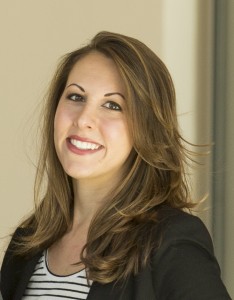
 Drew Kohlhorst is Associate Director, Curriculum Development and Program Evaluation in the Center for Science Education at Emory University
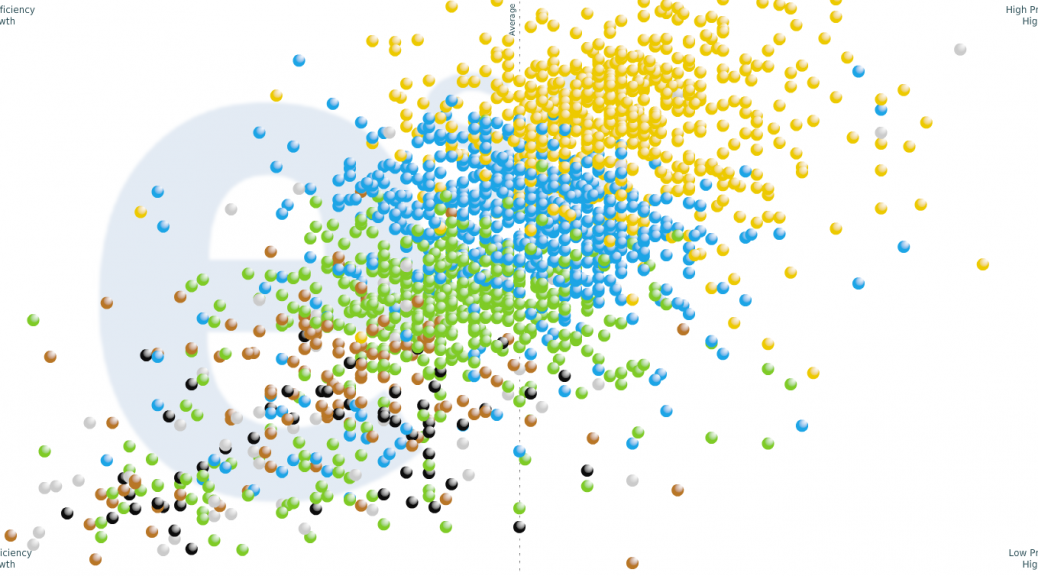
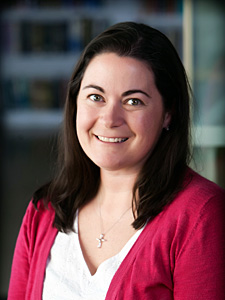 Tracy recently flipped her General Chemistry classroom with the aid of an artificial intelligence teaching tool called ALEKS. Adaptive learning tools can do an excellent job of facilitating student mastery of basic concepts. This kind of mastery, however, refers only to the ability to remember and understand simple concepts and problems (the two most basic levels of intellectual behavior identifies by Bloom’s Taxonomy). Too often, class time ends up being used to introduce basic concepts, and homework consists in leaving students working through complex problems on their own. But the adaptive nature of a tool like ALEKS makes it demonstrably more effective at ensuring concept mastery than an individual instructor, particularly when that instructor is facing a room of hundreds of students. What Tracy has done, then, is assign ALEKS as homework in advance of class, and use class time to go over more complex problems, that require higher orders of intellectual behavior.

 Charles Dziuban is Director of the Research Initiative for Teaching Effectiveness at the University of Central Florida (UCF) where has been a faculty member since 1970 teaching research design and statistics. He received his Ph.D. from the University of Wisconsin. Since 1996, he has directed the impact evaluation of UCF’s distributed learning initiative examining student and faculty outcomes as well as gauging the impact of online, blended and lecture capture courses on the university. Chuck has published in numerous journals including Multivariate Behavioral Research, The Psychological Bulletin, Educational and Psychological Measurement, the American Education Research Journal, the Phi Delta Kappan, the Internet in Higher Education, the Journal of Asynchronous Learning Networks, and the Sloan-C View. His methods for determining psychometric adequacy have been featured in both the SPSS and the SAS packages. He has received funding from several government and industrial agencies including the Ford Foundation, Centers for Disease Control, National Science Foundation and the Alfred P. Sloan Foundation. In 2000, Chuck was named UCF’s first ever Pegasus Professor for extraordinary research, teaching, and service and in 2005 received the honor of Professor Emeritus. In 2005, he received the Sloan Consortium award for Most Outstanding Achievement in Online Learning by an Individual. In 2007 he was appointed to the National Information and Communication Technology (ICT) Literacy Policy Council. In 2010, Chuck was named an inaugural Sloan-C Fellow. In 2012 the University of Central Florida initiated the Chuck D. Dziuban Award for Excellence in Online Teaching for UCF faculty members in honor of Chuck’s impact on the field of online teaching.