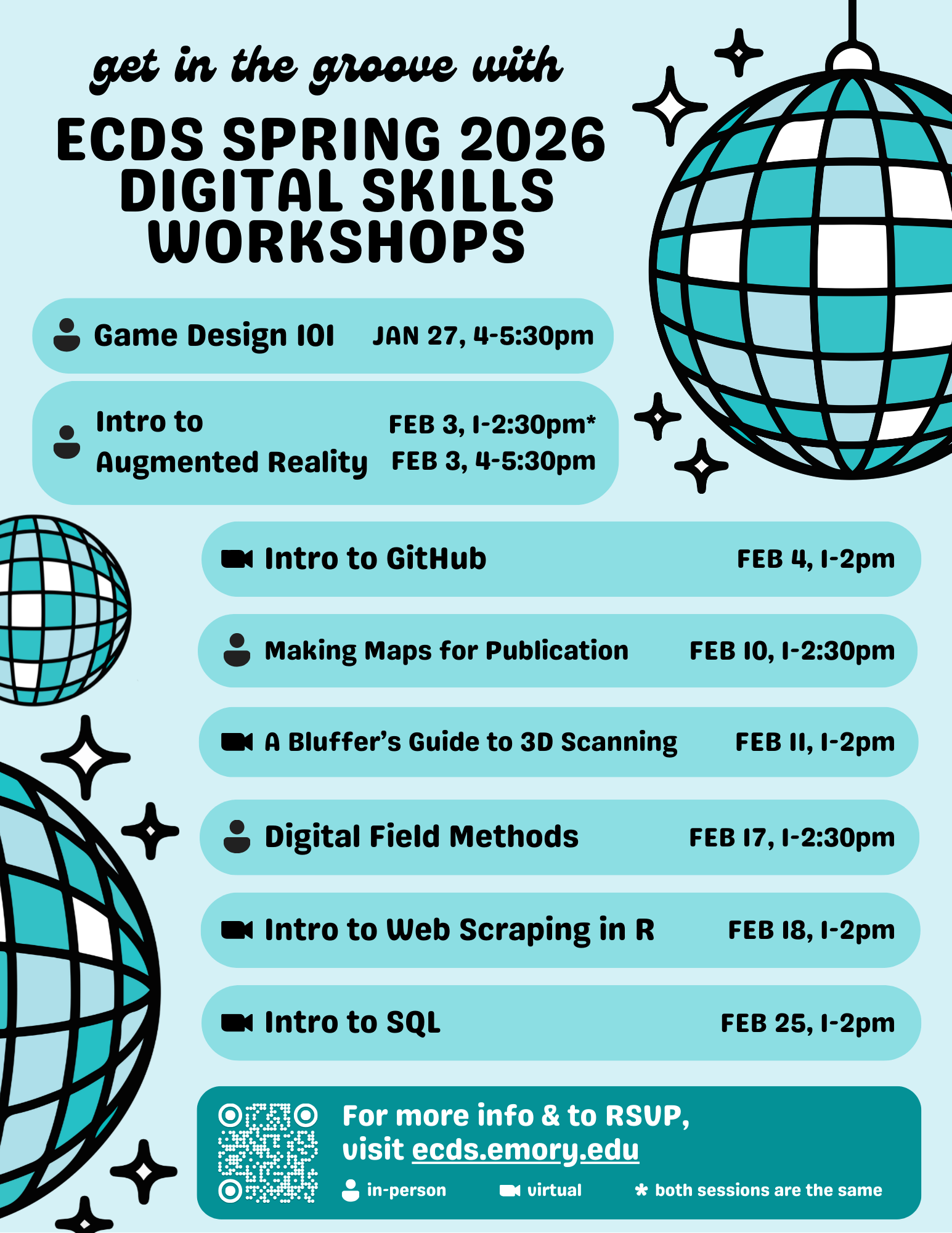
Registration is open for the Emory Center for Digital Scholarship’s Spring 2026 workshops, which start January 27!
This semester’s workshop series features a line-up of incredible presenters to give you research and pedagogy inspiration using digital scholarship tools. Workshops will be held in two formats: in-person and online.
Back by popular demand, our in-person workshops will be hands-on workshops held face-to-face in Robert W. Woodruff Library 310 and 312 on the third floor of the Woodruff Library (across from the Jones Room and near the Schatten Gallery). These workshops will include overviews of software as well as hands-on exercises to practice using them and will be held on Tuesdays from 1-2:30pm or 4-5:30pm, depending on the workshop.
Our online workshops will be held on Wednesdays from 1-2pm via Zoom and will also be recorded and available afterward on our ECDS Workshops site for Emory students, faculty, and staff: https://scholarblogs.emory.edu/ecds-workshops/. You can also go back and watch over 40 previous workshops on topics like manipulating and visualizing data using popular tools like R, Python, and Tableau.
For course descriptions and to RSVP for our Spring 2026 workshops, visit the ECDS calendar here. For questions about the workshops, email ecds [at] emory [dot] edu.
This semester’s topics are:
|
January 27, 4pm-5:30pm Robert W. Woodruff Library, Room 310 |
Game Design 101 Students will be introduced to game design and explore concepts in both physical and digital games. We will analyze the mechanics of historical card and dice games, and develop our own game from them. No experience required, and materials will be provided, but if you have some fun dice or cards, feel free to bring them! |
|
February 3, 1pm-2:30pm AND 4pm-5:30pm Robert W. Woodruff Library, Room 312 |
Intro to Web-Based Augmented Reality In this workshop, students will learn the fundamentals of augmented reality and how to deploy it. We will use Web AR Studio, a browser-based AR development platform, to build experiences that track to images, stick to real-world surfaces, and follow your face. No downloads or coding needed; just bring a smartphone or tablet, and leave with three shareable AR projects you can run instantly via QR code. |
|
February 4, 1pm-2pm, virtual |
Introduction to GitHub This beginner-friendly workshop shows you how Git and GitHub help you save your work and collaborate online. You’ll see how to create simple projects, make changes, and share them with others. No experience is needed, and you can start with a free GitHub account. |
|
February 10, 1pm-2:30pm Robert W. Woodruff Library, Room 312 |
Making Maps for Publication This workshop will guide researchers in producing maps for publication, with a particular focus on books and academic journals. We will spend the first part of the workshop covering best practices for effective visual communication, including design, dealing with common academic publication limitations (small map size, limited number of figures, restriction to greyscale), and working with art guidelines from the publisher. We will then complete a hands-on exercise in ArcGIS Pro applying many of these lessons to create a final map layout that is publication ready. This workshop is intended for those with some ArcGIS Pro experience and will not cover introductory concepts. However, all experience levels are welcome. We will work through the hands-on portion step-by-step using provided data. For those interested in learning more about GIS software, resources will be provided at the end of the workshop. |
|
February 11, 1-2pm, virtual |
A Bluffer’s Guide to 3D Scanning 3D scanning has transformed from specialist technology to creative tool in just three years. With breakthroughs like Gaussian splatting, powerful smartphone apps, and web-based delivery systems, anyone can now capture and share photorealistic 3D environments. This workshop demystifies the entire pipeline—from capture techniques to processing workflows to publishing your scenes online. We recommend downloading the free Reality Scan app (iOS/Android) to try capturing a space or object. Windows users with RTX GPUs can also explore Postshot (free version at jawset.com) for advanced processing. |
|
February 17, 1-2:30pm, Robert W. Woodruff Library, Room 312 |
Digital Field Methods This workshop engages in technology-based ways of gathering, recording, and managing observations, measurements, and survey responses in the field using electronic devices instead of paper notebooks and manual forms. This introductory workshop will cover the use of mobile/tablet to desktop Geographic Information Systems (GIS), GPS/GNSS receivers, digital sensors and loggers, Unmanned Aerial Systems (UAS), and cameras and best practices in developing field to lab workflows. |
|
February 18, 1-2pm, virtual |
Intro to Web Scraping in R This workshop will introduce a basic workflow of web scraping in R using the rvest and httr2 packages. We will walk through a few examples of scraping static and dynamic websites in R, how to examine the underlying html of sites, and how to leverage AI to automate much of the heavy lifting. Previous experience with R and RStudio will be beneficial, but is not required. |
|
February 25, 1-2pm, virtual |
Intro to SQL: Navigating Relational Data Are you trying to navigate and manage larger sets of data in your work? This workshop will introduce attendees to the fundamentals of SQL, a language for creating and querying relational databases. SQL is useful across a variety of databases and situations and can be used with open-source relational databases. |